
It’s Giving Tuesday !! Please consider ISHOF in your Giving….

https://www.swimmingworldmagazine.com/news/support-the-hall-of-fame-on-givingtuesday/

Olympian Mark Tewksbury Appointed Companion of the Order of Canada

by MATTHEW DE GEORGE
Olympic swimmer Mark Tewksbury was appointed Companion of the Order of Canada Friday, in recognition of his athletic and advocacy achievements.
The honor is the highest level within the Order of Canada, bestowed to only 165 living Canadians at a time, honoring those who make the most extraordinary contributions to the nation. Tewksbury was among four athletes appointed to the Order, along with Olympic rower Sandra Kirby as Officer and five-time ice dancing medalists Tessa Virtue and Scott Moir as Members.
“I had no idea when I won the Olympics so many years ago that it was just the beginning of my journey, not the end,” Tewksbury said in Canadian Olympic Committee news release. “I have never shied away from standing up for what I believe in or for using my voice to speak for those who might not have been able. It is an incredible honour to be appointed Companion of the Order of Canada not just for my sport accomplishments but for my fight for equity, inclusion and human rights for all.”

Tewksbury, 52, is one of Canada’s most decorated swimming Olympians. He won gold in the men’s 100-meter backstroke in the 1992 Olympics in Barcelona and earned medley relay golds at consecutive Games, helping the Canadians to silver in Seoul in 1988 and bronze in Barcelona. The Calgary native’s accomplishments include gold in the 100 back and silver in the 200 back at the 1987 Pan Pacific Championships; a silver medal at the 1991 World Championships in Perth in the 100 back; and four gold medals across two Commonwealth Games.
Since his retirement, he has served as an athlete representative to the International Olympic Committee and was the chef de mission for the 2012 Canadian Summer Olympic delegation. Tewksbury sits on the board of directors for both the Canadian Olympic Committee and the Canadian Olympic Foundation and has helped mentor young swimmers.
He has been a long-time advocate for the LGBTQ+ community, which stemmed from his coming out as gay in the 1990s, working with numerous organizations that fight for gay representation and human rights. Among his many sporting hall of fames (including enshrinement in the International Swimming Hall of Fame) and other accolades, he received the Muhammad Ali Humanitarian Award for Gender Equality in 2019.
Hall of Fame Aquatic Complex Thanksgiving Update, November 2020


Training Pool
THANKSGIVING UPDATE from COMMANDER IN CHIEF: LAURA VOET
It was a busy Thanksgiving week at the aquatic center, with each piece falling in line!
Besides pouring the concrete foundation for the new entry building, Neptune Benson Defender regenerative pool filters were placed inside the filtration room building. Utility site work is progressing, dive well and tower structural elements will continue next week after the holiday.

New Pool filters! Neptune Benson regenerative filters!

Grandstand and Filtration Room structure.
Seating Capacity – 1,522. New Musco sports lighting.

Inside electrical vault


Old Entrance
Everyone knows the bottom of the pool is a nice, quiet,
peaceful place; now it’s a great spot for lunch too!


I never realized how much dirt is moved in,
out and around on a construction job site. It is
a constant process moving it here and there.
Happy BIrthday 2005 Honor Swimmer David Berkoff !!!

DAVID BERKOFF (USA) 2005 Honor Swimmer
FOR THE RECORD: 1988 OLYMPIC GAMES: gold (4x100m medley relay), silver (100m backstroke); 1992 OLYMPIC GAMES: gold (4x100m medley relay-prelims), bronze (100m backstroke); FOUR WORLD RECORDS: 3-100m backstroke, 1-4x100m medley relay; 1987 PAN AMERICAN GAMES: silver (100m backstroke); THREE U.S.S. NATIONAL CHAMPIONSHIPS: 100y backstroke (1988, 1991), 100m backstroke (1988); TWO NCAA NATIONAL CHAMPIONSHIPS: 100m backstroke (1987, 1989).
At the 1912 Olympics, USA’s gold medalist Harry Hebner began to recover with his arms out of the water at the same time in the backstroke. In 1920 at Antwerp, Warren Kealoha (USA) was using the alternate arm recovery in his Olympic backstroke swimming. In 1936, Adolph Kiefer began using a straight arm recovery. Thirty years later swimmers began using a bent arm pull under water. All these changes revolutionized backstroke swimming.
Olympian Dave Berkoff was no exception to these great swimmers, for as a swimmer himself, he too, revolutionized backstroke swimming, with his underwater start-and-turn, a move which stirred debate amongst athletes and officials and caused FINA to make an adaptation to the rules governing the amount of the time a swimmer can remain under water after a start-and-turn. Dave’s “Berkoff Blastoff”, as his under water submarine dolphin kick became known, earned him Olympic medals and World Records and caused every backstroke swimmer following him to learn the kick in order to win and set records. His start-and-turn is one of the sports top innovations that has lead to faster times.
Born on November 30, 1966, in Philadelphia, Pennsylvania, Dave started swimming because he was not only overweight, he was fat. At one year old, he weighed 30 pounds. At 17 months old, he could speak in complete sentences yet was unable to walk. He eventually shed pounds as he progressed in age group swimming, competing for ten different clubs in the Middle Atlantic Region.
Although he was never a standout swimmer until he entered college, he competed for and learned from the best. From Westchester to Germantown, and coaches Jack Simon to Dick Schoulberg, Berkoff was persistent with his swimming. He attended the William Penn Charter School and in 1985 was accepted at Harvard University in Cambridge, Massachusetts where he enrolled and trained under the direction of Coach Joe Bernal. It was during his college years that he began playing around with a start and push off the wall with the hands outstretched overhead and the legs and feet kicking in a dolphin style much like the butterfly. Dave would stay 35 to 40 meters under water on each push off the wall and come up ahead of all the other backstroke swimmers in the race. After placing third in the 100y backstroke at the 1986 NCAA National Championships in Indianapolis, he refined the push off more to his advantage. The next year at the 1987 NCAA Nationals, held at the University of Texas, he won the 100y backstroke race in a time of 48.20 seconds, breaking the NCAA record. He became Harvard’s first NCAA National swimming champion since Bruce Hunter won the 50y freestyle in 1960, twenty-six years earlier. The same year, he won silver medals in the 100m backstroke at both the FISU Games and the Pan American Games.
On August 13, 1988 at the U.S. Olympic Trials, Dave broke Igor Poliansky’s (URS) 100m backstroke world record with a 54.95 in the preliminary heat and again in the finals with a 54.91. He broke the record a third time a month and a half later at the Seoul Olympics with a 54.51 in the preliminary heats. Berkoff held the world record for three years before it was broken by USA’s Jeff Rouse. Dave was the first swimmer to go under 55 seconds for the distance.
It was at the 1988 Seoul Olympics that the world saw for the first time at an international competition, the power of the “Berkoff Blastoff” in backstroke swimming. In the 100m race final, Dave was narrowly touched out by Japan’s David Suzuki, who also used a form of the kick. Because the kick created such a stir at the Games, FINA officials voted immediately after the Games to limit the under water portion of the race coming off the wall, by reducing the under water part to ten meters. Every backstroke world record holder since has used the “dolphin kick” as part of their start-and-turn. Even butterfly and freestyle swimmers have adopted it in their start-and-turns.
In his final event of the Seoul Games, the 4x100m medley relay, Dave, swimming backstroke, and his teammates Richard Schroeder (breast), Matt Biondi (fly) and Chris Jacobs (free) won the gold medal in a world record time of 3:36.93.
After Seoul, Dave returned home to Harvard competing in and winning another NCAA National Championship 100y backstroke title again in record time. After graduation he went into semi-retirement but then in 1991, back in competition, he placed in the consolation finals of the 100m backstroke and 200m I.M. at the Pan Pacific Championships. He won the 100m backstroke at the U.S.S. National Championship, qualified for the 1992 Barcelona Olympic Team and came home from Spain with a 100m medley relay gold medal for swimming in the preliminary heat.
All totaled in Olympic competition, Berkoff had won two gold medals, one silver and one bronze medal. He set three backstroke world records, was on a world-record setting medley relay team and is best known today as the man who revolutionized the stroke. Today he is a lawyer living, working and coaching in Missoula, Montana. He and fellow Olympian Matt Biondi are co-founders of the Delphys Foundation for Marine Study, specifically the study of dolphins and whales in their natural habitat.

Happy Birthday 2005 USA Honor Water Polo Player: Craig Wilson!
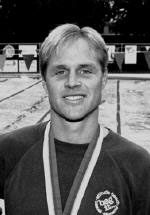
Craig Wilson (USA) 2005 Honor Water Polo Player
FOR THE RECORD: 1984 OLYMPIC GAMES: silver; 1988 OLYMPIC GAMES: silver; 1992 OLYMPIC GAMES: Fourth; 1982, 1986, 1991 WORLD CHAMPIONSHIPS: team member; 1982, 1984, 1988 and 1990 FINA WORLD CUP: team member; 1991 FINA WORLD CUP: gold; 1981 PAN AMERICAN GAMES: silver; 1983 PAN AMERICAN GAMES: gold; 1987 PAN AMERICAN GAMES: gold; 1991 PAN AMERICAN GAMES: silver; Five U.S. Water Polo National Championships; Voted World’s Top Goal Keeper.
Craig “Willy” Wilson rivals Hall of Famer Zdravko Kovacic (YUG) as one of the greatest goalies to play the game of water polo. He is a three-time Olympian playing in 1984, 1988, and 1992 winning silver medals in 1984 and 1988. From 1981 to 1992, he played in over 211 international tournaments. His six-foot, ten-inch, out- stretched arm length made it very difficult for opponents to score.
Craig was born on February 5, 1957, in Beeville, Texas, but at age four moved with his family to California living in Tujunga for seven years and Davis for eight years. As a kid, he loved any sport where there was a ball or a pool. He first played organized sports with Little League Baseball, playing first base, pitcher and right field and won the league championship. He began organized swimming at age 11, specialized in backstroke, but yearned for a team-oriented sport. He joined the water polo team.
Craig’s water polo career started at age 13 with the Davis Recreational Water Polo Team. There was no league, only games amongst themselves. At Davis High School, he started playing goalie, even wearing braces, and played his way to high school All-American status in 1975. At the University of California, Santa Barbara, he played water polo his junior and senior year, starting as a walk-on, fifth-string goalie and advancing to starting goalie and an NCAA National Championship, beating UCLA in the finals, 12-3. Craig became NCAA first team All-American.
With the end of his collegiate career, Craig envisioned his water polo playing days over, but in 1980, he was invited to join the National Team Training Squad, again as fifth-string goalie. He joined the Industry Hills Aquatic Club Team (1981-1982) and the team won the National Outdoor Club Championships each of the two years. As a member of the National Team, he quickly advanced and for the next 13 years, he played in 19 major tournaments including: 1981 Pan American mini-tournament – 2nd, Edmonton Canada; 1981 World Student Games – 2nd, Bucharest, Romania; 1982 National Sports Festival – 4th, Colorado Springs; 1982 World Championships – 6th, Guayaquil, Ecuador; 1982 Tungsram Cup – 3rd, Budapest, Hungary; 1983 Fina Cup – 4th, Malibu, California; 1983 Pan American Games – 1st, Caracas, Venezuela; 1984 Tungsram Cup – 2nd, Budapest, Hungary; 1984 Olympic Games – 2nd, Los Angeles, USA; 1986 Goodwill Games – 2nd, Moscow, Russia; 1986 World Championships – 4th, Madrid, Spain; 1987 Pan American Games – 1st, Indianapolis, USA; 1987 Fina Cup – 4th, Thessaloniki, Greece; 1988 Olympic Games – 2nd, Seoul, Korea; 1990 Goodwill Games – 5th, Seattle, USA; 1991 World Championships – 4th, Perth, Australia; 1991 Fina Cup – 1st, Barcelona, Spain; 1991 Pan American Games – 2nd, Havana, Cuba; 1992 Olympic Games – 4th, Barcelona, Spain.
The 6 feet 5 inch, 190 pound Wilson, led every major tournament in saves since 1984, the same year he tended goal for the USA silver medal-winning team at the Los Angeles Olympics, where they were a close second behind Yugoslavia. At the 1988 Seoul Olympics, the USA again won the silver medal behind Yugoslavia. Wilson led the tournament with 68 saves, 10 saves ahead of Spain’s Jesus Rollan with 58 saves. U.S. coach Bill Barnett said, “Without Craig, we would have never gone as far as we did. He was our saving grace.” Four years later when finishing his Olympic career at Barcelona in 1992, the USA placed fourth behind Italy, Spain and the Unified Team. But Wilson was credited with an Olympic record, most saves at 88, which translated to a 70% efficiency. Gold medalist, Italy’s Francesco Attolico had a 54% efficiency, silver medalist, Spain’s Jesus Rollen had a 56% efficiency and bronze medalist, Unified’s Evgenyi Sharanov had a 57% efficiency.
Barcelona was the third straight Olympiad that the 35 year old led all goalies in numbers of saves. No other goalie in the sports history is even close to matching this accomplishment. He was selected outstanding goalie at the 1992 French International, Tungsram Cup and Catania Tournament. He was a member of the 1991 World Championship Team competing in Perth, Australia and was also a member of three Pan American Teams winning two gold medals (1983, 1987) and a silver medal (1991). He was voted two times as the World’s Top Goalkeeper. He competed on five FINA World Cup Teams for the U.S. (1982, 1984, 1988, 1990, 1991) winning the gold medal in 1991.
Craig competed for two years in the Italian professional water polo league, signing a contract with Ortegia in Sicily, a division one team that represented the seaside town of Siragusa, the islands oldest settlement started by the Greeks more than 2000 years ago. He was only the second American player signed to play in Italy and the first defensive player signed. Each weekly match drew 10,000 spectators usually with radio and television coverage.
As team goalie, Craig was a field leader, coach and wasn’t afraid to take risks. He thrived on the responsibility of having a direct impact on the outcome of the game. Craig is also the author of The Guide to Water Polo Goalkeeping, an illustrated booklet for water polo goalies.
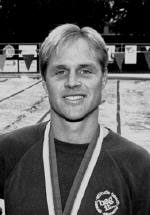
Happy Birthday to our favorite Podiatrist !!!

Marcella MacDonald (USA) 2019 Honor Open Water Swimmer
FOR THE RECORD: 16 ENGLISH CHANNEL CROSSINGS INCLUDING 3 DOUBLE CROSSINGS, LOCH NESS (36 km/22 miles), AROUND THE ISLAND OF JERSEY UK (66 km/41 miles), EDERLE SWIM (28 km/17.5 miles), Three times across LONG ISLAND SOUND (27 km/17 miles), 5 times around MANHATTAN ISLAND (46 km/28.5 miles), MOLOKAI CHANNEL (42 km/26 miles), TAMPA BAY (24 miles), 3 times BOSTON HARBOR (10 miles), MAUI CHANNEL (10 miles), MERCER ISLAND, WA (20 km/12.4 miles) and the TRIPLE CROWN.
When she was just 12-years-old, she knew open water swimming was her passion, and she told her younger sister that she would swim the English Channel one day.
In high school, Marcella MacDonald swam competitively until she was 17, and went to American International College as a softball player. While in college, she would sneak into the nearby Springfield College pool during her free time to swim.
In 1993, MacDonald first heard of an opportunity to swim around the island of Manhattan and has since completed the 28.5-mile swim five times.
In 1994, Marcella MacDonald made her childhood dream come true, at the age of 28. Since then, she has swum the English Channel 16 times, including three times when she did a double cross, swimming there and back. MacDonald was the first American woman to swim across the Channel, from England to France and back in 2001.
At 18.2 nautical miles, the English Channel is considered by many to be the “Mount Everest” of open water swims. Only 1500 men and women have successfully swam the English Channel and many, many more have tried. The trek generally starts at the White Cliffs of Dover at Shakespeare Beach and ends on the shore of Cape Gris Nez. By many accounts, it is the most difficult swim to finish. It’s a very cold, 20-mile swim in water that is much saltier, and the changing tides approaching the French shore can force swimmers to basically swim in place for up to four hours.
The English Channel and the Manhattan Island Marathon swim are a part of the Triple Crown of open water swimming, which also features the Catalina Channel Swim, a 20.1-mile swim from Catalina Island to the shores of San Pedro, California. MacDonald completed the triple crown in June, 2013 when she swam the Catalina Channel in 12 hours and 9 minutes.
MacDonald has also successfully completed the 24-mile Tampa Bay, Florida Marathon Swim, a solo swim around Mercer Island in Washington, and a 17-mile swim across the Long Island Sound in New York.
She has successfully crossed the Ka ’iwi Channel and Maui Channel in Hawaii and has also completed the 41-mile Round Jersey solo swim in the United Kingdom. MacDonald also swam the Lochness, a 22 mile swim.
This past September, MacDonald even attempted the 52-mile swim from the UK to Belgium in St. Margaret’s Bay, something no man or woman has ever completed. After 15 hours, an injury to her left shoulder forced her to stop at a beach north of France.
In addition to her open water swimming accomplishments, Dr. Marcella MacDonald is a Podiatrist who operates her own practice in Manchester, Connecticut. In her spare time, she enjoys coaching at the Laurel East Hartford YMCA and gives talks about her exciting adventures and open water swims.
MacDonald has already been inducted into the International Marathon Swimming Hall of Fame in 2005 and was named the Open Water Swimming Woman of the Year in 2011 by the World Open Water Swimming Association.
MacDonald still finds the time to train to ensure she is ready for the next big swim. She is usually in the water training every day at 5:30 a.m. This July, she is set to swim the English Channel again, on the 25th anniversary of her first crossing. The way she puts it, “it’s just right stroke, left stroke, right stroke, left stroke — for hours on end.”

Happy Birthday Honor Swimmer Tracey Wickham !!!


TRACEY WICKHAM (AUS) 1992 Honor Swimmer
FOR THE RECORD: OLYMPIC GAMES: 1976 Olympic Team Member; WORLD CHAMPIONSHIPS: 1978, gold (400m & 800m freestyle); AUSTRALIAN CHAMPIONSHIPS: 17 (200m, 400m, 800m & 1500m freestyle, 100m butterfly); WORLD RECORDS: 5 (400m, 800m, 1500m freestyle); COMMONWEALTH GAMES: 1978, gold (400m & 800m freestyle), silver (200m freestyle & relay), bronze (relay); 1982 (400m & 800m freestyle); U.S. OPEN RECORD: 1 relay; AAU: 1 relay; FINA CUP: 1979, silver (400m freestyle), 6th (100m butterfly), 5th & 6th (relays).
Tracey Wickham of Australia set world records in the 400-meter and 800-meter freestyle in 1978. It was not until 1987 that Janet Evans of the USA broke them– a period of 9 1/2 years. All totaled, she set five world records in the 400-meter, 800-meter and 1500-meter freestyles in a a period of two years.
Born in Melbourne, Victoria, in 1962, Tracey began swimming at age eight and broke her first State age group record in the 200-meter backstroke at age 10. Her first National gold medal came in the 200-meter individual medley at age 12, but it was the middle and distance freestyles which were to be Tracey’s strong events. By age 13, she had made the 1976 Australian Olympic team as the youngest competitor on the team.
It was the year following the Olympics that Tracey and her family moved to Mission Viejo for a nine month period and trained with Mark Shubert. Upon returning to Brisbane, Tracey broke the 1500-meter freestyle world record in a solo swim. Two weeks later she broke the 800-meter freestyle world record and only six months later, the 400-meter freestyle world record. Before the next year was over, she broke the 1500-meter and 800-meter freestyle world records again.
Tracy dominated the middle distance freestyle event for women in the years preceding the 1980 Moscow Olympics.
In 1978 Tracey started a nine week international swimming tour in Edmonton, Alberta, Canada, by taking six seconds off the 800-meter freestyle world record of teammate Michelle Ford at the Commonwealth Games. Next came the Berlin World Championships that same month and another record in the 400-meter freestyle where she also went on to win the 800-meter freestyle a few days later. She became Australia’s only gold medalist at the Championships and her country’s first gold medalist in World Championship history. Her remarkable accomplishments were all the more spectacular as her taper was getting stale after nine weeks on the road. Six months later she reset the 1500-meter freestyle world record in the Australian Championships in Perth.
Tracey was selected for the 1980 Australian Olympic team but pulled out for personal and family reasons. She retired, but came back eight months later to win gold medals in the 100-meter butterfly and 200-meter freestyle at the Australian National Championships. Her coach, Laurie Lawrence, was her inspiration to continue training for the 1982 Commonwealth Championships in her hometown of Brisbane where she repeated her 400-meter and 800-meter freestyle victories from four years earlier and took the silver in the 200-meter freestyle.
Before Tracey was through, she had 260 Australian records, twelve Commonwealth records, and was voted the Australian Sportsperson of the Year in 1978, as well as receiving the Australian Sportswoman of the Year, 1978 and 1979. Queen Elizabeth presented her with the prestigious M.B.E.–Member of the British Empire recognition in 1978.
Happy Birthday Larisa Ilchenko !!!

Larisa Ilchenko (RUS) 2016 Honor Swimmer
FOR THE RECORD: 2008 OLYMPIC GAMES: gold (10km); 2004 WORLD CHAMPIONSHIPS: bronze (5km); 2005 WORLD CHAMPIONSHIPS: gold (5km); 2006 WORLD CHAMPIONSHIPS: gold (5km, 10km); 2007 WORLD CHAMPIONSHIPS: gold (5km, 10km); 2008 WORLD CHAMPIONSHIPS: gold (5km, 10km); 2009 WORLD CHAMPIONSHIPS: silver (5km); 2006 EUROPEAN CHAMPIONSHIPS: bronze (5km)
This eight-time World Champion was unbeatable in major international competition beginning with her 2004 debut in Dubai as a 16-year-old, to her dramatic victory at the inaugural Olympic open water race at the 2008 Olympic Games in Beijing.
Larisa Ilchenko was born in 1988, in the Russian city of Volgograd. She began swimming at age four, to build up her strength, but when she began winning competitions, she decided to become a serious competitive swimmer. The 200 and 400-meter freestyle were Larisa’s favorite distances, but she was also quite successful on relay teams, too. She tried open water swimming for the first time in 2004. Although she placed third in the Russian championships in the 5k, her coach decided to take her to the FINA World Championship event in Dubai, over the second place finisher. At age 16, she surprised everyone by beating American Sara McLarty, and won the gold in the 5k by over 30 seconds. Many people in the open water community thought it was a fluke, but Larisa was determined to prove everyone wrong.
She did just that the next year when she won the 5K race at the FINA World Aquatic Championships in Montreal. At the 2006 World Open Water Championships in Naples, Italy, she swam to gold in both the 5K and 10K races, a feat she would repeat at the 2007 FINA World Aquatics Championships, in Melbourne, Australia and the 2008 World Open Water Championships in Seville, Spain.
Three months after her victories in Spain, she competed in the Olympic Games in Beijing, where the 10K Open Water Swimming event became part of the Olympic program for the first time. Larisa Ilchenko won the first gold medal presented in Olympic competition for open water swimming.
It has been said that Larisa Ilchenko was if nothing, predictable. She swam all her races with a proven open water strategy, now dubbed, “The Ilchenko”. She lagged just behind the leaders, drafting off them during 90% of the race, saving the majority of her energy before unleashing herself on the pack with a sprint in the final 200-400 meters. This strategy is now very typical of the world’s very best open water swimmers. It was that strategy that won her five consecutive 5k World Championship titles, as well as titles in the three major pre-Olympic 10k races.
Swimming World Magazine named her Open Water Swimmer of the Year in 2006, 2007 and 2008. She had eight world titles and one Olympic gold under her belt when she decided to retire in 2010. Larisa Ilchenko will always be remembered as the first gold medalist in the women’s Marathon 10km Open Water Swimming event in Olympic history.

On this day in 1915, the amazing Pioneer Honor Swimmer, Alfred Nakache was born in Algeria…..

Alfred Nakache (FRA) 2019 Honor Pioneer Swimmer
FOR THE RECORD: 1936 OLYMPIC GAMES: 4TH (4x200m freestyle); 1948 OLYMPIC GAMES; 1938 EUROPEAN CHAMPIONSHIPS: silver (4x200m freestyle); WORLD RECORD: 200m breaststroke (1941), 3x100m relay 3 strokes (1946); FRENCH CHAMPION: 13 titles, including 9 consecutive: 100m freestyle (1935-38, 41, 42), 200m freestyle (1937-38, 1941–42), 400m freestyle (1942), 4x200m freestyle (1937-39, 1942, 1944-52); 1931 NORTH AFRICAN CHAMPION: 100m freestyle in 1931; 1935 MACCABIAH GAMES: silver (100m freestyle)
The name of Mark Spitz with his unprecedented seven gold medals and seven world records at the 1972 Munich Olympic Games stands out above all other achievements in Jewish sports history, but the title for the first great Jewish butterfly swimmer, belongs to another and this is his story. This is the story of French Algerian, Alfred Nakache.
With shoulders lined with hard and protruding muscles, “Artem” as he was known, took part in his first French Championships, in 1933, in Paris where he later moved from Algeria that summer, to train and to pursue a degree in Physical Education. At the 1934 French Nationals, he placed second in the 100m freestyle, behind his idol, Jean Taris. In 1935, Artem was one of 1,000 Jewish athletes who traveled to Tel Aviv to attend the second annual Maccabiah Games.
In front of Hitler, in 1936, at the Berlin Olympic Games, Nakache finished fourth in the 4×200m freestyle relay along with teammates, Christian Talli, René Cavalero and Jean Taris. Although they didn’t make the podium, they had the pleasure of beating the Germans -who finished fifth- in their home country.
Between 1935 and 1938, Artem Nakache won seven national titles and began training in the new butterfly-breaststroke. After receiving his certificate as a professor of Physical Education, in 1939, he stopped training to join the French Air Force in preparation for war with Germany.
In the early part of the 1940’s, Nakache was forced to flee to Toulouse, into the unoccupied “Free Zone”, with his new wife Paule. There he was welcomed like a son by two historical figures of French swimming, coach Alban Minville and Jules Jany. He was provided a gym to run and he began training with Minville’s Toulouse Olympic Employee’s Club Dauphins. In 1941 and 1942 Nakache won six French National titles, but the high point of his career came on July 6th, 1941—when he broke American Jack Kasley’s world record, and Germany’s Joachim Balke’s European record, in the 200m breaststroke with a time of 2:36.8. His world record would last five years, until broken in 1946 by Hall of Famer Joe Verdeur of the USA.
As anti-Semitic persecution was intensifying across Europe, the French media was split in their support for Nakache. While Jean Borotra, the courageous Vichy Commissioner of Sport and Wimbledon tennis champion, celebrated his achievements, others called for his exclusion from national competitions and the record books because of his “Jewishness.”
In 1943, the French Swimming Federation finally gave in to the pressure from the Germans and banned Alfred Nakache from swimming in their 1943 National Championships. Although many of the country’s best swimmers refused to compete without Nakache, their support couldn’t save him from the Nazis. Finally, in December of 1943, Nakache, his wife and daughter, were arrested and sent to Auschwitz. Upon arrival he was immediately separated from his family.
Toward the end of the war, Nakache was moved to Buchenwald, where he was freed by the Allies in 1945. Of the 1,368 men, women and children in their death camp convoy, Nakache was one of only 47 who survived. His wife and daughter did not. Four months later and weighing less than 100 pounds, he returned to Toulouse, where he lived with the Jany family. Amazingly, less than a year after the liberation of Buchenwald, he was part of the French team in 1946 that set a world record in the 3×100m medley relay and reclaimed his title as French national champion in the 200m breaststroke.
He completed a truly remarkable comeback by qualifying for the 1948 French Olympic Team in two sports. At the London Games, 34-year-old Alfred Nakache swam well enough to reach the semi-finals in the 200m breaststroke, and after swimming concluded, he was a member of the French water polo team that finished in sixth place overall.
Nakache retired from swimming in the early 1950s and devoted himself to his gym and teaching. In addition, he helped train 1952 Olympic champion Jean Boiteux. With his long over-due induction, Nakache will forever be reunited with his idol, Jean Taris, his coach Alban Minville and world-record setting relay teammates, Georges Vallery and Alex Jany, into the International Swimming Hall of Fame.

Open Water Swimmer, Mercedes Gleitze was born on this day in 1900…

Mercedes Gleitze (GBR) 2014 Honor Pioneer Open Water Swimmer
FOR THE RECORD: BRITISH LONG DISTANCE SWIMMER: 1921-1932; FIRST EUROPEAN FEMALE TO SWIM THE ENGLISH CHANNEL: 1927; FIRST SWIMMER TO COMPLETE STRAITS OF GIBRALTAR: 1928; COMPLETED 51 ENDURANCE SWIMS, HALF OF THEM LASTING OVER 26 HOURS.
When Winston Churchill defined success as going from failure to failure without the loss of enthusiasm, he might have been thinking of Mercedes Gleitze.
She worked as a stenographer but dreamed of being a professional swimmer and the first woman to swim across the English Channel. But swimming the Channel would not be easy for Mercedes Gleitze. She made her first attempt in 1922, failed seven times and lost her dream to Gertrude Ederle in 1926. But she had a never-say-die spirit and became the first English woman to conquer the Channel, on her eighth attempt, in 1927.
Mercedes Gleitze may have been lost to history if the Channel Swimming Association had not questioned the legitimacy of her swim. She was so upset by the insinuation of cheating, that she announced she would swim it again 14 days later, to prove the naysayers wrong. Of course this caused a big media stir, and brought her to the attention of Hans Wilsdorf, founder of the Rolex watch company. For what she called her “vindication swim” Wilsdorf asked her to wear his newly invented “Oyster,” the world’s first waterproof watch. She agreed and wore it on a ribbon around her neck. Afterwards, the Oyster was found to have kept perfect time throughout its immersion. The swim itself, however, was not successful . The water was much colder than it had been a fortnight earlier and Mercedes had to be pulled out of the sea. Still, the Association admired her pluck, acknowledged her courage in undertaking this swim and agreed to recognize her first swim. It also proved to be a brilliant piece of marketing for the Rolex.
It wasn’t just her association with Rolex that made Mercedes Gleitze an international sports celebrity. In the years that followed, she set dozens of marathon and endurance records around the globe. The media followed her every move and marketers established connections between her stamina and glamour – with products as varied as honey, tea, whiskey and corsets. Her reputation was further enhanced when she established a Fund for Destitute Men and Women.
In an era when women were taught to believe that their role in life was purely domestic, the star persona of Mercedes Gleitze inspired women and girls around the globe to realize they were not weak and fragile human beings.
