
On this day in 1893, ISHOF Honor Pioneer Swimmer and Cal Bear, Ludy Langer was born…..

LUDY LANGER (USA) 1988 Honor Pioneer Swimmer
FOR THE RECORD: OLYMPIC GAMES: 1920 silver (400m freestyle); WORLD RECORDS: 2 (440yd, 500m freestyle); U.S. NATIONAL CHAMPIONSHIPS: 8 from 1915-1921.
Ludwig “Ludy” Ernest Frank Langer was an American swimmer who competed in freestyle events. He was one of six Hawaii-based swimmers who competed at the 1920 Summer Olympics in Antwerp, Belguim, and collectively won seven medals
Langer won a silver medal in the 400 meter freestyle at Antwerp. He set two world records in the 440 yard and 500 meter freestyle and won eight U.S. National Championships from 1915 through 1921. He held the world record in the quarter mile for five years until he lost it to Hall of Famer, Norman Ross, the same Ross who touched him out for the 400 meter gold at Antwerp.
Langer was just hitting his stride with a victory in Hawaii over the legendary Duke Kahanamoku, when World War I interrupted his career. He returned to win his last two Nationals in 1921.
This from Cal Blog’s FANPOST in December 2012:
The University of California has an extraordinary tradition of excellence in the sport of swimming. Cal students and alumni have won a total of 63 Olympic medals in swimming: 29 Gold, 21 Silver, and 13 Bronze. Two of Cal’s all-time greatest athletes are swimmers: Matt Biondi, who has 12 Olympic medals, and Natalie Coughlin, who has 11 (and counting). And, of course, the Cal men’s swimming team and the Cal women’s swimming team have each just won back-to-back national championships. This tradition of Cal swimming glory can be traced back to one individual, Cal’s first great swimmer, Ludy Langer.
To read the entire article and learn more about Lundy Langer from Cal’s FANPOST, visit:
https://www.californiagoldenblogs.com/2012/6/6/3038141/ludy-langer-cals-first-olympic-swimmer

Happy Birthday Karen Moe !!

KAREN MOE (USA) 1992 Honor Swimmer
FOR THE RECORD: OLYMPIC GAMES: 1972 gold (200m butterfly), 1976 4th place (200m butterfly); WORLD RECORDS: 4 (200m butterfly); AAU CHAMPIONSHIPS: 3 (200yd butterfly, 1 relay); AMERICAN RECORDS (Short Course): 1 (100yd butterfly); AMERICAN RECORDS (Long Course): 3 (200yd butterfly); OLYMPIC TRIALS: 1976 1st (200m butterfly).
Although she was born in Del Monoe, the Philippines, Karen Moe and her family settled in Orinda, California. At age eight she started swimming and after joining the Orinda Aqua Bears Swim Team, she competed for the next eight years as an age group swimmer. It was not until 1968, at age fifteen, that she competed in her first World Championship.
During those years she had to overcome two spinal deformities, for which she was required to wear a corrective back brace at all times, except when in the water. In 1970 she set the world record in the 200-meter butterfly, taking the record from the legendary Ada Kok of Holland, and overcoming a bout with shoulder tendonitis attributed to the many yards swum in practice sessions. Soon after, she and her family moved to Santa Clara where she swam for Coach George Haines at the Santa Clara Swim Club. Said Haines, “Karen is the type of girl that’s a great competitor and she’s an intelligent racer. She’s one of the smartest swimmers I’ve ever dealt with, in or out of the water.” Under Haines, Karen set the world record an additional three times.
Her greatest individual achievement was at the 1972 Munich Olympic Games where Karen won the 200-meter butterfly in world record time–two minutes, 15.56 seconds. It was a clean sweep by the American girls with Lynn Colella (second) and Ellie Daniel (third). She also placed forth in the 100-meter backstroke.
She returned home to a heroine’s welcome and soon enrolled at UCLA in Kinesiology. She took a two year layoff, but the Bruin’s coach Colleen Graham convinced her to swim for the team. They were contenders for the women’s collegiate national championship, and Karen became the national collegiate champion in the 200-yard butterfly, training the collegiate season from October through March only.
It was after graduation in 1976 that she married fellow student Mike Thornton and again began training for a second Olympic Games, even though she was considered an “old lady” at age 23. She made the team to Montreal, was elected the team captain and placed fourth in the 200-meter fly in an Olympics that saw the girls from the German Democratic Republic win every event but two.
Karen then retired from swimming, but again not for long. She coached at the Beverly Hills YMCA for two years and in 1978 became the head women’s coach at the University of California, coaching forty-nine All-Americans and nine Olympians. She is a three-time conference Coach of the Year and 1987 NCAA Coach of the Year.
All totaled, she won eighteen U.S. National Championships, setting seven American records. She was a member of the first U.S. Sports Team to make the Goodwill Trip to the Peoples Republic of China following the Ping-Pong Exchange in 1973.

ISHOF Museum One Step Closer To Getting New Buildings


by BRANDI WEST
22 January 2021, 12:41pm
The Fort Lauderdale City Commission voted to accept an unsolicited bid from the Hall of Fame Partners, LLC to replace the front and back International Swimming Hall of Fame (ISHOF) museum buildings. The proposal was accepted and will be revisited again after 21 days to allow additional competitive bids to be presented. The new building will complement the $45 million renovation of the aquatic center which is scheduled to be completed in the Fall (2021).
The ISHOF main museum was constructed in the 1960s and has exceeded its life expectancy. The swimmer man statue will be refurbished and relocated on the property.
Photo Courtesy: International Swimming Hall of Fame
The proposed plan will replace the existing museum with a 5-floor building. A teaching pool will be located under grandstands that overlook the newly renovated aquatic complex. On the ground level there will be a public gathering place, kiosks, and an ISHOF gift shop. The second floor will feature much needed public parking. The third floor will have skyboxes overlooking the new 27-meter-high diving tower and a multilevel museum for exhibits. The fourth floor will have meeting rooms, an event center and office space. The top floor will feature a restaurant with breath-taking views overlooking the intracoastal and Atlantic Ocean.
Photo Courtesy: International Swimming Hall of Fame – Arquitectonica
The ISHOF front building was built in the early 1990s and will be replaced with an iconic four floor building that will include a welcome center, coffee shop, observation deck, and office space. The current building was iconic for its time because of its wave design.
Photo Courtesy: ISHOF
Arquitectonica designed the original wave building and has partnered with the current developers to make the new front building more iconic with the letters SWIM stretched across the street side and DIVE stretched across the pool side of the building
Photo Courtesy: ISHOF – Arquitectonica
“The replacement of ISHOF’s two buildings is the final step in the total renovation of this aquatic peninsula. The Fort Lauderdale City Commissioners and Manager have displayed incredible vision for supporting this project. It will catapult Fort Lauderdale and the International Swimming Hall of Fame to the top of the aquatic world and reestablish Fort Lauderdale as an international destination unparalleled in the aquatic community,” said Brent Rutemiller – President and CEO of the International Swimming Hall of Fame.
The Hall of Fame Partners, LLC is a joint venture of local developers specializing in Public Private Partnerships, and the most awarded Design Builder in the United States. The group is led by Mario Caprini – CEO & Development Executive of Capital Group P3 Developments of Florida LLC, Laird Heikens – President, Development Hensel Phelps, Kirk Hazen – Vice President, Construction Hensel Phelps, and Cory Olson – Project Executive Hensel Phelps
“We are very pleased that the city is allowing us to take the next step in bringing this important upgrade to the city for its citizens and the aquatic community. We are very excited to be a part of this project,” said Mario Caprini.
Passages: Harry Gallagher, Legendary Coach of Dawn Fraser, Dies at 96


by IAN HANSON – OCEANIA CORRESPONDENT
20 January 2021, 10:51pm
Legendary Australian Olympic swim coach Harry Gallagher OAM – the mastermind behind Aussie swimming greats Dawn Fraser and Jon Henricks – passed away peacefully early today on the Gold Coast.
“The Crafty Fox” as he was fondly known around the pool decks throughout his colourful 96 years was surrounded by his family and his greatest protégé in four-time Olympic champion Fraser who drove from the Sunshine Coast last night to say her final fond farewells to “Mr Gallagher.”
ALWAYS MR GALLAGHER: Another legend leaves the pool deck. Legendary swim coach Harry Gallagher with “His Dawn” on the Gold Coast in 2019. Photo Courtesy: Hanson Media Group Collection
Their’s was as special a swimmer-coach relationship as there’s ever been in Australian sport – Dawn forever remaining in contact with Harry who was always “Mr Gallagher” to “His Dawny”, right till the last lap.
The triple Olympic golden girl of the pool in 1956, 1960 and 1964 was like family.
“I was with him until the end,” reflected Fraser today as she and Gallagher’s family gathered to cherish the amazing life of a swimming legend.
“He was a man who always played such a special part in my life.
“I made the journey down the highway last night, knowing very well it would be the last time I would see ‘Mr Gallagher’.
“It was a wonderful partnership we had and I would not have achieved the things I did without him.
“He taught me everything I know and we had a beautiful affection for each other. I would not have succeeded without him.
“He taught me self-discipline. If you missed a session, you doubled up the next day. That’s how it was. We have stayed in touch all these years. I feel I belong to his family and him to mine.
“If he didn’t know something, he would ask the top professionals in that field. If he wanted to know about the heart, he brought in Professor Edward Both, who invented the portable electrocardiograph machine. He trialled it on me and Jon Henricks. He always went to the top people.
“He was fair dinkum, a true Aussie.”
GOLDEN TRIO: Coach Harry Gallagher with Jon Henricks and Dawn Fraser. Photo Courtesy: Lanes Of Gold (Swimming NSW).
Gallagher with Fraser and Henricks captured the imagination of Australia’s sporting fraternity at the Melbourne Olympics in 1956, when the coach with the midas touch guided his star pupils to rare Olympic gold – the first time Australia had won both the coveted men’s and women’s 100m freestyle gold medal double in the blue ribband event.
He also played significant roles in the careers of 1968 Olympic champions Mike Wenden and Lyn McClements as well as fellow Olympic gold medallists Lorraine Crapp and Brad Cooper and so many others.
Gallagher was inducted into the International Swimming Hall of Fame at Fort Lauderdale in 1984 before receiving the Medal of the Order of Australia in 1986 for his services to swimming and a Life Membership of Swimming Australia last year.
But it was Gallagher’s discovery of Fraser and the re-discovery of Henricks that set him on a coaching path to greatness.
As a young aspiring coach in Sydney, Gallagher had been forced by circumstances to move his squad to the Balmain Baths.
There he quickly recognised the talent in this unruly, precocious and rebellious adolescent – who would go on to become one of the world’s greatest Olympians – “Our Dawn” the first person to win three consecutive individual events – adding her Melbourne triumph in the 100m freestyle in Rome in 1960 and again in Tokyo in 1964.
PRESSING TIMES: Dawn Fraser climbs into the press seats to find her coach Harry Gallagher in Melbourne in 1956. Photo Courtesy: Dawn Fraser Collection.
Australian Swimming’s History recalls that “After waiving the standard coaching fees, and exhibiting considerable patience and guile, Gallagher persuaded Dawn to join his squad who trained with discipline, dedication and regularity, features that had not previously characterized her swimming. By 1955, it paid off. Fraser won her first Australian Championship.
“Gallagher, always outfoxing his swimmers and other coaches, had won over Fraser.
“She worked hard, was rewarded with success and enjoyed a new lifestyle with social opportunities, different friends and a chance to travel. Gallagher took up leases in pools in Adelaide and then Melbourne, and Fraser followed her coach who she referred to as ‘her Professor Higgins’ (Howell and Howell, 1988: 156).
“Good coaching, intensive training and dedication paid off. An excellent Australian Championships was indicative of things to come at the Melbourne Olympic Games (1956). At the Games, Fraser, in a superb 100 metres freestyle event, out touched Crapp in a gripping race. Faith Leech completed an Australian trifecta. For the first time since Fanny Durack some 44 years earlier, an Australian won the prestigious 100 metres freestyle.”
ON THE PULSE: Harry Gallagher checks the pulse rate of his super star freestyler Dawn Fraser, Photo Courtesy: Lanes Of Gold (Swimming NSW).
Gallagher trained Fraser against male swimmers and set her up for a series of world records, Olympic and Commonwealth gold medals, and National and International acclaim.
Henricks swam in a tidal pool in Tuncurry before the family moved to Cabarita, and he trained at Drummoyne Baths.
Harry Gallagher spotted his talent as a freestyle swimmer early on and convinced his parents to give him the chance of coaching him. Henricks worked very hard, training twice a day, before and after school focusing on longer distances. Mediocre success did not match the effort and commitment. He missed selection for the 1952 Helsinki Olympic Games. As Gallagher summarized: ‘he was sick of swimming dumb miles in cold water and didn’t want to be a distance champion anyway’ (Gallagher, 1998: 176).
After consultation with Gallagher and the scientifically orientated Professor Frank Cotton, Henricks decided to resurrect his career and started to race over shorter distances.
Professor Cotton ascertained that physiologically Henricks was better suited to longer distances, but the psychology of the long mileage did not work for him. Sprint racing, combined with a program of tapering before major events, brought instant success.
In 1953 he set Australian records over 110 yards and 220 yards, accepted an invitation to compete at the Japanese National Championships where he won convincingly in front of large crowds, and he took out the 110 yard gold medal at the British Empire and Commonwealth Games at Vancouver (1954).
The crafty fox, Gallagher, added to psychological preparation for the Melbourne Games by taking both Henricks and Fraser to the top of the stands of the Melbourne Olympic Pool when all the swimmers were gone, as the deck lights lit the pool and as the cleaner slid his pole across the floor creating a ripple on the surface.
WARM RECEPTION: There was always a warm reception for coach Harry Gallagher and sprint stars Dawn Fraser and Jon Henricks caught here lapping up the Far North Queensland sunshine at Townsville on a training camp. Photo Courtesy: Dawn Fraser Collection.
He describes a discussion that has gone down in Australian sporting history: ‘Tomorrow you’ll make history, and what you do may never be repeated, for no two swimmers from the same club with the same coach have ever won the Olympic sprint double in world record time. You’ll be talked about in a hundred years’ time … You’re going to win by leading all the way- sprinting flat out from gun to gold’ (Gallagher, 1998: 244).
Gallagher was right, but for Henricks it was a tight race. Henricks got his characteristic slow start, gathered momentum and came through the field, but Australian team captain John Devitt (who would win gold in Rome in 1960) led with 25 metres to swim. When they hit the wall Henricks won by a touch – four tenths of a second – to take the gold medal. It was a world record..and Harry’s kids had created history.
Gallagher’s passing comes just over two months after the death of the great Don Talbot, who passed away on the Gold Coast aged 87.
Swimming World will keep its readers posted on the details of a funeral service to celebrate the life and times of the late great, Harry Gallagher OAM who was awarded ASCTA Coaching ring number four in 1956 behind Forbes Carlile (No 1), Bill Holland (No 2) and Syd Grange (No 3).
On this day in 1901, Liliian “Billie” MacKellar, Honor Synchronized Swimming Coach and Contributor was born…..

LILLIAN “BILLIE” MACKELLAR (NZL, CAN, USA) 1993 Honor Pioneer Coach/Contributor
FOR THE RECORD: COACH: University of Western Ontario, 1943-1950; Kia-Ora Swim Club, St. Catherines, Ontario, 1945-1951; Hollywood Athletic Club, 1952-1962; Glendale Swim Club 1963-1975; U.S. Synchro Committee Chairman, Southern Pacific Association Chairman 1956-1972, 1980-1984; ATHLETE: New Zealand National Champion (diving, breaststroke).
Lillian “Billie” MacKellar in her youth was a swimmer and diver of international renown. She was a national breaststroke and diving champion in her native New Zealand and a participant in many long distance swims in Australia, England, and France. She went to Canada to compete and ended up staying to coach both women’s and men’s swimming and synchronized swimming at the University of Western Ontario. Her foremost pupil, Hall of Famer June Taylor, won Canadian and the U.S. National solo titles.
After traveling to the 1951 Pan American Games in Argentina as manager of the Canadian exhibition team, she moved to Hollywood, California, and later Glendale, where she developed an entirely new group of swimmers know as “Billie’s Kids.” Her national and international swimmers included Betty Vickers, Barbara Burke, Joanne Shaack, and Gina Childers.
Billie was an untiring missionary in the sport of synchronized swimming, traveling to every corner of the United States, Canada, and across the world giving clinics and coaching to help bring synchronized swimming into the forefront of the sports world.
Whenever a need arose in the sport, Billie MacKellar was there to help. In 1971, the 25th anniversary of synchronized swimming’s acceptance by the AAU as an official sport, Billie felt there should be an award to recognize outstanding contributions by individuals for synchronized swimming. Billie not only proposed the award, but she even supplied the funding for it. Today, the Lillian MacKellar Distinguished Service Award is presented annually to an individual who has given unselfishly to the support of synchronized swimming with particular attention to the welfare of the athletes. Over her strong protest, the selection committee chose Billie as the first recipient of the award.
As U.S. Synchronized Swimming’s national chairman and member of the national committee, Billie MacKellar established recognition awards for the Outstanding Collegiate Athlete of the Year Award, the Synchronized Swimming Life Membership Program, and college scholarships for synchronized swimmers.
Billie died September 1, 1991, in Burbank, California. After becoming ill at the 1987 Pan American Games, Billie was thought to have been on her way to recovery when cancer was found just four days before her death.

Happy Birthday Aleksandar Sostar !

Aleksandar Sostar (SRB)
2011 Honor Water Polo Player
FOR THE RECORD: 1988 OLYMPIC GAMES: gold; 1992 OLYMPIC GAMES: prevented from competing per United Nation sanctions; 1996 OLYMPIC GAMES: 8TH; 2000 OLYMPIC GAMES: bronze; 1986 WORLD CHAMPIONSHIPS: gold; 1988 WORLD CHAMPIONSHIPS: gold; 1991 WORLD CHAMPIONSHIPS: gold; 1998 WORLD CHAMPIONSHIPS: bronze; 2000 WORLD CHAMPIONSHIPS: bronze; 2001 EUROPEAN CHAMPIONSHIPS: gold.
Yugoslavia’s Partizan Water Polo Club produced many great water polo players over the years including: Hall of Famers Zoran Jankovic, Ciro Kovacic, Igor Milanovic, and Mirko Sandie. In 1975, at the age of eleven, Alexandar Sostar joined the club. In his 16 years with the club and another 10 years with four other clubs, he developed into one of the world’s greatest water polo goal keepers of all time. At 6 feet 5 inches tall weighing 225 pounds, he kept the opposing team from scoring goals, deflecting many shots on goal. At thel988 Seoul Olympics, Yugoslavia won the gold medal, losing only one game in the tournament, and defeating the USA in the final round.
Sostar was known as a fierce competitor, quick with his hands and reflexes and never willing to give his opponents an opportunity to score. Prevented from playing in the 1992 Barcelona Olympics due to United Nations sanctions, he competed again in 1996 Atlanta as Serbia and Montenegro finishing in 8th place. At the 2000 Sydney Olympic Games, his team was back on the podium, winning the bronze medal behind Hungry and Russia. He also won gold and bronze medals at the 1991 and 2000 World Championships respectively and competed in five European Championships, winning two gold medals and three silver medals.
As a goal keeper, Sostar was dominant for most of his 20 year career. Since his retirement from the game he has been the President of Serbia and Montenegro Water Polo Federation, Director of Sport for the Serbian Government,Assistant to the Minister of Sports for the Republic of Serbia and President of Serbian Sports Association. In 2001, he was declared “Athlete and Sportsman of the Year” for Yugoslavia.

Happy Birthday John Naber !!!!!
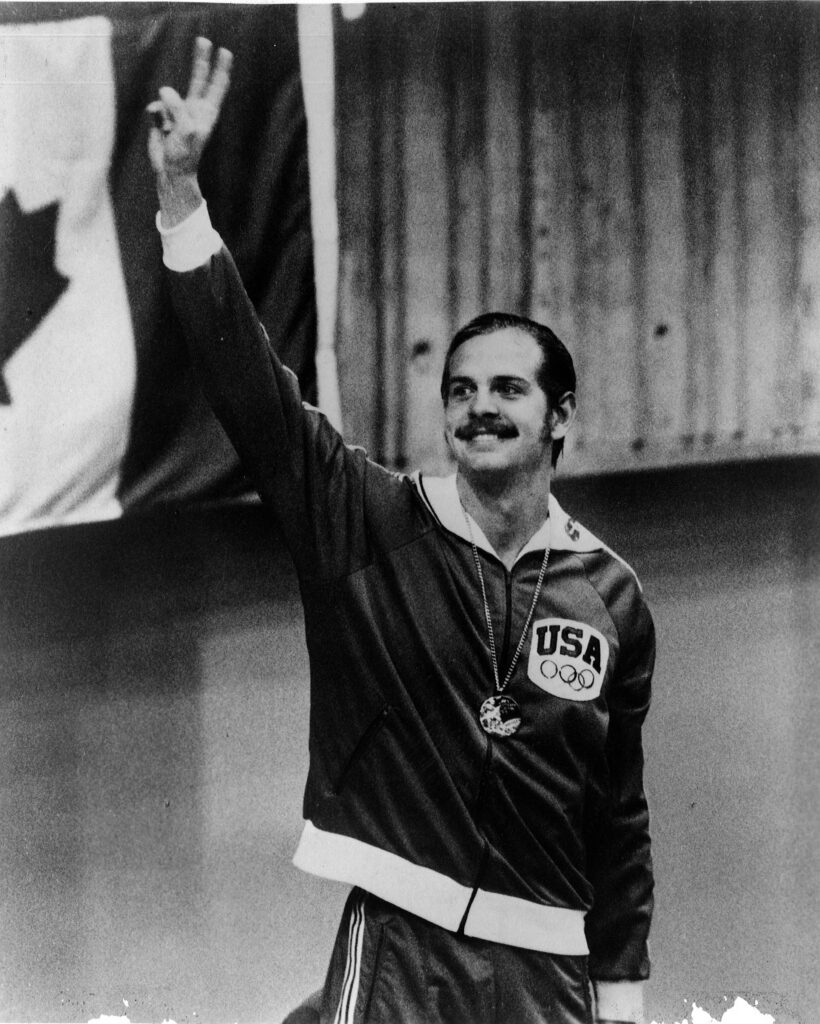
JOHN NABER (USA) 1982 Honor Swimmer
FOR THE RECORD: OLYMPIC GAMES: 1976 gold (100m, 200m backstroke; 2 relays), silver (200m freestyle); WORLD RECORDS: 6 (100m, 200m backstroke; 2 relays); AAU NATIONALS: 25 (100yd, 200yd backstroke, 1650yd freestyle; 7 relays); PAN AMERICAN GAMES: 1977 gold (500m freestyle; 100m, 200m backstroke); NCAA CHAMPIONSHIPS: 15 (100yd, 200yd backstroke; 500yd freestyle; 5 relays); WORLD CHAMPIONSHIPS: 1973 bronze 9200m backstroke); 1976 Southern California Athlete of the Year; 1976 World Male Swimmer of the Year; 1977 AAU Sullivan Award; 1977 Trophy of the International Committee for Fair Play (Warsaw, Poland).
Six foot-six inch John Naber (USA) was high man at the 1976 Montreal Olympics, winning four gold medals all in World Record time and taking a silver in the 200 meter freestyle behind his USC teammate Bruce Furniss, who set a world record to beat Naber. John’s honors were highlighted but not limited to the Olympics.
He entered competitive swimming at age 13, won 25 AAU titles and holds the record of ten individual and 15 NCAA relay titles in his four years of college (1974-77). In milestone achievements, Naber was the first man under two minutes for the 200 meter milestone achievements. Naber was the first man under two minutes for the 200 meter back, the first under 1:50 for 200 yd. back, the first under 50 seconds for the 100 yard back, and the first under 56 seconds for the 100 meter back.
He won the Sullivan Award as the USA’s No. 1 athlete in 1977, was 1976 Southern California Athlete of the year, 1976 World Male Swimmer of the year, and was even named USA Sportsman of the year by the USSR’s Tass News Agency.
As an indication of things to come after competition, as an inspiration to to other swimmers, he was the first American swimmer awarded the Trophy of the International Committee for Fair Play in Paris, France for the year 1977. He pays his debts to swimming every day with his inspirational speaking tours, sportscasting, and as a consultant to MacDonald’s in the sponsorship of age group swimming, and a traveling ambassador for Speedo. He was also a member of the 1984 Los Angeles Olympic Games Organizing Committee. He lived it and tells it like it was and has a message for everyone. John Naber makes us all feel like we could be winners!
The great Captain Webb was born on this day in 1848……First man to swim the English Channel

CAPTAIN MATTHEW WEBB (GBR) 1965 Honor Swimmer FOR THE RECORD:
First swimmer to cross the English Channel, 1875.
Immortality doesn’t come often and once is enough for most swimmers, but not for Captain Matthew Webb, who was first to swim the English Channel in 1875. This feat was an accomplishment of the impossible, according to all estimates up to that time. Many tried but it was 36 years before anyone else (Burgess, 1911) ever made it across the Channel. But Webb was not around to greet No. 2. Webb’s feat lasted 28 years longer than he did. In an effort to bolster lagging attendance for his vaudeville act in 1883, just 8 years after his Channel swim, Captain Webb decided to try for immortality a second time by swimming across the rapids just above Niagara Falls. Once again considered opinions said, “impossible” and this time they were right. Webb is buried at Niagara Falls, Ontario.
But enough of Webb’s failure and on to his accomplishment, a swimming record that stood 59 years until 1934. It all started in 1862 when merchant seaman William Hoskins rode a bundle of straw from Griz Nez to South Foreland. Captain Matthew Webb decided to try it without artificial bouyancy. His first attempt failed, but as his fatigue faded, he planned again. On August 25, 1875, he was successful. The start was from Admiralty Pier at Dover; the time 4 minutes to one on Tuesday, August 24th. With the southwesterly stream running at considerable speed, he ran into difficulty from the start. Although ships had navigated the Channel for centuries, swimming it was a different proposition. Tidal calculations, accurate enough for ship navigation, were by no means accurate for man navigation. Therefore, in comparing Webb’s effort with more recent ones, one great point must be constantly appreciated. Not only was the swimmer attempting a new and colossal task, but so were the boatmen and pilots. The present specialized knowledge has been built on the experience of the preceding years. So, as a result of combined inexperience at that time, Webb was last seen from the English shore being swept vigorously westwards into the main English Channel.
For the main part of the passage, he swam breaststroke at 26 strokes a minute. At one period in mid-Channel, a jellyfish sting temporarily slackened his pace. And for the last two and a half hours he was so exhausted that his stroking became weak and irregular; indeed, much anxiety was felt about his ability to finish at all. His cross-Channel diet was beer, brandy and beef tea. Lack of modern knowledge was in some little way compensated by the lack of modern rules. For instance, he had an attendant lugger and two rowing boats throughout. And at the finish an outsize rowing-boat accompanied him on the weather side to keep the cresting waves from getting at him.
Webb finally reached the Calais sands at 19 minutes to eleven on Wednesday, August 25th. A crowd of thousands massed on the French beach. They gave him a rousing welcome as he was assisted into a horse-drawn vehicle in shallow water and taken to recuperate. In England, of course, he became one of the greatest heroes that has ever arisen in peacetime. The whole nation was depressed 8 years later when, at the age of 35, Captain Webb drowned. He went over Niagara Falls, but not successfully.
Note: A special thanks to Cdr. Gerald Forsberg for excerpts from his book, Long Distance Swimming.

MISHOF Honoree Rich Burns is One in A Thousand!

Masters Hall of Fame swimmer Rich Burns has joined ISHOF’s “One in a Thousand campaign,” designed to help the hall prosper during the difficult financial times of the COVID-19 pandemic.
“I feel like I’ve always had a connection or affiliation to the Hall of Fame. The first time I ever swam down there was as a high school team in 1960 at the old casino pool, before the museum was even built. One of the people I worked with was on a team with the architects that designed the building so I was very familiar with the complex that was being developed and I had been a part of the swimming community for almost 75 years and I consider that to be the Citadel of swimming and the repository of everything swimming stands for. I have been a long time supporter.
“It was especially meaningful when they added Masters to the Honoree contingent and when I was inducted into the Masters Hall of Fame in 2010, it was almost as if it had become a part of your whole dynamic as a swimmer.

Rich Burns at the 1999 Masters Nationals. Photo Courtesy: Gerry Vuchetich / Swimming World Archive
“So when they introduced the one in a thousand to show support, I had been a member for as long as I could remember. This struck me as a way of attributing in a sustainable way, and particularly having that coincide with the reconstruction of the facility made it more important and significant. It was almost a small-token way in helping guarantee the future of the facility. There is something important in keeping the Hall of Fame in the place where it was born and has established its legacy.”
Burns, a long-time masters swimmer would frequently attend Masters Nationals when the meet was in Fort Lauderdale and is eager for the facility to finish construction so the meet can return to the site, which had become a fan favorite of fellow masters swimmers.
Burns is still swimming, even in the difficulties of the COVID pandemic. He lives in the Bay Area in northern California, and has shared a video with us about how he has adjusted his water time during the odd year that was 2020:
“We have discovered that there are tremendous number of places that we can access water that are pretty attractive. They opened the pools in the summer and the rules were very Draconian with no locker rooms and only one per lane and no socializing, really. There is a reservation system that can get very convoluted – it’s a lot like trying to get a seat on Southwest Airlines, waiting for the moment when the clock strikes to reserve your space. We are nowhere near getting back to normal but I have probably swam more now than before. Workouts are shorter – we are in the water less than an hour.”
Join the One in a Thousand Club by helping ISHOF on a monthly or one-time basis.
$10 Monthly Commitment
$25 Monthly Commitment
$50 Monthly Commitment
Make a One-Time Commitment
For larger corporate sponsorships and estate-planning donations, please contact us at customerservice@ishof.org.
Rich Burns – 2010 Honor Masters Swimmer
If there is a common thread to Rich Burns’ swimming career, it has been the opportunity to swim on great teams with great swimmers.
Rich grew up in Chicago. His family had a cabin on the shores of Lake Michigan where he spent every summer on the beach. Swimming to the sand bar, which was usually only 25 yards from shore, were his earliest swimming practices.
Rich Burns getting inducted in 2010. Photo Courtesy: International Swimming Hall of Fame
When he entered New Trier High School in 1957 he followed his best friend to the swim team tryouts and just managed to make the team. That New Trier team emerged as one of the best high school swim team ever assembled. In his senior year, they placed third in the AAU Nationals behind only Southern California and Indiana. Rich, however, was a ‘C’ team swimmer through the better part of his four years. A breakthrough swim mid-senior year earned him a 10th place All-American ranking in the 100 back but as the third fastest backstroker on the team, he never swam in a big meet.
He was recruited to Indiana University by Doc Counsilman to join a team comprised of that era’s swimming superstars. Olympic Champions, World Record holders, and All-Americans were his teammates, roommates and fraternity brothers. But despite these stellar influences, Rich Burns never achieved personal greatness.
Masters offered the chance to excel beyond what he had realized as a youth. In 1976 he was invited to drop by a local Masters meet. The lure of the pool was compelling. Although he hadn’t swum a competitive stroke in over ten years, he borrowed a suit and deck entered the meet. Though the race wasn’t pretty he was hooked. He joined coach Marie McSweeney’s Tamalpais Aquatic Masters program in San Rafael, California and has been there ever since.
Rich set his first World Records in 1983. Since then he has appeared on the Top 10 list for 23 of the next 25 years. He has set 37 FINA Masters World Records, 22 long course meters and 15 short course meters. He has also been a part of 16 World Record setting relays. Rich’s signature stroke is the backstroke but he has also set four I.M. and one butterfly records. He was named one of Swimming World magazine’s top six male Masters in 2008 and 2009.
He credits the camaraderie of his teammates and the quality of the competitors in his age group for his motivation and success.
The International Swimming Hall of Fame wants to know if you are one in a thousand? We think you are! Show how special you are and become a member of the International Swimming Hall of Fame’s “One In A Thousand” Club. Help keep the International Swimming Hall of Fame moving forward toward a new vision and museum by joining now!
During these unprecedented times, the ISHOF Board is calling on every member in the aquatic community to make a small monthly commitment of support to show how special you are and how special the International Swimming Hall of Fame is to everyone.
“Our goal is simple. If we get 1,000 people to simply commit $10, $25 or $50 per month, we will generate enough revenue to go beyond this Covid-19 Pandemic Crisis.” – Bill Kent – Chairman of the ISHOF Board
“Those that believe in our vision, mission, and goals can join us in taking ISHOF into the future and be a part of aquatic history.” – Brent Rutemiller – CEO and President of ISHOF
Since 1965, ISHOF has been the global focal point for recording and sharing the history of aquatics, promoting swimming as an essential life-skill, and developing educational programs and events related to water sports. ISHOF’s vision for the future is to build a new museum and expand its reach by offering its museum artifacts digitally through a redesigned website.
The ISHOF Board of Directors is calling on all members of the aquatics community to make a small monthly commitment to show their dedication to aquatics and how special the International Swimming Hall of Fame is to everyone.
Happy Birthday Evgeni Sadovyi !!

EVGENI SADOVYI (EUN) Honor Swimmer
FOR THE RECORD: 1992 OLYMPIC GAMES: gold (200m freestyle, 400m freestyle, 4×200 freestyle relay); TWO WORLD RECORDS: 400m freestyle, 4x200m freestyle relay; 1991 EUROPEAN CHAMPIONSHIPS: gold (400m freestyle, 4x200m relay); 1993 EUROPEAN CHAMPIONSHIPS: gold (2 relays), silver (200m freestyle).
In 1992, Evgeni Sadovyi of the United Team was chosen World Swimmer of the Year. Probably never before has there been a more unexpected winner of this award. He had been ranked third and ninth in the 400m and 200m freestyles in 1991, but in Barcelona he captured 3 Olympic gold medals – the most in men’s competition. He shattered the world record by 1.95 seconds in the 400m freestyle and achieved the world record-setting 800m free relay.
Born in 1973 in Volzsky, Russia, Sadovyi started swimming at age six. In an economically depressed region, his grandmother took him to swim, with the dream of making it to the Olympic Games. In 1981, his family moved to Volgograd where he continued swimming on the “TROUT” team of kids. His mother worked long-hard hours to support him both morally and financially. After a year of disappointment academically in a special sports training school, his mother enrolled him in the School of Olympic Reserve where he grew with success. Three years later in 1983, his coach Victor Avdienko began training him for international competition. Soon after, in the USSR vs. GDR Dual Meet, he won the 400m freestyle and 4 x 200m medley relay. The next year in 1988, he won the National 4 x 200m medley relay. It was here he was presented a copy of Vladimir Salnikov’s life story. It became the motivational key to Sadovyi’s drive for success.
In 1989 at the World Cup in Rostok, GDR, the small thin Sadovyi imagined himself as Arnold Schwarzenegger to swim against the big East German swimmers. Spectators giggled when they compared “skeleton-in-skin” Sadovyi to the hunk Yve Dassler. But he won the 400m freestyle and the giggling stopped. When he swam the 800m freestyle, he stopped at the 750m mark thinking the race over. After everyone else turned and kept swimming, he pushed off the wall and caught up to a spectacular second place finish. At the 1990 European Championships, he set a Junior Record in the 400m free. He competed in the 1991 last Sports Festival of the USSR and the 1991 European Championships in Greece winning the 400m free and 4 x 200m relay.
In early 1992, an operation to remove stones from his body almost kept him out of the Barcelona Olympics. But his perseverance qualified him for the team and won 3 gold medals at the Games 200m freestyle, 400m freestyle and the 4 x 200 freestyle relay. Upon his return home from Barcelona, he was greeted by President Boris Yeltsin and IOC President Juan Antonio Samaranch. He was awarded Russia’s Athlete of the Year, a special prize from the Olympic Committee and a gold watch from the President.
The Barcelona press called him “a water king” and “golden boy of Russia”, but he remained open-hearted with a shy but disciplined demeanor. Following the 1993 European Championships in England where Evgeni won gold medals on two relay teams and a silver in the 200m freestyle, disappointment began to set in and he decided to take a rest. By September of 1996, he decided to withdraw from training and put his efforts into assisting his coach Victor Avdienko, now Head Coach of the Russian Swimming Team at Swimming Club Volga.
