
Happy Birthday Michael Phelps!!

Country: USA
Honoree Type: Swimmer
FOR THE RECORD: GREATEST ATHLETE/SWIMMER IN THE HISTORY OF THE OLYMPIC GAMES; 28 total Olympic medals: 23 gold, 3 silver, 2 bronze; 2016 OLYMPIC GAMES: gold (200m butterfly, 200m I.M., 4 x 100m medley relay, 4 x 100m, 4 x 200m freestyle relay), silver (100m butterfly); 2012 OLYMPIC GAMES: gold (100m butterfly, 200m, I.M., 4 x 100m medley relay, 4 x 200m freestyle relay), silver (200m butterfly, 4 x 100m freestyle relay); 2008 OLYMPIC GAMES: gold (100m, 200m butterfly, 200m freestyle, 200m, 400m I.M., 4 x 100m medley relay, 4 x 100m, 4 x 200m freestyle relay); 2004 OLYMPIC GAMES: gold (100m, 200m butterfly, 200m, 400m I.M., 4 x 200m freestyle relay); 2013 FINA WORLD CHAMPIONSHIPS: gold (100m, 200m butterfly, 4 x 200m freestyle relay, 4 x 100m medley relay), silver (200m freestyle, 200 I.M.), bronze (4 x 100m freestyle relay); 2011 FINA WORLD CHAMPIONSHIPS: gold (100m, 200m butterfly, 4 x 200m freestyle relay, 4 x 100m medley relay) silver (200m freestyle, 200 I.M.), bronze (4 x 100m freestyle relay); 2009 FINA WORLD CHAMPIONSHIPS: gold (100m, 200m butterfly, 4 x 100m, 4 x 200m freestyle relay, 4 x 100m medley relay), silver (200m freestyle); 2007 FINA WORLD CHAMPIONSHIPS: gold (100m, 200m butterfly, 200m freestyle, 200m, 400m I.M., 4 x 100m, 4 x 200m freestyle relay); 2005 FINA WORLD CHAMPIONSHIPS: gold (200m freestyle, 200m, 400m I.M., 4 x 100m, 4 x 200m freestyle relay), silver (100m butterfly); 2003 FINA WORLD CHAMPIONSHIPS: gold (200m butterfly, 200m, 400m I.M.), silver (100m butterfly, 4 x 200m freestyle relay); 2001 FINA WORLD CHAMPIONSHIPS: gold (200m butterfly).
More than 20 years ago, a teenager from Baltimore arrived on the swimming scene, hungry to showcase his prodigious talent. Yet, for all the potential he flashed at a young age and for all the promise recognized by coach Bob Bowman, there was still no way of predicting a career that can only be described as one-of-a-kind.
The summer of 2000 was a transformative period for the sport as USA Swimming watched a special group of teenage boys emerge as cornerstones for the future. One of them was Phelps, who as a 15-year-old qualified for the Olympic Games in Sydney in the 200-meter butterfly, in the process becoming the youngest male swimmer to qualify for Team USA in 68 years. A month later, Phelps claimed a fifth-place finish at the Games, and his journey to greatness was underway.
Within a year of making his Olympic debut, Phelps had elevated to another level, thanks to a world record in the 200 fly while still 15 years old, and by claiming the first world championship of his career in the summer of 2001. From there, additional events were added to Phelps’ program, this expansion providing the opportunity to showcase his vast skill. While additional world records were registered in the 200 fly, Phelps also defined himself as a world-record setter in the 100 butterfly, 200 individual medley and 400 individual medley.
At the 2004 Games in Athens, the birthplace of the Olympics, Phelps embraced an eight-event schedule that resulted in eight medals – six gold and two bronze. A world record in the 400 individual medley launched his efforts in Greece, which also included solo titles in the 200 IM, 100 butterfly and 200 fly. A bronze was earned in the 200 freestyle, where Phelps challenged himself on the turf of legends Ian Thorpe and Pieter van den Hoogenband.
Over the next few years, Phelps continued to reign, enhancing his portfolio via the World Championships and Pan Pacific Championships, and by encouraging growth in the sport among young boys who envisioned themselves as the next Michael Phelps. When he walked away from the 2007 World Champs in Melbourne with seven gold medals, including four solo world records, the stage was set for the 2008 Olympic Games in Beijing.
Not since the great Mark Spitz in 1972 had an athlete captured seven gold medals in a single Olympiad, and inside the Water Cube in China, Phelps was prepared to chase eight. To accomplish the feat, Phelps needed to be at his peak, and required a little good fortune. Both proved true. From August 9 through August 17, Phelps was perfect. Eight events. Eight gold medals. There were also seven world records.
In the 400 freestyle relay, Phelps’ pursuit of history was kept alive by the greatest relay leg in history, Jason Lezak’s epic anchor and rundown of France’s Alain Bernard. Meanwhile, Phelps’ instinctual decision to take an extra half-stroke at the finish of the 100 butterfly handed him an improbable comeback triumph over Serbia’s Milorad Cavic, the margin of victory as small as possible – .01. Simply, it was a special week, one forever etched in the annals of the Olympic Games and the sport of swimming.
Following Beijing, Phelps remained an ever-present force, evident in further world championships, world records and epic performances, including another comeback victory over Cavic in the 100 fly at the 2009 World Champs. Come the 2012 Olympics in London, Phelps may not have been in peak form, but he still secured six medals – four of them gold. When the torch was extinguished in the British capital, Phelps headed for retirement.
Eventually, Phelps returned to the pool, eager to end his competitive career with a flourish at the 2016 Olympics in Rio de Janeiro. Again, Phelps collected six medals, headlined by a fourth consecutive title in the 200 individual medley and the recapturing of gold in the 200 butterfly, the event that initially sparked the Phelps phenomenon.
All told, Phelps captured 28 Olympic medals during his illustrious career, 10 more than the second-most ever. Of that total, Phelps won 23 gold medals, 14 more than the second-most in history. His career featured 33 medals from the World Championships and 21 medals from the Pan Pacific Championships, along with an incredible 39 world records.
As impressive, Phelps has served as an inspiration to the next generation of athletes to walk the deck, and his public emphasis on the importance of mental health has highlighted the need to take care of oneself and seek support when necessary.
The information on this page was written the year of their induction
July Featured Honoree: Buster Crabbe (USA) and his Memorabilia

Each month ISHOF will feature an Honoree and some of their aquatic memorabilia, that they have so graciously either given or loaned to us. Since we are closed, and everything is in storage, we wanted to still be able to highlight some of the amazing artifacts that ISHOF has and to be able to share these items with you.
We continue in July 2025, with 1965 ISHOF Honoree, Buster Crabbe Honor Swimmer. Buster donated many fabulous things to ISHOF and we want to share some of them with you now. Also below is his ISHOF Honoree bio that was written the year he was inducted.
Buster also stared in some movies like Tarzan the Fearless (1933), Flash Gordon, Buck Rogers) from 1936 to 1940, and in 1940, he began a string of Billy the Kid westerns.
1 1925 Honolulu Star Bulletin Medal1 1930 National A.A.U. Gold 500 yd. Freestyle Medal1 1931 National Collegiate Athletic Association Medal1 1932 South Pacific Association A.A.U. 300 yd. Medley Medal
Left photo InterPacific Swimming Meet 400m Freestyle Victory Cup #34
Right photo 1928 Olympic 1500 Freestyle Bronze medal and 1932 Olympic Participant medal
Tarzan loincloth from Tarzan the Fearless (1933)
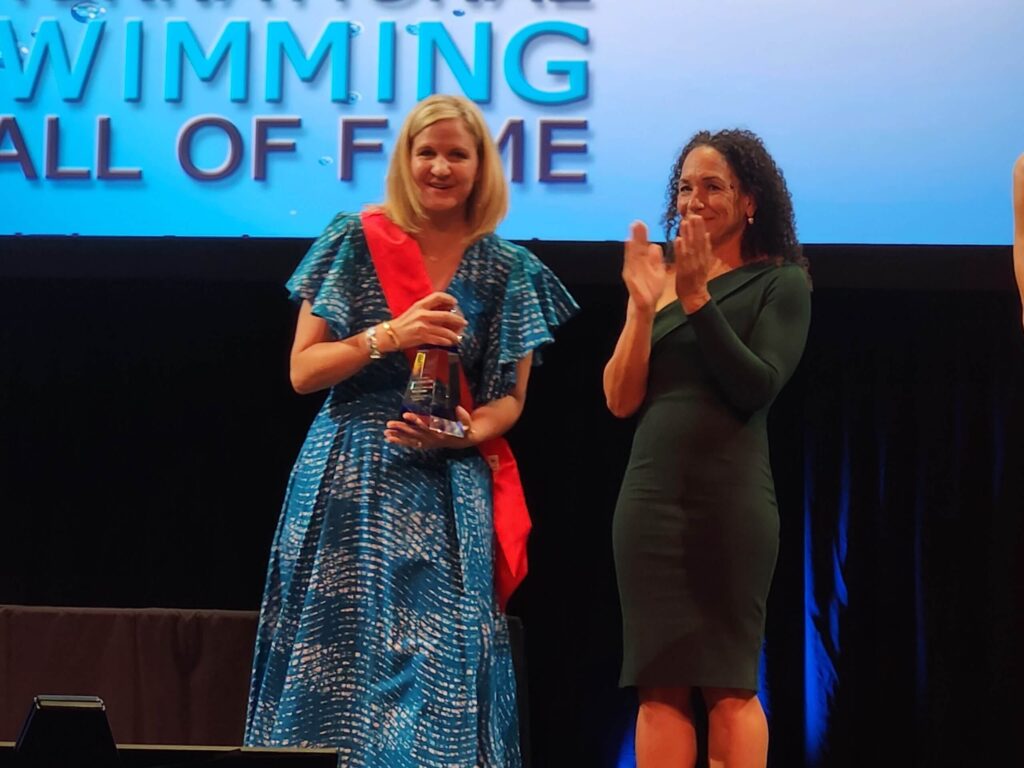
2023 ISHOF Honoree Kirsty Coventry Set to Take Presidency of International Olympic Committee
by Swimming World Editorial Staff
21 June 2025
Kirsty Coventry Set to Take Presidency of International Olympic Committee
In her first major media appearance since being elected President of the International Olympic Committee (IOC), Kirsty Coventry offered a strikingly human portrait of the leader she intends to be: humble, collaborative, and unwaveringly grounded in the values of sport, equity, and Olympism, as she addressed international media during an online open roundtable on Zoom this afternoon.
FIRST WOMAN & AFRICAN Speaking candidly for over an hour, the Zimbabwean reflected on the life journey that brought her from the pools of Harare to the corridors of Olympic power in Lausanne. Her presidency, set to begin officially on Olympic Day, 23 June 2025, will mark a historic moment as she becomes the first woman and first African to lead the IOC.
GROUNDED LEADERSHIP Coventry made it clear that her leadership will not be rooted in authority, but in consensus and a collaborative, human-centred vision: ”In both my personal and professional career, I’ve always had incredible people around me to keep me grounded and humble; those are people whom I will continue to keep around me.”
She added: “Values are at the core of our daily business, they’re incredibly important in today’s communities, and I hold this very close to my heart.”
WHY IOC FORUMS MATTER Replying to a question from Japan’s Wakako Yuki on the role of IOC Forums in attribute Conventry’s vision as president, “I have a vision that I would like to see, but I want to do it in a collaborative way. The Athletes Forum, eSport, Olympism365, the two ASOIF and WOF General Assemblies have been great platforms to listen to people, to hear topics that are important to them.”
SECOND MEDIA ROUNDTABLE IN SIGHT Coventry announced that immediately following the IOC Session on June 23-24, she has invited members to stay for a two-day “pause and reflect” workshop, an opportunity for honest dialogue about the IOC’s challenges and future direction:
“I’ve invited the IOC members to stay two extra days so that I can hear what is on their mind and what they see as our opportunities and what they may see as our challenges, as we move into the future and come up with different ideas. This is the first point in a longer consultation process with all stakeholders, including yourselves as media, where we’ll create another round table where I’ll get to ask you all a bunch of questions. That will strengthen the Olympic movement in a collaborative way.”
VALUES CARRIED TO IOC PRESIDENCY Nadine Hassan from Jordan asked Kirsty, looking back on her journey, from Olympic champion to minister and now IOC President, which moments off the podium had the greatest impact in shaping the person she is today? “I’ll need a moment to properly reflect on this. I think I’d have to go back to my roots. Growing up in Zimbabwe played a huge role. It’s a small community in many ways. We’re a big country geographically, but we’re just 15 million people, and we lean on each other.
“I think that kind of upbringing, maybe a bit more sheltered, surrounded by strong values and close-knit support, helped me understand the importance of having grounded, humble, genuine people around me. And it’s those people who’ve consistently reminded me of where I come from. That’s been one of the most powerful influences throughout my journey.
CHALLENGES, AND DIFFICULT MEN.. New York Times reporter Tariq Panja referenced Coventry’s previous remarks about dealing with “difficult men.” She smiled knowingly and recounted the pressures she faced as a young Olympic medallist representing Zimbabwe during politically turbulent times:
“As athletes, we had a lot of pressure coming from different government officials in Zimbabwe, and you know, it was hard. To look at others and trying to say, I’m an athlete, I don’t believe in the politics in sport. I want to just focus on performing well,” She said, without names mentioned, “Looking back now, it taught me a lot about how to work with people, how to be respectful of differing opinions and still move forward on a shared agenda.”
WOMEN SUPPORT WOMEN USA’s Rachel Axon asked, How has your career been shaped by other women at various career points, adding the gender equality initiatives to your role as female IOC President. Conventry highlighted the women who shaped her path, from her mother and grandmother to her university head swim coach, even Olympic trailblazers like Donna de Varona:
She said, “My grandfather passed away when Mom was in her late teens. And so my grandmother was a single mom for most of her life, with three kids, and both were just incredibly strong women who raised families, and I think my mom’s pretty great, and my uncle and aunt. She did a great job, but she also had a successful career in fashion. My mum got to see her doing that, so she was always an incredible role model for my sister and I.”
She adds: “My swim coach, Kim, who became a Division I coach while her husband was deployed overseas, with two very young kids, watching how she balanced that was inspiring. When we were preparing for the 2004 Olympics, her eldest came to Athens as a baby.. Again, I’ve been fortunate in my life to have very strong women around me who have shown me that it’s possible. It’s not always easy, but it’s possible,” noting her hope to pay that inspiration forward, especially for her two daughters.
AFRICAN HERITAGE A question from China’s Mandan Zhu touched on Coventry’s rich international background and the impact of her African heritage, coming from Harare to Lausanne as a little girl with big dreams,“I can remember exactly where I was standing in my parents’ living room. I was still in my swimsuit, feeling cold after swimming in the pool, only to stand in front of the TV and watch divers compete. I would say that there’s never a dream too big.
“You know, where there is a will to achieve, there’s a way. And don’t let someone talk you out of having that dream of what could be the best thing that happens to you. It’s quite powerful.”
WEIGHT OF BEING ‘FIRST’ British journalist Jamie Gardner asked Coventry about the significance of becoming the IOC’s first female president at this particular moment in history. While she admitted it wasn’t something she initially focused on, the outpouring of messages from women around the world has since left a powerful mark: “I had a coworker tell me that his mum said, ‘Never in my lifetime did I think I’d see a woman lead the movement you work for.’” That moment, she admitted, hit her deeply. “It’s not just an exciting day, it’s a day with a lot of responsibility.”
FROM SYDNEY TO BRISBANE Australia, particularly the Sydney 2000 Games, remains a defining touchstone for Coventry’s Olympic journey. Asked about her journey coming full circle, from a wide-eyed young swimmer at Sydney 2000 to President for Brisbane 2032, Coventry shared a funny tale about struggling to put on her first Speedo sharkskin suit, helped up by none other than Australian legend Susie O’Neill:
“When we arrived in Sydney, I went into the changing room to try my Speedo suit on, and it turned into a total disaster. I had one leg in, was struggling to get the other in, lost my balance completely, and toppled over. Mortifying. Then this amazing person next to me leans down to help, and as I look up, I realise… It’s Susie. I never forget that moment because she was a role model to me, those Games, changed everything for me,” she recalled. “Now I hope Brisbane will show the world the warmth and passion of Australia, and inspire the next generations like Sydney did for me.”
LIFTING VOICES As the media roundtable with IOC President-elect Kirsty Coventry progressed, her clarity of purpose sharpened further. In a movement often shaped by the world’s most powerful nations, Coventry made a point of bringing attention to her roots, and how they shape her priorities: “I come from a much smaller NOC, a developing country,” she said of Zimbabwe. “And I understand the challenges our athletes face. How do we close that gap? How do we ensure that athletes from all walks of life, if not with the same opportunities, at least have equal opportunities?”
Coventry affirms that she intends to elevate voices often left on the margins. Her presidency, she hinted, will focus as much on inclusion as it will on innovation.
LEARNING FROM YOUNG GENERATIONS Perhaps the most poignant reminder of who Coventry is, and who she intends to be as IOC President, came when she spoke about her own children. “They’re a daily reminder of our responsibility to keep sport relevant, and to listen, really listen, to what young people think is important. Kids are honest,” she said with a smile. “And sometimes that’s a very good thing.”
Her two young daughters, she explained, are constant reminders that sport must remain relevant and engaging for younger generations. Despite the gravity of her new role, Coventry remains adamant about keeping her family grounded: “We won’t be staying in the Lausanne Palace. I want my kids to grow up doing the same things I did, making their beds, doing house chores, and just being kids.”
ROAD AHEAD As Kirsty Coventry prepares to officially assume the role on June 23, her message is one of optimism, inclusivity, and integrity. With the weight of history on her shoulders and the wind of lived experience at her back, she is poised not just to lead the Olympic Movement but to reshape it for the modern age, starting by one athlete, one story, one honest conversation at a time.
This press release was distributed by APO Group on behalf of International Sports Press Association (AIPS).
On Juneteenth 2025, we remember “Black Splash: The history of African-American Swimmers”

Happy Birthday Michael Read!!

Michael Read (GBR)
Honor Open Water Swimmer (2011)
The information on this page was written the year of their induction.
FOR THE RECORD: KNOWN FOR MOST OF 26 YEARS (1979-2005) AS KING OF THE ENGLISH CHANNEL (33 CROSSINGS); FIRST TO SWIM 4 WAY LAKE WINDERMERE (42 miles, 26h 3m), HUNSTANTON – SKEGNESS-HUNSTANTON (40 MILES), MORA TO AMPOSTA (SPN) (65 KM) AND ENGLISH CHANNEL SWIM SIX TIMES IN ONE YEAR (1984); COMPLETED CROSSINGS AROUND ISLE OF WRIGHT (60 MILES), LOCH LOMOND (22 MILES), LOCH EURN (16 MILES), LOCK TAY (16 MILES), JEBLE TO LATAKIA SYRIA (25 MILES), EVIAN TO LAUSANNE (25 KM) AND NOEL RIVER INTERNATIONAL; CHANNEL SWIMMING ASSOCIATION (CSA) COMMITTEE (1973) AND CHAIRMAN SINCE 1993; 1960 OLYMPIC TEAM: 4x200m freestyle relay alternate.
Mike Read was an English school-boy butterfly champion who earned a position on Great Britain’s 1960 Olympic Team in the 4×200 meter freestyle relay. But he loved swimming in the open water and between 1960 and 2000, he swam in more than 150 British Long Distance Swimming Association Championships setting more than 25 records. He was the 25 Kilometer Lake Windermere International Champion in 1970 and the first person to swim four lengths of Lake Windermere in succession, a total of 42 miles in 26 hours. In total, Michael Read has completed England’s longest lake Windermere 39 times.
He was only the second person to swim around the treacherous waters of the Isle of Wright, 60 miles in 24 hours 36 minutes. In 1975, he became the first to swim Humstonton to Skegness and return, 40 miles in 16 hours 4 minutes. In 1979, he swam the English Channel six times in one season to capture the title King of the Channel. According to Channel Swimming Association Records, he retains the title today with 33 Channel crossings.
During the 1970’s, the Scottish Lochs became a target including 24 mile Loch Ness at 42°F in 14 hours 24 minutes, as well as Lochs Lomond, Earn, Rannoch and Tay. He was the first to swim from Mora to Amposta, Spain, 65 kilometers. Other swims include lake and sea crossings in Greece, Holland, Italy, Switzerland, Yugoslavia, Egypt, Syria, Turkey, Tunisia and the USA.
In 1978, he was elected Honorary Vice President of the Channel Swimming Association and serves as President today. Mike believes in defending his titles and for over 55 years has done just that.
Happy Birthday Dr. Ferenc Salamon!!

L to R Tom Gompf and Dr. Ferenc Salamon
Dr. Ferenc Salamon (HUN)
Honor Contributor (2019)
The information on this page was written the year of their induction.
FOR THE RECORD: more than 70 YEARS IN WATER POLO : Player, Referee, Administrator; FINA TWPC MEMBER: 1972-2000; LEN WATER POLO COMMITTEE MEMBER: 1970-2004; WATER POLO REFEREE AT EVERY OLYMPIC GAMES FROM 1972, EVERY WORLD CHAMPIONSHIP FROM 1973, EVERY EUROPEAN CHAMPIONSHIP 1970, EVERY FINA WORLD CUP FROM 1979; EXECUTIVE BOARD MEMBER OF HUNGARIAN WATER POLO AND SWIMMING ASSOCIATIONS: 1968-HONORARY MEMBER FOR LIFE
Hungary is a land of thermal springs and although landlocked, swimming and water sports are ingrained in its culture. This love of water led to an early domination of international swimming and diving competitions in the late 19th and early 20th century. In the 1920’s, it was water polo that came to symbolize Hungary’s unique strengths and individuality. So, it was natural for a boy born in 1930 to want to play water polo.
Dr. Ferenc Salamon was a swimmer who started playing water polo late, at the age of 19, in 1949. He was a talented athlete and his development was rapid. In 1952, he joined the Hungarian National Team and was a member of the silver-medal winning team at the World University Games in Paris in 1957. Although Dr. Salamon retired as a player in 1966, he has remained active in water polo for almost 70 years.
Two years after his retirement as a player, he became an internationally certified referee and immediately began officiating all types of competitions, including the 1970 European Championships, 1972 Olympic Games and the very first FINA World Championships in 1973 in Belgrade. He continued officiating major events, such as the European Championships for 34 years, the Olympic Games for 28 years, the World Championships for 26 years and the FINA World Cup for 21 years.
Salamon has served as a member of the European Swimming League Technical Water Polo Committee for 34 years, uninterrupted, from 1970-2004, and has also been a member of the FINA Technical Water Polo Committee for 28 years, from 1972-2000.
During these many years of service, Dr. Salamon’s contributions to the organization have been exemplary and he has been helpful in the various areas of aquatic sports, including organizing, directing, and participating in many world and other international events, tournaments, conferences, clinics and congresses between 1970 and 2004. They include ten Olympic Games, all World and European Championships, FINA World Cups, Youth World Championships, and numerous Olympic and World Championship qualification tournaments during these years.
Salamon is also a Masters Committee Member of FINA and is on the Awards Commission of the European Swimming League. In his role as Masters Committee Member, he participated in the FINA Masters World Championships in the 2014, 2015 and 2017 Games and is also a member of the recent action committee for the upcoming 2019 event.
He has offered numerous proposals, amendments and advice for the technical committee with the intention to improve and further develop the game. Some of his suggestions influenced the entire sport of water polo including the regulation regarding the 55-year age limit for acting referees; introduction of experimental tournaments, and the 1970’s system to supervise officials.
In addition to the many hours he devotes to the sport of water polo, Dr. Salamon is a Chief Hospital Physician. His medical and professional publications appear regularly in the FINA Magazine.
Dr. Salamon was presented the FINA and LEN gold and silver pins for his extraordinary work and dedication to the sport of water polo. He was awarded an Honorary Life Membership in LEN and to the Hungarian Swimming Federation. He has been bestowed with the honors of the Hungarian Sports Award, the Sport of the Hungarian Republic, and the Olympic Award, presented by the Hungarian Olympic Committee.
Today We Remember 1965 Honoree Johnny Weissmuller on His Birthday!!

Johnny Weissmuller (USA)
Honor Swimmer (1965)
The information on this page was written the year of their induction.
FOR THE RECORD: OLYMPIC GAMES: 1924 gold (100m, 400m freestyle; 4x200m freestyle relay), bronze (water polo); 1928 gold (100m freestyle; 4x200m freestyle relay); WORLD RECORDS: 51; U.S. NATIONAL CHAMPIONSHIPS: 52; Played Tarzan in 16 movies.
Johnny Weissmuller holds no current world swimming records and by today’s Olympic standards, you might say he never swam very fast, but you can’t get anyone who ever saw him swim say that there never was a greater swimmer. This was the verdict of 250 sportswriters at A.P.’s mid-century poll and it is still the verdict 15 years later.
He was the swim great of the 1920’s Golden Age of Sports, yet because of the movies and TV, he is as much a part of the scene in the 1960s as he was in the 1920s when his name was coupled with sports immortals such as Babe Ruth, Bill Tilden, Bobby Jones, Jack Dempsey and Red Grange. He is the only one of this group more famous today than in the “Golden Age.”
Weissmuller set many world records and won 5 gold medals in two Olympics (1924 and 1928). He never lost a race in 10 years of amateur swimming in distances from 50 yards to 1/2 mile. Johnny’s 51 seconds 100 yard freestyle record set June 5, 1927, in the University of Michigan Union Pool stood for 17 years until it was broken by Alan Ford at Yale in 1944. The 100 yd. distance is swum more often than any other, yet in 17 years, only one man ever swam it faster. That man was Johnny Weissmuller, who later, as a professional in the Billy Rose World’s Fair Aquacade swam 48.5 at the New York Athletic Club while training Walter Spence to win the nationals. For those who think swimmers must be teenage bobby-soxers, it might be of interest to note that Spence was 35 at the time and Weissmuller was 36.
His record of 52 national championship gold medals should stand forever. He is famous for his chest high crawl stroke seen by millions in Olympic swim stadiums, on movie screens and on TV, but he also held world records in the backstroke and never lost a race in that stroke. “I got bored,” says Johnny, “so I swam on my back where I could spend more time looking around.” Weissmuller set 51 world records in his ten years as an amateur but many more times he broke world records and never turned in the record applications. Every time he swam, the crowd expected a new record, so Johnny learned pace. He learned how to shave his records a tenth of a second at a time. If he missed, his 350 lb. coach Bill Bachrach would say “rest a few minutes, Johnny, and we’ll swim again.” Bachrach would promise his protégé a dinner if he broke the record and Johnny always seemed to be hungry. Many a world mark was set with only a couple of visiting coaches or a few guests of the Illinois Athletic Club to watch.
Every old-timer in swimming has a favorite Johnny Weissmuller story. To them all, he was the world’s greatest swimmer, yet ironically the producer who signed him to play Tarzan didn’t know Johnny could swim. “Many think I turned pro to go into the movies,” Johnny says, “but this is not true. I was working for a bathing suit company for $500 a week for five years, which was not bad money then (or now). I was in Los Angeles and they asked me if I would like to screen test for Tarzan. I told them ‘no thanks’ but they said I could go to the MGM lot and meet Greta Garbo and have lunch with Clark Gable. Any kid would want to do that so I said ‘okay’. I had to climb a tree and then run past the camera carrying a girl. There were 150 actors trying for the part, so after lunch, I took off for Oregon on my next stop for the swim suit outfit. Somebody called me on the phone and said ‘Johnny, you got it.’ ‘Got what?’ ‘You’re Tarzan.’ ‘What happened to those other 150 guys?’ ‘They picked you.’”
“So the producer asked me my name and he said it would never go. ‘We’ll have to shorten it,’ he said. ‘Weissmuller is to long. It will never go on a marquee.’ The director butted in. ‘Don’t you ever read the papers?’ he asked the producer. ‘This guy is the world’s greatest swimmer.’ The producer said he only read the trade papers, but okay, I could keep my name and he told the writers, ‘put a lot of swimming in the movie, because this guy can swim.’”
“So you see why I owe everything to swimming,” Weissmuller says. “It not only made my name, it saved my name. Without swimming, I’d be a nobody. Who ever heard of Jon Weis, marquee or no marquee.”
Besides swimming, Johnny Weissmuller played on two U.S. Olympic water polo teams. “Water polo’s a rough game,” Johnny says. “We never could beat those Yugoslavians. They never blow a whistle over there. Anyhow, that’s where I learned to duck. It came in handy when Cheetah started throwing coconuts.”
1st photo L to R Johnny Weissmuller, Duke Kahanamoku and Buster Crabbe
2nd photo Marshall Wayne, Stubby Kruger, Dick Degner and Johnny Weissmuller
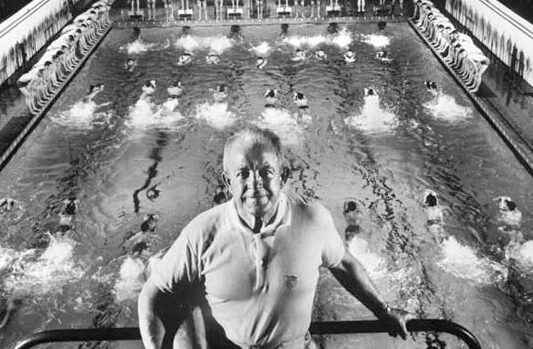
Memorial Day Weekend: How World War II Impacted Yale Coaching Legend and ISHOF Honoree Bob Kiphuth
by Swimming World Editorial Team
26 May 2025
Memorial Day Rewind: How World War II Impacted Yale Great Bob Kiphuth
Editor’s note: We are reposting this great feature by Chuck Warner, originally written as part of a series of articles about the great Yale coach Bob Kiphuth, highlighting a moment in Kiphuth’s career that intersected with the rise of World War II. It fits well with this Memorial Day Weekend to take a look back.
By Chuck Warner
As Coach Bob Kiphuth drove across the George Washington Bridge he might have gazed up and down the Hudson River. The New York City skyline was magnificent in its height as well as breadth. Kiphuth loved grand experiences, which is one of the reasons why the Yale Water Carnival was such a joy for him to produce and direct each year. But in those early years when the new Payne Whitney Gym housed the Carnival it was also a time when the strength of the USA Olympic swimming teams was challenged. Coach Kiphuth was a patriot. He openly expressed his concern that America was too directed toward short course swimming and ill-prepared to race as successfully in a long course pool in international competition.
In 1931 Coach Kiphuth made his first trip to Japan. The passion that the Japanese had for swimming was stunning. They hadn’t begun participating in Olympic swimming competition until 1920, but were earnest in their desire to become more competitive. Nearly every year they invited the best swimmers in the world to perform exhibitions in their country. Johnny Weissmuller made several trips and became a model that Japanese coaches studied endlessly. When Kiphuth took a swimmer to the Japanese pool for an exhibition in 1931, there were 40,000 fans in the stands.
At the 1932 Olympics in Los Angeles a youth brigade from Japan put on one of the most dominating swimming performances in men’s swimming history. Kuzono Kitamura, 14, led a 1-2-3 sweep in the 1500-meter freestyle. Yasuji Miyazaki, 15, teamed with 20-year old Tasugo Kawaishi to finish 1-2 in the 100-meter freestyle. Before they were finished the Japanese men would win five gold medals out of a possible six, five silver medals out of possible six and add another two bronze medals.
What was the secret of the Japanese success? Studies done by Forbes Carlisle show Japanese coaches talking about the advantage of swimming with short strokes and having loose ankles to be good kickers. Weissmuller didn’t swim with short strokes, but their observations about what made a good kick would be applicable today. The greatest discovery the Japanese seemed to have made was the benefits of hard work.
For three months of training each year in Japan, they had swum twice a day covering 6,000-7,500 meters per day. This was an enormous increase from the 400-meter training days that Weissmuller and his coach Bill Bachrach had insisted was optimal. In the context of the 1930s the Japanese showed that work does work.
American Helene Madison led a superb performance by the American women in 1932 in which they won four of the available five gold medals. By the 1936 Games, however, the Netherlands had over taken the Americans to dominate women’s swimming. The Japanese men were not as dominant but still the best in the world in Berlin.
The Olympics in Germany were more than a stage for sport. They were the opening act for World War II, the most widespread war in history. Observing the Olympic track events was German Chancellor Adolf Hitler. Hitler’s anti-Semitic beliefs were well-known and his belief in the superiority of the German and Aryan racial superiority was being challenged by the performance of Jesse Owens in track and field. Owens was an African-American who eventually won four gold medals. But it was his second one that might have been the most remarkable. While Hitler looked on, German Luz Long was positioned to beat Owens for the gold medal in the long jump. Owens had faulted on his first two jumps taking off past the wooden plank on the track that marked the appropriate takeoff point. In a show of what has long been held as the ‘true Olympic spirit,’ Long took a towel and laid it down a few inches or so before the wooden plank. Owens used the towel cue, performed legally and won the long jump.
Long was the first to greet Owens after the win. Owens’ long jump world record stood for nearly 24 years. The two athletes maintained a friendship until Long was killed in World War II.
In 1937 the Japanese emperor invaded China. In 1939 Germany invaded Poland. The war was on.
More than 100 million people joined and fought in the military over the next six years during the awful ordeal. One was Yale’s Dick Baribault. Baribault was a member of Yale’s record-setting 4 x 100 freestyle relay when he enlisted into the United States Air Force. Why enlist? He believed in the cause of defeating Hitler, but it was also evident that he would be drafted to fight. By enlisting there was a chance to choose your military branch of service.
“Your best chance to survive was to stay away from the land battles that the Army would be engaged in,” Dick said years later. Eventually he returned to Yale to swim. “After machine gun battles in the air against the Germans, nothing Kiphuth had us do in training scared me.”
The 1940 and 1944 Olympics were canceled due to the War. The Japanese were banned from participating in the 1948 Games opening the door for the most dominant performance by an Olympic men’s team in history. The head coach for the USA in 1948? The man steering his car down the New Jersey Turnpike in the direction of Washington D.C.: Robert John Herman Kiphuth.
Story help from the work of Pete Kennedy and Forbes Carlisle.
A Week of Katie Ledecky Stats (Day Four): Distance Ace Has Made Sub-4:00 Her Home in 400 Freestyle

by John Lohn – Editor-in-Chief
14 May 2025,
A Week of Katie Ledecky Stats (Day Four): Distance Ace Has Made Sub-4:00 Her Home in 400 Freestyle
In recognition of Katie Ledecky lowering her world record in the 800-meter freestyle to 8:04.12, Swimming World continues its Week of Katie Ledecky Statistics. Each day for a week, we are running a short piece that highlights Ledecky-related stats, numbers that place additional context on her legendary career.
There’s no debate that the 800-meter freestyle and 1500 freestyle are recognized as Katie Ledecky’s premier events, with the 400 freestyle solidly slotted in the No. 3 position. Since capturing Olympic gold in the 400 freestyle at the 2016 Games in Rio de Janeiro, Ledecky has been eclipsed in the discipline by Ariarne Titmus. The Australian ace has won the past two Olympic titles, with Ledecky earning silver and bronze in Tokyo and Paris.
Yet, Ledecky remains the most-decorated female in terms of sub-4:00 performances, a time that has been cracked by only five women in history – Federica Pellegrini, Ledecky, Titmus, Summer McIntosh and Erika Fairweather. Of the 56 all-time marks under four minutes, 31 belong to Ledecky. That total accounts for 55.35% of the historical sub-4:00 efforts. Next on the list is Titmus with 13 trips under four minutes, followed by McIntosh with nine.
Ledecky’s personal best in the 400 freestyle sits at 3:56.46, her winning time in the Olympic final in Rio. Earlier this month, she clocked the second-fastest time of her career, a 3:56.81 showing at the TYR Pro Series in Fort Lauderdale. Ledecky has been sub-4:00 at least once in 13 consecutive years, a streak that began in 2013.
Great Races: When Jim Montgomery and Jonty Skinner Broke a Special Barrier – A Unique Summer Pursuit Of Sub-50

by John Lohn – Editor-in-Chief
26 April 2025
When Jim Montgomery and Jonty Skinner Chased Sub-50: A Unique Summer Pursuit
Swimming World’s Great Races Series has featured numerous duels between star athletes. In this edition, Jim Montgomery and Jonty Skinner engaged in a great race, albeit one in separate pools.
The most iconic barrier-breaking performance in sports history is not difficult to decipher. It is the 3:59.4 mile run by Great Britain’s Roger Bannister in 1954, marking the first time the four-minute threshold was eclipsed. The effort captured the attention of the world and opened the imagination of what was possible in an athletic endeavor.
Fourteen years later, American sprinter Jim Hines produced another legendary outing, as he became the first man to officially cover the 100-meter dash in under 10 seconds. The speed Hines displayed in 1968 handed him the gold medal in the event at the Olympic Games in Mexico City.
From the equine world, Secretariat is celebrated as the greatest racehorse of all-time and used the 1973 Kentucky Derby to put on a show that remains unmatched. Running 1:59.40 at Churchill Downs, Big Red – as he was known – became the first horse to crack the two-minute barrier in the Derby, which is run on a 11⁄4-mile track. His Triple Crown was completed several weeks later, when he delivered his epic run at the Belmont Stakes
In the pool, breaching the 50-second barrier in the 100-meter freestyle became a major storyline of 1976. The men at the center of the chase, American Jim Montgomery and South African Jonty Skinner, never met during that Summer of Speed, as politics kept them apart. Nonetheless, they engaged in an entertaining, albeit long-distance, duel.
The 100 freestyle has long been considered swimming’s blue-ribbon event, and the territory of some of the sport’s legends. Duke Kahanamoku, Johnny Weissmuller, Don Schollander and Mark Spitz, to name a quartet, won Olympic gold in the two-lap discipline. More, Weissmuller was the first man to break the one-minute barrier, accomplishing the feat in 1922. Over the next half-century, the record continued to dip, to the point where sub-50 became a legitimate possibility midway through the 1970s.
In most eras, the Olympics bring together the best competitors an event has to offer. However, that was not the case at the 1976 Games in Montreal, where a key figure was missing from the pool deck. Four years before President Jimmy Carter infused politics into sports by leading a United States boycott of the 1980 Olympics in Moscow, politics played a role in the 1976 Games.
Due to its apartheid policies, South Africa was banned from the Olympic Games by the International Olympic Committee in 1964, a restriction that lasted until the 1992 Games. Caught in the middle of his country’s segregation practices, which he did not support, was Skinner, one of the world’s premier sprint freestylers.
Competing collegiately for the University of Alabama, Skinner established himself as an NCAA and United States national champion in the 100 freestyle. As much as Skinner might have been detached from his homeland and apartheid, his citizenship – based on IOC rule – made Skinner ineligible to compete on the biggest stage in sports. It was a hand Skinner was forced to accept, and it also dealt a blow to the depth of the 1976 Games. Without Skinner, Montgomery raced the clock, and not a rival who would have raised the level of competition.
As he prepared for the Montreal Games, Montgomery was a well-known commodity. In 1973, Montgomery flourished as a member of Team USA at the inaugural World Championships. In Belgrade, Yugoslavia, Montgomery earned gold medals in the 100 freestyle and 200 freestyle, and helped the United States win three relay titles.
Following the World Champs, Montgomery joined the power program of Indiana University, which was guided by Hall of Fame coach Doc Counsilman. As a Hoosier, Montgomery captured three individual NCAA titles and developed into an Olympian, thanks to Counsilman’s influence. Although Montgomery exhibited natural ability before working with Counsilman, the coach enabled Montgomery to hone his mental approach.
Jim Montgomery
Ahead of the Olympics in Montreal, Counsilman convinced the men’s team that it could establish itself as the greatest team in history. Indeed, that is what Team USA accomplished, as it won 12 of the 13 events and swept the podium in four disciplines.
“He’s the smartest guy I’ve ever known in my entire life,” Montgomery said of Counsilman. “Just sheer brain power. And he had a sense of humor. He just put it right on the plate. ‘We’re going to absolutely dominate. That’s my goal, and that’s my goal for you guys.’”
Montgomery personally accepted Counsilman’s challenge.
Coming off a bronze medal in the 100 freestyle from the 1975 World Championships, Montgomery elevated his performances in Montreal, a fact that was evident during the semifinals of the 100 freestyle. Erasing any doubt over who was the favorite for gold, Montgomery blistered a world record of 50.39, a mark which was nearly more than a second faster than the No. 2 seed, Italian Marcello Guarducci (51.35). Montgomery’s dominance allowed he and Counsilman to experiment in the final.
“After the prelims, we figured we had the race pretty much won,” Counsilman said. “So we risked it. We swam the race to break the record by going out harder. We figured that even if he died a little coming home, he’d still have enough to win.”
Montgomery and Counsilman were not just concerned with lowering the world record. The final was about taking Montgomery into – pardon the pun – uncharted waters. A sub-50 performance was within reach and producing a readout on the clock that started with a “4” was an enticing opportunity.
As a member of a squad that was obliterating the opposition, there was a competition within a competition of sorts for Team USA. Who could produce the most memorable performance? For that honor, the battle primarily came down to Montgomery and John Naber, the University of Southern California star who won the 100 backstroke and 200 backstroke events in world-record time. Montgomery, though, had the extra power of delivering a barrier-breaking outing.
The bronze medal Montgomery claimed in the 100 freestyle at the 1975 World Champs also served as motivation. During 1974 training, Montgomery and Counsilman toyed with a workload that was more geared toward the middle-distance events. Ultimately, it cost Montgomery some of his pop in his main event, but the error was better realized at the World Champs, rather than the Olympics. By the time Montreal called, Montgomery was in peak form and possessed lofty target times.
“I thought realistically I could swim 49.4 or 49.5,” Montgomery said. “I had some relay splits that were that fast at that time, and back then we didn’t have the fancy relay starts they do now. If I didn’t have that training failure in 1974, I wouldn’t have become Olympic champion. I was stronger and handled the power training necessary for the 100 free.”
The confidence brewed by Counsilman in Montgomery was clear from the start in the final as the 21-year-old bolted to the front of the field and held a half-body-length lead at the turn. Coming off the wall in 24.14, the question wasn’t whether Montgomery would win the race, but if he could join Bannister and Hines as a barrier breaker. Indeed, Montgomery was given access to the club by the slimmest of margins, the scoreboard flashing 49.99. Countryman Jack Babashoff followed in the silver-medal position, well behind in 50.81.
“This will put Montgomery in the Swimming Hall of Fame,” Counsilman said. “I think this is the last barrier in swimming. We broke one minute in the 100 freestyle 50 years ago, and I don’t think we are going to break 40 seconds. So this is it, at least for a long time. I thought it was the best swim of the Olympics, and we’ve had some good swims.”
Counsilman was prophetic in his statement, as Montgomery was enshrined into the International Swimming Hall of Fame as a member of the Class of 1986. While Montgomery’s profile obviously highlights his gold medal, it also references his barrier-breaking identity and place in history alongside Bannister.
Jonty Skinner – Photo Courtesy: Amelia B. Barton
As monumental as it was, Montgomery’s world record and solo status in the sub-50 club was short lived. Without the opportunity to race at the Olympics, Skinner identified the Amateur Athletic Union National Championships in Philadelphia as his focus meet for the summer. Scheduled for three weeks after the Olympics, the competition lacked the firepower present in Montreal, but Skinner wasn’t really racing the men in the adjacent lanes in Kelly Pool. Instead, Skinner was racing the clock and Montgomery.
Before settling on Philadelphia as the stage for his personal Olympics, an attempt was made to get Skinner American citizenship in time to compete at the United States Olympic Trials. A petition with more than 50,000 signatures was sent to Washington, D.C. and Representative Walter Flowers, a democrat from Alabama, introduced a bill to Congress – HR 12257 – that would award Skinner citizenship in time to compete at Trials. Alas, the push on Skinner’s behalf fell through, leaving him as a spectator to the Montreal Games.
“I really had no issues with not being there since I was focused on Philly,” Skinner said. “It ticked me off that (Montgomery) 50, and that is what fueled me the last few weeks getting ready. I had focused on breaking 50 as a season goal, so when (Montgomery) went 49.9, I adjusted to 49.8. I wasn’t nervous at all. I did a lot of visualization to prepare, so I was ready in my mind.”
Racing alone or without rivals to push the pace is not an easy chore, but Skinner had plenty of motivation. Despite besting the field by more than two seconds, Skinner relented. He went out in 23.83, .31 quicker than the split of Montgomery, and he came home slightly quicker as well. At the touch, Skinner produced a time of 49.44 to shave .55 off Montgomery’s performance from the Olympic Games.
Although an Olympic medal was not draped around Skinner’s neck, the moment was as meaningful. He had an opportunity taken from him for no fault of his own, but Skinner turned his situation into a positive. His world record was so impressive, it last nearly five years, until Rowdy Gaines clocked 49.36 in April 1981. As impressive, Skinner’s time would have won Olympic gold in 1980 and 1984 and would have earned the bronze medal at the 1988 and 1992 Games.
“Coach, I did it,” said Skinner to his coach at the University of Alabama, Don Gambril. “Since I couldn’t swim against (Montgomery), my opponent had to be the clock. I just kept telling myself, ‘This is your only chance. Don’t blow it.’”
Linked by the Summer of 1976, Montgomery and Skinner have remained involved in the sport in prominent ways. Montgomery followed his Olympiad by winning the silver medal in the 100 freestyle at the 1978 World Championships and, following a brief retirement, started training for the 1980 Olympic Trials, a pursuit that ended when the American boycott of the Moscow Games was announced. Montgomery eventually shifted into Masters competition and has operated swim clubs and swim schools.
As for Skinner, who was inducted into the Hall of Fame in 1985, he took his skills in the water to the deck and a coaching career. Skinner served as the first coach of USA Swimming’s Resident National Team at the United States Olympic Training Center and later held the role of USA Swimming’s Director of Performance Science and Technology. The latter role is one he also held for British Swimming. Before retiring in 2020, Skinner returned to the college ranks, serving as an assistant coach for the University of Alabama, and then Indiana University.
“I could always talk from experience when it came to helping swimmers prepare for peak-level events,” Skinner said of the transition from elite athlete to coach. “I very rarely talked about (his world record in Philadelphia), but the athletes knew my background, so they trusted my opinions.”
Montgomery and Skinner each had his moment to shine, and history looks back favorably at each career. Montgomery will always have his Olympic gold medal. Skinner will always have his day, Aug. 14, 1976, as proof of overcoming disappointment and factors beyond one’s control. There is room to honor both men.
“The Olympics were one day, and this was another,” Skinner said. “But I hope Jim was watching me on TV.”