
On this day in 1932, the great Ohio State Diver, Don Harper was born…….

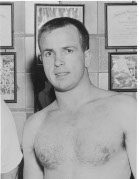
Don Harper (USA) Honor Diver
FOR THE RECORD: 1956 OLYMPIC GAMES: silver (3m springboard); 1959 PAN AMERICAN GAMES: silver (10m platform); FIVE U.S. NATIONAL CHAMPIONSHIPS: 1955, 1959 (outdoor 3m springboard), 1956, 1958 (indoor 3m springboard), 1957 (indoor 1m springboard); THREE NCAA CHAMPIONSHIPS: 1956, 1958 (3m springboard), 1958 (1m springboard), SEVEN NATIONAL A.A.U. CHAMPIONSHIPS 1955, 1959 (outdoor 3m springboard), 1956, 1958 (indoor 3m springboard), 1959, 1960 (indoor 1m springboard), 1961 (10m platform).
As the record books show, only Mexico’s Joaquin Capilla and Juan Botella could match the divers of the USA during the 1950’s. Many of those U.S. divers competed for Hall of Fame Coach Mike Peppe at Ohio State University Teams. At one time in the 1950’s, the Ohio State University had 17 National Champion divers. Team competition was fierce and always brought out the best in each athlete. No exception to this rule was Don Harper, National AAU and NCAA Champion 11 times in springboard diving and trampoline. Springboard diving and trampoline complimented one another and trampoline was an NCAA sport during the 1950’s. In 1956 and 1958, Harper became the only athlete in NCAA history to win national championships in two different sports in the same season.
Don enrolled at Ohio State in 1953 and during his tenure received Bachelor, Master and Doctorate degrees in the field of physical education, health and physiology. He was an excellent student and a motor genius when it came to applying mechanical techniques to his diving and acrobatic trampoline routines. He was one of the first divers to apply a mechanical approach to his dives. As the national trampoline champion, he would strap a video camera to his chest while performing spins and somersaults. He would then apply what he saw on the film to his dives on the board, creating a mental picture and imitating the move.
In 1955, at the Pan American Games in Mexico City, he won the gold medal on the trampoline, unofficially becoming the first World Champion since this was the first international competition in trampoline. Earlier in the year he had already won 4 major diving contests in Japan, on both the springboard and platform, at meets in Tokyo and Osaka. The following year, 1956, Don had victories at the Big10, NCAA and AAU Championships in 3m springboard competition. He qualified first at the 1956 U.S. Olympic Trials. Traveling with a strong American contingent to the Olympics at Melbourne, he was narrowly out-scored by teammate Bob Clotworthy, receiving the silver medal in 3m springboard competition.
Don continued diving for another five years, winning at least one major national championship each of those years. He won another USA vs. Japan Duel Meet in 1959 and silvered on the 10m platform in the Chicago Pan American Games that same year.
As a retired diver, he was a positive influence on the development of other divers and traveled throughout the world, at the invitation of international diving federations, to conduct clinics and tours. Dr. Harper remained at Ohio State University as a professor of physiology, sharing his qualities as an elite athlete.
James Heatly, Grandson of Sir Peter Heatly, 2016 ISHOF Honoree and Olympic Diver, makes the Great Britain 2020(1) Olympic Team, 69 years after his grandfather !!!


JAMES HEATLY MAKES 2020(1) OLYMPIC TEAM 69 YEARS AFTER HIS GRANDFATHER, PETER HEATLY MADE THE TEAM IN THE SAME SPORT, DIVING……..IN THE 1948 and 1952 OLYMPIC GAMES. CONGRATULATIONS JAMES AND GOOD LUCK!!!
Interesting story coming from our friend, Peter Heatly in Edinburgh, Scotland. Peter’s Dad, Sr. Peter Heatly is an Honoree at ISHOF, a 2016 Honor Contributor.
Sir Peter’s grandson, (and Peter’s Nephew) has just been selected to represent Great Britain in the 2020(1) Olympic Games as a Diver.
See post below from Peter:
“He’s made it! Congratulations to my nephew James Heatly who has been selected to compete for Great Britain at the Olympic Games in Tokyo. Congratulations also to his Mum and Dad and brothers Ross and Craig (a family effort), Coach Jen Leeming, and many others that have contributed to James’ success (you know you are). We are all very proud of James and the hard work he has put in over many years has been rewarded. There will be someone special looking down on James with pride and he will be delighted that his Grandson is going to emulate what he did in 1948 and 1952. Yes, James will become an Olympian 69 years after his Grandpa.”

James with Grandfather, Sir Peter Heatly at 2014 Commonwealth Games
Read the article from Scottish Swimming here:
To read more about Sir Peter Heatly, Click here:
https://ishof.org/sir-peter-heatly.html

Coach Ursula Carlile to be Inducted into the International Swimming Hall of Fame Among Four Aussies In Class of 2021

For more than half a century, Ursula Carlile, teamed up with her husband, Forbes, to form swimming’s first internationally-prominent husband and wife coaching team. The two collaborated at every level of the sport by sharing teaching, coaching, filming and administrative duties at their own Ryde Swim Club. The club originated in a backyard pool of their home in the Sydney suburb of Ryde. The pool is still there today! There they taught thousands of youngsters to swim and have coached some of Australia’s most celebrated Olympians.

Ursula and Forbes Carlile Photo Courtesy:
Ursula Carlile began her international coaching career in the Netherlands, where she and Forbes co-coached the Dutch National team from 1962-64 and where she was the Dutch Olympic Co-Head Coach with her husband. In the following decade, the husband and wife team made frequent periodic visits to the People’s Republic of China, working with China’s top coaches and national team. In 1980, the Carliles were named Honorary Olympic Coaches for China.
Ursula Carlile Photo Courtesy:
Come and meet Carlile in person and hear his incredible life story at the ISHOF Induction dinner on Saturday, October 9, 2021. Become an ISHOF Legacy Member and attend the ISHOF Induction Dinner for FREE. Can’t attend the event? Please consider donating to ISHOF, support Ursula and our other inspirational Honorees.
More about Ursula Carlile:
In 1972, Ursula became Australia’s first female Olympic swimming coach when she was selected as an assistant coach to Don Talbot, for the Munich Games. She served as an assistant to Terry Gathercole the next year at the World Championships, held in Cali, Colombia. In 1974, she was selected as Australia’s first female Head Coach for the Commonwealth Games, held in Christchurch, New Zealand. In yet another sterling accomplishment, during the 1970’s and ’80’s, she and Forbes coached five Olympians – all of them world record-holders: Karen Moras, Shane Gould, Jenny Turrall, Gail Neal and John Bennett.
In the days when Forbes Carlile could not secure official staff selection to the Australian Olympic team, it was Ursula Carlile who accompanied Gould as chaperone at the Munich 1972 Games. Forbes was there in a commentator’s position with the media as Gould raced to what remains a record five-medal haul in solo events among women, her three golds secured with World records, a silver and a bronze completing a unique collection for a a pioneering pantheon. Gould is Dr. Shane Gould these days.
A Life Member of the Australian Swimming Coaches and Teachers Association, Ursula Carlile lectured frequently around the world until lately. Forbes, pioneer of the pace clock and several aspects of swimming science, entered the Hall of Fame in 1976. He passed away on the eve of the Rio Olympic Games in 2016.
Ursula Carlile and swimmers at Ryde Swim Club, Sydney, Australia Photo Courtesy:
About the International Swimming Hall of Fame Induction Weekend:
The International Swimming Hall of Fame (ISHOF) Induction Ceremony is shaping up to be a star-studded weekend with ISHOF Honoree and Sullivan Award Winner, Debbie Meyer, and double Olympic gold-medalist and everyone’s favorite Olympic swimming broadcaster, Rowdy Gaines acting as co-emcees and hosts of the induction with multiple events spread out over two days in beautiful Fort Lauderdale, Florida.
Make your plans now to attend the weekend of October 8-9, 2021! ISHOF Members can purchase the Complete Weekend Package (see below) and save! (Get info on membership here.) Can’t attend the event? Donate to ISHOF to support our honorees.
This year’s International Swimming Hall of Fame Honorees include:
HONOR SWIMMERS: Brendan Hansen (USA), Michael Klim (AUS), Jon Sieben (AUS), Rebecca Soni (USA), and Daichi Suzuki (JPN)
HONOR DIVER: Matthew Mitcham (AUS)
HONOR SYNCHRONIZED (ARTISTIC) SWIMMER: Elvira Khasyanova (RUS)
HONOR WATER POLO: Mirko Vičević (YUG/MON)
HONOR OPEN WATER SWIMMER: Marilyn Bell (CAN)
HONOR COACH: Ursula Carlile (AUS) and David Marsh (USA)
HONOR CONTRIBUTOR: Bob Duenkel*(USA) and Peter Hürzeler (SUI)
In addition to the Class of 2020, two Honorees from the Class of 2019, who were unable to attend last year, will be present to be inducted. Honor Swimmer: Otylia Jedrzejczak (POL) and Honor Diver: Li Ting (CHN).
Get more information about this year’s induction class here and more information about Otylia Jedrzejczak and Li Ting.
*deceased
The Induction Weekend Schedule
Friday, October 8, 2021
Paragon & ISHOF Awards Night
5:30 pm Cocktails
6:30 pm ISHOF and Paragon Awards
Saturday, October 9, 2021
Honoree Induction Day Luncheon – Meet Rowdy Gaines and go on a behind the scenes tour of the Aquatic Complex construction
12-1:30 pm Luncheon
Official 56th Annual International Swimming Hall of Fame Induction Ceremony and Dinner
5:30 pm VIP Reception
6:30 –10:00 pm Induction Ceremony & Dinner
Ticket Information
October 8-9th Complete Weekend Package (Includes Paragon/ISHOF Awards Night, Saturday Luncheon, and Induction Ceremony)
ISHOF Members $350
ISHOF Non-Members $425 BEST PRICE!!
October 8th Paragon Awards and ISHOF Awards Night (Hors D’oeuvres and Open Bar) 5:30 pm
ISHOF Members $75
ISHOF Non-Members $100
October 9th Saturday Luncheon 12:00-1:30 pm
ISHOF Members $35
ISHOF Non-Members $50
October 9th Induction Ceremony and Dinner5:30 pm
ISHOF Members $275
ISHOF Non-Members $300
10 Person Table $3,500 and $5,000 (Prime location) options
*See all ticket options here.
HOTEL INFORMATION
Host Hotel: Fort Lauderdale Marriott Harbor Beach Resort & Spa
Upscale retreat with private beach access, two pools, four restaurants, full service spa and oceanside bar. Location of the Saturday evening induction ceremony. ¼ mile south of the International Swimming Hall of Fame.
3030 Holiday Drive, Ft. Lauderdale, FL 33316 (954) 525-4000
Special ISHOF Guest Rate of $259 per night
Book your group rate for International Swimming Hall of Fame
NOTE: RESORT FEE IS INCLUDED in the $259 rate
Courtyard by Marriott Fort Lauderdale Beach
440 Seabreeze Blvd., Ft. Lauderdale, FL 33316 (954) 524-8733
Special ISHOF Guest Rate of $169 per night
Honoree Ceremony October 9, 2021Start Date: Wednesday, October 7, 2021End Date: Tuesday, October 12, 2021Last Day to Book: Friday, September 15, 2021
Book your group rate for Honoree Ceremony October 2021
Questions: contact Meg Keller-Marvin at meg@ishof.org or 570-594-4367
Jimmy Tierney Joins ISHOF’s One in a Thousand Campaign, “I’ve Aways Been Enthralled With Swimming History”


by ANDY ROSS
01 June 2021, 06:42pm
McKendree head coach Jimmy Tierney has joined the One in a Thousand campaign, which is designed to help the Hall of Fame prosper during the COVID-19 pandemic.
“I’ve always been enthralled with swimming history since I was a young swimmer,” Jimmy Tierney said. “The Hall of Fame is the caretaker of the history of our sport and the center of all of that. Monuments, articles, equipment and apparel were all things that attracted me to go down there and visit and soak up all that history. I have always loved that kind of stuff and it’s the same in any sport for me. I love reading about the history of the great people that have left their mark on the various sports.
Jimmy Tierney, while at Northwestern, with sister Dorsey at 2011 Nationals. Photo Courtesy: Peter H. Bick
“I remember my early days of going to the Hall of Fame in the early 80s – I was an age group coach at Lakeside Swim Club in Louisville and I started at some juniors and zones meets there and I loved the environment. I loved the closeness to the ocean and the sunshine that made that a very special place to have big meets. When I was there, we would go through the Hall of Fame and look at different things and try to find something new that maybe I didn’t know before.
Erik Vendt and Michael Phelps at the Hall of Fame pool in 2002. Photo Courtesy: George Olsen / Swimming World Archive
“I even had one of my favorite races of all-time from the pool down there which was the 400 IM between Michael Phelps and Erik Vendt at the 2002 Nationals. I bring that up to other coaches and other people have a similar feeling about that race. That has always been a special place from the swimming side, too.
“In my eyes, on the national scene it was the first time (Phelps) had unleashed that underwater kick on that last wall. I just remember the reaction of the crowd was stunned and it brought a huge roar from the crowd. Erik is such a tough competitor and racer and I just thought that was such a great battle. To have it down there in that iconic venue and have it be outdoors – it was great theater for our sport.”
“I have always been a fan of the Hall of Fame and I saw this as an opportunity that I could help in some small way and contribute to keeping that institution thriving and more successful in years to come.”
Jimmy Tierney had planned on attending the Hall of Fame induction of his long-time friend David Marsh in April 2020, but with the ceremony being postponed to October 2021, he will be unable to attend, but is still proud of his friend for getting the honor.
“I was thrilled,” Tierney said. “It was only a matter of time before he was going to get inducted into the illustrious group of coaches that are in the Hall right now. We have been friends for decades and I just was wanting to be there and share it with him and his family and we had several coaching friends that were going to go down and make a weekend out of it and be a part of the festivities. I’m excited for him and proud to be a friend and a colleague.
“Hopefully if others down the road can get inducted then I’ll be able to make it down but it’s a terrific honor for him and he has been one of our leaders in success nationally and internationally for quite a bit of time now. It’s definitely time for him to be honored for everything he has done for the sport.”
Jimmy Tierney has been the head coach of Division II McKendree in Lebanon, Illinois, since building the program from the ground up in the fall of 2016. In 2020, his men’s team was leading the NCAA championships after day 1 before the meet was cancelled and was never concluded. His swimmers won the Division II NCAA title in the 200 medley relay in 2020 as well as Fabio Dalu in the 1000, who broke the NCAA Division II record in the 1000 and 1650 in 2021.
Join the One in a Thousand Club by helping ISHOF on a monthly or one-time basis.
$10 Monthly Commitment
$25 Monthly Commitment
$50 Monthly Commitment
Make a One-Time Commitment
For larger corporate sponsorships and estate-planning donations, please contact us at customerservice@ishof.org.
The International Swimming Hall of Fame wants to know if you are one in a thousand? We think you are! Show how special you are and become a member of the International Swimming Hall of Fame’s “One In A Thousand” Club. Help keep the International Swimming Hall of Fame moving forward toward a new vision and museum by joining now!
During these unprecedented times, the ISHOF Board is calling on every member in the aquatic community to make a small monthly commitment of support to show how special you are and how special the International Swimming Hall of Fame is to everyone.
“Our goal is simple. If we get 1,000 people to simply commit $10, $25 or $50 per month, we will generate enough revenue to go beyond this Covid-19 Pandemic Crisis.” – Bill Kent – Chairman of the ISHOF Board
“Those that believe in our vision, mission, and goals can join us in taking ISHOF into the future and be a part of aquatic history.” – Brent Rutemiller – CEO and President of ISHOF
Since 1965, ISHOF has been the global focal point for recording and sharing the history of aquatics, promoting swimming as an essential life-skill, and developing educational programs and events related to water sports. ISHOF’s vision for the future is to build a new museum and expand its reach by offering its museum artifacts digitally through a redesigned website.
The ISHOF Board of Directors is calling on all members of the aquatics community to make a small monthly commitment to show their dedication to aquatics and how special the International Swimming Hall of Fame is to everyone.
Happy Birthday Johnny Weissmuller!!!

JOHNNY WEISSMULLER (USA) 1965 Honor Swimmer
FOR THE RECORD: OLYMPIC GAMES: 1924 gold (100m, 400m freestyle; 4x200m freestyle relay), bronze (water polo); 1928 gold (100m freestyle; 4x200m freestyle relay); WORLD RECORDS: 51; U.S. NATIONAL CHAMPIONSHIPS: 52; Played Tarzan in 16 movies.
Johnny Weissmuller holds no current world swimming records and by today’s Olympic standards, you might say he never swam very fast, but you can’t get anyone who ever saw him swim say that there ever was a greater swimmer. This was the verdict of 250 sportswriters at A.P.’s mid-century poll and it is still the verdict 15 years later.
He was the swim great of the 1920’s Golden Age of Sports, yet because of the movies and TV, he is as much a part of the scene in the 1960s as he was in the 1920s when his name was coupled with sports immortals such as Babe Ruth, Bill Tilden, Bobby Jones, Jack Dempsey and Red Grange. He is the only one of this group more famous today than in the “Golden Age.”
Weissmuller set many world records and won 5 gold medals in two Olympics (1924 and 1928). He never lost a race in 10 years of amateur swimming in distances from 50 yards to 1/2 mile. Johnny’s 51 seconds 100 yard freestyle record set June 5, 1927, in the University of Michigan Union Pool stood for 17 years until it was broken by Alan Ford at Yale in 1944. The 100 yd. distance is swum more often than any other, yet in 17 years, only one man ever swam it faster. That man was Johnny Weissmuller, who later, as a professional in the Billy Rose World’s Fair Aquacade swam 48.5 at the New York Athletic Club while training Walter Spence to win the nationals. For those who think swimmers must be teenage bobby-soxers, it might be of interest to note that Spence was 35 at the time and Weissmuller was 36.
His record of 52 national championship gold medals should stand forever. He is famous for his chest high crawl stroke seen by millions in Olympic swim stadiums, on movie screens and on TV, but he also held world records in the backstroke and never lost a race in that stroke. “I got bored,” says Johnny, “so I swam on my back where I could spend more time looking around.” Weissmuller set 51 world records in his ten years as an amateur but many more times he broke world records and never turned in the record applications. Every time he swam, the crowd expected a new record, so Johnny learned pace. He learned how to shave his records a tenth of a second at a time. If he missed, his 350 lb. coach Bill Bachrach would say “rest a few minutes, Johnny, and we’ll swim again.” Bachrach would promise his protégé a dinner if he broke the record and Johnny always seemed to be hungry. Many a world mark was set with only a couple of visiting coaches or a few guests of the Illinois Athletic Club to watch.
Every old-timer in swimming has a favorite Johnny Weissmuller story. To them all, he was the world’s greatest swimmer, yet ironically the producer who signed him to play Tarzan didn’t know Johnny could swim. “Many think I turned pro to go into the movies,” Johnny says, “but this is not true. I was working for a bathing suit company for $500 a week for five years, which was not bad money then (or now). I was in Los Angeles and they asked me if I would like to screen test for Tarzan. I told them ‘no thanks’ but they said I could go to the MGM lot and meet Greta Garbo and have lunch with Clark Gable. Any kid would want to do that so I said ‘okay’. I had to climb a tree and then run past the camera carrying a girl. There were 150 actors trying for the part, so after lunch, I took off for Oregon on my next stop for the swim suit outfit. Somebody called me on the phone and said ‘Johnny, you got it.’ ‘Got what?’ ‘You’re Tarzan.’ ‘What happened to those other 150 guys?’ ‘They picked you.’”
“So the producer asked me my name and he said it would never go. ‘We’ll have to shorten it,’ he said. ‘Weissmuller is to long. It will never go on a marquee.’ The director butted in. ‘Don’t you ever read the papers?’ he asked the producer. ‘This guy is the world’s greatest swimmer.’ The producer said he only read the trade papers, but okay, I could keep my name and he told the writers, ‘put a lot of swimming in the movie, because this guy can swim.’”
“So you see why I owe everything to swimming,” Weissmuller says. “It not only made my name, it saved my name. Without swimming, I’d be a nobody. Who ever heard of Jon Weis, marquee or no marquee.”
Besides swimming, Johnny Weissmuller played on two U.S. Olympic water polo teams. “Water polo’s a rough game,” Johnny says. “We never could beat those Yugoslavians. They never blow a whistle over there. Anyhow, that’s where I learned to duck. It came in handy when Cheetah started throwing coconuts.”

Happy Birthday Giorgio Cagnotto !!!

GIORGIO CAGNOTTO 1992 Honor Diver
FOR THE RECORD: OLYMPIC GAMES: 1964, 1968 Olympic team member; 1972 silver (3m springboard), bronze (10m platform); 1976 silver (3m springboard); 1980 bronze (3m springboard); WORLD CHAMPIONSHIPS: 1978 bronze (3m springboard); FINA CUP: 1979 (3m springboard); EUROPEAN CHAMPIONSHIPS: 1966 bronze (3m springboard); 1970 gold (3m springboard), bronze (10m platform); 1974 silver (3m springboard); 1977 silver (3m springboard); EUROPEAN DIVING CUPS: 1967 gold (3m springboard); 1969 gold (10m platform); 1975 gold (3m springboard); 1976 gold (3m springboard). on both the 1-meter and 3-meter boards. He is the producer of the prize-winning documentary, “Hobie’s Heroes”. Hobie’s greatest pride is in the fact that there are more diving coaches in the high school and college ranks in the U.S. that have graduated from Indiana University under his tutelage than from any other university.
Italy’s Giorgio Cagnotto was one of the world’s most prolific divers during the 1960s and 1970s. At the age of eight, he began to train with this uncle, professional diver Lino Quattrrini. Just eight years later he found himself competing in the 1964 Tokyo Olympic Games, kicking off an Olympic career of epic proportion.
Cagnotto’s Olympic appearances spanned three decades, competing in five consecutive Olympic Games. He was best off the springboard, but medaled in the platform as well. After Tokyo, he competed in Mexico City in 1968, but it was during his third Olympic effort in the ’72 Munich Games that he earned a silver medal for his performance on the springboard and a bronze in the platform competition. At the 1976 Montreal Games, he won his third Olympic medal– a silver in the springboard competition. He retired at the age of thirty-two after earning his fourth Olympic medal at the 1980 Moscow Games where Cagnotto again medaled in the springboard competition, taking the bronze.
Giorgio was competing at a time when diving competition was dominated by fellow countryman Klaus Dibiasi, the only diver to win gold medals in three consecutive Olympic Games. Giorgio was as far in advance of the rest of the sport as Klaus was of him. Between them, the red, white, and green Italian flag was raised many times in international competition. Holder of two gold, two silver, and two bronze European Cup Championships and a medal winner in every European championship from 1966 through 1977, Cagnotto won eight outdoor and twelve indoor Italian National Championships.
Both Cagnotto and Dibiasi were coached by Papa Dibiasi, a former Italian National Champion with a long career in the sport. Papa retired just in time so as not to be competing against his son and Cagnotto. The only medal winner to dive in five consecutive Olympic Games, Giorgio Cagnotto is presently the Italian National Team Coach and the Federal Technical Director of Diving, living in Bolzano, Italy, with his wife. Giorgio Cagnotto is a true legend representing excellence and longevity in a sport demanding commitment, style and grace.

Happy 94th Birthday plus 4 days to Dawn Bean!!!!!

DAWN PAWSON BEAN (USA) 1996 Honor Synchronized Swimming Contributor
FOR THE RECORD: Synchronized swimming editor, publisher, administrator, judge, coach/teacher, official, athlete for over 50 years; Publisher of “Synchro Info”; FINA “A” Official; 1955 PAN AMERICAN GAMES: gold (team).
You can synchronize your watches and you can synchronize your plans, but you can’t find anyone who can synchronize swimming better than Dawn Pawson Bean has synchronized swimming.
She began her career in 1941 as a water ballet swimmer on San Francisco’s Fairmont Hotel Team. Then, for the next eight years, she competed in speed swimming before devoting herself exclusively to synchronized swimming. From 1947 to 1955 she was both swimmer and coach along with her husband Ross who coached the girls to their first U.S. National Team Championship in 1952 while at the Athens Athletic Club of Oakland, California. They went on to win four more national championships.
In 1955, her team won the gold medal at the Pan American Games, the first international competition in Synchronized Swimming. Dawn’s two sisters, Joan and Lynn, were a part of the team, making it a real family affair. Between 1958 and 1983, she established and coached the Riverside Aquettes and Tustin/Irvine Meraquas where her swimmers were national Team finalists for 22 consecutive years producing five National Team members.
But her involvement went far beyond coaching. In 1963, to promote communication in the sport, she began publishing “Synchro-Info” which, by 1992 had grown to become a 68 page publication with international distribution in over 50 countries. It is considered to be the single largest contribution which helped lead the development of Synchronized Swimming as a world-wide sport.
Beginning in 1959, Dawn chaired many U.S. Synchronized Swimming committees including Olympic International, which established the U.S. National Team concept in 1979. She served eight years on the U.S. Olympic Committees Executive Board. She was the editor of the official rule books, directories, scoring and training manuals. She is author of the “Athletes Handbook,” “Coaching Synchronized Swimming Effectively” and three other United States Synchronized Swimming publications which became models of expertise.
As an official, she has been an international judge since 1971 at three FINA World Cups, four Pan American Games, five Pan Pacific Championships and eighteen other international competitions in over eight countries. She has been a judge at the World Championships in 1978, 1982, 1986 and 1992 and at the 1988 Olympic Games. At the 1984 Olympic Games, she was the Competition Director, as she has been for eight other international competitions. She has instructed international coaching and judging seminars in over eight countries and lectured in many more, including all continents of the world. She was one of FINA’s first three “A” rated judges.
With her husband and three daughters supporting her, Dawn Bean has been involved and served the sport of synchronized swimming for more than 50 years as an athlete, coach, teacher, administrator, official judge, publisher and editor.

Happy Birthday Domenico Fioravanti !!!

Domenico Fioravanti (ITA) 2012 Honor Swimmer
FOR THE RECORD: 2000 OLYMPIC GAMES: gold (100m, 200m breaststroke); 2001 WORLD CHAMPIONSHIPS: silver (100m breaststroke), bronze (50m breaststroke); 1999 WORLD CHAMPIONSHIPS (25m): silver (100m breaststroke); 1997 EUROPEAN CHAMPIONSHIPS: 5th (100m breaststroke); 1999 EUROPEAN CHAMPIONSHIPS: gold (100m breaststroke); 2000 EUROPEAN CHAMPIONSHIPS: gold (100m breaststroke), silver (200m breaststroke).
Domenico Fioravanti was born in Novara, Italy on the 31st of May, 1977. He started to swim competitively at the age of nine. One year later, following in the footsteps of his older brother, Massimiliano, he began training daily.
Although a breaststroke specialist, Domenico won his first international medal in 1996 at the European Short Course Championships in Rostock as a member of Italy’s silver medal 4×50 meter freestyle team. In 1997, he obtained his first career international gold medal, winning the 100 meter breaststroke at the Mediterranean Games in Bari, Italy.
1998 was another year of growth, with Fioravanti winning nine Italian national titles in individual and relay races, and finishing fifth in the 100 meter breaststroke at the FINA World Championships in Perth, Australia. In 1999, his steady rise in world rankings continued with a silver medal in the 100 meter breaststroke at the World Short Course Championships in Hong Kong, and a gold at the European Long Course Championships in Istanbul. A year later in Sydney, Domenico got the biggest wins of his career, winning gold medals in both the 100 meter and 200 meter breaststroke events at the 2000 Olympic Games.
Fioravanti remained among the world’s elite breaststrokers after Sydney, but in preparing for Athens in 2004, he was diagnosed with cardiac hypertrophy. So, as a precaution, he retired from swimming. In 2008, he received the Olympic Legends Fair Play Award and he is currently an ambassador for the Italian Swimming Federation and television commentator for RAI.
During his racing career, Fioravanti won 46 Italian national titles, including relays. At the Sydney Olympic Games, he made history by becoming the first Italian swimmer to win an Olympic gold medal.

Happy Birthday Steve Holland !!!

STEVE HOLLAND (AUS) 1989 Honor Swimmer
FOR THE RECORD: OLYMPIC GAMES: 1976 bronze (1500m freestyle); WORLD RECORDS: 11 (800m, 1500m freestyle); WORLD CHAMPIONSHIPS: 1973 gold (1500m freestyle); Australian records: 5 (400m, 1500m freestyle); COMMONWEALTH GAMES: 1974 gold (1500m freestyle).
Most of the World had to wait until the first World Championships at Belgrade, Yugoslavia in September 1973 to see if the Australian wonder boy was for real. At age 15, Steve “Toothpick” Holland looked much younger, particularly when lined up beside Olympic medal winners Big John Kinsella, USA, Rick DeMont, USA, and his countryman Brad Cooper. Less than a year before, all these bigger men had won gold medals at the 1973 Munich Olympics. Holland, Five feet tall and weighing 9 stones 6 pounds had broken Mike Burton’s World and Olympic record by 15 seconds in the Australian Championships the month before but this was his first international competition.
The world waited to see if this wonder kid could do it against the best. He did, breaking his own world record by six more seconds. On the way to this amazing swim, Holland also broke the world record for 800 meters and kept swimming after the end to break the mile record. He had also broken the half mile as well as the 1000 meters. While the last three distances are not FINA-recognized world records, he nevertheless swam the world’s fastest times in five distances. His reason for swimming more than the 1500 meters was not intentional. FINA had installed a horn instead of the gun and Holland did not hear the “gun lap” signal. He swam more than 100 yards too far and seemed like he could go forever. “Swimming World” called it the most supreme exhibition of a “will-to-win” ever seen in swimming.
Steve Holland again broke the world 1500 meter record in Christchurch, New Zealand at the Commonwealth Games with the Queen watching. Holland’s greatest triumph came when he went on to own the 800 meters (half mile) breaking his own record six more times. He held a total of 11 FINA world records with his high turn over, two beat kick. His age, his size, his style and his fast rise to prominence made Steve Holland the most exciting swimmer of his brief era.

Happy Birthday Jill Sterkel !!!


JILL STERKEL (USA) Honor Swimmer
FOR THE RECORD: 1976 OLYMPIC GAMES: gold (4x100m freestyle relay); 1980 OLYMPIC GAMES: (boycotted); 1984 OLYMPIC GAMES: gold (4x100m freestyle relay – preliminary heat); 1988 OLYMPIC GAMES: bronze (50m freestyle, 4x100m freestyle relay – preliminary heat); THREE WORLD RECORDS: 2 (4x100m freestyle relay), 1 (4x200m freestyle relay); 1978 WORLD CHAMPIONSHIPS: gold (4x100m freestyle relay); 1982 WORLD CHAMPIONSHIPS: silver (4x100m freestyle relay), 4x100m medley relay), bronze (100m freestyle); 1986 WORLD CHAMPIONSHIPS: bronze (water polo); 1983 PAN PACIFIC CHAMPIONSHIPS: gold (4x100m freestyle relay); 1975 PAN AMERICAN GAMES: gold (4x100m freestyle relay), silver (100m freestyle); 1979 PAN AMERICAN GAMES: gold (4x100m freestyle relay, 4x100m medley relay, 100m butterfly), silver (100m freestyle); 1983 PAN AMERICAN GAMES: gold (4x100m freestyle relay); 20 U.S. NATIONAL CHAMPIONSHIPS: 13 individual, 7 relays; 21 NCAA/AIAW NATIONAL: 16 individual, 5 relays.
In 1971, Jill Sterkel appeared in her first US National Championship meet at the age of ten. At age 14, she qualified for the Pan American Games, the same year she made her first appearance in the world rankings, with a 12th in the 100m freestyle. Sterkel strongly kept the momentum going, becoming a member of four U.S. Olympic Teams (1976, 1980, 1984, 1988), the most for any American swimmer in the first 92 years of the modern Olympiad. She won medals at each Olympics in which she competed.
Her first Olympic medal came in 1976 at Montreal when her 4x100m freestyle relay defeated the favored East German team and won the gold medal in the world record time of 3:44.82, with teammates Kim Peyton, Wendy Boglioli and Shirley Babashoff. Little did the athletes know at the time, but the competitors from East Germany had been under a planned drug doping program for six years. Their female swimmers won every event except two. When the East German drug scandal was exposed 17 years later, it proved their swimmers performances to be unfair, unbalanced and completely against the rules. They had won 11 of 13 gold medals and many silver and bronze medals.
At the 1980 Moscow Games, Jill’s Olympic aspirations were again dampened by another incident out of her control – U.S. President Carter’s boycott of the U.S. Olympic Team from competing in Moscow. Jill was picked to win three gold medals and to be team captain.
But, she could not compete.
Jill’s second gold medal came as a member of the 1984 Olympic 4x100m freestyle relay team (preliminary heat). When the 50m freestyle became an Olympic event in 1988, she tied with Katrin Merssner (GDR) for the bronze medal with a career best time of 25.71 behind Kristen Otto (GDR) and Yang Wenyi (CHN). This was Jill’s fourth Olympic quadrennial. She also received a second bronze medal for swimming the 4x100m freestyle relay – preliminary heat. Sterkel was elected captain of the U.S. Team for three Olympic Games – 1980, 1984, 1988.
Jill started her swimming career as an age group swimmer with coach Don Garmon (1966-1971). She then moved to El Monte Aquatics Team (1971-1979) in her home state of California where she trained under Don LaMont, competing in her first U.S. Nationals at age 12. By 14, she was competing at the 1975 Pan American Games where she won gold as a member of the 4x100m freestyle relay and took home a silver medal in the 100m freestyle. Sterkel was then coached by Hall of Fame coaches Paul Bergen (1979-1983), Richard Quick (1983-1988) and Mark Schubert (1988-1991) while at the University of Texas, Austin.
Jill won gold medals at the 1978 World Championships (4x100m freestyle relay) and the 1979 Pan American Games (14x100m freestyle and medley relays) where she also won a silver in the 100m freestyle.
Sterkel competed at the 1982 World Championships in Guayaquil, Ecuador, winning silver medals in both relays and a bronze in the 100m freestyle. At the 1983 Pan American Games in Caracas, Jill won the gold on the freestyle relay. All totaled, Jill won 20 U.S. National Championships and 21 NCAA/AIAW National Championships while swimming for the University of Texas Longhorns.
Not only was Jill a great swimmer, she was also a member of the 1986 U.S. National Water Polo Team that won a bronze medal at the Madrid World Championships. From 1986 to 1991, Jill was assistant women’s swim coach at the University of Texas, and head coach from 1992 to present. “I am glad and proud to be able to give girls growing up in the sport some sort of example to follow…,” Jill Sterkel said in a 2001 USA Today interview. One of the first females to break into the USA Swimming coaching hierarchy to coach at the World Championship level, Sterkel is “an American swimming legend,” said Dale Neuburger, USA Swimming President, “and she’s already distinguished herself as one of our country’s foremost coaches.”
Jill Sterkel’s accolades continue to flow. She won nearly every award available in swimming, from Olympic gold to the Broderick Cup U.S. National Female Athlete of the Year and a Texas-record 28 All-America honors. She was named assistant women’s swimming coach for the 1999 Pan American Games in Winnipeg and the 2001 World Championships in Fukuoka.
Sterkel has had a profound impact on the Texas women’s swimming program. She placed two swimmers on Olympic teams: Whitney Hedgepath (1996) winning silver medals in the 100m and 200m backstrokes and gold on the 4x100m medley relay – preliminary heat and Erin Phenix (2000) winning gold on the 4x100m freestyle relay – preliminary heat. Sterkel was inducted into the Texas Women’s Athletics Hall of Honor and was the 2000 Big 12 Conference Coach of the Year.