
USA Swimming Announces Nominees for Golden Goggle Awards

by John Lohn – Editor-in-Chief
26 August 2026, 04:39pm
USA Swimming Announces Nominees for Golden Goggle Awards
Following a 50-medal performance in the pool by the United States at the 2026 Pan Pacific Championships in Irvine, California, USA Swimming has announced its nominees for the 2026 Golden Goggle Awards. This year’s event takes place September 26 in Denver, Colorado, and will be the 23rd year the celebratory awards show has run.
This year’s ballot features six awards: Female Athlete of the Year, Male Athlete of the Year, Coach of the Year, Open Water Swimmer of the Year, Relay Performance of the Year, and Breakout Performer of the Year.
Fans can vote using the online ballot here. Fan voting is open now through Sunday, September 6 at 11:59 p.m. MT.
Proceeds from the Golden Goggle Awards benefit the USA Swimming Foundation, whose mission is to Save Lives, Build Champions, and Impact Communities. In addition to providing learn-to-swim grants and community impact grants to programs across the country, the USA Swimming Foundation supports the U.S. National Team and its development efforts aimed at strengthening the future of USA Swimming’s programs and services.
To purchase a seat at this year’s Golden Goggle Awards, to stay updated with the upcoming online auction, or to see other opportunities to get involved with the event, visit https://www.usaswimming.org/foundation/ways-to-engage/golden-goggle-awards.
2026 Golden Goggle Awards Ballot
Female Athlete of the Year
Katharine Berkoff
Kate Douglass
Katie Ledecky
Gretchen Walsh
Male Athlete of the Year
Jack Alexy
Luke Hobson
Van Mathias
Quintin McCarty
Coach of the Year
Bob Bowman
Todd DeSorbo
Braden Holloway
Ray Looze
Open Water Swimmer of the Year
Josh Brown
Mariah Denigan
Becca Mann
Ivan Puskovitch
Relay Performance of the Year
Mixed 4x100m Medley Relay (Will Modglin, Van Mathias, Gretchen Walsh, Kate Douglass)
Men’s 4x200m Freestyle Relay (Luke Hobson, Aaron Shackell, Patrick Sammon, Gabriel Jett)
Women’s 4x100m Freestyle Relay (Kate Douglass, Gretchen Walsh, Torri Huske, Simone Manuel)
Men’s 4x100m Medley Relay (Will Modglin, Van Mathias, Luca Urlando, Jack Alexy)
Breakout Performer of the Year
Van Mathias
Luka Mijatovic
Anna Moesch
McKenzie Siroky
Isabelle Stadden
The above press release was provided to Swimming World by USA Swimming.
Happy Birthday, Duke Kahanamoku!!
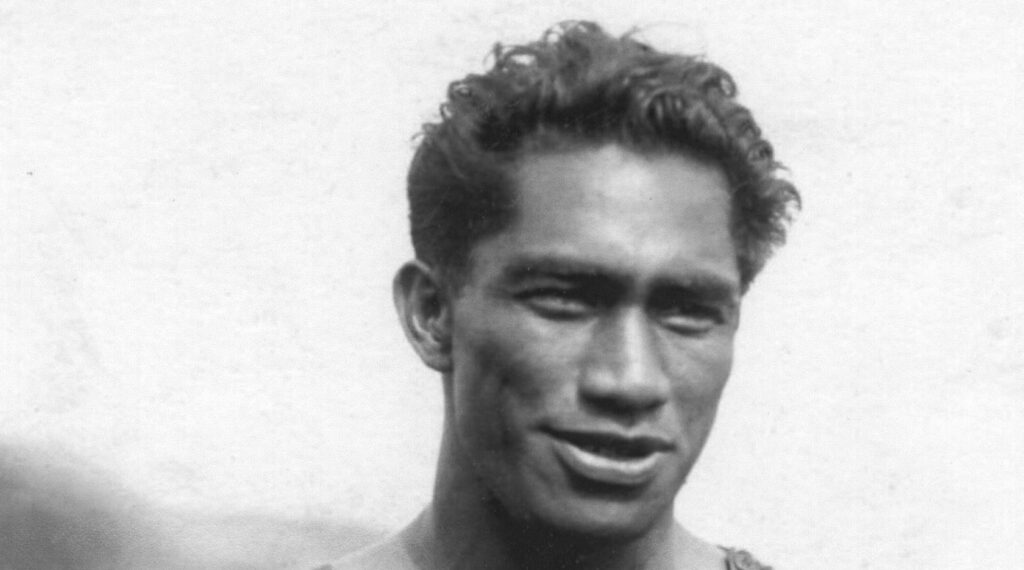
Country: USA
Honoree Type: Swimmer
FOR THE RECORD: OLYMPIC GAMES: 1912 gold (100m freestyle), silver (4x200m freestyle relay); 1920 gold (100m freestyle; 4x200m freestyle relay), 4th (water polo); 1924 silver (100m freestyle); 1932 team member (water polo); WORLD RECORDS: freestyle.
The history of modern swimming started with the English in 1838. It was the breaststroke, and still the breaststroke, when Matthew Webb swam the Channel in 1875; yet, bas-reliefs dating to 880 B.C. taken from the palace of Nimroud (now in the British Nimroud Gallery) show a fugitive escaping from soldiers by swimming a river using a head high overarm crawl. This stroke was evolving painfully in the western world until a bronzed Duke Kahanamoku swam out of the Hawaiian Islands with it in 1911. His world record times no one would believe.
Jam Handy describes The Duke as a superbly conditioned athlete planing and crawling over the top of the water as no one his size and only one smaller man, Perry McGillivry, seemed able to do. Only after ten years in Hollywood did a 42 year old Duke Kahanamoku in 1932 finally fail to make an Olympic team in swimming. He made it in water polo. He made his first Olympic team in 1912. “He still swam well,” says Handy, “but in the water like other mortals, he was no longer in that superb condition needed to get his body planing up on top of the water.” Kahanamoku, the perennial Sheriff of Honolulu, and island king in so many movies, was and is a real Duke by christened surname, as well as in deference to his royal Hawaiian blood. His father, Captain Kahanamoku, born in Princess Ruth’s palace during a visit of the Duke of Edinborough, named him Duke in honor of that occasion.
In swimming, he rates his dukedom by Olympic titles as well as his ambassadorship in first introducing surfing around the world, including Australia where it has become a national sport. Duke’s royal position in swimming took time to be recognized. He first startled the swimming world by shattering both the 50 and 100 yard world records on the anniversary of Hawaiian annexation day, August 2, 1911, just 12 days before his 21st birthday–doing 24 1/5 in the 40 or 1 3/5 seconds better than the record, and 55 2/5 in the 100, 4 3/5 seconds better than the record. Unfortunately the cast was all Hawaiian and the times were so unbelievable that the Amateur Athletic Union, headquartered in New York, refused to recognize them in spite of the careful reports that were compiled showing that the course in Honolulu Harbor had been measured before the race and 3 times after; had been surveyed by a registered surveyor, that the swimmers were swimming against the tide; and that his nearest competitor, Lawrence Cunha, was 30 feet behind.
After considerable correspondence back and forth, President Wahle of the AAU wrote:
“According to my mind, this matter should be treated very carefully and with extreme caution before the 100 yard record is to be accepted as an AAU record. If his 55 2/5 seconds were accepted and he should afterwards compete in the U.S. or Europe and be beaten by swimmers, the correctness of his 55 2/5 seconds would be seriously questioned as well as the good faith of the AAU.
For this reason, I would like to see Kahanamoku beat the fast men first and have the record accepted afterward.”
In the 1912 Stockholm Olympics, Longworth of Australia was the favorite but Duke won the Olympic championship in 63 2/5 seconds. Eight years later at the 1920 Antwerp Olympics, on his 30th birthday, the Duke had to win his gold medal twice. The Australians protested his first win saying their man had been boxed, so the Duke had to win it again. Australia was fourth with Hawaiians first, second and third.
From the time the King of Sweden presented him with his Olympic gold medal and wreath of olive branches in 1912, the Duke has been an international idol, the first and foremost in a long line of Hawaiian world record holders, national and Olympic champions. These tiny islands dominated world swimming from 1912 until 1956 when the six Hawaiians on the U.S. Olympic team were no match for the Australians. Swimming had gone full cycle for it was the Australians who had been dominant in swimming when Duke swam past them in 1912.
The information on this page was written the year of their induction
Rich Burns Recognized with USMS’ Ransom Arthur Award; Honored for Decades of Service
by John Lohn – Editor-in-Chief
Rich Burns Recognized with USMS’ Ransom Arthur Award; Honored for Decades of Service
Rich Burns couldn’t figure out what was happening.
Several of his teammates in the 1980s would disappear for a few days every September and come back talking about rule changes and national championship locations. He eventually asked where they had gone. Their response: U.S. Masters Swimming’s annual meeting.
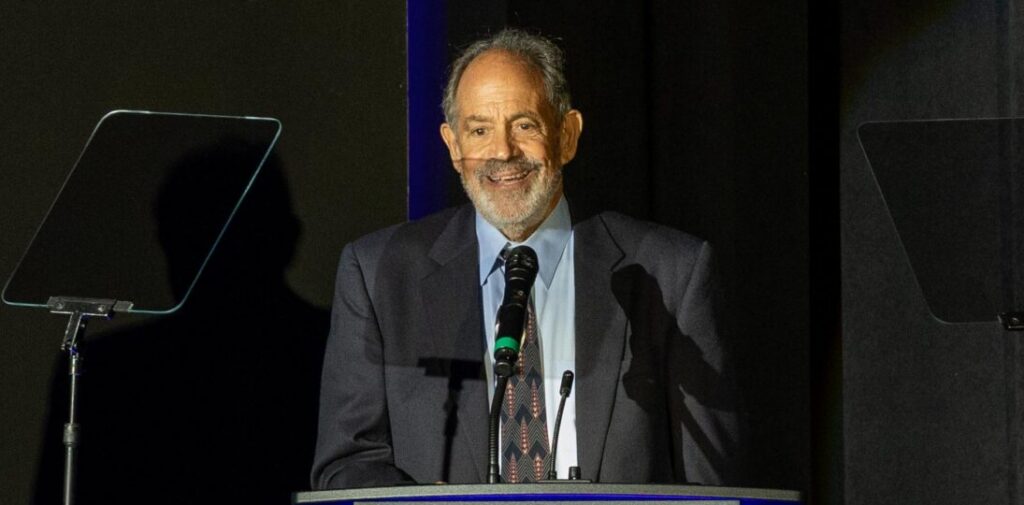
Burns attended the next year, in 1986, starting 40 years of volunteer service with USMS. His longtime dedication has led to him being named the recipient of the 2026 Capt. Ransom J. Arthur M.D. Award, USMS’s most prestigious volunteer award.
“It’s a great sense of satisfaction that I certainly made a contribution—and, hopefully, that I contributed a little bit to making it a better, different organization,” says Burns, 83. “It’s fun to have the recognition. It’s an affirmation that what you’re doing has some value.”
This is the second major recognition this year for the Tamalpais Aquatic Masters member. Burns, who has set nearly 100 AQUA Masters world records and more than 150 USMS records, was also inducted into the International Swimming Hall of Fame in May alongside multiple Olympians that included Nathan Adrian and Ryan Lochte.\
His journey to receiving this year’s Ransom J. Arthur Award—given annually to a volunteer who has done the most to further the objectives of the organization—has been lengthy.
Richard Burns and Laura Val.
Burns recalls trying to learn as much as he could about USMS during his flight to his first annual meeting, which was in Fort Worth, Texas. “The distinction between clubs and teams, associations and zones, LMSCs and MSCs became as rarefied as the air I was flying through,” Burns wrote in a personal note about his deep dive into the organization.
The experience became more confusing once he learned about parliamentary procedure and Robert’s Rules of Order, which govern how the House of Delegates operates at the annual meeting.
But Burns, who also received a USMS Dorothy Donnelly Service Award in 1998 and the 2015 USMS June Krauser Communications Award, soon found his niche working in marketing.
Burns’s educational and professional background is in graphic design, which allowed him to create USMS’s first logo, which was in place for nearly 20 years. Burns also worked to establish SWIM as the official magazine of the organization—SWIMMER took that title in 2005—and created high-gloss calendars that featured members from multiple age groups to highlight both the membership and the fact that swimming can be done for a lifetime.
One of Burns’s novel creations was a personal planner that allowed swimmers to track their workouts. He secured the organization’s first paid sponsorships and advertisements to help launch this member benefit, which has since been replaced by the digital Fitness Logs.
Burns has extensive committee experience with USMS, serving on the now-defunct Marketing Committee from 1989–2003 and on the Recognition and Awards Committee since 2013. Combined with his work on the Ad Hoc ISHOF Nominating Committee from 2000–03, he’s spent 18 years helping others be recognized for their achievements.
He now deserves to be recognized for his efforts, wrote Tamalpais Aquatic Masters member Nancy Ridout, the 1994 recipient of the Ransom J. Arthur Award, and Ian King, chair of the Pacific LMSC, in their letter nominating Burns for his own Ransom J. Arthur Award.
“Through four decades, Rich’s behind-the-scenes contributions have facilitated the growth and influence of USMS not only within our membership, but to those who didn’t know it existed,” they wrote. “He has not sought recognition for his many contributions, and most of our members probably are unaware of who it was that provided them. Rich is quiet, unassuming, talented, and committed to giving back to the sport he loves.
“It’s time to recognize Rich’s impact throughout a 40-year period of continuous contributions to enhancing the vision, values, and programs of U.S. Masters Swimming.”
The above article was provided to Swimming World by U.S. Masters Swimming.
Passages: Masters Honoree Phillip Whitten, Former Editor of Swimming World, Dies at 82; Impacted Sport in Multiple Ways
by John Lohn – Editor-in-Chief
18 August 2026
Passages: Phillip Whitten, Former Editor of Swimming World, Dies at 82
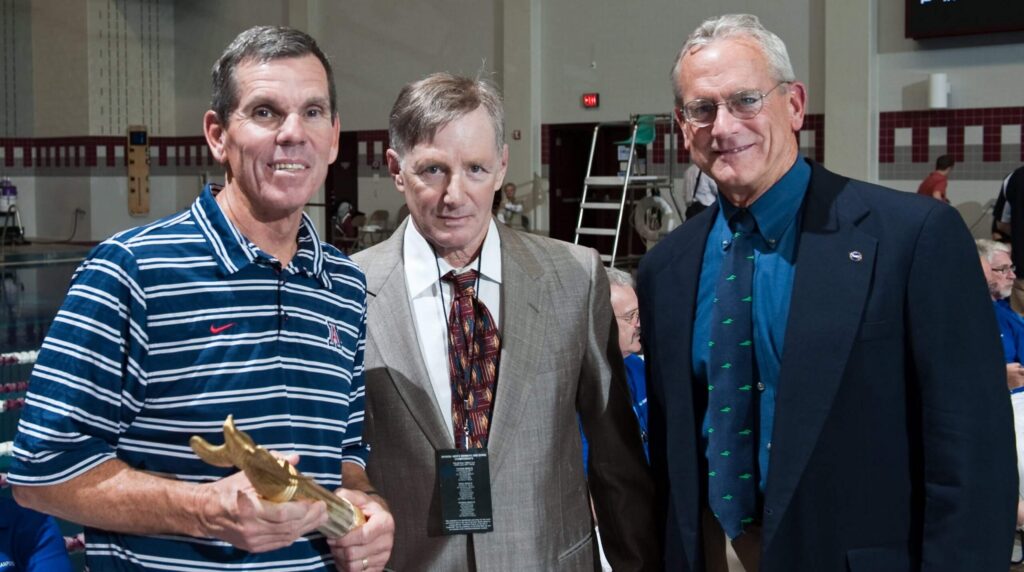
Phillip Whitten, the former Editor-in-Chief of Swimming World, and its sister publications, Swimming Technique and SWIM (Masters), passed away on Saturday, August 15. He was 82. Whitten was a highly respected journalist, having covered the Olympic Games and the top issues in the sport of swimming for years, while guiding Swimming World as both a print magazine and into the digital landscape.
Whitten, who was named Editor of Swimming World in 1992, was an encyclopedia on the sport of swimming, able to discuss pressing topics, current events, achievements, athletes and history with ease. He could easily reach into his deep knowledge and tell a story from the past, or provide analysis of a developing rivalry. As a writer, he was a wordsmith, using his vast vocabulary to craft engaging articles, ranging from columns to features to meet coverage
In the 1990s, Whitten was one of the leading journalists to expose the systematic doping program of East Germany, whose women dominated the sport from the 1970s until the fall of the Berlin Wall. Whitten led Swimming World to publish the Stasi (Secret Police) files related to the GDR’s calculated doping program, and he argued for proper recognition for the athletes whose careers were affected, such as Shirley Babashoff and Enith Brigitha. Whitten also wrote extensively about Chinese doping and Title IX.
An inductee of the International Swimming Hall of Fame as a Masters swimmer, Whitten wasn’t just a standout athlete, but was a steadfast promoter of Masters as a vehicle to health and camaraderie. In the pool, Whitten set numerous records as a Masters swimmer while he was a Masters board member outside of the water. In 1991, he published a study – conducted over more than a decade – that showed Masters swimmers did not experience the typical physiological decline of non-swimmers.
Whitten wrote more than 20 books during his life, between swimming and academia. His “Complete Book of Swimming” was published in 1994.
Whitten was born in Philadelphia and grew up in New York before moving to California when he was 13. He found a talent in the pool as a high school swimmer, particularly in the breaststroke. He attended San Jose State University as an undergrad and was a member of the school’s swim team, and later attended Harvard University, at which he later taught.
Personal Remembrance: Phil first gave me a chance to write for Swimming World in 2000, after I emailed him suggesting a story on Brendan Hansen. While Phil initially declined the proposal, he eventually offered me the chance to write a piece for SW about a group of up-and-coming breaststrokers – Ed Moses, Kyle Salyards, Dave Denniston and Hansen among them. From there, Phil assigned me additional work, and he became a mentor. It was a wonderful moment when he informed my now-wife Dana and I that he was flying in from Arizona to attendour rehearsal dinner and wedding. He held court during those evenings, sharing his typically wonderful tales with our family and friends. Phil, thank you for your guidance, our chats and influence. RIP.
Passages: ISHOF Honoree Kenneth Treadway Dies at 96; Legendary Hall of Famer Was Definition of Service
by John Lohn – Editor-in-Chief
05 August 2026
Passages: Kenneth Treadway Dies at 96; Legendary Hall of Famer Was Definition of Service
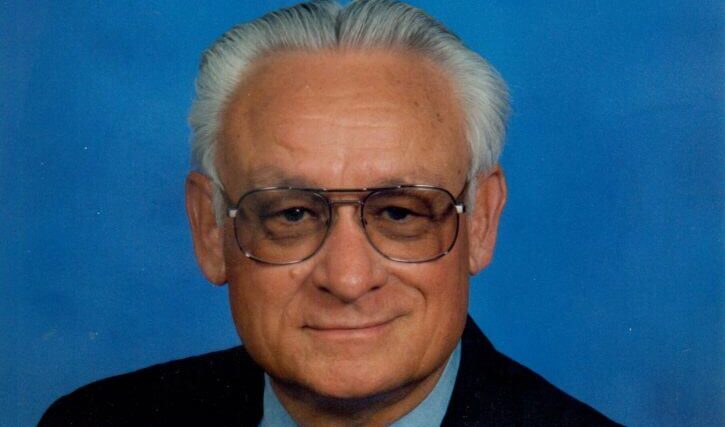
Kenneth Treadway, a 1983 inductee into the International Swimming Hall of Fame as a contributor for his vast service to the sport, died on July 31 at his home in Lawrence, Kansas. He was 96. Throughout his life, Treadway had an impact on swimming, influencing the sport as a coach, innovator, administrator and advocate. He traveled the world to ensure swimmers and coaches received the support they needed.
Born in Oklahoma, Treadway founded the Phillips 66 Splash Club in 1950 in Bartlesville, Oklahoma, the club becoming one of the finest in the country. He also helped that the Bartlesville Public Schools establish swimming programs that promoted water safety and opened the doors to children for competitive opportunities. Eventually, Treadway’s reach extended to California as he and legendary coach Don Gambril founded the Phillips 66 Long Beach Aquatic Club that produced Olympians.
Treadway’s professional career in corporate business with Phillips Petroleum led to the company regularly supporting national championships in the United States, with the Phillips 66 sponsorship of USA Swimming becoming the longest continuous sponsorship of an amateur sport in the United States.
Wherever Treadway went, he had his hand in swimming – sometimes as a coach or official, other times in various influential committee roles. More than 60 years ago, he represented the United States when FINA officially recognized the International Swimming Hall of Fame. He was also a staff member of three United States Olympic Teams, attending the Games of 1964 (Tokyo), 1968 (Mexico City) and 1972 (Munich).
In addition to his Hall of Fame enshrinement, Treadway was recognized by ISHOF in 2008 with its prestigious President’s Award, which honors an individual whose career is defined by exceptional and extraordinary efforts to promore the organization’s mission. More, Treadway was presented with the 1972 AAU Neptune Award, then recognized as swimming’s highest service award. In 2009, he was inducted into the Bartlesville Sports Commission Hall of Fame.
Treadway will be remembered for his never-ending desire to celebrate and support the sport of swimming.
100 Years ago Today! Gertrude Ederle becomes the first woman to successfully cross the Channel ~ August 6, 1926
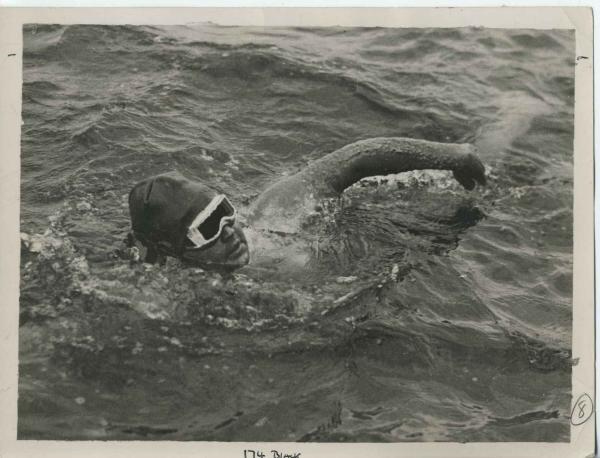
Gertrude Ederle vs. the Channel
The setting for the greatest sports story of the year, to my mind, will be the twenty-two miles of sullen gray Channel water between Cape Gris-Nez and Dover early in August, when Gertrude Ederle makes her second attempt to conquer the elements that beat her last year. Only five men out of the hundreds who have tried have made it and not a single woman.
This is more than a great melodramatic sporting event. The Ederle family is installed at the Hotel of the Lighthouse talking it over and Pa Ederle is planning his celebration in the event of his daughter’s victory. And Gertrude said naïvely, “And I’ll bet all the women in the world will celebrate that night.” That is the keynote of the interest. Swimming the Channel is a supreme test of courage and endurance, requiring a physique which makes victory possible. And a victory for Gertrude Ederle will be one of the greatest feminist stories, as well as one which will appeal to the dullest imagination.
In Paris the gamblers are willing to give heavy odds on the Channel against the young champion of her sex, a girl who is to make the attempt to demonstrate that the members of her sex can possess virtues held previously exclusively by the masculine. She is trying for the second time a feat that only the hardiest and most exceptionally equipped male swimmers have succeeded in accomplishing.
Standing beside Miss Ederle as she sat on one of the rocks near the lighthouse and looked across the gray, sullen water, I’d be inclined to back this girl against the Channel. If there is one woman who can make the swim, it is this girl, with the shoulders and back of Jack Dempsey and the frankest and bravest pair of eyes that ever looked into a face. It is improbable, but not impossible.
At first Miss Ederle gives the impression of being dull, because she is slightly deaf through an injury to her eardrums from swimming and because, like all swimmers, she is a mouth breather. But she is far from dull. She has a sense of humor. She told me of her last attempt, when she swam for an hour on instinct alone, blinded, deaf, and only half conscious. She remembered only the humor of the trip.
She told of the correspondents boarding the tug at Cape Gris-Nez airily waving at her and saying, “See you in Dover.” Then she told in words and pantomime how they crawled off on the English side, wan and seasick, and how one of them said, “This is the last time I make any Channel swims.” She threw back her bobbed head and laughed with the heartiness of a big boy.
“This time,” she said, “I am preparing myself to stay eighteen hours in the water. The last time I was trying for a record. When I start again it will be with the idea of reaching the other side, and I will not quit until I cannot move.”
As she spoke she peered through the chill mists that hid the outlines of the English coast. Below, the Channel was growling as it lashed against the rocks with a constant menace. Behind her was standing the north coast of France.
“All I am going to get for this is a roadster. Pa promised me one if I make the swim this time. So I’ll be seeing nothing but that roadster on the boat while I am making the swim.” A little while later she was cuddling a little baby rabbit, which she had picked up in the fields, against her brown cheek. A strange mixture is this girl, with the simplicity of Shaw’s Joan of Arc and the physique and many attributes of a male giant. To picture what eighteen hours in the Channel might seem you must stand with her on the rocks at Cape Gris-Nez.
Consider the ancestry of this young Amazon. Her grandmother was the mother of twenty-one children and she is still alive and active in Stuttgart, on the edge of the Black Forest in Germany. When this swim is over Gertrude is going to visit her. The swimmer herself is one of a family of twelve—one of the old-fashioned German-American families.
Her training quarters are rougher than those of any prize fighter I have ever visited. In fact, the manager of one of these delicate male athletes would seize his fighter and flee at first sight of the Hotel of the Lighthouse, with beds that sag in the middle and running water that never runs. The diet she eats would shock a trainer. It is the diet of a stenographer mixed with pickles. Yet I have heard third-rate prize fighters complaining that they didn’t get their proper nourishment even when they had their own chefs.
The loneliness would make even an unimaginative prize fighter mad in a few weeks. But this girl keeps her even temper and her sunny good humor, living day by day with a battlefield by her side. This time she is under the charge of the gray-haired William Burgess, who swam the Channel years ago, and a man who has spent his life studying its changes and its cruel moods. The present plan is to have Gertrude Ederle start from the point on the French coast where he finished and have the light of Cape Gris-Nez guide her through the long, weary miles of darkness and silence, broken only by the growl of the waters.
She was at the door of the lighthouse when I left her with her toy phonograph playing a jazz tune. She held out one of the strong brown hands that will beat against the waters of the Channel and said with that boyish smile, “Good-by, good luck.”
I felt that I would sooner be in that tug the day she starts than at the ringside of the greatest fight or at the arena of the greatest game in the world, for this, in my opinion, is to be the greatest sports story in the world.
Written by the New York Daily News, August 1926
Counting down to the 100th Anniversary Celebration of Gertrude Ederle’s successful Crossing of the English Channel ~ August 6, 2026
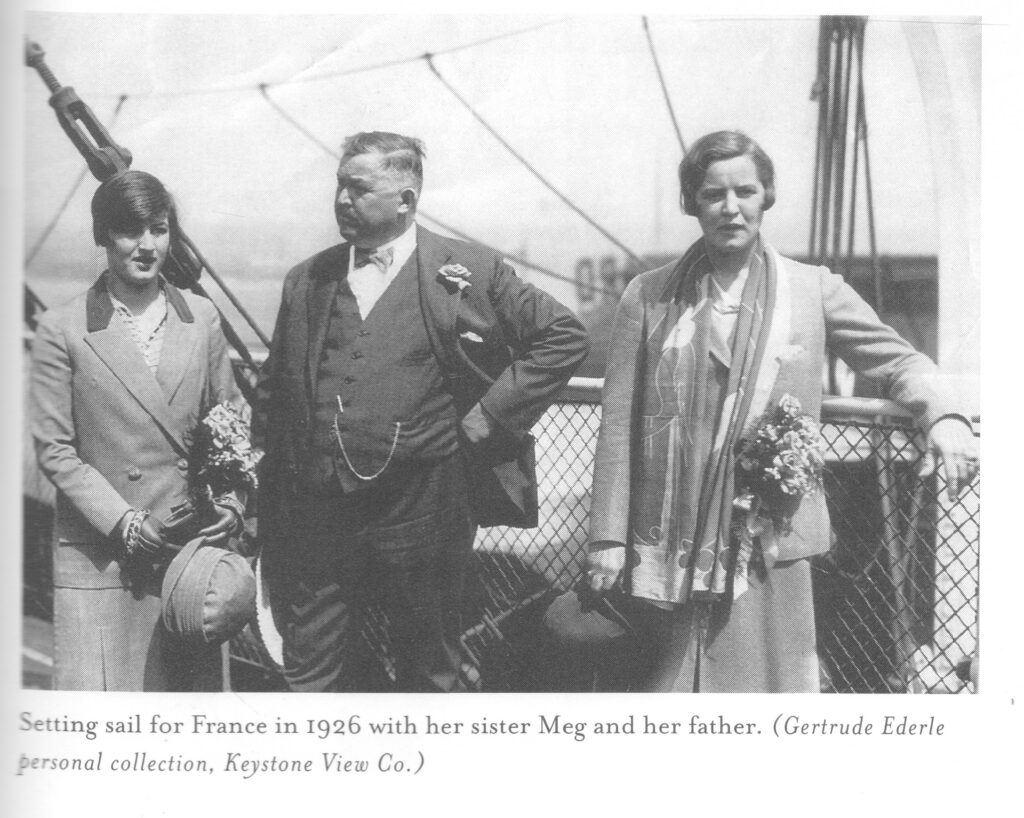
On August 6, 1926, Gertrude “Trudy” Ederle became the first woman to successfully swim the English Channel. Only five men had completed the Channel swim before Trudy, beginning with Captain Matthew Webb in August, 1875. In 1926, it was said that women were dainty and could not possibly achieve a feat so grueling as swimming the English Channel. Not only did Ederle complete the grueling Channel swim, but she beat all the men’s times by two hours.
As we count down to the Centennial anniversary of Trudy’s swim this week, we are going to share “All Things Trudy” with you, leading up to her swim.
As we start our series, we begin with the first photo, of Trudy with her father, and her sister Meg on the boat heading to England in 1926 for Trudy’s second attempt to cross the Channel. Trudy had tried the Summer before, but this time she would be more prepared, as she knew what to expect, and more importantly, she would have the moral support of her father and her sister, Meg.
They would land in England, spend almost two months getting ready on both sides of the Channel, Dover and Cape Gris Nez, preparing for the swim. This year she would be ready; she had a new trainer and lots of swimming friends surrounding her.
International Swim & Save Program “Leucothea” created by Dr. Stathis Avramidis, Greek Lifesaving Sports Assoc.
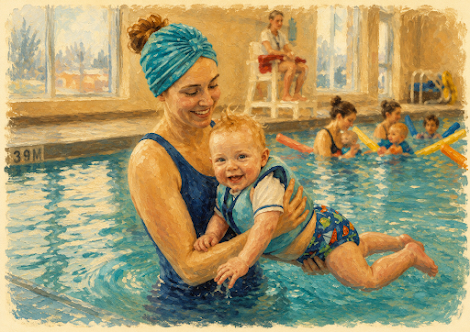
Greece 25.07.2024. On the World Drowning Prevention Day, seven international organizations launch the International Swim & Save Program “Leucothea”, to preserve human lives from aquatic related injuries through free online education on swimming, safety, resuscitation, first aid, survival, fair play, and lifesaving sport.
The problem
Our world is covered at 75% by water. Drowning is a global public health problem, with 1 fatal death every 30 seconds. Those aged 0-5 years old, teenagers and elderly belong to a high-risk group. There is clearly a need for preventing death in these age groups.
The solution
To achieve drowning prevention, resources are needed (money, access to training facilities) but this does not necessarily mean that such intervention is always effective or available to the potential “victims”. According to a famous quote, “the bait should be attractive to the fish and not to the fisherman.” In our today’s society, children learn how to use technology often before they are able to walk and even before their parents find the time or money to offer them proper swimming lessons. Likewise, adults spend a substantial time scrolling on their electronic devices.
The program is endorsed by the following organizations: Greek Lifesaving Sports Association (GLSA), International Federation of Swimming Teachers’ Association (IFSTA), International Life Saving Federation (ILS), International Life Saving Federation of Europe (ILSE), International Swimming Hall of Fame (ISHOF), Mediterranean Lifesaving Confederation (MLC), Lifesaving Network (LiNe).

Creator of Leucothea is Dr Stathis Avramidis, GLSA President, MLC Secretary General and ISHOF Every Child A Swimmer Committee Member. It was developed by the following students from Furtwangen University (Germany): Antonios Stefanakis (Greece), Takal Ebrahimkhel (Germany), Marian Ankoma-Sey (Ghana), Mohammad Sharif Azimy (Afghanistan), Basim Siddiqui (Pakistan), and Gayatri Naidu Arnapalli (India).
Content
The program is composed by 18 modules that are available online. The content deals with the issues of drowning and water safety in all aquatic environments, theories and models of water safety, rescue methods, fair play, swimming and lifesaving sport techniques and legendary figures who excelled in their career as athletes, lifeguards or administrators. The number of modules may increase in the future. Water is our world, but sky is our limit! Upon successful reading of the modules, the participants may test their understanding and receive 18 elegant certificates. This may hopefully motivate them to attend theoretical and practical on swimming and lifesaving lessons.

Comments
The ILS Secretary General, Dr Harald Vervaecke PHD, said: “Leucothea represents an important step in raising water safety awareness globally.”
The ISHOF Chairman of the Board, Dr Bill Kent, said: “Congratulations for uniting prestigious organizations and for creating a priceless modern educational means that can save lives. We are happy to support initiatives that make swimming and lifesaving education accessible to all.”
The MLC President, Dott. Giorgio Quintavalle, said: ““Leucothea is an innovative idea to reach everyone and everywhere, without being limited by time or money. Everyone with internet access can learn how to protect themselves and what to do to save others in and around the water. Congratulations!”
The ILSE President, Dirk Bissinger, said: “We appreciate the effort and contribution to drowning prevention and water safety. Thanks for adding this valuable tool to the community.”
The Deputy President of the Royal Life Saving Society Commonwealth and Co-Chair of the Canadian Drowning Prevention Coalition, Dr Steve Beerman, said: “Children need basic survival swim skills, communities need trained lifesavers. We can deliver this training in a safe and effective manner in all settings.”
The IFSTA President, Leslie Donavan, said: “We applaud the Greek Lifesaving Sports Association and the team of students from Furtwangen University for creating the International Swim & Save Program Leucothea.”
The Project Coordinator of the Lifesaving Network, Bojan Golubovic, said: “Leucothea is a beautiful and user-friendly instrument that helps us meet our constitutional goals and to use the technology for teaching swimming, survival, safety, sports across the globe.”
The GLSA President and creator of the program, Dr Stathis Avramidis, said: “In our first meeting, the team said that they should create an application as part of their academic commitments. It could be something that would improve the professional activity of any kind of client, for example the owner of a pizza restaurant. I asked: “Do you want to sell pizza or to save lives from drowning?” They were inspired and decided to help me serve a higher purpose. This is how Leucothea was born.”

Advantages
The program has several advantages:
it is available online on a 24/7/365 basis.
It is available to every organization and individual.
It can engage people at school, home, holidays or at a sports club.
It offers to the youngsters the opportunity to use the technology that is so dear for gaining easily accessible knowledge.
It helps children to build self-esteem with the certificates of accomplishment and adults to gain basic awareness and stimulation to expand their learning experiences.
It helps organisations to make their members feel creative and become safe.
It fulfills the mission of all the involved organisations to enhance drowning prevention and water safety at no cost.

Invitation
We encourage everyone (World Aquatics, International Life Saving Federation, National Olympic Organisations, parents, swimming and lifesaving clubs, schools, summer camps, scouts and youth organisations) to circulate and use the program. Nobody can cope drowning alone. Together we can!
Access
To access the program, click here: https://leucothea.vercel.app/
August Honoree: After The Applause ~ Klaus DiBiasi, Honor Diver, 1981
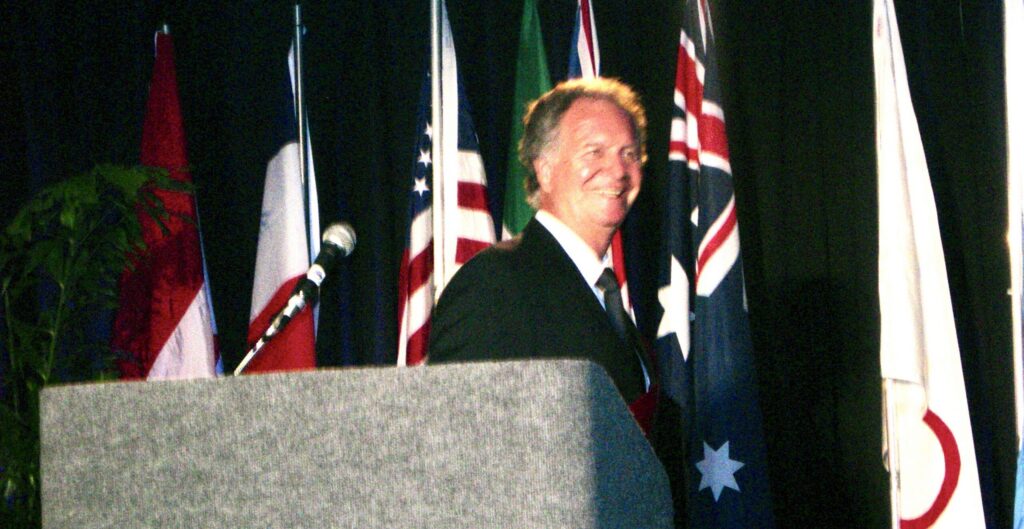
Honoree Questions for: Klaus Dibiasi ~ Honor Diver
You were inducted in 1981, tell us what you have been up to since then?
After the Moscow Olympics 1980 I was still in charge by the Italian Swimming Federation as National Head Coach and had many occasions to compete again with the Italian diving team in Ft. Lauderdale. In 2006 my father Carlo was introduced in the Hall of Fame as Pioneer Coach. Later I was Technical Director and on the board of the Federation. I was also in LEN and FINA for several years and now I am the Secretary of TDC in European Aquatics and am still working for the Federation.
2. What do you do for work / as a profession?
I am retired, but since 1990 I opened with my wife Laura Schermi in Roma the diving club named in memory of father “Papa Carlo”, A.S.D.Carlo Dibiasi. My work is then still with the Italian Swimming Federation as Technical Diving Collaborator.
3. Are you still involved in diving in any capacity?
I have spent my life in Diving and really love my sport. I am no more active as coach on pool-deck but am busy with my Diving Club and European Aquatics where I am involved in educational programs for judges and coaches.
4. Do you still stay in touch with any diving friends from your competition days, if so, who?
Of course, my best friend is Team-made Giorgio Cagnotto with whom I shared all my diving activity and coaching. I was in contact with coach Dick Smith, Dr. Sammy Lee, Dick Kimball and Carlos Giron for many years when they were alive and now, at the Paris Olympics 24 I have met again my friend Greg Louganis. Unfortunately, some good diving friends I competed with, passed already away.
5. If you have children, do your kids dive, if yes, tell us about them, if no, tell us about what they are involved in (sports, arts, etc.)
Yes, I have a daughter with my wife Laura, Elisa Dibiasi, who is really a sportive girl having practiced beside diving, skiing, tennis, kick boxing, climbing, canoeing and horse riding, (one time she rode the famous hors “Diver” of Dick Smith at his home).
She is now living in Ericeira, Portugal practicing surfing. She studied photography for three years in Roma and likes drawing and painting.
6. What is best memory of your days in diving? (You can have more than one)
1964 when we entered the first time the Olympic Pool build by Kenzo Tange, we realized that Olympics are special. Then, my last competition with Greg Louganis in Montreal 76 when I had my physical problems and could not train as expected, the experience and the mind power made there an incredible difference. Also the CAN-AM-MEX competitions from cold Canada to warm Ft.Lauderdale and Mexico were always my preferred diving experiences.
7. Seeing the changes that have occurred in diving/aquatics now versus when you were competing, do you wish you could have competed now, or are you glad you competed when you did and why?
First of all, you can’t compare different eras directly. Situations are much different. On one side I was really happy to have been diving in a period when diving was limited by DD table and really an amatorial activity without great pressure exalting beauty and technique. For that time, we have been the best physical prepared and technically guided athletes. Today it is much different, Pierre De Coubertin’s Olympic principles are almost overwritten and more effort is spent into diving by the federations and the athletes may have also economical profit. Since in 1994 the DD table has been opened and Chinese divers were admitted again the performances raised quickly showing all the hardest dives an individual can perform. Amazing for me was to see the video of Mexican Joaquin Capilla in 1951 trying a 4 1/2 somersault from 10m platform which was not allowed in competition that time. The spring boards have changed much and so the hurdle technique, permitting harder dives for men and women but the platform is still the same. Except economical reasons I am really happy to have lived in an era when diving came really from our heart and coaches were mostly volunteers…
8. Have you written a memoir/book about yourself, if yes, what’s the title and can our readers purchase it? If not, do you ever plan on written a book?
When I met again in Roma my good friend Mario Zanotelli, a diver from my club in Bolzano, and saw that he was a very good cartoonist with a strong sense of humor, I decided to write my book about diving “Tuffi per Tutti” (Diving for Everybody). The content is for any kind of diver from beginner to advanced, with technical advices. The humoristic notes are not missing and it is really fun to go through. Obviously, the introduction is a historical review of my life. The book is in Italian and available on Amazon and other book stores. An English version is planned soon.
9. Any advice to all the future want-to-be Olympic divers out there?
Diving is not an easy sport and needs years of practice to become competitive; that’s why you need to love what you are doing and having fun during even hard workouts. Trust your coaches and do not set too high targets too close. Each new dive you learn brings you a step forward and you can say “I made it” feeling great. It is like a castle to build starting with the first brick! Believe in it and remember, you will never finish to learn new dives!
10. As an Olympian, National Team Member, you travelled all over the world. What was your favorite place you visited, or your favorite meet to attend?
I can tell you that long time ago our Federation sent us to many European important Diving Meetings and never overseas. Then, when the time came to join the CAN-AM-MEX Diving Meetings, a different world was discovered and specially when we dove the first time in Ft. Lauderdale with all the friendly people and a really holiday climate, it was love at first sight. The competitions were high level and well organized. The specialty was the “Friday night show” before the competitions showing humoristic dives and special dives by some famous coaches with a small trampoline put on the 10m platform. The Hall of Fame Museum was also an amazing institution. I am glad about the restructuring done recently to the facility including the High Diving tower and the new Museum building keeping high history and actual needs for diving competitions.
I add a historical picture of high diving done when it was started in Ft Lauderdale as exhibition. An incredible height, must have been about 40m!!! I can’t remember the year….
International Swimming Hall of Fame and Lynne Cox Featured on Travel Channel’s “Mysteries at the Museum”
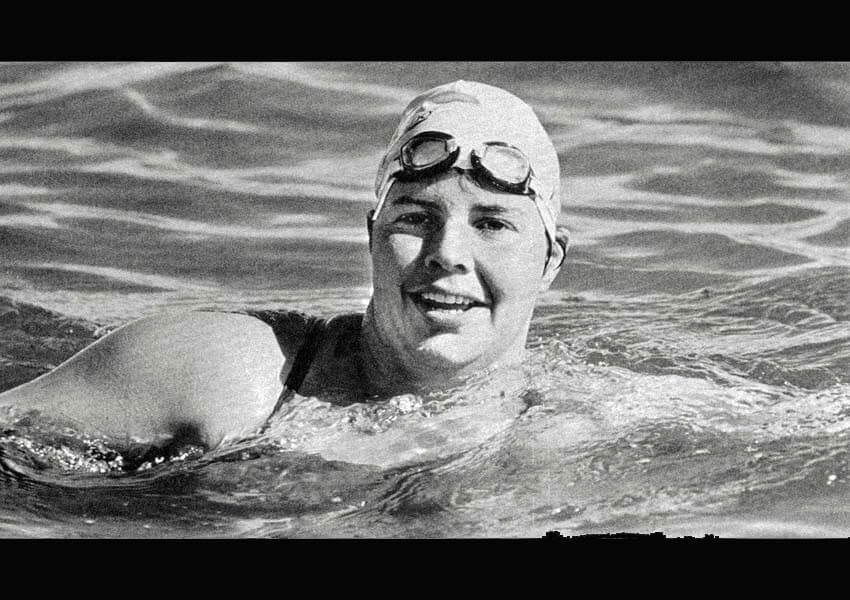
Have you ever wondered why is the International Swimming Hall of Fame is so important?
The answer is simple. It is the only entity that archives important aquatic related memorabilia in order to preserve history and educate the next generation. Nothing demonstrates this fact more than the recent Travel Channel’s show Mysteries at the Museum. The episode was filmed at the International Swimming Hall of Fame and documented the journey of Lynne Cox, who was the first swimmer to swim the Bering Strait from Alaska to the Soviet Union in the summer of 1987. Her swim demonstrated how close the Soviet Union and the United States were to each other and was instrumental in ending the Cold War between the two super powers.
“I wanted to open the border so we could become friends,” says Cox, who first conceived of the idea of the swim in 1976 and spent years lobbying Soviet officials for permission to enter their waters.”The difficulty was that nobody believed it could happen.” – Not just swimming in freezing water, but to bring an end to the cold war.
After being ignored at every turn, Cox finally decided to use “every last penny” of her savings to do her swim. On the eve of the swim, there was still no word from Moscow, and the military on both sides of the Cold War were jittery.
But at the last minute, the Soviets had sent a top-level delegation, including KGB officials and sports stars. They had even prepared a small beach party. The swim turned Cox into a Cold War celebrity in the United States and the Soviet Union.
When President Gorbachev traveled to Washington to sign a nuclear weapons treaty later that year, he and President Reagan raised a glass to toast the swimmer.
“She proved by her courage how close to each other our peoples live,” Gorbachev said.
Lynne Cox was inducted into the International Swimming Hall of Fame in 2000. Support the International Swimming Hall of Fame by becoming a member
Read Lynne Cox’s ISHOF Honoree bio here:
Lynne Cox
Country: USA
Honoree Type: Open Water Swimmer
FOR THE RECORD: First crossing of the Catalina Island Channel (1971) 12:36 hrs.; Women’s and men’s record crossing of the English Channel (1972) 9:57 hrs.; Women’s and men’s record crossing of the English Channel (1973) 9:36 hrs., Catalina Island Channel crossing record (1974) 8:48 hrs.; Cook Straits between North and South Islands of New Zealand (1975) 12 hrs., 2 min.; Straits of Magellan (Chile), Oresund and Skagerrak (Scandinavia) (1976) 1 hr., 2 min.; Aleutian Islands (three channels) 1977; Cape of Good Hope (S. Africa) 1979; Around Joga Shima (Japan) 1980; Across three lakes in New Zealand’s Southern Alps (1983); Twelve difficult “Swims Across America” (1984); “Around the World in 80 Days”, 12 extremely challenging swims totaling 80+ miles (1985); Across the Bering Strait, U.S. to Soviet Union (1987) 2 hr., 6 min.; Across Lake Baikal, Soviet Union (1988); Across the Beagle Channel between Chile and Argentina (1990); Across the Spree River between the newly united German Republics (1990); Lake Titicaca Swim (1992).
Lynne Cox became the best cold water, long distance swimmer the world has ever seen. Her 5 foot 6 inch, 180-pound frame of a body was at one with the water. With a body density precisely that of sea water, her 36% body fat (normal is 18% to 25%) gave her neutral buoyancy. Her energy could be used all for propulsion and not to keep afloat. Propelling though the most treacherous waters of the globe is what Lynne Cox did best.
When her parents moved the family from New Hampshire to Los Alamitos, California in 1969 so that Lynne and her older brother and two sisters could receive better swim coaching, Hall of Fame coach Don Gambril, at the Phillips 66 Swim Club, took her under his guidance. What he saw was a large-boned girl with boundless energy and great upper body strength who could slice through the water like a porpoise. When she was 14 and already tired of “going back and forth in the pool and going nowhere”, Gambril urged her to enter a series of rough water swims near Long Beach. As a result in 1971, at age 14, she swam the 31-mile Catalina Channel in Southern California with four other friends. She loved it. The chill, the chop, the solitude, and the liberation were all exhilarating to Lynne. “Everything opened up. It was like going from a cage to freedom.”
For the next two decades, Lynne competed against the elements in swims which took her to all the major bodies of water in the world, many of which had not been crossed before and most of which had not been done by a woman. Her study of history at the University of California Santa Barbara may have been a catalyst in choosing which swims to pursue. It became her desire to use her swims to help bring people together, to work toward a more peaceful world. This realization was sparked during her 1975 swim as the first woman to swim the 10-mile Cook Straits in New Zealand in 12 hours 2-1/2 minutes. During this difficult swim, the outcry of support from the New Zealand people was all she needed to finish this 50 degree Fahrenheit swim, even when the tides and current had taken her farther away from the starting point after the first five hours of the crossing.
Her most famous swim was in 1987, eleven years after her father had planted the seed in her head. Lynne completed 2.7 miles in the Bering Straits, 350 miles north of Anchorage, Alaska where the water temperature ranges from 38-42 degrees Fahrenheit. Perhaps the most incredible of cold water swims, her 2 hours, 16 minutes from Little Diomede (USA) to Big Diomede (USSR) astonished the physiologists who were monitoring her swim. It marked one of the coldest swims ever completed. One can’t get much colder. After this temperature, the water turns to ice. It was a swim that brought the United States and Soviet Union together in an exchange of glasnost and perestroika. In Washington, Presidents Reagan and Gorbachov toasted Lynne’s swim saying that she “proved by her courage how closely to each other our peoples live”. Before this time, at the start of the Cold War, the families of the Diomede Islands had been split and had not been permitted to see one another since 1948.
Lynne is the purist of marathon swimmers. She does not wear a wet suit in frigid water and does not use a cage in shark infested waters. Her swims in Iceland’s 40 degree F Lake Myzvtan and Alaska’s 38 degree F Glacier Bay, where the lead boat had to break a path in the one quarter inch ice, were done wearing only a swim suit, cap and goggles. She wanted to do more than just achieve times and set records. And she did. But in the process, she became the fastest person to swim the English Channel (1972 and again in 1973), the first person to swim the Straits of Magellan (Chile) 4-1/2 miles, 42 degree F (1976), Norway to Sweden, 15 miles 44 degree F (1976), three bodies of water in the Aleutian Islands (USA) 8 miles total, 44 degree F (1977) and around the Cape of Good Hope (South Africa) 10 miles, 70 degree F which attracted sharks, jellyfish and sea snakes (1978). Many other swims included Lake Biakal in the Soviet Union (1988), the Beagle Channel of Argentina and Chile (1990) and around the Japanese Island of Joga Shima. In 1994 at the age of 37 years, she swam the Gulf of Aqaba in the Red Sea joining the 15 miles of 80-degree water between Egypt, Israel and Jordan. She has swum Lake Titicaca in the Andes Mountains, the world’s highest navigable lake.
Lynne works as an author, motivational lecturer, and teaches swimming technique both in the pool and open water.
The information on this page was written the year of their induction