
Gertrude Ederle vs. the Channel
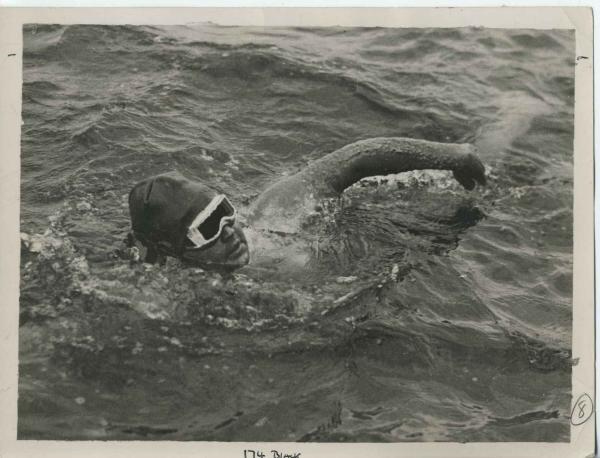
The setting for the greatest sports story of the year, to my mind, will be the twenty-two miles of sullen gray Channel water between Cape Gris-Nez and Dover early in August, when Gertrude Ederle makes her second attempt to conquer the elements that beat her last year. Only five men out of the hundreds who have tried have made it and not a single woman.
This is more than a great melodramatic sporting event. The Ederle family is installed at the Hotel of the Lighthouse talking it over and Pa Ederle is planning his celebration in the event of his daughter’s victory. And Gertrude said naïvely, “And I’ll bet all the women in the world will celebrate that night.” That is the keynote of the interest. Swimming the Channel is a supreme test of courage and endurance, requiring a physique which makes victory possible. And a victory for Gertrude Ederle will be one of the greatest feminist stories, as well as one which will appeal to the dullest imagination.
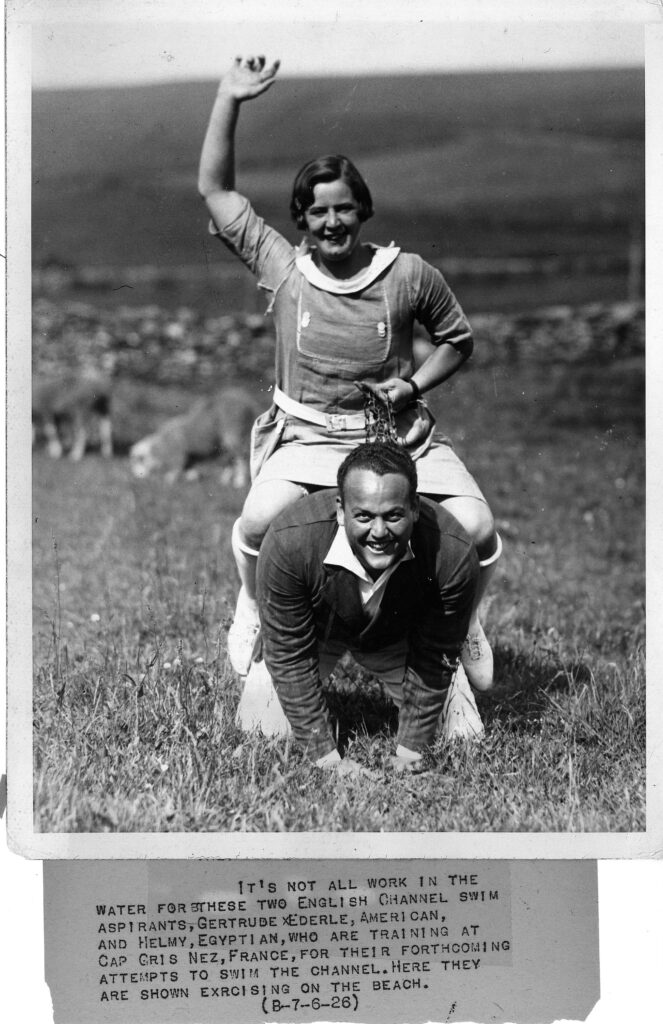
In Paris the gamblers are willing to give heavy odds on the Channel against the young champion of her sex, a girl who is to make the attempt to demonstrate that the members of her sex can possess virtues held previously exclusively by the masculine. She is trying for the second time a feat that only the hardiest and most exceptionally equipped male swimmers have succeeded in accomplishing.
Standing beside Miss Ederle as she sat on one of the rocks near the lighthouse and looked across the gray, sullen water, I’d be inclined to back this girl against the Channel. If there is one woman who can make the swim, it is this girl, with the shoulders and back of Jack Dempsey and the frankest and bravest pair of eyes that ever looked into a face. It is improbable, but not impossible.
At first Miss Ederle gives the impression of being dull, because she is slightly deaf through an injury to her eardrums from swimming and because, like all swimmers, she is a mouth breather. But she is far from dull. She has a sense of humor. She told me of her last attempt, when she swam for an hour on instinct alone, blinded, deaf, and only half conscious. She remembered only the humor of the trip.
She told of the correspondents boarding the tug at Cape Gris-Nez airily waving at her and saying, “See you in Dover.” Then she told in words and pantomime how they crawled off on the English side, wan and seasick, and how one of them said, “This is the last time I make any Channel swims.” She threw back her bobbed head and laughed with the heartiness of a big boy.
“This time,” she said, “I am preparing myself to stay eighteen hours in the water. The last time I was trying for a record. When I start again it will be with the idea of reaching the other side, and I will not quit until I cannot move.”
As she spoke she peered through the chill mists that hid the outlines of the English coast. Below, the Channel was growling as it lashed against the rocks with a constant menace. Behind her was standing the north coast of France.
“All I am going to get for this is a roadster. Pa promised me one if I make the swim this time. So I’ll be seeing nothing but that roadster on the boat while I am making the swim.” A little while later she was cuddling a little baby rabbit, which she had picked up in the fields, against her brown cheek. A strange mixture is this girl, with the simplicity of Shaw’s Joan of Arc and the physique and many attributes of a male giant. To picture what eighteen hours in the Channel might seem you must stand with her on the rocks at Cape Gris-Nez.
Consider the ancestry of this young Amazon. Her grandmother was the mother of twenty-one children and she is still alive and active in Stuttgart, on the edge of the Black Forest in Germany. When this swim is over Gertrude is going to visit her. The swimmer herself is one of a family of twelve—one of the old-fashioned German-American families.
Her training quarters are rougher than those of any prize fighter I have ever visited. In fact, the manager of one of these delicate male athletes would seize his fighter and flee at first sight of the Hotel of the Lighthouse, with beds that sag in the middle and running water that never runs. The diet she eats would shock a trainer. It is the diet of a stenographer mixed with pickles. Yet I have heard third-rate prize fighters complaining that they didn’t get their proper nourishment even when they had their own chefs.
The loneliness would make even an unimaginative prize fighter mad in a few weeks. But this girl keeps her even temper and her sunny good humor, living day by day with a battlefield by her side. This time she is under the charge of the gray-haired William Burgess, who swam the Channel years ago, and a man who has spent his life studying its changes and its cruel moods. The present plan is to have Gertrude Ederle start from the point on the French coast where he finished and have the light of Cape Gris-Nez guide her through the long, weary miles of darkness and silence, broken only by the growl of the waters.
She was at the door of the lighthouse when I left her with her toy phonograph playing a jazz tune. She held out one of the strong brown hands that will beat against the waters of the Channel and said with that boyish smile, “Good-by, good luck.”
I felt that I would sooner be in that tug the day she starts than at the ringside of the greatest fight or at the arena of the greatest game in the world, for this, in my opinion, is to be the greatest sports story in the world.
Written by the New York Daily News, August 1926