
Happy Birthday Rebecca Soni!!

Rebecca Soni (USA)
Honor Swimmer (2021)
FOR THE RECORD: 2008 OLYMPIC GAMES: gold (200m breaststroke), silver (100m breaststroke, 4×100m medley relay); 2012 OLYMPIC GAMES: gold (200m breaststroke, 4×100m medley relay), silver (100m breaststroke); EIGHT WORLD RECORDS: 100m breaststroke (1 LC, 1 SC), 200m breaststroke (3 LC, 1 SC), 4×100 medley relay (1 LC, 1 SC); 2009 WORLD CHAMPIONSHIPS (LC): gold (100m breaststroke), silver (50m breaststroke); 2011 WORLD CHAMPIONSHIPS (LC): gold (100m breaststroke, 200m breaststroke, 4×100m medley), bronze (50m breaststroke); 2010 WORLD CHAMPIONSHIPS (SC): gold (50m breaststroke, 100m breaststroke, 200m breaststroke), silver (4×100m medley relay)
Rebecca Soni is known as a breaststroke phenom. What she lacked in size, she made up for in strength and desire. Her much-discussed technique is what separated her from her rivals. It featured an abbreviated leg kick aligned with perfectly timed rapid arm sweeps. It was an effective and efficient approach, and it was gold – Olympic gold.
Soni is a two-time Olympian and six-time Olympic medalist. She broke eight world records in breaststroke events and as part of two women’s medley relay teams, one long course and one short course.
During the summer of 2006, Soni had a procedure called a cardiac ablation that helped regulate her heartbeat. She had an irregularly high heartbeat that affected her training and needed to be treated.
Soni worked through her health issues and qualified for her first Olympic team in 2008 by winning the 200m breaststroke. In the 100m breaststroke, she took fourth place. However, fate stepped in when one American teammate withdrew and another missed a deadline for the Games, allowing Soni to represent the United States in her first Olympic Games in three events – both breaststrokes and the 4×100 medley relay. She did not disappoint.
In her first event, the 100m breaststroke, Soni won the silver medal behind world record holder Leisel Jones of Australia. She followed with a stunning victory in the 200m breast, out-swimming Jones with a time of 2:20.22 that also broke Jones’ world record.
Soni wrapped up her first Games as a member of the USA medley relay team, taking her second silver medal, behind the Australians.
Soni attended the University of Southern California from 2005-2009 and swam for multi-time Olympic coach Dave Salo. Her career was defined by four national titles in the 200-yd breaststroke and in her junior and senior years, she also won titles in the 100-yd breaststroke. Soni ended her career at USC with the NCAA record in the 200-yd breaststroke, gathered 12 All-American honors and finished as one of the most dominant breaststrokers in NCAA history.
At her second Olympic Games in 2012, Soni again won the silver medal in the 100m breaststroke, this time behind Lithuania’s Ruta Mejlutyte by only .08 seconds. In the 200m breaststroke, Soni broke the world record in the semi-finals with a time of 2:20.00. In the finals, she won the gold medal and broke the world record again with a time of 2:19.59. The effort made Soni the first woman to break 2:20 in the event.
With that gold medal, Soni became the first female to successfully win back-to-back Olympic titles in the 200m breaststroke. In the medley relay, Soni helped the United States win gold, as she teamed with Missy Franklin, Dana Vollmer and Allison Schmitt. Together, the foursome broke the world record with a time of 3:52.05.
After her retirement in 2014, Soni went into business with friend and former Olympic teammate, Caroline Burckle. They co-founded a company called RISE Athletes, an online mentoring platform for young athletes. Soni’s company recruits Olympians to help mentor young athletes by using one-on-one interaction.
Happy Birthday Tom Gompf!!
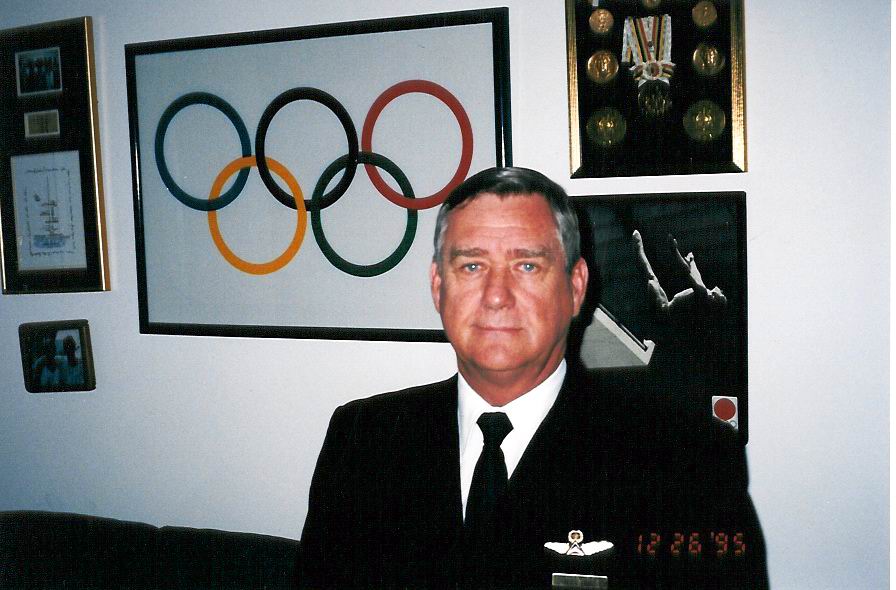
Tom Gompf (USA)
Honor Contributor (2002)
FOR THE RECORD: 1964 Olympic Games: bronze (10m platform); 3 National AAU Championships: (trampoline-1, 10m platform-2); 4 Foreign National Championships: Japan (3), Spain (1); 2 World Professional High Dive Championships; 11 years Diving Coach: University of Miami (FL) (1971-82); 1976, 1984 U.S. Olympic Diving Team: Coach/Manager; U.S. Olympic Committee Executive Board of Directors: Member (1977-2000); 1984-2004 FINA Technical Diving Committee: Chairman (1988-2000); U.S. Diving, Inc.: President (1985-90); U.S. Aquatic Sports: President (1999-present); Executive Board of Amateur Swimming Union of the Americas: member (1999-present).
Tom Gompf loves all aspects of diving; always has, always will. He started as a young local
competitor, advanced to the Olympic Games, performed in professional competition and grew to serve the international diving community as an administrative leader. He is a hard worker for the good of the sport and a friend to all. Gompf has had a profound international influence on the sport of diving.
As a youngster, growing up in Dayton, Ohio, Tom won five National YMCA Diving titles and two National AAU Junior Nationals Championships. He was coached in the early years by Ray Zahn, George Burger and Lou Cox.
By the time he graduated from college at Ohio State University in 1961, diving for Hall of Fame Coach Mike Peppe, Tom had won the NCAA National Trampoline Championships and a year later, the U.S. National AAU Diving Championships twice on the 10m platform. In 1964 at the Tokyo Olympics, and under the eye (1961-1965) of coach Dick Smith, Tom won the bronze
medal on the 10m platform, only two points behind gold medalist Bob Webster (USA) and one point behind silver medalist Klaus Dibiasi (Italy) both Hall of Famers. Tom went on to win National Championships in Spain and Japan and then competed in and won first place in the 1970 and 1971 World Professional High Diving Championships in Montreal. His next competition
was diving off the cliffs of Acapulco. He survived. All this was while flying several hundred combat missions in Vietnam from 1965 to 1967 earning the Distinguished Flying Cross, the Air Force Commendation Medal and the Air Medal with multiple silver clusters.
From 1971 to 1982, he coached diving at the University of Miami (FL) developing divers, winning six National Championships and competing on World, Pan American and Olympic teams. Steve McFarland, Melissa Briley, Julie Capps, Greg Garlich and Greg Louganis were among his team members.
But perhaps Tom’s greatest contribution came from behind the scenes as a leader in the sport. Universally acknowledged for his low-key, amiable manner, his stock-in-trade is his ability to work effectively and silently to promote the sport. Extremely intelligent, he can be very persuasive. Says one veteran, “Tom can make you believe a watermelon is an apple.” Since 1977, he has served on the United States Olympic Committee Board of Directors (1977-2004) and Executive Board, working to autonomize the four aquatic disciplines under the Amateur Sports Act of 1978. He helped establish U.S. Diving, Inc. in 1980 and serves as the only continuous board member. He served four years as its president (1985-90) and since 1998 has been president to United States Aquatic Sports which represents all the disciplines and reports directly to FINA.
On the international scene, Tom serves on the Executive Board of the Amateur Swimming Union of the Americas (ASUA). In 1984, he was elected to the FINA Technical Diving Committee and continues in that position today. He served three, four-year terms as chairman during which time he proposed and passed legislation to include 1 meter diving in the FINA World Championships (1986) and synchronized diving for World competitions, with its debut at the 2000 Sydney Olympics. “It lends the element of team, which every other sport has. It’s TV and a proven crowd favorite,” says Tom. Tom is responsible for the renovation of international judging, initiating a judges’ education program involving clinics and manuals. Tom has served as the
Chairman of the FINA Diving Commission for the World Swimming Championships (1990-98) and as Chairman of the FINA Diving Commission for the Olympic Games (1992-2000).
Tom has received the FINA silver and gold pins, served as the U.S. Team Manager for the 1976 and 1984 Olympic Games, was Chairman eight years (1991-98) for the ISHOF Honoree Selection Committee and served four years (1986-90) on the ISHOF Board of Directors. All the while, Tom was airline captain for National (1967-80), Pan American (1980-91) and Delta Airlines (1991-2000). He has received the Mike Malone/Glen McCormick Award (1984) for outstanding contribution to U.S. Diving, the Phil Boggs Award (1995), U.S. Diving’s highest award and the 1997 Paragon Award for competitive diving.
Tom’s accomplishments were never for personal fame, but always an honest attempt to help the sport he loves. He has applied the same determination and passion that made him an Olympic medalist to pursuing the goal of advancing and improving all aspects of diving on the international scene for the good of the sport and the athletes.
Buy your TICKETS NOW~ ISHOF’s 2025 Honoree Induction Ceremony in Singapore with World Aquatics Championships ~ July 28

WHAT: Buy your tickets NOW for ISHOF’s 60th Anniversary of the Honoree Induction Ceremony in Singapore in conjunction with the World Aquatics World Championships
WHEN: Monday, July 28, 2025, 1:00 PM
WHERE: Park Royal Collection, Marina Bay, Singapore
Tickets are NOW ON SALE ~ purchase them HERE!
Buy your tickets NOW for ISHOF’s 60th Anniversary of the Honoree Induction Ceremony

WHY: To honor this year’s Class of Honorees and celebrate ISHOF’s 60 years
HONOR SWIMMERS:
Anthony Ervin (USA)
Ryan Lochte (USA)
Federica Pellegrini (ITA)
Joseph Schooling (SIN)
OPEN WATER SWIMMER: Ous Mellouli (TUN)
DIVERS: Chen Ruolin (CHN) , Guo Jingjing (CHN)
WATER POLO PLAYER: Endre “Bandi” Molnar (HUN)
ARTISTIC SWIMMER: Andrea Fuentes (ESP)
COACH: Gregg Troy (USA)
CONTRIBUTOR: Captain Husain Al Musallam (KUW)
PIONEER: Sachin Nag* (IND)
*deceased
The International Swimming Hall of Fame (ISHOF) is proud to announce this truly international Class of 2025. This year, ISHOF will induct 12 honorees from nine countries. In addition, ISHOF will be inducting Honorees from four new countries that we have never had Honorees inducted from before, Kuwait, India, Tunisia, and Singapore.
Today We Remember Honoree and Long Time ISHOF Friend Ron O’Brien on His Birthday!!

Ron O’Brien (USA)
Honor Diver (1988)
FOR THE RECORD: NCAA CHAMPIONSHIPS: 1959 (one meter); AAU NATIONAL CHAMPIONSHIPS: 1961 (3 meter); OLYMPIC COACH: 1972, 1976, 1980, 1984, 1988; Assistant Coach: 1968; WORLD CHAMPIONSHIPS COACH: 1975, 1978, 1982, 1986; PAN AMERICAN COACH: 1967, 1975, 1983, 1987; WORLD CUP COACH: 1981, 1983, 1985, 1987; 1974 Malone Memorial Award; 1976 Fred Cady Award; 1979-1987 Mike Peppe Award; 1984 Ohio State University Sports Hall of Fame; Winner of 62 National Team Championships while coaching at University of Minnesota (1962-1963); Ohio State (1963-1978), Mission Viejo (1978-1985) and Mission Bay (beginning 1985-1988).
Ron O’Brien has done it all in diving from NCAA and AAU national champion under Mike Peppe while a six letter man (gymnastics and diving) at Ohio State to the top professional water show act (with Hall of Famer Dick Kimball), to the Ph.D. that made believers out of the academicians, to a top college, club, national and international coach. He has won U.S. Diving’s Award as the “Outstanding Senior U.S. Diving Coach” every year since the award was inaugurated in 1979.
It seems like Ron O’Brien has always been a diving coach. Standing next to the deep end (now a diving well), speaking in sort of a stage whisper, animated by body language and hand signals of what the diver did or did not do. His face is constantly sunburned–his green eyes bloodshot with crinkle smile lines around his mouth. His ears and nose peeling as he does a dance in place, teetering on the edge of the pool.
In his first 25 years of coaching, his divers have won 154 gold, 90 silver and 78 bronze medals in major Olympic, world, national, NCAA and Big Ten Conference diving championships. This doesn’t take into account the dozens of medals in prestigious invitational meets around the world. He has coached everyone from beginners to the famed Greg Louganis.
Ron narrowly missed the 1960 Olympic team himself placing third or fourth in the Olympic trials where only two were taken. Perhaps this experience gave him the patience, persistence and understanding to be the coach of every Olympic team since 1968. “It certainly was a good motivator,” he says. “It made me want to make it as a coach. But what keeps me going is not winning,” O’Brien says, “but the quest for reaching potential in myself as a coach and my kids as divers. It’s the pursuit of excellence.”
If you had to pick a highlight from his first 25 years of coaching at Minnesota, Ohio State and the two Missions, it might be the 1982 World Championships when O’Brien’s divers from Mission Viejo won all four of the diving gold medals, the first and only time this has happened in diving history.
Throwback Thursday ~ The New Swimming Hall of Fame Pool vs. The Fort Lauderdale Casino Pool

Today for throwback Thursday, we have some throwback photos. The featured photo is a photograph that was taken during a very short period of time, in the mid-1960’s, when the new sparkling Hall of Fame Pool with crystal clear freshly chlorinated waters had just been built, but they had now yet taken down the old Casino pool, which sat right across from Fort Lauderdale Beach. At the time, the old Casino pool was filled with salt water which was pumped in directly from the ocean. The Casino was considered old and outdated as it was built in the 1920’s. Of course looking at it now, we look at it and think it is one of the most amazing structures and wish we still had it, right? Ah, progress…….
Here are some photos of the old Casino Pool
In honor of Women’s History Month, Hilda James: One of the great early female pioneers and feminists!

Hilda James (GBR) 2016 Honor Pioneer Swimmer
FOR THE RECORD: 1920 OLYMPIC GAMES: silver (4x100m freestyle); SEVEN WORLD RECORDS: two (300yd freestyle), two (150yd freestyle), one (440yd freestyle), one (400m freestyle), two (220yd freestyle), three (300m freestyle); 29 ENGLISH RECORDS: four (300yd freestyle), one (440yd freestyle), one (500yd freestyle), four (220yd freestyle), four (100yd freestyle), four (150yd freestyle), two (440yd freestyle), two (500yd freestyle), one (440m freestyle), one (1750yd freestyle), one (880yd freestyle), one (1000yd freestyle); EIGHT U.K. NATIONAL CHAMPIONSHIPS: four (220yd freestyle), one (100yd freestyle), two (Thames Long Distance from Kew Putney five miles 50yd), one (440yd freestyle); FOUR SCOTTISH RECORDS: one (220yd freestyle), two (200yd freestyle), one (300yd freestyle), one (400m freestyle); FOUR OTHER MEET RESULTS: gold (300yd individual medley), gold (220yd freestyle), gold (110yd breaststroke), one River Seine 8k Race.
To avoid attending Church of England religious education classes, which conflicted with her parents religious beliefs, this 11-year old Liverpudlian was assigned to swimming classes at the Garston Baths.
Five years later, Hilda James was Great Britain’s best female swimmer and left for the 1920 Olympic Games with high expectations. Unfortunately in Amsterdam, the USA women completely dominated, sweeping the gold, silver and bronze medals in the 100m and 300m freestyle, the only individual swimming events for women at the 1920 Games. And while the British did win silver medals in the 4x100m relay, they finished a full 30 seconds behind the Americans. The following day Hilda cheekily asked the American coach, Lou de B. Handley, to teach her the American Crawl.
In 1922, Hilda was invited by her American friends to visit the USA for the summer racing season. While she was still behind the American stars Helen Wainwright and Gertrude Ederle, she was closing the gap.
By 1924, Hilda held every British and European freestyle record from 100 meters to the mile, and a handful of world records as well. She easily made the 1924 Olympic team, and it was widely believed that she would return from Paris with a handful of medals. When Hilda’s mother insisted she accompany her daughter as chaperone, and the British Olympic Committee refused, Hilda’s mother refused to let her go. Unfortunately, Hilda was not yet 21, was under the care of her parents – and had to obey.
Hilda turned 21 shortly after the Olympic Games, gained her independence, and took a job with the Cunard Shipping Company, traveling the world as a celebrity spokesperson, at a time when women were just starting to gain their freedom.
We will never know how Hilda would have fared in the 1924 Olympic Games, but she was a trailblazer and one of Europe’s first female sports superstars who inspired future generations of girls to follow in her wake.
From Hilda’s grandson: Ian Hugh McAllister:
Ian Hugh McAllister
Tynemouth Outdoor Pool
tFenSbcpodroungssagaeryr lo5tnarm, e2d0d1a4 · Poole, United Kingdom ·
My Grandmother Hilda James officially opened the pool in 1925. As the premiere swimming star of the era she was also invited to participate in the opening gala but declined to swim in the races, substituting a demonstration of trick and fancy swimming instead. What the audience didn’t know was that she had already signed as a professional with Cunard, and was due to become the first celebrity crew member aboard Carinthia, the very first purpose-built cruise liner. Although not officially on the Cunard payroll until the following week, she was not exactly sure when they would start paying her, and dared not compete in case the press found out she was no longer an amateur. It was a poignant moment for Hilda, her last ever appearance as an amateur following a meteoric nine year career. During that time she held an Olympic silver medal, broke seven World Records, and actually introduced the crawl stroke to the UK.
The whole story is told in her biography “Lost Olympics” which was published last year on Amazon and for Kindle download. Please visit the Lost Olympics facebook page for a lot more information, including my various TV and radio interviews etc. Hilda has recently been nominated for induction to The International Swimming Hall of Fame.
When the pool gets rebuilt, can I come and open it again for you, or at least be at the opening? (although I am no swimmer!)
If you are interested in purchasing a copy of The Hilda James story: Lost Olympics, please reach out to meg@ishof.org

Salute to National Women’s Month: Honoree Ethelda Bliebtrey

There are so many strong women in sports, particularly aquatic sports, but in the month of March, we specifically try to really pay tribute to them. So for our first woman, we’ve decided to tell the story of one of the greatest women swimmers in the sport with a life as fun and exciting as her name: Ms. Ethelda Bliebtrey.
Ethelda Bleibtrey was the USA’s first female Olympic swimming champion and the only person ever to win all the women’s swimming events at any Olympic Games. She took up competitive swimming for the first time in 1918, won the nationals within a year, and was the best in the world by the end of the second year (1920 Olympics).
Miss Bleibtrey won three gold medals in the Games at Antwerp and says only fate kept her from being swimming’s first four gold medal winner in one Olympic Game, an honor Hall of Famer Don Schollander accomplished 44 years later in Tokyo. “At that time,” she says, “I was the world record holder in backstroke but they didn’t have women’s backstroke, only freestyle in those Olympics.”
U.S. Girls 400 Freestyle Relay: Frances Schroth, Margaret Woodbridge, Ethelda Bliebtrey, Irene Guest
For her world and Olympic records in the 100 and 300 meter freestyle and anchor leg of the winning U.S. 400 freestyle relay, Ethelda was congratulated by King Albert of Belgium. She later surfed with the Prince of Wales in Hawaii, dated oarsman Jack Kelly in Atlantic City, and triumphantly toured the Panama Canal, Australia and New Zealand. The invitation down under came when she was the first girl ever to beat Hall of Famer Fanny Durack, the long-time Australian multi-world record holder on Fanny’s U.S. tour in 1919.
Miss Bleibtrey had several other firsts for which she got citations but no medals. Her first citation was for “nude swimming” at Manhattan Beach. She removed her stockings before going in to swim. This was considered nudity in 1919. Resulting publicity and public opinion swinging in her favor not only emancipated Ethelda from jail, but women’s swimming from stockings. On her trip to Australia with Charlotte Boyle the misses Bleibtrey and Boyle were the second and third famous women to bob their hair — something Irene Castle had just introduced. Charlotte’s parents told them not to come home until it grew out (citation #2), for which they were reprieved when the ship landed and the Boyle’s decided it didn’t look as bad as they had feared. Citation #3 got Ethelda arrested in Central Park and paddy-wagonned down to the New York police station for a night in jail but it also got New York its first big swimming pool in Central Park after Mayor Jimmy Walker intervened.
It happened like this: “The New York Daily News” wanted the City to open up its Central Park reservoir for swimming and arranged to have Ethelda arrested while diving in. For this they paid her $1,000.00, money she sorely needed after an abortive attempt to turn pro with a tank tour of the Keith Circuit. Her tank leaked — all over the theater — and Keith’s sued her instead of continuing her promised 14 week tour.
Ethelda and Charlotte Boyle with their Famed “bobbed” haircuts
Ethelda Bleibtrey, who started swimming because of polio, and took it up seriously to keep her friend Charlotte Boyle company, turned pro in 1922 after winning every national AAU championship from 50 yards to long distance (1920-1922) in an undefeated amateur career. She also started the U.S. Olympians Association with Jack Kelly, Sr., and later became a successful coach and swimming teacher in New York and Atlantic City. She is currently a practicing nurse in North Palm Beach, Florida — not as young but just as interesting. The sparkle remains in her eyes as she tells how they swam their 1920 Olympic races “in mud and not water,” in a tidal estuary; and how she participated in the first athletic sit-in when Hall of Famer Norman Ross organized the Olympic team to sit it out on the beach in Europe until the U.S. Olympic Committee sent better accommodations for the voyage home. “I have my memories,” says Ethelda, “and I guess some of those other people remember too. I owe a great deal to swimming and to Charlotte Boyle, who got me in swimming and L. deB. Handley, who coached me to the top.”
ISHOF salutes Black History Month: Remembering the Tennessee State Tigersharks

Left to Right, First Row: Captain Meldon Woods, Co-Captain Clyde Jame, Ronnie Webb, Jesse Dansby, Osborne Roy, Cornelias Shelby, Frank Oliver, James Bass and Roland Chatman. Second Row: Cecil Glenn, William Vaughn, Raymond Pierson, Robert Jenkins, George Haslarig, Leroy Brown, Frank Karsey, John Maxwell and Coach Thomas H. Hughes.
The Tennessee State University Tigersharks finished the 1960 – 61 swimming season with a 6 – 1 record, losing only to Indiana’s Ball State University, one of two white schools willing to swim TSU. The first time they met in the 1950s, TSU won. Co-captain Clyde James, was a finalist in the NAIA National Championships in the 100 yard butterfly. Clyde went on to become a legendary coach at the Brewster Recreation Center and Martin Luther King HS in Detroit. Tennessee State started its swimming team in 1945 and it’s coach, Thomas “Friend” Hughes was the first African American accepted as a member of the College Swimming Coaches Association in 1947.
Happy Birthday Steve Lundquist!!

Steve Lundquist (USA)
Honor Swimmer (1990)
FOR THE RECORD: OLYMPIC GAMES: 1984 gold (100m breaststroke; relay); U.S. NATIONALS: 14 (100yd, 200yd, 100m, 200m breaststroke; 200yd, 200m individual medley); NCAA CHAMPIONSHIPS: 7 (100yd, 200yd breaststroke; 200yd individual medley); WORLD RECORDS: 9 (100m breaststroke; 200m individual medley; relays); PAN AMERICAN GAMES: 1979 gold (100m, 200m breaststroke; 1 relay); 1983 gold (100m, 200m breaststroke), bronze (200m individual medley; 1 relay); AMERICAN RECORD holder: (100yd, 200yd breaststroke); 1981, 1982 U.S. Swimmer of the Year; First swimmer in the world to break 2 minute barrier in the 200yd breaststroke.
“Lunk” the other swimmers called him except for the late Victor Davis who called him “the intimidator.” “It takes one to know one,” was Steve Lundquist’s reply. He was and is the golden boy of swimming, going right from the pool, medaling to modeling and a featured part on the afternoon “soap” “Search for Tomorrow”. He may have been a hot dog in the same sense as Johnny Weissmuller and Buster Crabbe. Steve was the first man in the world to break two minutes for the 200 yard breaststroke. “Lundquist can swim and win anything he wants to train for,” said Hall of Fame Honor Coach Walt Schlueter. He was almost as brilliant in the freestyle sprints and butterfly as he was in his breaststroke specialty. Steve was an honorary member of the 1980 Olympic Team. Unfortunately since the U.S. did not attend, Steve’s 100 meter breaststroke time, even though it was faster than the winning time, did not garnish him an Olympic gold. All totaled, he won two Olympic gold medals, set nine world records, won 14 U.S. Nationals, seven NCAA crowns and six gold medals in the Pan American Games. As an athlete in football, track, wrestling, water and snow skiing, tennis and especially swimming, he self-destructed on motorcycles and in dormitory wrestling matches, but that was only between races. In the pool he was always awesome. “Swimming World” magazine picked him as 1981 and 1982 World Swimmer of the Year. To all of this, Weissmuller and Crabbe might add, “Yes, old Steve is a pretty fair country swimmer.” The “country is Lake Spivey of Jonesboro, Georgia, USA where the Lunk was born in 1961.
Black History Month: Despite Stolen Gold, Enith Brigitha Was a Sporting Pioneer

By John Lohn, Editor, Swimming World
Emerging as a youth star from the island nation of Curacao in the Netherlands Antilles, Brigitha etched herself as one of the world’s most consistent performers during the 1970s, appearing in a pair of Olympic Games and three versions of the World Championships. More, she was a regular medalist at the European Championships.
It didn’t take long for Brigitha to become a known entity in the pool, such was her talent in the freestyle and backstroke events. But there was another factor that made the Dutchwoman impossible to miss. On a deck filled with white athletes, Brigitha stood out as one of the few members of her race to step onto a starting block, let alone contend with the world’s best.
In Montreal in 1976, Brigitha captured bronze medals in the 100 freestyle and 200 freestyle to become the first black swimmer to stand on the podium at the Olympic Games. The efforts delivered a breakthrough for racial diversity in the sport and arrived 12 years ahead of Anthony Nesty’s historic performance. It was at the 1988 Games in Seoul in which Nesty, from Suriname, edged American Matt Biondi by .01 for gold in the 100 butterfly.
Photo courtesy: Enith Brigitha
What Brigitha achieved in Montreal fit neatly with the progression she showed in the preceding years. After advancing to the finals of three events at the 1972 Olympic Games in Munich, Brigitha was a medalist in her next five international competitions. It was this consistency that eventually led to Brigitha’s 2015 induction into the International Swimming Hall of Fame.
“(It meant a lot) to be told by a coach, ‘We believe in you. You are going to reach the top,’” Brigitha said during her induction speech into the Hall of Fame. “It is so important that people express trust in you and your qualities when you are working on your career. I am very grateful to all the people who were there for me when I needed them the most.”
Photo Courtesy: Enith Brigitha
Brigitha’s first medals in international competition were claimed at the inaugural World Championships. In Belgrade, Yugoslavia, Brigitha earned a silver medal in the 200 backstroke and added a bronze medal in the 100 freestyle. That performance was followed a year later by a five-medal haul at the European Championships, with four of those medals earned in individual action. Aside from winning a silver medal in the 200 freestyle, Brigitha collected bronze medals in the 100 freestyle and both backstroke events.
Bronze medals were added at the 1975 World Championships in the 100 freestyle and 200 freestyle and carried Brigitha into her second Olympiad. A silver medal in the 100 freestyle marked her lone individual podium finish at the 1977 European Championships, while the 1978 World Champs did not yield a medal and led the Dutch star into retirement.
Shirley Babashoff Kornelia Ender and Enith Brigitha 1973 – Photo Courtesy – NT/CLArchive
Despite her success, which twice led to Brigitha being named the Netherlands’ Athlete of the Year, her career is also defined by what could have been. No two athletes were more wronged by East Germany’s systematic doping program than Brigitha and the United States’ Shirley Babashoff. At the 1976 Olympics, Babashoff won silver medals behind East Germans in three events, prompting the American to accuse – accurately, it was eventually proved – her East German rivals of steroid use. For her willingness to speak out, Babashoff was vilified in the press, called a sore loser and tagged with the nickname, “Surly Shirley.”
Brigitha experienced similar misfortune while racing against the East German machine. Of the 11 individual medals won by the Dutchwoman in international action, she was beaten by at least one swimmer from the German Democratic Republic in 10 of those events. Her bronze medal in the 100 freestyle is the performance that stands out.
In the final of the 100 free in Montreal, Brigitha placed behind East Germany’s Kornelia Ender and Petra Priemer. Upon the fall of the Berlin Wall and the release of thousands of documents of the East German Secret Police, known as the Stasi, it was revealed that Ender and Priemer were part of a systematic-doping program that spanned the early 1970s into the late 1980s and provided countless East German athletes with enhanced support, primarily in the form of the anabolic steroid, Oral-Turinabol.
Had Ender and Priemer not been steroid-fueled foes or been disqualified for their use of performance-enhancing drugs, Brigitha would have been the first black swimmer to win an Olympic gold medal, and her Hall of Fame induction would have come much earlier. Ender was a particular hurdle for Brigitha, as she won gold medals in six of the events in which Brigitha medaled on the international stage.
“Some gold medals didn’t come my way for reasons that are now well-known, namely the use of drugs by my rivals,” Brigitha said. “That gold has come my way (through induction into) the Hall of Fame. I thank the women who set an example and those who crossed the line with confidence and respect, but without the use of drugs.”
Babashoff has been a vocal proponent of reallocation, citing the need to right a confirmed wrong. If nothing else, she has sought recognition from the IOC and FINA that an illicit program was at work and damaged careers. Those pleas, however, have fallen short of triggering change, the IOC unwilling to edit the record book.
Calls have frequently been made for East German medals – Olympic, World Championships and European Champs – to be stripped and reallocated to the athletes who followed in the official results. However, officials from the International Olympic Committee and FINA, swimming’s global governing body, have refused to meet these demands.
“Every once in a while, we’ve looked at the issue hypothetically,” once stated Canadian Dick Pound, a 1960 Olympic swimmer and former Vice President of the International Olympic Committee. “But it’s just a nightmare when you try to rejigger what you think might have been history. For the IOC to step in and make these God-like decisions as to who should have gotten what…It’s just a bottomless swamp.”
Even without an Olympic gold medal that can be considered her right, Brigitha shines as a pioneer. In a sport in which black athletes were rare participants, Brigitha compiled an exquisite portfolio and proudly carried her race to heights that had never before been realized.