
Scott “Scotty” Lazeroff (male) and Izzi Mroz (female) crowned the first ever HIGH DIVE LIVE! champion!

Divers with ISHOF Executive Committee Member Mike Dooley
Over the weekend, eleven of the world’s best high divers gave the City of Fort Lauderdale an unforgettable show, full of inspiring athleticism, jaw dropping airtime, and fierce competition. High Dive Global partnered together with the International Swimming Hall of Fame (ISHOF) to present the very first ever, HIGH DIVE LIVE!
The event offered general admission tickets, as well as VIP tickets, which included an open bar, tour of the tallest diving tower in the western hemisphere, virtual reality high dive experience and a meet and greet with the incredible athletes.
Each day the show began and ended with a bang as seven divers flew simultaneously in tight formation demonstrating a perfect mass dive. Shortly thereafter, local junior and masters divers demonstrated their skills, and the prerequisites for high diving. The main event was a friendlycompetition between 11 of the worlds best high divers. After the first round, the standings were so tight, that the top three athletes were called back to perform a second dive to decide the winner.
On Day one, the finalists were Scott “Scotty” Lazeroff, USA, who is an Olympic trials finalist and placed 16th at his first World Championships earlier this year, James Lichtenstein, USA, and Kivanc Gur, of Turkey, with Scotty ultimately being crowned the first ever HIGH DIVE LIVE! champion! Day 2 the finalists were Izzi Mroz, USA, who dove for Virginia Tech and transitioned into high diving less than a year ago, Scott Lazeroff, USA and Matt Cooper, USA with Izzi Mroz, USA, becoming the first ever woman to be crowned HIGH DIVE LIVE! champion.
ISHOF Chairman of the Board, Bill Kent and Ellie Smart / ISHOF Exec. Comm. Members Mike (Bonnie) DooleyMatt (Barrie Lipton)
After the competition athletes headed up to the VIP area where audience members had a chance to take photos with the athletes and ask any questions they had about high diving. The Mayor of the City of Fort Lauderdale, Dean Trantalis, and District 2 City Commissioner and ISHOF Board Member, Steve Glassman stopped by to view some of the excitement taking place in our fabulous city! And you couldn’t have asked for a more beautiful day weather-wise!
Mayor Dean Trantalis, City of Fort Lauderdale
#ISHOF #CityofFortLauderdale #HighDiveLive! #USADiving #mayordeanftl #VisitLauderdale #FortLauderdaleAquaticCenter #TeamHorner
Happy Birthday Andras Bodnar!!

Andras Bodnar (HUN)
Honor Water Polo (2017)
FOR THE RECORD: 1960 OLYMPIC GAMES: bronze; 1964 OLYMPIC GAMES: gold; 1968 OLYMPIC GAMES: bronze; 1972 OLYMPIC GAMES: silver
Hungary is a land of thermal springs and although landlocked, swimming and water sports are ingrained in their culture. This love of water led to an early domination of international swimming and diving competitions in the late 19th and early 20th century. In the 1920s, it was water polo that came to symbolize Hungary’s unique strengths and individuality.
Andras Bodnar was born on April 9, 1942 in Ungvar, Hungary, a town that today is known as Uzhgorod, in the Ukraine. In 1952, he began swimming and playing water polo for various clubs in Eger until 1962, when he joined the team of the Budapest University Medical Association. In addition to being an outstanding water polo player, he was also one of Hungary’s top middle distance swimmers and qualified for the 1960 and 1964 Olympic Games in both sports.
Although he did not make the finals in swimming, he did win the bronze medal in Rome and the gold medal in Tokyo as a member of Hungary’s water polo team. After 1964, the academic demands of medical school limited him to one sport. He was a member of Hungary’s water polo team that won the Olympic silver medal at the 1968 Mexico City Olympic Games, and again at the Munich Olympic Games in 1972. In 1973, his team won the gold at the first FINA World Aquatic Championships in Belgrade. Between 1960 and 1976, he played for the Hungarian National Team in 186 international games. At the same time he was pursuing his medical career.
n 1968, Bodnar earned his medical degree from the Budapest Semmelweis Medical University, where he was an Assistant Professor of Surgery until 1985, when he became Head of Surgery at Frigyes Koranyi Hospital and later National Public Health and Medical Office Supervisor. A man of incredible energy and dedication to his sport, he served as Vice President of the Hungarian Swimming Federation, water polo division from 1981 to 1989, and as president of the newly formed Hungarian Water Polo Federation from 1989 to 1992. Since 1990, he has been a member of LEN (European Swimming Federation Medical Committee) and since 2004 a member of the Francis Field Foundation Board of Trustees.
In a swimming and water polo career spanning almost two decades, in which he won four Olympic medals (one gold, two silver, one bronze), the inaugural World Championship gold, two European Championships and seven Hungarian Championships, Dr. Andras Bodnar goes down in history as one of the greatest players of all time and the twentieth player from Hungary to be so honored.
Just when you thought Katie Ledecky couldn’t get any COOLER….

Photo Credit: Peter H. Bick
Check out this video of Law and Order SVU’s Marisa Hargitay on Katie Ledecky:
https://www.facebook.com/nbcolympics/videos/1112533819797917
Are you ready for the Paris Games??? We know we are!
2024 Paris Summer Olympics Competition Schedule
DateEventTime (ET)July 27Women’s 100m Butterfly – HeatsWomen’s 400m Freestyle – HeatsMen’s 100m Breaststroke – HeatsMen’s 400m Freestyle – HeatsWomen’s 4x100m Freestyle Relay – HeatsMen’s 4x100m Freestyle Relay – Heats5a-7aWomen’s 100m Butterfly – SemifinalsMen’s 400m Freestyle – FinalWomen’s 400m Freestyle – FinalMen’s 100m Breaststroke – SemifinalsWomen’s 4x100m Freestyle Relay – FinalMen’s 4x100m Freestyle Relay – Final2:30p-4:30pJuly 28Men’s 200m Freestyle – HeatsMen’s 400m Medley – HeatsWomen’s 100m Breaststroke – HeatsMen’s 100m Backstroke – HeatsWomen’s 200m Freestyle – Heats5a-7aMen’s 400m Medley – FinalWomen’s 100m Butterfly – FinalMen’s 200m Freestyle – SemifinalsWomen’s 100m Breaststroke – SemifinalsMen’s 100m Backstroke – SemifinalsMen’s 100m Breaststroke – FinalWomen’s 200m Freestyle – Semifinals2:30p-4:30pJuly 29Women’s 400m Medley – HeatsWomen’s 100m Backstroke – HeatsMen’s 800m Freestyle – Heats5a-7aWomen’s 400m Medley – FinalMen’s 200m Freestyle – FinalWomen’s 100m Backstroke – SemifinalsMen’s 100m Backstroke – FinalWomen’s 100m Breaststroke – FinalWomen’s 200m Freestyle – Final2:30p-4:30pJuly 30Men’s 200m Butterfly – HeatsMen’s 100m Freestyle – HeatsWomen’s 1500m Freestyle – HeatsWomen’s 100m Freestyle – HeatsMen’s 200m Breaststroke – HeatsMen’s 4x200m Freestyle Relay – Heats5a-7aMen’s 100m Freestyle – SemifinalsMen’s 200m Butterfly – SemifinalsWomen’s 100m Backstroke – FinalMen’s 800m Freestyle – FinalWomen’s 100m Freestyle – SemifinalsMen’s 200m Breaststroke – SemifinalsMen’s 4x200m Freestyle Relay – Final2:30p-4:30pJuly 31Women’s 200m Breaststroke – HeatsMen’s 200m Backstroke – HeatsWomen’s 200m Butterfly – Heats5a-7aWomen’s 100m Freestyle – FinalMen’s 200m Butterfly – FinalMen’s 200m Breaststroke – FinalWomen’s 1500m Freestyle – FinalMen’s 200m Backstroke – SemifinalsWomen’s 200m Breaststroke – SemifinalsWomen’s 200m Butterfly – SemifinalsMen’s 100m Freestyle – Final2:30p-4:30pAugust 1Women’s 200m Backstroke – HeatsMen’s 50m Freestyle – HeatsMen’s 200m Medley – HeatsWomen’s 4x200m Freestyle Relay – Heats5a-7aWomen’s 200m Butterfly – FinalMen’s 200m Backstroke – FinalWomen’s 200m Backstroke – SemifinalsWomen’s 200m Breaststroke – FinalMen’s 200m Medley – SemifinalsMen’s 50m Freestyle – SemifinalsWomen’s 4x200m Freestyle Relay – Final2:30p-4:30pAugust 2Men’s 100m Butterfly – HeatsWomen’s 200m Medley – HeatsWomen’s 800m Freestyle – Heats4x100m Mixed Medley – Heats5a-7aMen’s 50m Freestyle – FinalWomen’s 200m Backstroke – FinalMen’s 200m Medley – FinalMen’s 100m Butterfly – SemifinalsWomen’s 200m Medley – Semifinals2:30p-4:30pAugust 3Women’s 50m Freestyle – HeatsMen’s 1500m Freestyle – HeatsMen’s 4x100m Medley Relay – HeatsWomen’s 4x100m Medley Relay – Heats5a-7aMen’s 100m Butterfly – FinalWomen’s 50m Freestyle – SemifinalsWomen’s 200m Medley – FinalWomen’s 800m Freestyle – Final4x100m Mixed Medley – Final2:30p-4:30pAugust 4Women’s 50m Freestyle – FinalMen’s 1500m Freestyle – FinalMen’s 4x100m Medley Relay – FinalWomen’s 4x100m Medley Relay – Final12:30p-2:30pAugust 8Women’s 10km Open Water1:30a-4:30aAugust 9Men’s 10km Open Water1:30a-4:30a
Venues
La Défense Arena will be transformed for the 2024 Paris Olympic Games. The home of the French rugby union club, Racing 92, will make room for roughly 660,000 gallons of water in the form of an Olympic-size swimming pool thanks to its modular, multipurpose design.
Unfiltered Waters: Katie Hoff-Missy Franklin Hosted Podcast Has Dug Deep Into Athlete Stories (Watch Intro Video)

by JOHN LOHN – EDITOR-IN-CHIEF
08 April 2024, 05:56am
Unfiltered Waters: Katie Hoff-Missy Franklin Hosted Podcast Has Dug Deep Into Athlete Stories
Recalling certain events can make for a fun march down memory lane, and I’ve been in a position through the years to chronicle my share of incredible moments in this sport. It’s truly been a pleasure, and I’ll forever be grateful for these opportunities. So, for a moment, allow me to share a pair of memories that were recently rekindled.
At the 2007 edition of the World Championships in Melbourne, I had a decision to make. Attend the closing press conference of Michael Phelps or remain inside Rod Laver Arena and watch Katie Hoff race the final of the 400-meter individual medley. I fortunately chose the latter and was treated to a spectacular world-record performance by the American teen, who seemingly raced against the clock en route to a seven-second rout.
374.3K
Did you grow up wanting to be a mermaid Make your childhood dream a reality thanks to this course
Four years later, at the 2011 World Champs in Shanghai, rising teenager Missy Franklin put her precocious talent on display, including in a gold-medal and American-record showing in the 200 backstroke. Once her meet was over, I had the chance to sit with Franklin for a one-on-one interview in which the then 16-year-old’s effervescence shined through.
In recent weeks, through video calls and emails, Swimming World has partnered with Hoff and Franklin, who recently launched the Unfiltered Waters Podcast. On a regular basis, Swimming World will highlight specific segments of Unfiltered Waters and provide the readership with information regarding episodes of the podcast and where it can be viewed.
Unfiltered Waters
To be given the opportunity to promote Unfiltered Waters was a no-brainer, as the podcast is fueled by two of the greats in swimming history. Their insights offer an angle of assessment that a miniscule percentage of individuals can provide, as Hoff and Franklin reached the pinnacle of their sport.
But there is so much more to Unfiltered Waters than two legendary athletes hosting a podcast. In Hoff and Franklin, we witness two empowered women taking on a new career with one another. We see them venturing into business. We see them discuss mental health and other critical topics in society that go beyond times and places in the water. We see them give guests the chances to tell their stories and investigate their journeys and roadblocks. We see emphasis on perseverance. On teamwork. On turning to support systems. We laugh. We nod in appreciation. We might even cry a bit.
There’s a reason “Unfiltered” is part of the podcast’s title. It is real. It can be raw. It’s honest.
Simply, Unfiltered Waters is special – an all-encompassing and unique podcast that has already welcomed some amazing names (Caeleb Dressel, Jessica Long, Ryan Murphy, and track star Sydney McLaughlin-Levrone) and has many more lined up for future episodes.
For starters, we are featuring an introductory compilation of Unfiltered Waters and hope you enjoy this glimpse into what has become a sensational podcast. We are thrilled to promote what Katie Hoff and Missy Franklin have brought to the podcast universe.
Unfiltered Waters is available on numerous podcast-carrying platforms, including Apple, Spotify and YouTube.
Happy Birthday Anastasia Ermakova!!

Anastasia Ermakova (RUS)
Honor Synchronized / Artistic Swimmer (2015)
FOR THE RECORD: 2004 OLYMPIC GAMES: gold (duet, team); 2008 OLYMPICGAMES: gold (duet, team); 2001 WORLD CHAMPIONSHIPS: silver (duet),gold (team); 2003 WORLD CHAMPIONSHIPS: silver (solo), gold (duet, team); gold (team); 2005 WORLD CHAMPIONSHIPS: gold (duet, free combination);2007 WORLD CHAMPIONSHPS: gold (duet technical, duet free, combination; 2002 WORLD CUP: gold (duet, team); 2006 WORLD CUP: gold (duet, team, combination); 2006 WORLD TROPHY: gold (duet); 2007 WORLD TROPHY: gold (team); 2010 EUROPEAN CHAMPIONSHIPS: gold (combination).
She is one of the most decorated synchronized swimmers in history with a combined 19 gold and two silver medals at the Olympic Games, World Championships, World Cups and World Trophies.
Anastasia Ermakova was born in Moscow, Russia in 1983. At the age of four, she joined a choreography school in Moscow, where she began down a road of the creative world of dance, art, and eventually synchronized
swimming. The next year, at the age of five, she passed the test and made the selection for synchronized swimming. Anastasia says that from that moment on, “sport became the most important part of her life, and the gold medal was the goal to reach!” Synchronized swimming did not come to her naturally. She did not have natural ability, was not flexible like other athletes; but what she lacked in talent, she had twice as much in determination and willpower.
Training became a way of life, and then came the competitions. In 1998, Anastasia won her first Youth Olympic Games, which were held in Moscow; she won gold medals in the solo, duet and team. Anastasia began competing internationally and the medals continued to be gold. She competed at the 1999 World Junior Championships in
California and won gold in duet and team; at the 2000 European Junior Championships Bonn-Berlin, gold medals in figures, solo, duet, team; and the 2001 World Junior Championships in Seattle, where she again won the gold in solo, duet and team.
After Anastasia proved herself as a junior synchronized swimmer, she advanced to become a member of the Russian National Synchronized Swimming Team in 2000. In 2004, she won the duet and team at the Athens Olympic Games, and then won the same at the Beijing Olympic Games in 2008, becoming a four-time Olympic Champion. She’s also a nine-time World Champion and has won gold medals in every synchronized event – solo, duet, team and figures.
Anastasia has received many honors for her success in synchronized swimming. She has been awarded the Order of Friendship by Russian President Vladimir Putin in 2005, and in 2009 she was awarded the Order of Honor by Russian President Dmitry Medvedev.
After retiring from synchronized swimming earlier than she had hoped, due to a shoulder injury, Anastasia began coaching.
In October 2011, she relocated to Savona, Italy, to become the Executive Coach for the RARI Nantes Synchronized Swimming Team, as well as coach and choreographer for the Italian National Synchronized Swimming Team.
Happy Birthday Edward “Ted” Stickles!!

Edward “Ted” Stickles (USA)
Honor Swimmer (1995)
FOR THE RECORD: 4 WORLD RECORDS: 400m individual medley; 8 U.S. NATIONAL AAU CHAMPIONSHIPS: 200m individual medley, 400m individual medley.
Ted Stickles swam with Doc Councilman’s legendary Indiana University swim team from 1962-1965. At on point during his career, he and his roommate, Hall of Famer Chet Jastremski, held a total of seven world records. Ted dominated the individual medley throughout the early ’60s, breaking a total of nine world records throughout his career.
His mother taught him to swim at an early age, but it was not until he entered high school that Ted began competitive swimming. After enjoying a successful high school career, Hall of Famer Doc Councilman recruited him to his IU team.
At first, Ted felt that Doc had made a mistake in his recruitment, but before long, he surprised himself and began to break unforgettable records. Ted was one of the first people to actually train for the individual medley events. Ted’s ease in moving from one stroke to another and fluidity without breaking stroke helped him be the first person to break two minutes in the 200 yard individual medley and five minutes in the 400 meter individual medley. For a span of three years, Ted Stickles held all of the world records in the individual medley events.
At the height of his career, he developed tendonitis in his elbow, hindering his ability to train. Yet Ted continued to swim and barely missed making the ’64 Olympic team. This was a disappointment because his sister, Terri Stickles, made the team; they would have been the first brother and sister to make an Olympic team.
Ted went on to coach swimming for the University of Illinois and Louisiana State University. Presently, he resides in Louisiana with his wife and two children and is event management director for all athletic functions at Louisiana State University.
Happy Birthday to ISHOF’s 2023 Honor Coach Bob Bowman, the newly appointed Director of Swimming and Diving at the University of Texas
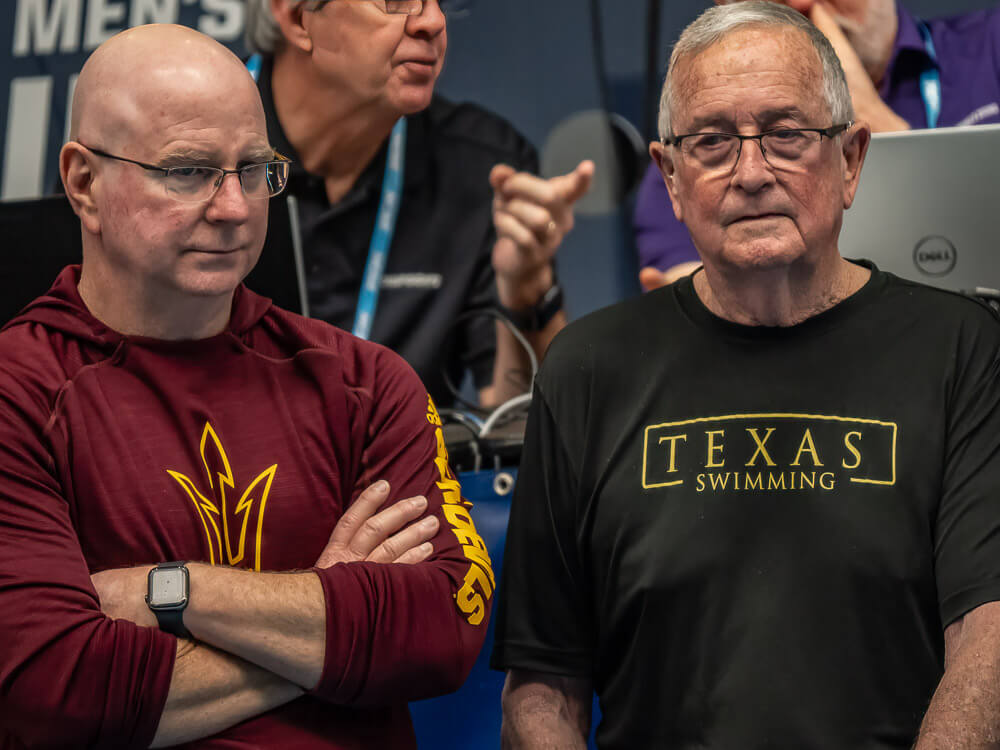
Photo Courtesy: Peter H. Bick
click here to read story of Bowman taking the helm at UT:
To read Bob Bowman’s ISHOF bio, click here: https://ishof.org/honoree/bob-bowman-usa/
To watch Bowman’s induction video and speech, click here: https://www.youtube.com/watch?v=xrwlaX4nRPo&t=15s
Happy Birthday Djurdjica Bjedov!!

Djurdjica Bjedov (YUG)
Honor Swimmer (1987)
FOR THE RECORD: OLYMPIC GAMES: 1968 gold (100m breaststroke), silver (200m breaststroke); OLYMPIC RECORD: (100m breaststroke); Many time Yugoslavian National Champion and record holder; First Yugoslavian swimmer to win an Olympic gold medal.
As the only swimming gold medalist Yugoslavia ever had, Djurdjica Bjedov may just be the all-time Cinderella of the modern Olympics. She is certainly a wonderful story on why it pays to be ready because no one really knows when their big chance might come. Swimming’s miracle wonder story went something like this:
The best Bjedov had ever done was third in her heat at the European Championships two years before her 1968 Olympics in Mexico City. The Yugoslavian Swimming Federation decided they had to take her to the Olympics because they had no other breaststroker for their medley relay (which was ultimately disqualified in the preliminaries because she jumped on her relay start). Bjedov qualified fifth in the 100 meter breaststroke in a final in which the odds were on favorite, world record holder Catie Ball of the United States who placed a sub par fifth because of a serious intestinal disorder. The formidable field that remained included Galina Prosumenschikova, the only European to have won a gold medal fours earlier at Tokyo.
Everyone was worried about the altitude affecting their performance, something Bjedov thought might improve her chances. She was fit, and she was ready, and she had made the finals. To everyone’s surprise, the unknown from Split, Yugoslavia, came through to win in Olympic record time. A few days later she almost did it again in the 200. Qualifying seventh, she swam in an outside lane, topped her best previous time by three seconds and again beat the Soviet Prosumenschikova, but this time she was the only Yugoslavian swimmer to win a silver medal as American Sharon Wichman came on to win the event.
Happy Birthday Franziska van Almsick!!

Franziska van Almsick (GER)
Honor Swimmer (2010)
FOR THE RECORD: 1992 OLYMPIC GAMES: silver (200m freestyle, 4x100m medley relay), bronze (100m freestyle, 4x100m freestyle relay); 1996 OLYMPIC GAMES: silver (200m freestyle, 4x200m medley relay), bronze (4x100m freestyle relay); 2000 OLYMPIC GAMES: bronze (4x200m freestyle relay); 2004 OLYMPIC GAMES: bronze (4x100m medley relay, 4x200m freestyle relay); TWO WORLD RECORDS: 200m freestyle; FOUR WORLD RECORDS (25m): 50m freestyle (1), 100m freestyle (2); 200m freestyle (l); 1994 WORLD CHAMPIONSHIPS: gold (200m freestyle), silver (4x200m freestyle relay), bronze (100m freestyle, 4x100m freestyle relay), 1998 WORLD CHAMPIONSHIPS: gold (4x200m freestyle relay), silver ( 4x100m freestyle relay); 1993 EUROPEAN CHAMPIONSHIPS: gold (50m freestyle, 100m freestyle, 200m freestyle, 4x100m freestyle relay, 4x200m freestyle relay, 4x100m medley relay), silver (200m butterfly); 1995 EUROPEAN CHAMPIONSHIPS: gold (100m freestyle,400m freestyle, 4x100m freestyle relay, 4x200m freestyle relay, 4x100m medley relay) silver (50m freestyle), 1999 EUROPEAN CHAMPIONSHIPS: gold (4x100m freestyle relay, 4x200m freestyle relay), silver (4x100m medley relay), 2002 EUROPEAN CHAMPIONSHIPS: gold (100m freestyle, 200m freestyle, 4x100m freestyle relay, 4x200m freestyle relay, 4x100m medley relay); WORLD SWIMMER OF THE YEAR: 1993; GERMAN SPORTSWOMAN OF THE YEAR: 1993, 19995, 2002; EUROPEAN SWIMMER OF THE YEAR: 1993, 1994, 2002; WORLD SWIMMER OF THE YEAR: 1993.
Growing up in Berlin, Germany in the former GDR, “Franzi” loved swimming, joined a team and by the time the Berlin Wall came down in 1989, she was ready to burst onto the international swimming scene. At age 14, at the 1992 Olympic Games in Barcelona, she was the youngest participant of the re-united German team, and sensationally won the 200m and 1 OOm freestyle silver and bronze medals, as well as silver and bronze medals on Germany’s medley and freestyle relays. She set the 200m freestyle World Record at the 1994 World Championships in Rome, breaking an eight-year record held by Heike Friedrich, the last of the GDR swimmers. She broke her own record in 2002 in Berlin. Overall, her 200m freestyle World Record stood for 13 years until broken by Federica Pellegrini of Italy in 2007. Franziska held the record longer than any other female in that event except for Hall of Fame swimmer Ragenhild Hveger of Denmark from 1938 to 1956.
Competing in another three Olympic Games, she won a total of 10 silver and bronze freestyle medals, the most of any female swimmer until surpassed by Hall of Farner Jenny Thompson (USA) with 12 medals, also in 2004.
Swimming for SC Dynamo Berlin, she competed at four European Championships between 1993 and 2002 winning 18 gold and silver medals. She is a three-time German Sports Woman of the Year, (1993, 1995, 2002), two-time European Swimmer of the Year and the 1993 World Swimmer of the Year.
Happy Birthday Péter Biros!!

Péter Biros (HUN)
Honor Water Polo (2016)
FOR THE RECORD: 1998 WORLD CHAMPIONSHIPS: silver; 2000 OLYMPIC GAMES: gold; 2003 WORLD CHAMPIONSHIPS: gold; 2004 OLYMPIC GAMES: gold; 2005 WORLD CHAMPIONSHIPS: silver; 2007 WORLD CHAMPIONSHIPS: silver; 2008 OLYMPIC GAMES: gold
Hungary is a land of thermal springs and although landlocked, swimming and water sports are ingrained in their culture. This love of water led to an early domination of international swimming and diving competitions in the late 19th and early 20th century. In the 1920s, it was water polo that came to symbolize Hungary’s unique strengths and individuality. From 1928 to 1980, the Hungarian National Water Polo Team dominated the sport like no other nation, reaching the podium at twelve consecutive Olympic Games. During this streak the Hungarians won six gold medals, three silver medals, three bronze medals, and back to back titles twice: 1932 and 1936 and, 1952 and 1956. It came to be that anything less than the gold medal was considered a failure.
So it became something of a national catastrophe and source of embarrassment when the pride of Hungary failed to medal in four consecutive Olympic contests. After finishing fourth in 1996, the Federation reached out to a young coach, who had made a name for himself coaching in Italy and Australia, to rescue the program.
Denes Kemeny started by building his team around two young men who had helped Hungary finish fourth at the 1996 Games in Atlanta: Tibor Benedek and Tamas Kásás.
Benedek was one of the most talented youngsters to ever play the game. He had joined the National Team as a teenager prior to the 1992 Olympic Games. His speed, quickness, rifle left arm and goal-scoring in Barcelona earned him the Hungarian Player of the Year titles in 1992, 1993 and 1994.
Tamas Kásás took up water polo at the age of six, being taught by his father Zoltan, a famous coach and silver medalist in 1972. Because of his world-class swimming speed, defensive skills, accurate shooting and passing he would come to be regarded as one of the world’s best defensive and all around players of his era.
Born in Szeged, Tamás Molnár was selected for the national team in 1997. He was a powerhouse at the all-important center position and could score or draw exclusions against the best defenders in the world.
The youngest to join the team in 1997, was 19-year old Gergely Kiss. He was not only a brilliant left-hander and center defender, but at 6’6”, 245 pounds, he was one of the most physically intimidating players in the sport.
It was 1998 when Péter Biros joined the team. Born in Miskolc, Biros had combined water polo with handball until the age of 17. He could play any position and could score from anywhere in the pool.
The final piece of Kemeny’s team was the goalkeeper, 21-year old Zoltán Szécsi. Standing 6’6” tall, he had learned to swim as an infant, but grew up playing a variety of other sports, like basketball and tennis, which was good training for his position.
Kemeny’s new approach brought immediate results, as the Hungarians won gold at the 1997 European Championships, silver at the 1998 FINA World Championships and gold at the 1999 World Cup.
At the 2000 Sydney Games, Hungary regained its Olympic water polo success by winning their first Olympic medal in 24 years, and their record seventh water polo gold medal, by routing Russia, 13-6.
Four years later, at the 2004 Athens Olympic Games, Gergely Kiss scored four goals, including the game-winner in an 8-7 come-from-behind victory over Serbia-Montenegro to defend their title.
In Beijing, at the 2008 Olympic Games, the Hungarians faced off against the surprising team from the USA. In a wild shoot out, the Magyars took command in the fourth quarter for a 14-10 victory.
The win gave Hungary an unprecedented third consecutive Olympic title. While a total of 21 players won Olympic gold medals playing for Hungary over the period of 2000 to 2008, only six own three by themselves. It is to them, and their coach, that we honor the Hungarian Men’s National Water Polo Team as the first team to be inducted into the Hall of Fame.