
Happy Birthday Donna DeVarona!!

Donna DeVarona (USA)
Honor Swimmer (1969)
The information on this page was written the year of their induction.
FOR THE RECORD: OLYMPIC GAMES: 1960 (participant); 1964 gold (400m individual medley, 4x100m freestyle relay), 5th (100m butterfly); WORLD RECORDS: 8 long course events; AMERICAN RECORDS: 10 short course events (she broke and re-broke her World and American records in these events many times); NATIONAL CHAMPIONSHIPS: 37 individual titles in backstroke, butterfly and freestyle (including 18 gold medals and 3 national high point awards); AWARDS (1964): America’s Outstanding Woman Athlete, Outstanding American Female Swimmer, San Francisco’s Outstanding Woman of the Year, Mademoiselle Award, National Academy of Sports Award, and others.
What Eleanor Holm and Esther Williams were to the “Aquacades” 20 years earlier, Donna deVarona was to swimming in the 1960s. Her glamour and showmanship seen on television, in swimsuit ads, and as an after-dinner speaker are a popular reflection of a swimming record second to none in her time.
Miss deVarona won 37 individual national championship medals, including 18 golds and three national high point awards. She held world records in 8 long course events and American records in 10 short course events, which would have been world records if FINA still recognized 25 yard pool times as they did until 1957. Most of Donna’s world and American records were broken and re-broken numerous times by Donna herself, so she actually held many times more records than the 18 events she held them in.
Her versatility is reflected in her absolute dominance of the tough four stroke Individual Medley, often thought of in tract terms as “the decathlon of swimming.” She further won national titles and set world fastest times in 3 of the 4 strokes in individual events (backstroke, butterfly, and freestyle), establishing herself at various times as the world’s fastest as well as the world’s best all-round swimmer of her day. Her day was a 5-year period which extended from the Rome Olympics until retirement after the Tokyo Games. She was the youngest American on the 1960 team, and four years later she won two gold medals.
In between and following these two Olympics, she was the Queen of Swimming and was so recognized by the International Swimming Hall of Fame at its first International Meet in 1965. During her reign, as most photographed woman athlete, Donna was cover girl on “Life”, “Time”, “Saturday Evening Post” and twice on “Sports Illustrated”.
Her biggest award year was 1964 when she was voted America’s Outstanding Woman Athlete, Outstanding American Female Swimmer, and San Francisco’s Outstanding Woman of the Year, plus the Mademoiselle Award, National Academy of Sports Award and many others in as many languages. She has represented the United States, “doing her thing” in Australia, New Zealand, Germany, Japan, Netherlands, Peru, Brazil, England and Italy.
Happy Birthday Tom Stock!!
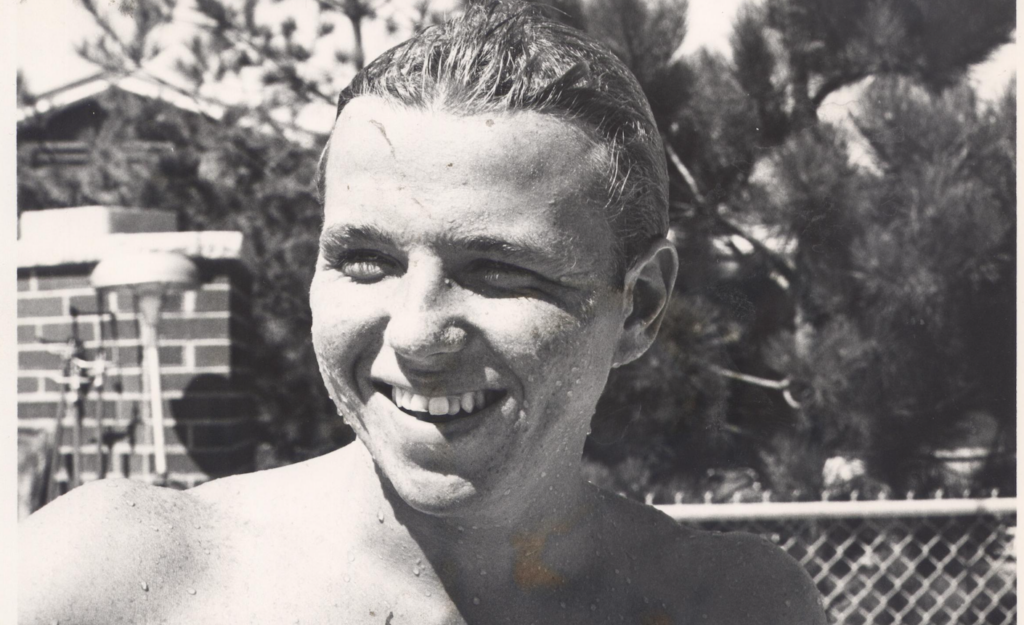
Tom Stock (USA)
Honor Swimmer (1989)
The information on this page was written the year of their induction.
FOR THE RECORD: WORLD RECORDS: 10 (100m, 200m, 220yd backstroke; relays); AAU NATIONAL CHAMPIONSHIPS: 11 (100m, 200m, 220yd backstroke; relays; AMERICAN RECORDS: 14 (200yd, 220 yd, 100m, 200m backstroke; relays).
Tom Stock may just be the greatest backstroker who never swam in the Olympics, due to prolonged illness before the 1964 Olympic Games. He may have been the smallest backstroker to hold a world record. He weighed in at 130 lbs. and set 10 world records. When he was in his second month of competition at Indiana University, Stock became the first man in history to swim the 200 yard backstroke under 2 minutes. This was a performance that caused his coach, “Doc” Counsilman to put a sign on the locker room door which said, “It’s not the size of the dog in the fight, but the size of the fight in the dog.”
This desire and an amazing feel of the water, long arms and a powerful kick, made Tom Stock great in the opinion of his famous coach. To the spectators he looked like he was riding on top of the water from the waist up. This unique buoyancy, plus the fastest arm turnover yet seen in backstroke, took him to 11 National championships, 14 American records and five world records in the 100 meter, 200 meter, 110 yard, 220 yard backstroke and the 400 meter medley relay. For four years he was the World Record holder and “King” of the 200 meter backstroke.
It started just after the Rome Olympics and finished just before Tokyo in 1964. In between, he victoriously represented the USA in Japan, South America, and Europe and was The American Swimmer of the Year in 1962. Stock had only two coaches, Dave Stacy at Bloomington, Illinois and “Doc” Counsilman at Bloomington, Indiana. He missed making the 1960 U.S. Olympic team by a judge’s decision. They took only two and not three as chosen in previous Olympics.
Happy Birthday Milena Duchkova!!

Milena Duchkova (CZE)
Honor Diver (1983)
The information on this page was written the year of their induction.
FOR THE RECORD: OLYMPIC GAMES: 1968 gold (platform), 1972 silver (platform); EUROPEAN CHAMPIONSHIPS: 1970 gold (platform); EUROPEAN CUP: 1967, 1971 gold (platform); WORLD CHAMPIONSHIPS: 1973 silver (platform); CZECHOSLOVAKIAN NATIONAL CHAMPIONSHIPS: 62 (1965-1977); ITALIAN CHAMPIONSHIPS: 3; EAST GERMAN INTERNATIONAL CHAMPIONSHIPS: 3; SWEDISH CUP: 1; Swimming World magazine’s World’s most outstanding female “Platform Diver of the Year”: 1968, 1970.
Milena Duchkova won Czechoslovakia’s first, second and only Olympic medals in any aquatic sport and she was the first female tower diver from any country to score more than 100 total points in the Olympics. This courageous little (5′ 2 1/2″) tower diver with the big eyes and the cute button nose started diving at age 12 and won the Olympics at 16, in 1968, although she wasn’t sure until two weeks before the Olympics that she would be allowed to go to Mexico for the competition. Her country was occupied by the Russians at that time, and she had to cross a bridge guarded by Soviet guards each day to train. She came back to win the silver medal in 1972 and competed (without medaling) in 1976 after she had shoulder surgery 8 weeks before the Games. She received the Czechoslovakian “President’s Award of Distinction” in 1972. Milena was a member of the Czech Olympic Committee and official medical doctor for the Czech diving team in 1978-1979. She began coaching in Prague 1978-1980 and in 1980 moved to Canada as head diving coach for the Newfoundland diving team, acting also as a coach and consultant to the Canadian National diving team. A brilliant student as well as athlete, Milena is fluent in 6 languages, won her Master of Sport ’66. Meritorious Master of Sport ’68, and coaching certificate also ’68. She graduated as an M.D. in 1977 into the faculty of medicine with a specialty in dental surgery. On immigrating to Canada, she worked her way through dental school at the University of Manitoba in two years and is presently on the faculty while still coaching the Pan Am Diving Club in Winnipeg. Her coach was Marie Cermakova throughout her diving career.
Happy Birthday Marco D’Altrui!!

Marco D’Altrui (ITA)
Honor Water Polo (2010)
The information on this page was written the year of their induction.
FOR THE RECORD: 1992 OLYMPIC GAMES: gold; 1984, 1988 OLYMPIC GAMES: 7th; FINA WORLD CHAMPIONSHIPS: 1994, gold; 1986, silver; FINA CUPS: 1983-bronze; 1985, 1987-5th, 1989-silver; 1993-gold; 1983 MEDITERRANEAN GAMES: bronze; 1987, 1990 MEDITERRANEAN CHAMPIONSHIPS: gold; 1983 EUROPEAN CHAMPIONSHIPS: 6th; 1985 EUROPEAN CHAMPIONSHIPS: 4th; 1987, 1989 EUROPEAN CHAMPIONSHIPS: bronze; 1993 EUROPEAN CHAMPIONSHIPS: gold.
For the first time in history, the International Swimming Hall of Fame is recognizing a father and son as one, jointly in the same year. This honor goes to three-time Olympic water polo players Giuseppe and Marco D’Altrui of Italy.
Giuseppe “Geppino” D’Altrui was born in Naples on April 7, 1934. He played in over 300 Series A games, from 1952 through 1964. Coached by Hall of Famer Mario Majoni, Giuseppe competed in 75 Italian National Team games from 1954 to 1964. He was a member of the 1956 Italian Olympic Team that competed in Melbourne finishing fourth, but as the Captain of the 1960 Olympic Team, he helped to lead his team to a gold medal victory in front of a home-town crowd at the Rome Olympic Games. He was also Captain of the 1964 Olympic Team that just finished out of the medal count.
Giuseppe’s love for the game flowed naturally from his love of being in the water. “I can say that I have spent more time in the water than on earth and for me is never enough!”
Following in the footsteps of famous fathers can be a difficult burden for young athletes and few are the ones who achieve the same level of success. But for Marco, who was born on April 24, 1964, following in the wake of his father came as naturally as learning to swim, which he did before he was three years of age. “For me to stay in the water was a game, fun, a hobby. I was diving and played with the ball in full freedom from the time I was three,” says Marco.
From his father’s example Marco learned to love the water and the dedication, commitment and time management skills that make a champion. He played in over 700 Series A matches as a member of Recco and Pescara and like his father before him was a member of the national team for ten years. In 1984 and 1988 he was on the Olympic teams that finished 7th in Los Angeles and Seoul. Then, playing for Hall of Fame coach Ratko Rudic, at the 1992 Olympic Games, Marco and the Settebello once again won the gold, 32 years after his father. As a great defensive player, Marco helped to keep his opponents from scoring, resulting in a grand slam of the Italian National Team from 1992-1994 (Olympic Games, World Championships, European Championships) and a grand slam of European Cups (Euro League Cup, Winners Cup, LEN Cup and LEN Super Cup).
“When athletes are young,” says Marco, “certainly the most credit goes to parents for their commitment both in terms of organization of management of daily life. I have no regrets at the sacrifices and am delighted to have followed in the footsteps of my father. Perhaps the best thing about the gold medal won in Barcelona was just to see the joy and emotion of my parents when I got off the plane with the medal around my neck. To win the Olympics was a dream that I’ve always had and it has accompanied me since I played with a small ball in the shallow water. I always wanted to imitate my father, who had won the gold medal at the Olympics in Rome. It goes to show that if you dream it, and work hard, you can do it.”
Happy Birthday Xu Yiming!!

Xu Yiming (CHN)
Honor Coach (2003)
The information on this page was written the year of their induction.
FOR THE RECORD: 1988, 1992, 1996, 2000 OLYMPIC GAMES: Head Diving Coach (men, women); Coach of OLYMPIC DIVERS: winning 15 gold medals, 4 silver medals, 1 bronze medal; NATIONAL TEAM HEAD COACH: 1985-2000; 1982, 1986, 1991, 1994, 1998 WORLD CHAMPIONSHIPS: Head Diving Coach (men, women); Coach of WORLD CHAMPIONSHIP DIVERS: winning 10 gold medals, 7 silver medals, 4 bronze medals; Served Four Terms on FINA TECHNICAL DIVING COMMITTEE 1984-2000.
Born in 1942 in Guang Dong Province, China, Xu Yiming was destined to lead his country to world dominance in the sport of diving. He began as an eight-year-old diver, diving for Coaches Lui Chen Hai (1950-1960) and then Chen Kuan Xian (1960-1973). But it was not until age 30, in 1972, that he won the 10-meter platform event at the China National Games. The next year, Xu took the step from competitor to coach and started a dynasty of World and Olympic Champions.
From his coaching debut in 1973, Xu rapidly ascended in coaching success. With a strong sense of responsibility, he felt ill-at-ease about China’s slow progress in diving. He was convinced that the Chinese divers would some day do as well as any great divers in the world, provided that they broke away from conventional training methods and tried something new. Trainees used to practice basic somersault skills on a trampoline while a complete dive had to be tried over the pool at the risk of getting whopped by the water. With his diving experience, Xu knew only too well what a belly-flop was like. After carefully studying the training methods used by other coaches, he invented a new device for trampoline exercise. With two pulleys fixed on the ceiling and a belt attached to the waist of the trainee, he was able to increase the height of flight and the speed of somersaults to lengthen the time of descent so that the trainee could take his time in completing a sophisticated dive with his eyes open in the air.
It was with this new method of training that, at the 1974, 7th Asian Games in Teheran, the Chinese Diving Team swept all four gold medals. His first star pupil, Li Kongzhen, then only 15, was a victor.
Xu became five-times Olympic Diving Coach (1984, 1988, 1992, 1996, 2000) and from 1984-2000, coached divers to 15 gold medals, 4 silver medals and 1 bronze medal in Olympic competition, winning more than one-half of the available gold medals in those five Olympiads. In his 16 years as National Team Head Coach, Xu’s Olympic and World Championship medal winners include: Li Conejeng (platform 1984 Olympic bronze, 1986 World Championships silver); Tan Liangde (3m springboard 1984, 1988 and 1992 Olympic silver); Zhou Jihong (platform 1984 Olympic gold); Chen Lin (platform 1986 World Championships gold); Xu Yanmei (platform 1988 Olympic gold); Gao Min (3m springboard 1988 and 1992 Olympic gold); Sun Shuwei (platform 1992 Olympic gold); Fu Mingxia (platform 1992 Olympic gold, 3m springboard and platform 1996 Olympic gold, 3m springboard 2000 Olympic gold); Xiong Ni (3m springboard 1996, 2000 Olympic gold); Tiao Liang (platform 2000 Olympic gold); Xiong Ni / Xiao Hailiang (3m springboard synchro 2000 Olympic gold); Tian Liang / Hu Jia (10m platform synchro 2000 Olympic silver); Guo Jingjing / Fu Mingxia (3m springboard synchro 2000 Olympic gold); and Li Na / Sang Xue (10m platform synchro 2000 Olympic gold).
Xu was also “coaching” the coaches to advance their level of technique. Eighty percent of all diving coaches attended his two- to four-month long seminars held throughout the provinces.
From 1984-2000 Xu served four terms on the FINA Technical Diving Committee. In 1996, he offered and edited Basic Diving Coaching Manual, a 412-page publication presented by FINA to the world diving community. Printed in multiple languages, it describes his training methods used from 1973-1995 and includes new, innovative dryland equipment he introduced.
In 2000, FINA appointed Xu to produce a 10-volume video series on diving coaching which includes material from his first publication as well as new methods used from 1995-2002.
Xu is engaged to establish an international diving training center with all amenities and has designed competitive stadiums throughout China including Beijing, Shanghai and Guangzhou as well as at TsingHua University in Beijing. New dryland training facilities are designed with each location.
To Xu, success lies with strict discipline. You can never train too long or too hard. A perfectionist, Xu has an insatiable desire for success. He trains children into world champions.
Happy Birthday Mary Kok!!

Mary Kok (NED)
Honor Swimmer (1980)
The information on this page was written the year of their induction.
FOR THE RECORD: OLYMPIC GAMES: 1956 (boycott); WORLD RECORDS: 10 (440yd, 880yd, 800m, 1760yd freestyle; 100yd, 100m butterfly; 400yd, 400m individual medley; 1 relay) from 1955 to 1957.
Hall of Fame coach Jan Stender developed 8 world record holders living on one street in Hilversum, Holland, in 1955. Yet neither coach Stender nor any of his Dutch swimmers were allowed to compete in the 1956 Melbourne Olympics. This boycott which the Dutch Government called as a protest to the Russian repression of the Hungarian Revolution was toughest on Mary Kok, perhaps the finest of the Dutch swimmers and the world’s most prolific record holder (10) in 1955. The versatile Mary (no relation to Hall of Famer Ada Kok) held the middle distance freestyle records and was one of the first world record holders in the four stroke individual medley and the butterfly stroke. After the 1956 Olympics, Mary Kok became one of the world’s greatest marathon swimmers. She is currently married to Kees Oudegeest coaching in Spain.
Happy Birthday Martin Lopez Zubero!!

Martin Lopez Zubero (ESP)
Honor Swimmer (2004)
The information on this page was written the year of their induction.
FOR THE RECORD: 1988 OLYMPIC GAMES: 11th (200m backstroke); 1992 OLYMPIC GAMES: gold (200m backstroke), 4th (100m backstroke), 7th (100m butterfly); 1996 OLYMPIC GAMES: 4th (100m backstroke), 6th (200m backstroke); FOUR WORLD RECORDS: 2-200m backstroke (L.C.), 2-200m backstroke (S.C.); 1991 WORLD CHAMPIONSHIPS: gold (200m backstroke), bronze (100m backstroke); 1994 WORLD CHAMPIONSHIPS: gold (100m backstroke), silver (200m backstroke); 1989, 1991, 1993, 1997 EUROPEAN CHAMPIONSHIPS: 5 gold (4-100m backstroke, 1-200m backstroke (’91)), 2 silver (1-200m backstroke (’93), 1-100m butterfly (’91); Over 20 SPANISH NATIONAL CHAMPIONSHIPS; Over 6 SPANISH NATIONAL RECORDS: 50m, 100m, 200m backstroke, 100m, 200m butterfly, 200m I.M. (LCM, SCM); 4 NCAA NATIONAL CHAMPIONSHIPS: 2-200y backstroke, 1-200y I.M., 1-4x100m medley.
Martin Lopez Zubero was born April 23, 1969, with Spanish-American citizenship in Jacksonville, Florida, USA. Swimming became the sport of his family, and at the age of 11, this skinny little kid watched his big brother David win the Olympic bronze medal in the 100m butterfly at the 1980 Moscow Games. At that time, he decided that he wanted to go to the Olympic Games too. Sister Julie was also an Olympian, both for Spain.
Martin progressed as an age-group swimmer. He competed for Coach Greg Troy at Bolles School and Coaches Randy Reese and Skip Foster at the University of Florida. Older brother David was always there as Martin’s personal coach. Ron Ballatore coached him at the Florida Aquatic Swim Team (FAST), post university level.
On the international scene, Martin became an unbeatable machine. He competed on three Olympic teams – 1988, 1992, 1996. He was 11th in the 200m backstroke at the Seoul Olympics of 1988 but came back four years later in Barcelona to capture the gold medal. At these 1992 Olympic Games, he was also 4th in the 100m backstroke and 7th in the 100m butterfly. Again in Olympic competition four years later in Atlanta, 1996, he finished 4th in the 100m backstroke and 6th in the 200m backstroke.
Zubero was a two-time world champion, winning the 200m backstroke at the 1991 Perth World Championships and the 100m backstroke at the 1994 Rome World Championships. He won the bronze medal for the 100m backstroke in 1991 and the silver medal for the 200m backstroke in 1994. He is a five-time European champion, winning the 100m backstroke in 1989 (Bonn), 1991 (Athens), 1993 (Sheffield) and 1997 (Seville). He was the 200m backstroke gold medalist in 1991 and silver medalist in 1993.
Swimming at the University of Florida, Martin was the 1991 NCAA Swimmer of the Year and four-time NCAA National Champion, winning the 200y backstroke in 1990 and 1991, the 200y individual medley in 1991, and the 4x100y medley relay in 1991.
Martin set four world records swimming backstroke. He was the first to swim under 1:58.00 for the 200m backstroke, when in 1991 at the Hall of Fame pool in Fort Lauderdale, he went 1:57.30, breaking Igor Poliansky’s (URS) six-year-old world record. Three months later in Tuscaloosa, Alabama, he went a 1:56.57, another world record which stood for eight years until broken by Lenny Krayzelburg (USA) in 1999. He set two short course world records in the 200m backstroke which held for almost nine years until broken again by Krayzelburg.
Martin won the 100m and 200m backstroke at the Goodwill Games of 1990 and 1994. He and his brother David are only the fourth set of brothers to win Olympic medals in swimming competition, the others being Duke and Sam Kahanamoku and Warren and Pau Kealoha of the 1920s and Bruce and Steve Furniss of the 1970s.
Martin graduated from the University of Florida in 1998 with a degree in health and human performance and recreation. He is the assistant head swimming coach at the Bolles School and has been the Florida Age Group Coach of the Year in 1998, 1999 and 2002 (American Swimming Coaches Association).
Amid Chinese Doping Controversy, We Remember When Rick DeMont Was Not Granted Similar Leniency

by JOHN LOHN – EDITOR-IN-CHIEF
21 April 2024, 05:30am
Amid Chinese Doping Controversy, We Remember When Rick DeMont Was Not Granted Similar Leniency
With the revelation that 23 Chinese swimmers tested positive for a banned substance ahead of the 2020 (2021) Olympic Games in Tokyo, several instances of inadvertent banned-substance have come to mind. Madisyn Cox and Markus Thormeyer, among them. Except in their cases, they were penalized with suspensions, not given the same leeway that the Chinese athletes have been granted.
At the 1972 Olympics, American distance star Rick DeMont was stripped of his gold medal in the 400-meter freestyle after following all correct procedures related to his use of asthma medication. He wasn’t given leniency, as is the apparent case with the recent Chinese situation. We turn to the archive to remind readers of the story of DeMont, who went on to enjoy a stellar coaching career.
The 50th anniversary of the 1972 Olympic Games is a week away. There will be celebrations of Mark Spitz’s iconic seven-gold show. We’ll remember the precociousness of Shane Gould, the Australian teenager whose five solo medals remain a female standard. And we’ll honor the backstroke greatness of Roland Matthes, who doubled in his events for the second straight Olympiad.
Golden anniversaries are supposed to be joyous occasions. But there is nothing celebratory about what about what Rick DeMont endured in Munich. DeMont’s story, a half-century later, remains a sporting crime, a young man deprived of his rightful place in history. A young man let down by the adults around him. A man, defined by extraordinary achievements in the coaching world, who does not possess what is rightfully his.
When DeMont arrived in Munich, he was one of the younger members of the American delegation. Spitz, of course, was the highest-profile name on the roster. Yet, DeMont was a leading contender for a pair of Olympic titles – in the 400 freestyle and the 1500 freestyle. In the longer event, DeMont was the world-record holder, having set that global standard at the United States Olympic Trials. Munich, quite simply, was the stage to verify his status as the world’s premier distance freestyler.
The 400 freestyle was DeMont’s first event of the Games, held a few days into the competition. By the time DeMont took the blocks, he had handled the necessary pre-Games protocols. Most critical for the 16-year-old was a meeting with United States Olympic Committee officials to complete paperwork regarding his asthma, and to denote the medications (Marax, Actifed, Sudafed) he took for the condition. At no point did officials raise any concerns.
Photo Courtesy: Swimming World
Once the 400 freestyle started, the race evolved into a two-man battle between DeMont and Australian Brad Cooper, considered the favorite for gold. Cooper held the lead for much of the race, including into the final lap. But relying on his greater closing ability, DeMont cut into Cooper’s lead and drew even as the wall neared. At the finish, the gold medalist could not be determined by the human eye, and it wasn’t until the scoreboard flashed the results that a victor was known. At the touch, it was DeMont who prevailed in 4:00.26, with Cooper the slightest margin back in 4:00.27.
“I’ve been swimming come-from‐behind style since I began,” DeMont said of his late rally. “At the United States Olympic Trials, I was strictly thinking of the 1500 meters. Now, I love the 400, especially after tonight.”
Since DeMont was stronger in the 1500 freestyle, a second gold seemingly awaited the American later in the meet. Any chance at a double, however, quickly evaporated. And so did the gold medal that DeMont had captured in the 400 freestyle. Following his apparent triumph in the eight-lap event, DeMont was informed that his post-race doping test revealed trace amounts of Ephedrine, a banned substance.
The presence of Ephedrine in his doping sample was hardly a shock, as the substance was contained in his asthma medication. The substance was also not supposed to be an issue, as USOC officials – following the processing of DeMont prior to the Games – were charged with the task of informing the International Olympic Committee of DeMont’s use for medical reasons. If the IOC had a problem with the substance, it would have notified the USOC and an alternative option would have been sought. The USOC, however, never engaged with the IOC on the topic.
“It was (the USOC’s) responsibility to let me know there was an illegal substance in my prescription and either get it cleared or find an alternative,” DeMont once said. “They failed to do it. I was only 16 years old. I relied on those officials to tell me what I could take, but somehow, I ended up paying the price. I guess it was easier to hang a 16-year-old kid out to dry than to tell the truth.”
Days after his apparent gold-medal swim, DeMont was stripped of his title, with Cooper elevated to the status of Olympic champion. As ugly as the situation was at that moment, it was about to get nastier. After DeMont’s urine test revealed the Ephedrine in his system, U.S. team doctors confiscated the medication DeMont was taking for his asthma. More, at a hearing with IOC officials, DeMont was peppered with questions while Team USA doctors sat quiet, offering no assistance or defense. Simply, DeMont was abandoned by the adults around him – those who dropped the ball in the first place and now refused to accept their role in the mess.
“It’s a gross injustice,” said U.S. Men’s Coach Peter Daland of the IOC’s decision to strip DeMont of his gold medal. “Young De Mont was robbed, robbed because of the mistakes of adults. (USOC personnel) knew of the boy’s medical record because he had it on paper. They said nothing to me or his head coach about it. The communications were atrocious. It’s a young man being punished when he should be applauded. He overcame asthma to win a gold medal and took nothing more than his doctor ordered.”
As the IOC weighed his case, DeMont qualified for the final of the 1500 freestyle. Even if his pursuit of an overturn of the 400 freestyle verdict failed, at least DeMont would get the chance to compete for another gold. Ultimately, that opportunity never materialized. As DeMont was preparing for the final of the 1500 freestyle and the possibility of redemption, United States assistant coach Don Gambrill, with tears running down his cheeks, approached the teenager and told him the IOC ruled he was not allowed to compete.
Reports from Munich indicate that multiple options were considered in the DeMont case. One scenario was to allow DeMont to race in the 1500 freestyle. Instead, the IOC went with the harshest choice, and banned DeMont from the Games. DeMont left Munich devastated. In the minds of many, he hadn’t committed an error, but instead was let down by officials who were supposed to provide support.
A year later, at the inaugural World Championships in Belgrade, DeMont engaged in a rematch with Cooper in the 400 freestyle and became the first man to break the four-minute barrier. DeMont was timed in 3:58.18, with Cooper also cracking the four-minute barrier in 3:58.70. DeMont also went under the existing world record in the 1500 freestyle but had to settle for the silver medal when Australian Stephen Holland blasted an even quicker time.
Photo Courtesy: Peter H. Bick
Following his competitive days, DeMont emerged as one of the world’s finest coaches. For years, he worked alongside Frank Busch at the University of Arizona, where he eventually served as head coach from 2014-17. During his coaching tenure at his alma mater, DeMont mentored a bevy of NCAA champions and became well known for establishing a pipeline between the program and South Africa. It is DeMont who is primarily credited for molding the South African 400 freestyle relay that won gold at the 2004 Olympic Games in Athens behind the efforts of Roland Schoeman, Lyndon Ferns, Darian Townsend and Ryk Neethling. DeMont served as a South African coach in Athens and coached every member of that relay.
In 2001, DeMont was provided with a measure of vindication when the USOC honored him at a banquet and presented him with a black leather jacket given to all 1972 Olympians. The IOC, however, has not taken steps to restore DeMont’s gold medal, despite several conversations on the topic through the years.
“I don’t need any ceremonies,” DeMont said. “I don’t need any hoopla. I just want the IOC to repair the historical record.”
Happy Birthday Judith van Berkel-de Nijs!!

Judith van Berkel-de Nijs (NED)
Honor Open Water Swimmer (2014)
The information on this page was written the year of their induction.
FOR THE RECORD: WORLD PROFESSIONAL MARATHON SWIMMING FEDERATION LADIES CHAMPION 1965–1968; ENGLISH CHANNEL CROSSING: 1969; WINNER OF MANY MARATHON RACES FOR BOTH MEN AND WOMEN.
When women’s swimming was added to the Olympic program in 1912, it was inconceivable that women could ever compete equally against men in sports. The impossible became possible when Gertrude Ederle beat the record time of the male Channel swimmers in 1926.
Before the 1990’s, professional marathon swimming was unique in the world of sports with its inter-gender competitions. Men and women competed head-to-head, mano-o-mano for the same prize money and some extraordinary women often came out on top. In the 1950’s Greta Anderson beat every male marathon swimmer of her era at least once. And then came Judith de Nijs.
Judith was born in Hilversum, Holland, where she trained under the famous Dutch coach and Hall of Famer, Jan Stender, with her older sister, Lenie. Both girls became record breaking, elite swimmers for their native Holland. Judith began her career, specializing in the 400 meter individual medley and in 1961, she set a European record in the event. She then began swimming longer distances, swimming the 1500 meter freestyle, where she became the national champion in the event in 1962.
Inspired by the success of the Flying Dutchman, Herman Wilemse, Judith began competing in open water competitions in 1962. But when she entered the Canadian National Exposition, in 1964, she was a relative unknown among a field of the greatest marathon swimmers ever assembled. The CNE race was a grueling 32 miles across Lake Ontario from Toronto to St. Catherines, in near frigid waters. Almost from the start, Judith and the race favorite, the great Egyptian, Abdellatief Abouhief, swam shoulder to shoulder, trading short leads for fourteen hours before the Egyptian made his move. By then, thirteen of the eighteen swimmers who started the race suffered hypothermia and were pulled from white-capped, 53 degree water. Sixteen hours into the race, Judith, insensible was pulled out and 2 miles short of the finish line, Abouheif, suffered the same fate. While the cruelty of the swim marked the end of the CNE marathon, it was the beginning of Judith’s great career. From 1965 to 1968 and again in 1970, she was ranked number one in the world and in 1969, she joined Hall of Famer, Ada Kok, as the second Dutch woman to swim the English Channel.
In 1968, de Nijs kept to her aquatic roots and married Dutch water polo player, Bob van Berkel. They had a daughter and a son who both played water polo. Judith continues to swim competitively through Masters Swimming, winning national titles. She swims the freestyle events, and currently holds records in the 100 and 200 meter freestyle events.
Like Ederle, Gleitze, and Anderson, Judith helped move the gender-equity movement forward with her courageous swims.
Happy Birthday Eraldo Pizzo!!

Eraldo Pizzo (ITA)
Honor Water Polo (1990)
The information on this page was written the year of their induction.
FOR THE RECORD: OLYMPIC GAMES: 1960 gold; EUROPEAN CUP: 1965 gold; EUROPEAN CHAMPIONSHIPS: 3 (1958, 1966, 1970); Member of Olympic Teams (1960, 1964, 1968, 1972).
Contemporaries say Italy’s Eraldo Pizzo had no peers during his 12 years of high scoring, world class water polo. He burst on the world scene in the 1960 Olympics, leading his team to a Rome gold at home. He made every Italian Olympic team and every all-star selection in the next few Olympics, 1960, 1964, 1968, and 1972, but never again did the Italian team medal, in spite of winning three European Championships in 1958, 1966, and 1970 against the teams that beat them in the Tokyo, Mexico City and Munich Olympics. It is a tribute to Eraldo Pizzo, Mr. Italian Water Polo, that the Hungarians, Russians and Yugoslavs were unanimous in saying his time in the International Swimming (and Water Polo) Hall of Fame was overdue. During a 29 year career in top competition, Pizzo played on the Italian National team 178 times. His final world match was against the United States in the Munich Olympics in 1972, but he played ten more years of club competition in Italy for one of the longest careers in water polo history. Pizzo was on 15 Italian Water Polo teams. He was the top scorer in 1962 (27 goals) and in 1969 (69 goals). When he retired as an active player in 1982, he became the Pro Recco’s Club President for the next three years. He was elected to the International Water Polo Hall of Fame in 1984 and has received Athlete of the Year, Sportsman of the Year and Golden Swimmer Awards. He was decorated by the Italian President after receiving the Carnegie Foundation Silver Medal in 1984.