
Happy Birthday Danyon Loader!!

Danyon Loader (NZL)
Honor Swimmer (2003)
The information on this page was written the year of their induction.
FOR THE RECORD: 1992 OLYMPIC GAMES: silver (200m butterfly); 1996 OLYMPIC GAMES: gold (200m, 400m freestyle); FOUR WORLD RECORDS: 3-200m butterfly (s.c.), 1-400m freestyle (s.c.); 1994 WORLD CHAMPIONSHIPS: silver (200m butterfly), bronze (200m, 400m freestyle); 1994 COMMONWEALTH GAMES: gold (200m butterfly), silver (400m freestyle, 4x100m freestyle, 4x200m freestyle), bronze (200m freestyle); 1993 PAN PACIFIC CHAMPIONSHIPS: gold (200m butterfly), bronze (100m butterfly); 1995 PAN PACIFIC CHAMPIONSHIPS: gold (200m freestyle), silver (400m freestyle); 58 NZL NATIONAL RECORDS.
At the 1996 Atlanta Olympic Games, Danyon Loader’s first-place finish in both the 400m and 200m freestyles distinguished him as his country’s first Olympic gold medallist in swimming since New Zealander Malcolm Champion swam on a combined Australasia Team (New Zealand and Australia) in the 4 x 200m freestyle relay at the 1912 Olympic Games in Stockholm, Sweden. Loader was his country’s first swimmer to break world records (short course) in two different strokes, butterfly and freestyle. (New Zealander Pip Gould had set world backstroke records in the 100y, 220y, 100m and 200m events in 1957 and 1958.) He won gold medals in Commonwealth Games and Pan-Pacific Championships and won silver and bronze medals at World Championships. Unwantingly, he became a New Zealand hero and his country’s most successful international swimmer ever.
As a child, Danyon loved being in the water. He would voluntarily take up to four baths a day. His dad, Peter, taught him to swim at the Forbury Indoor Swimming Pool in South Dunedin. At age ten he joined the Zenith Amateur Swimming Club in Dunedin, but spent all of his time trying to get out of training, playing video games and hanging out. “I can remember that before Mom came to pick me up I’d wet my hair and togs and towel so that she thought I had been training,” he would say.
Then, in 1988, at age 12, he joined Coach Duncan Laing’s squad and his swimming career never looked back. Duncan became his mentor. He guided Danyon through a career in which Loader became the fastest swimmer in the world in his events. By age 13 he had won medals in the New Zealand National Age Group Championships and he soon began winning events on the national level. At the young age of 14, he represented New Zealand at the 1990 Auckland Commonwealth Games. Only 2-1/2 years later, as still a young 17-year-old, at the 1992 Barcelona Olympics, he surprised the world when he won the silver medal behind USA’s Melvin Stewart in the 200m butterfly. His international dominance was breaking through, and in his humble fashion he was swimming because he enjoyed it and not because he was addicted to the thrill of being number one. The world was now watching this up-and-coming athlete from New Zealand.
Improvement and success were in play each year. In 1993, he set the 200m butterfly short course world record three times in eight days during the European World Cup Tour. The next year, at the 1994 Commonwealth Games in Victoria, he won gold in the 200m butterfly, silver in the 400m freestyle and both freestyle relays and bronze in the 200m freestyle behind the established Kieren Perkins of Australia. He medaled in the same events at the Rome World Championships later that year.
In 1995, Loader won eight gold medals on the World Cup circuit in Europe, breaking the 400m freestyle short course world record in the process. But this was only the prelude to the next year’s 1996 Atlanta Olympic performance where he won gold medals in both the 200m and 400m freestyles, an Olympic feat accomplished only once before by Evgeni Sadovy of the Russian Unified Team in 1992.
Loader did all of his training with Duncan Laing at their hometown Moana Pool and later while attending Otaga University. Danyon was very low key and never pursued the limelight. According to Coach Laing, “He is a normal Kiwi lad at heart. He just does and gets results. He’s just one of those guys who goes into action and swims to win. Beneath the laid-back exterior is a steely determination, an absolute commitment to fulfill his potential. He does not speak of it, he just does it.” Australian Coach Don Talbot called him “The Quiet Assassin.”
All totaled, he set four world records – three in the 200m butterfly, short course, and one in the 400m freestyle, short course. The 400m freestyle record held for 3-1/2 years until broken by Australian Ian Thorpe.
After Atlanta, Danyon continued swimming for another 2-1/2 years. He attended two semesters at the University of California Berkeley (1997). Without a whole lot of specific training, he competed at the 1998 Kuala Lumpur Commonwealth Games, winning a bronze medal as a member of the 4 x 200m freestyle relay. By the time he retired, he had set a record 58 New Zealand national records. But he preferred to go about his business with a minimum of fuss, Danyon Loader the person, not Danyon Loader the great swimmer. He practices Tai Chi for relaxation and is an accomplished SCUBA diver. Three months before the 1998 Commonwealth Games, he joined the New Zealand Army Territorial Force for service experience and to maintain his level of fitness. He has received the prestigious Lonsdale Cup by the New Zealand Olympic Commonwealth (1992) and was twice named Sportsman of the Year (1992, 1997) at the Halberg Awards. In 2000, he was named New Zealand Sportsperson of the Decade (1990s).
Danyon Loader is both ordinary and extraordinary, a quiet achiever who is an inspiration to thousands of his compatriots. He has most definitely raised the level of sport in New Zealand and around the world.
Happy Birthday Rick Demont!!

Rick Demont (USA)
Honor Swimmer (1990)
The information on this page was written the year of their induction.
FOR THE RECORD: WORLD RECORDS: 3 (400m, 1500m freestyle; relay); WORLD CHAMPIONSHIPS: 1973 gold (200m freestyle), silver (1500m freestyle); PAN AMERICAN GAMES: 1975 gold (relay), silver (200m freestyle); AMERICAN RECORDS: 4 (400m, 1500m freestyle; 2 relays); AAU RECORDS: 5 (400m, 1500m freestyle; relays); First under 4 minutes for 400m freestyle.
Rick DeMont was born in San Rafael California, April 21, 1956. It did not take him long to become a record breaker, as seen by his 10 and under age group national record. Rick developed as a dominant middle distance swimmer, leading to his first world mark of 15:52.91 in the 1500 meters freestyle at the age of 16.
Then it was the 1972 Olympic Games in Munich. At age 16, Rick DeMont became the youngest male swimmer ever to win the Olympic 400 meter freestyle, and he was favored to win the 1500 meter event too. He had already qualified for the finals. Then, suddenly he was removed form the pool, stripped of his medal and disqualified from any further competition. It seemed grossly unfair at the time, and times have not changed the feeling in most of us. It seems that Rick’s asthma medication included a trace of a substance called ephedrine, which was banned by the Olympic Medical Commission. When he was tested, it showed up in his sample. He made no attempt to hide it, for he had written it on his medical questionnaire form. The U.S. team doctors, not the 16 year old kid, were guilty. There was no way this trace of medication could have affected the outcome of DeMont’s race performance, even though he had been using medication to enable him to exercise with asthma since the age of four. However, the rule was innocently broken, and Rick is still hoping someday his case will be reviewed.
In 1973, at the first World Championships in Belgrade, Yugoslavia, DeMont won the 400 meter freestyle, without the banned substance, beating Brad Cooper, the Australian who had won DeMonts’s Olympic gold medal by default. Cooper, who wanted to win it in the pool, was magnificent, but he lost by .52 seconds as Rick won in a new world record of 3:58.18 the first man to break the four minute barrier for the distance. Cooper was also under the four minute barrier, but lost by a touch.
1973 is the same year Rick was voted World Swimmer of the Year.
Today, Rick is an artist living in California. His achievements as the best in the world will always remain.
Happy Birthday Alex Baumann!!

Alex Baumann (CAN)
Honor Swimmer (1992)
The information on this page was written the year of their induction.
FOR THE RECORD: OLYMPIC GAMES: 1984 gold (200m & 400m individual medley); PAN AMERICAN GAMES: 1979 bronze (400m individual medley); FINA CUP: 1979 gold (400m individual medley); WORLD RECORDS: 5 (200m individual medley), 5 (400m individual medley); COMMONWEALTH GAMES: gold, 2 (200m individual medley), 2 (400m individual medley); CANADIAN NATIONAL CHAMPIONSHIPS: 34 titles, 32 national records; WORLD CHAMPIONSHIPS: 1986 silver ( 200m individual medley), bronze (400m individual medley).
It was in 1912 that Canadian Olympian George Hodgson won gold medals in swimming for Canada. It was not until 72 years later that Alex Baumann of Sudbury, Ontario won the next gold medal for Canada in swimming. Baumann won the 200m and 400m individual medley, establishing world records in both. Bauman joins only two other Canadians to win in a summer Olympics before him–Hodgson and runner Percy Williams in 1928. Teammates Victor Davis and Ann Ottenbrite joined Alex as Olympic champions in 1984, winning the men’s and women’s breaststroke.
From 1978-1987, Baumann won 34 Canadian National Championships, establishing 32 national records in the sprint freestyle as well as both individual medley events. He swam all events: backstroke, breaststroke and butterfly. He started as an age group swimmer who reached every young swimmer’s goal–the Olympic gold. Baumann won five golds in Commonwealth Games competition and established a total of three world records in the 200 I.M. and two world records in the 400 I.M.. Undefeated from 1981 through 1986, Alex’s records stood for six years.
Alex, known as Sasa to his family and close friends, was born in Prague, Czechoslovakia and came to Canada with his parents as a young boy. He learned how to swim at age five and soon after joining the Laurentian University Swim Club, which he would coach 20 years later, showed talent for the sport. His large hands and feet worked like paddles and his intense training turned swimming into his life.
Through long-term collaboration with his coach of fourteen years, Dr. Jeno Tihanyi, Alex overcame obstacles which would have defeated a lesser champion. He had repeated bouts of tendonitis and shoulder problems which prevented him from competing for most of 1982, including having to miss the World Championships. The deaths of his father and older brother left profound gaps in his life, but Tihanyi played a major role in keeping him focused on his goals. Perhaps his single most admired quality was his disciplined approach to swimming. He always gave 100 percent. Every swim was a race. Nothing was wasted. Alex was a bit of a prankster, but never lost his humbleness and feel for his teammates and others. His self-determination to excel, coupled with a swimming program geared to his style, were the keys to his success.
Following his retirement, Alex became a sports broadcaster for CBC television at the 1988 Olympic Games. Among his many honors, he was the Canadian Press Male Athlete of the Year in 1984 and was chosen as the flag bearer at the 1982 Commonwealth Games, 1983 World University Games and the 1984 Olympic Games.
Swim Across America Events Span Nantucket to Golden Gate Bridge

Photo Courtesy: Swim Across America
by DAN D’ADDONA — SWIMMING WORLD MANAGING EDITOR
19 April 2024, 04:04am
In 2024, thousands of swimmers and volunteers committed to fighting cancer will be making waves against cancer by participating in charity swims with Swim Across America. The swims take place April 20 through October 6, 2024.
This year’s schedule includes 24 communities with open water swims and hundreds of pool swims across the U.S. All of the charity swims have one singular goal: raise money and awareness for funding cancer research and patient programs. Each charity swim benefits a research hospital or cancer partner in their community. Participants of all ages and skill levels participate for the cause.
Registration is open at swimacrossamerica.org.
Athletics takes centre stage on day six of the Commonwealth Games
“This year marks our 37th year of making waves to fight cancer,” said Rob Butcher, CEO of Swim Across America. “What started on the shores of Long Island Sound in 1987 has turned into a movement offering community and hope to those fighting cancer.”
Throughout the years, Swim Across America has raised more than $100 million to fight cancer. Thousands of participants and volunteers spanning all generations participate each year.
Funds raised by Swim Across America and its grants have helped support the research and clinical trials for FDA approved immunotherapy treatments, including Keytruda, Opdivo, Yervoy and Tecentriq. Swim Across America is also a grant funder of the successful clinical trial at Memorial Sloan Kettering that was published in The New England Journal of Medicine and showed a 100 percent success rate in treating patients in a phase 2 clinical trial for advanced rectal cancer with dostarlimab. Swim Across America grants support more than 60 projects each year and there are ten named Swim Across America Labs at major institutions including: Children’s Healthcare of Atlanta, John Hopkins Medicine Baltimore, Rush University Medical Center Chicago, Baylor Scott & White Charles A. Sammons Cancer Center in Dallas, Memorial Sloan Kettering Cancer Center New York, Infusion Center at Nantucket Cottage Hospital, UCSF Benioff Children’s Hospital Oakland and San Francisco, Fred Hutch Cancer Center, The Swim Across America Pediatric Research Lab at Columbia University Medical Center New York, and at Meyer Cancer Center at Weill Cornell Medicine.
Swim Across America charity calendar of swims includes:
July 27: Long Island Sound/Westchester/Larchmont
August 3: Nassau/Suffolk/Long Island/Sound to Cove
Photo Courtesy: Swim Across America
— The above press release was posted by Swimming World in conjunction with Swim Across America. For press releases and advertising inquiries please contact Advertising@SwimmingWorld.com.
Happy Birthday Brenda Villa!!

Brenda Villa (USA)
Honor Water Polo (2018)
The information on this page was written the year of their induction.
FOR THE RECORD: 2000 OLYMPIC GAMES: silver (team competition); 2004 OLYMPIC GAMES: bronze; 2008 OLYMPIC GAMES: silver; 2012 OLYMPIC GAMES: gold; 2003 WORLD CHAMPIONSHIPS: gold; 2005: WORLD CHAMPIONSHIPS silver; 2007 WORLD CHAMPIONSHIPS: gold; 2009 WORLD CHAMPIONSHIPS: gold; 2003 PAN AMERICAN GAMES: gold; 2007 PAN AMERICAN GAMES: gold; 2011 PAN AMERICAN GAMES: gold; 2002 FINAWORLD CUP: silver; 2010 FINA WORLD CUP: gold; 2004, 2006, 2007, 2009, 2010, 2011, 2012 FINA WORLD LEAGUE: gold; 2008 FINA WORLD LEAGUE: silver
Brenda was five years old when her parents, immigrants from northern Mexico, took her to the pool so she wouldn’t be afraid of the water like her mother. After two years on the swim team, they reluctantly allowed her to follow her older brother, Edgar into the rough and tumble sport of water polo. This was before the explosion of girls water polo programs and Brenda practiced with and competed mostly against boys. It didn’t take long for her to realize that she was as good, if not better than most of the boys.
Brenda had to play on the boys team in high school, because there was no girls team, but the competition improved her game and helped her develop the smarts, instincts and toughness that contributed to her becoming one of the best players in the world, male or female.
While Brenda enjoyed water polo and excelled in the classroom, her goal from at least the age of 12, was to attend Stanford University on a swimming scholarship. But that goal changed in the fall of 1993 when Stanford announced it was starting a women’s water polo team.
Following her freshman year in High School, Brenda was selected for the U.S. Junior Women’s National Team. After playing in the 1995 Junior World Championships, where she was selected for the All-World Jr. Team, Women’s National Team Coach Sandy Nitta moved her up to the Senior National Team. Two years later she was the U.S. team’s leading scorer at the 1997 FINA World Cup.
While Brenda enjoyed wearing the red, white and blue and traveling around the world, her top goal was to play water polo for Stanford. In the fall of 1997, during her senior year in high school, the International Olympic Committee announced that Women’s water polo would join the 2000 Olympic program. She reset her goal higher, it was also to win an Olympic gold medal for the USA. She just had no idea then that it would take 14 long years to do it.
When Brenda entered Stanford in the fall of 1998, it was as the nation’s most heralded recruit. To pursue her new goal she had to red-shirt her first two years to prepare for the Olympics, an opportunity that was anything but assured.
There were two chances for teams to qualify for the 2000 Olympic Games. When the USA failed to qualify at the FINA World Cup in May of 1999, it came down to a last chance qualification tournament in Palermo, Sicily in April of 2000. In what was a do or die game against Hungary, it was a goal by Brenda that broke a 5-5 tie late in the fourth quarter to earn the USA a ticket to Sydney.
In Sydney, Team USA reached the gold medal match and it came down to last minute heroics again, but it was not to be, as Australia scored a game winner at the buzzer.
Finally, in the spring of 2001, Brenda played her first game for Stanford. During her three years playing for Cardinal, she would twice be named player of the year and led Stanford to its first women’s NCAA title in 2002.
After graduating from Stanford, Brenda played professionally in Europe and coached in the off season as Team USA dominated the world of women’s water polo. In the first decade of the new millennium, the USA won three world championships, seven World League Super Finals and numerous other tournaments. The Olympic Games remained a disappointment, with a bronze medal in Athens and silver again in Beijing.
Then came London. After 17 years on the national team, Brenda, once the youngest player on the team was now the captain. Only Heather Petri, two years older, remained from Sydney. Once again, behind a new coach, Adam Krikorian, and an infusion of new talent, Team USA entered the 2012 Olympic Games as the favorite, and this time they didn’t disappoint. Brenda and Team USA finally got the gold with an 8 to 5 victory over Spain.
Brenda has received numerous awards and recognition over the course of her incredible career, but none mean more to her than the City of Commerce naming the pool she grew up swimming in, the Brenda Villa Aquatic Center.
Today, Brenda and her husband Gino are the proud parents of a baby girl, Gianna. They live in northern California where Brenda continues to share her passion for excellence and love of water polo through coaching, personal appearances and her work with several non-profit foundations.
Happy Birthday Carin Cone!!

Carin Cone (USA)
Honor Swimmer (1984)
The information on this page was written the year of their induction.
FOR THE RECORD: OLYMPIC GAMES: 1956 silver (100m backstroke); WORLD RECORDS: 7 (100m, 100yd, 220yd backstroke; 1 relay); PAN AMERICAN GAMES: 1959 gold (100m backstroke; medley relay); AAU NATIONALS: 16 (100yd, 110yd, 200yd, 220yd backstroke); AMERICAN RECORDS (Short Course): 10 (100yd, 150yd, 200yd backstroke); AMERICAN RECORDS (Long Course): 14 (100m, 200m 220m backstroke; 1 relay).
Carin Cone literally came on like a hurricane to win her first Senior National Championship in the 200yd backstroke. It was at Philadelphia in the middle of a hurricane in August, 1955. Two days later she won the 100 back, an event in which she continued undefeated in the Nationals, Indoor & Outdoor, for the next five years. Her moment of greatest triumph and yet disappointment was at the 1956 Olympics where she and Judy Grinham (Great Britain) had identical times, and yet the judges picked Judy first. Carin won 16 Nationals and set four World and 24 American records all in backstroke. This “queen of backstrokers” in her time, like Eleanor Holm and Gloria Callen before her, and Lynne Burke afterwards, was also a cover girl supreme. The four of them, all from the New York area, were on more magazine covers than four full-time models, which all were invited to be. Carin had just two coaches in Marie Giardine at the Women’s Swimming Association in New York and Phill Hansel at the University of Houston. Perhaps Carin Cone’s finest year was 1959 when she began by winning both women’s backstroke titles at the Indoor AAU meet. In July, Carin lowered her own World’s Record in the 220yd backstroke, slicing more than three seconds from her 1956 time. Two months later at the Pan American games in Chicago, Carin won the 100m backstroke title, and also established a world’s record of 1:11.4 on the lead off backstroke leg in the medley relay. She retired from competitive swimming in 1960. In 1962 she married Al Vanderbush–Army’s football co-captain and all-American guard.
Happy Birthday Joe Bottom!!

Joe Bottom (USA)
Honor Swimmer (2006)
The information on this page was written the year of their induction.
FOR THE RECORD: 1976 OLYMPIC GAMES: silver (100m butterfly); TWO WORLD RECORDS: 100m butterfly, 4x100m freestyle relay; 1973 WORLD CHAMPIONSHIPS: gold (4x100m medley relay, 4x100m freestyle relay), silver (100m butterfly); 1978 WORLD CHAMPIONSHIPS: gold (100m butterfly, 4x100m medley relay); NINE U.S. NATIONAL CHAMPIONSHIPS: short course (100y freestyle, 100y butterfly, 4x100y medley relay, 4x100y freestyle relay), long course (50m freestyle, 100m butterfly, 4x100m medley relay); NINE NCAA CHAMPIONSHIPS: 50y freestyle, 100y freestyle, 100y butterfly, 4x100y freestyle relay, 4x100y medley relay.
Since his win at the 1972 Olympic Games in Munich, Germany, Mark Spitz’s 100m Butterfly World Record had stood for 10 years when Joe Bottom broke the record of 54.27 setting a new time of 54.18. In the process, he had to beat East Germany’s Roger Pyttel at the DDR-USA Duel meet, also in Germany, this time in Berlin. Bottom had been the silver medalist in the event a year earlier at the 1976 Olympics in Montreal.
Coached by George Haines at Santa Clara and Peter Daland at USC, Joe stood at 6′ 41/2″ with an easy-going demeanor on land, but as a fierce competitor in the water. He won the 1978 Berlin World Championships 100m Butterfly after taking the silver in the same event at the inaugural 1973 World Championship. Because of the U.S. Olympic Boycott of 1980, he was unable to compete in his prime-time Olympic year.
At USC, he currently holds the sprint 50 yard freestyle school record at 19.70, almost 30 years after he set it in 1977. He has five NCAA individual titles to his name and has the third fastest 100y freestyle and sixth fastest 100y butterfly times in school history. He won nine U.S. National Championships between 1974 and 1980.
ISHOF Newsletter Contest

The International Swimming Hall of Fame is looking for a new
name for its monthly newsletter and we’ve decided to have a
contest and give all our favorite swimmers, aquatic athletes, and
fans a shot at naming it.
If your choice is selected, you will win two tickets to the 2024
ISHOF Induction Ceremonies or a $100 gift card to the ISHOF Gift
Shop.
The contest is now open and ends April 26th. You may enter your
responses in the comment section of this post or send an email to rob@ishof.org
We will select a winner to be announced on May 1 via ISHOF
socials.
Happy Birthday Nancy Hogshead!!

Nancy Hogshead (USA)
Honor Swimmer (1994)
The information on this page was written the year of their induction.
FOR THE RECORD: 1984 OLYMPICS: gold (100m freestyle (tie), 4x100m freestyle relay, 4x100m medley relay), silver (200m individual medley); 8 U.S. NATIONAL CHAMPIONSHIPS: (butterfly, freestyle, relays).
Nancy Hogshead was 14 years old when she was first ranked number one in the world. At 18 she qualified for the 1980 Olympic team, but was unable to participate due to the US boycott. She retired one year later.
Unable to stay out of the water, Nancy made a comeback in 1983 and took a leave of absence from her political science and women’s studies at Duke. Within three months back from retirement, she was named “Comeback Swimmer of the Year.” Her success did not go unnoticed; she received the Kiphuth Award, which is given to the best all around swimmer nationally.
Culminating eight years of world class swimming, Nancy showed her versatility qualifying at the 1984 Los Angles Olympics in three individual events, the 100 free, 200 fly and 200 IM. Nancy, Pablo Morales and Tracy Caulkins were the only three to do so.
Nancy was ready when her big chance came. Little did she know she would walk away the winningest swimming medal winner of the 1984 Games with three golds and one silver. On opening night, Nancy Hogshead won her fist Olympic gold medal in the 100 freestyle. She and Carrie Steinseifer, nicknamed “The Gold Dust Twins,” actually tied and an unprecedented two gold medals were awarded, one to each girl.
Hogshead anchored the 400 freestyle and medley relays, taking gold in both. Not finished yet, she silvered in the 200 IM behind Caulkins. In less than eighteen months, Nancy Hogshead had gone from no time in the pool–not even for exercise–to a four time Olympic medal winner.
Nancy is one of those swimmers who continues to give back to the sport. As a dynamic corporate motivational speaker to more than 100 groups annually, Nancy says “I’m still discovering why my swimming experience was so successful. I continue to learn about principles that create success, and I’m committed to applying those principles to helping others.”
Nancy is the current president of the Women’s Sports Foundation, the non-profit educational organization that serves as the national collective voice of all those who are dedicated to promoting and enhancing the sports experience for all girls and women. Speaking from her personal victory over asthma, Nancy wrote the book Asthma and Exercise, of which 35,00 copies have been sold. She is the national spokesperson for the American Lung Association and contributing editor to Fitness Magazine. As the first female spokesperson for Jocky International, Nancy Hogshead is also women’s swimming’s number one jock. She showed Hall of Famer Jim Palmer that the world will take a woman athlete seriously in Jockey briefs and certainly in a swimsuit.
Happy Birthday Enith Brigitha!!
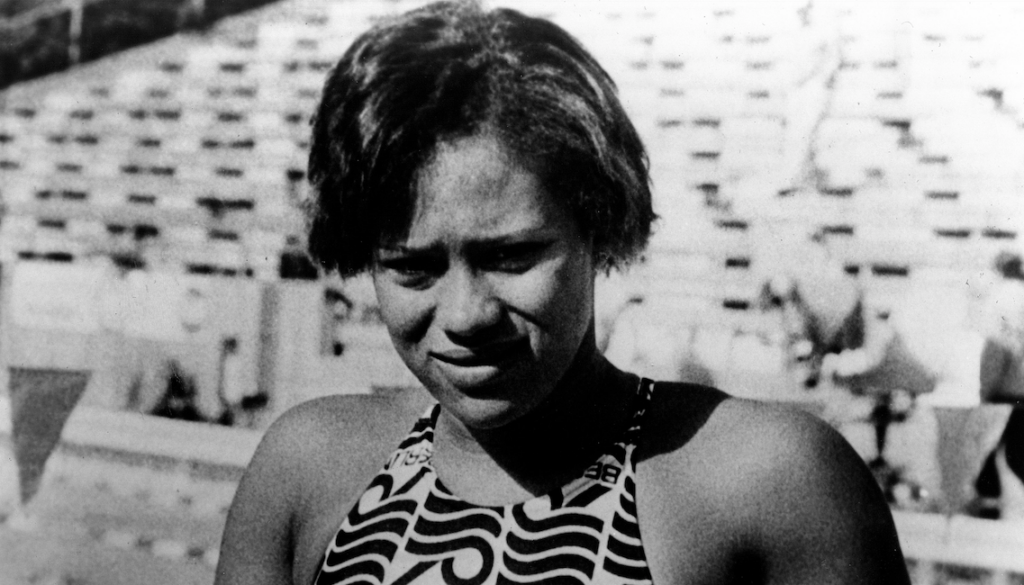
Enith Brigitha (NED)
Honor Swimmer (2015)
FOR THE RECORD: 1972 OLYMPIC GAMES: 8th (100m freestyle), 6th (100m backstroke), 6th (200m backstroke), 5th (4x100m freestyle); 1976 OLYMPIC GAMES: bronze (100m freestyle), bronze (200m freestyle), 4th (4x100m freestyle relay), 5th (4×100 medley relay), 10th (100m backstroke); FIVE SHORT COURSE WORLD RECORDS: 2 (100m freestyle), 2 (200m freestyle), 1 (400m freestyle); 1973 WORLD CHAMPIONSHIPS: bronze (100m freestyle); silver (200m backstroke); 1975 WORLD CHAMPIONSHIPS: bronze (100m freestyle, 200m freestyle, 4x100m freestyle); 1974 EUROPEAN CHAMPIONSHIPS: bronze (100m freestyle, 100m backstroke), silver (200m freestyle, 4x100m freestyle); 1977 EUROPEAN CHAMPIONSHIPS: silver (100m freestyle, 4x100m freestyle).
Enith Brigitha was born on the West Indian Island of Curacao, where she first learned to swim in the Caribbean Sea. By the time she moved to Holland with her mother and brother in 1970, she had become the island’s most promising swimmer.
Two years later, swimming for Coach Willie Storm at the Club Het Y in Amsterdam, Enith qualified for the 1972 Munich Olympic Games and reached the final in four events, and this was just the start of her success. At the 1973 inaugural FINA World Championships in Belgrade, she claimed a silver medal in the 200 meter backstroke and a bronze medal in the 100 meter freestyle. At the 1974 European Championships she won five medals, including four individual medals for the 100 and 200 meter freestyle and backstroke events. In 1975, at the II FINA World Championships in Cali, Columbia, she added three bronze medals to her collection, including individual pieces of hardware in the 100 and 200 meter freestyle.
At the 1976 Olympic Games in Montreal, she earned individual bronze medals in both the 100 and 200 meter freestyle, and at the 1977 European Championships, she won a silver medal in the 100 meter freestyle.
Enith was a genuine superstar in an era dominated by women swimmers from the German Democratic Republic. All told, she set five short course world records and collected 21 Dutch titles in the freestyle, backstroke, medley and butterfly events. She won the Dutch 100 meter freestyle title seven years in a row, was twice named Dutch Sportswoman of the Year – and has the distinction of being the first person of African descent to win Olympic medals in swimming.
Still, her accomplishments have for too long been diminished by the dazzling success of the East Germans. Of the 11 individual medals Enith won at the Olympic Games, World and European Championships – only East German swimmers finished ahead of her in 10 of those events, the one exception being America’s Shirley Babashoff, in the 200 meter freestyle at Munich.
After the fall of the Berlin Wall, Dr. Werner Franke and his wife Brigitte Berendonk, discovered files from the Stasi – the East German secret police – documenting the fact that all of the East German swimmers who finished ahead of Enith Brigitha had been systematically doped, without the knowledge or consent of them or their parents, as a matter of national policy. To the GDR’s rulers, these young athletes were nothing more than pawns in
a global chess game, sacrificial lambs on the altar of East German ideology. Had the world known this at the time, the steroid and testosterone enhanced performances of the GDR’s athletes would have resulted in their disqualification, and Enith’s record would be even more stellar than it is. She also would be recognized today as the first black Olympic champion in swimming history, beating Anthony Nesty of Suriname to the top of the podium by 12 years.
There’s more to life than just swimming, of course. After hanging up her swimsuit and retiring from the sport, Enith married and had three daughters. She moved back to Curacao, where she opened her own swimming school and taught children to swim. Once her daughters were ready to go to University, the family moved back to Holland, where they remain today. Enith says, “With the girls in Holland and with our three grandchildren, it’s not so easy to leave Holland again.”