
Honor Swimmer Frank McKinney, Jr. was born on this day in 1938

FRANK MCKINNEY (USA) 1975 Honor Swimmer
FOR THE RECORD: OLYMPIC GAMES: 1956 bronze (100m backstroke); 1960 gold (400m medley relay), silver 100m backstroke); PAN AMERICAN GAMES: 1955, 1959 gold (100m backstroke; medley relay); NATIONAL AAU CHAMPIONSHIPS: 14; BIG-TEN Gold medals: 9; NCAA CHAMPIONSHIP Titles: 2.
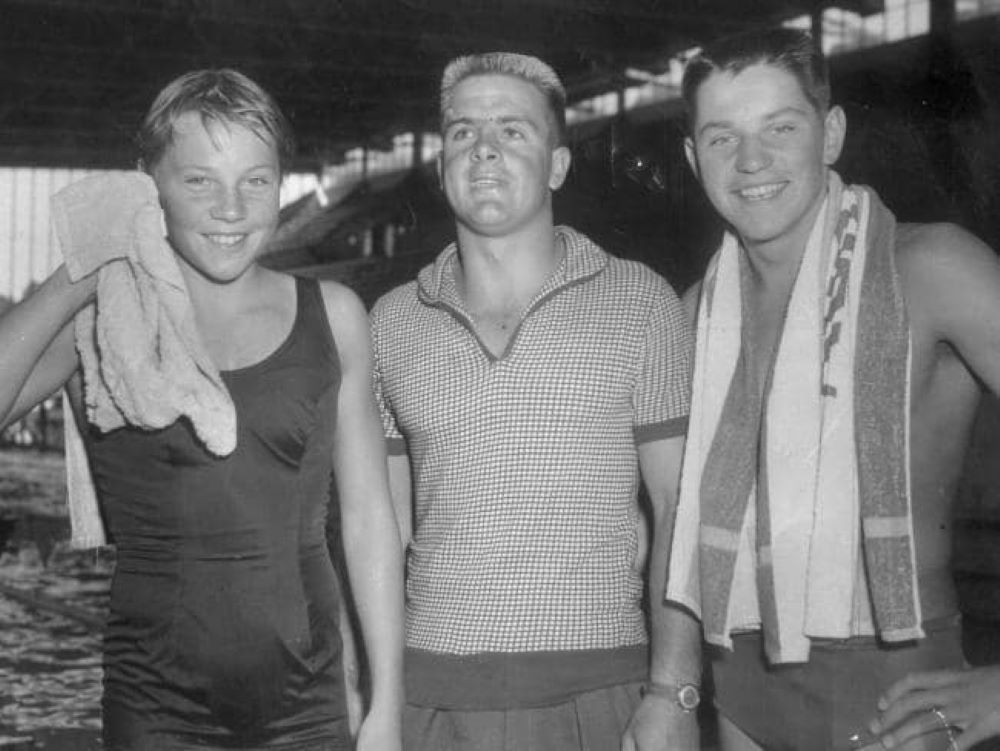
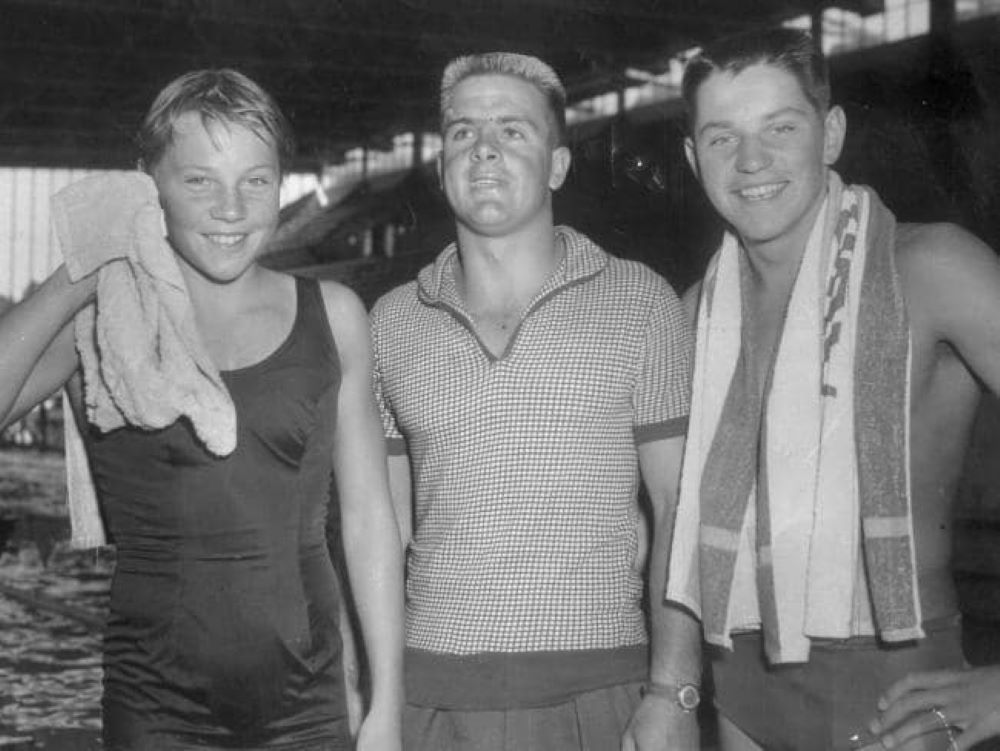
The American swimmer who did the most to introduce modern backstroke techniques is Frank McKinney. Following Yoshi Oyakawa as premier U.S. backstroker, McKinney was the pioneer of the modern bent-arm backstrokers, even as Oyakawa had been the last of the straight-arm school. McKinney was the leader of a remarkable group of teenagers who won the U.S. Nationals for the Indianapolis Athletic Club while the boys were still in high school. If they had been a musical group, national champions McKinney, Mike Troy, Bill Barton, Bill Cass and Allan Sommers would have been known as “The Jim Clark 5”. Later when they all swam under another great coach, Doc Counsilman, McKinney was the captain of Indiana University’s first Big Ten Champions. Films shot by Counsilman of McKinney’s bent-arm had a profound influence on modern bent-arm backstroke.
Frank McKinney at 16, won the Pan American Games 100m backstroke in 1955 at Mexico City and was the youngest member of the American World Record Medley Relay Team. He repeated these two Pan American gold medals in Chicago in 1959 and both years he was elected to go to Japan for the Japanese-American dual meet.
McKinney won 14 National AAU Championships, 9 Big-Ten gold medals and 2 NCAA titles. Twice in 1956 he held the 200m backstroke world record and twice in 1960 he held down his 1/4 of the 400m medley relay world record. In the big ones, the 1956 Melbourne Olympics and the 1960 Rome Olympics, Frank McKinney raced to the hat trick winning all 3 Olympic medals, bronze (1956 – 100m backstroke), silver (1960 – 100m backstroke) and gold (1960 – 400m medley relay).
Frank McKinney a member of the Helms Hall of Fame, was voted 1956 Outstanding U.S Male Athlete in Aquatics by both the Los Angeles Times and the Columbus Touchdown Club. Hanging up his suit in 1960, McKinney, began his transition from national and Olympic gold medals to the coin of the realm. After two years as an officer in U.S. Army Intelligence, he became a banker and quickly advanced from Assistant Cashier of the First National Bank of Chicago in 1966 to Vice President, then President and Chairman of the Board of the American Fletcher National Bank in Indianapolis. Jim Counsilman and the late Jim Clark were proud of Frank McKinney, not only for his Hall of Fame swimming achievement but for all he has done since.

On this day in 1914, Honor Contributor, R. Jackson Smith was born…

R. JACKSON SMITH (USA) 1983 Honor Contributor
FOR THE RECORD: USA representative to FINA, International Diving Committee, 1952-1972 and 1976-1984, Committee Chairman 1968-1972; Chairman Men’s National AAU diving committee 1948-1963; member U.S. Olympic Diving Committee 1960-1984; Founder and meet director ISHOF/USA International Diving Meet, Fort lauderdale, 1970-1980; Referee or judge of diving at Rome, Tokyo, Mexico, Munich Olympics and at 1978 and 1982 FINA World Aquatic Games; As diver, 3rd in AAU Nationals 1943; Consulting architect on ISHOF, Montreal Olympic diving pools, Columbia, Ohio State, Florida university pools, U.S. Naval Academy and Dartmouth pools.
R. Jackson Smith, known as either Jack or Jackson to his contemporaries, and “R.J.” to the younger generation, is literally the architectural prototype of everything a Hall of Fame diving Contributor should be.
Born in Columbus, Ohio, he grew up as a diver under the ultimate diving coach, Mike Peppe. He went to Dartmouth, and was captain of the 1936 swimming team. In WWII, he served on U.S. Navy aircraft carriers, where duty would have made it impractical for him to try out for the war-cancelled ’44 Olympics.
As a Yale architectural graduate, he specialized in the planning school, college and sports facilities. Jackson served on U.S.A. and International Diving Committees doing everything from re-writing rules to modernizing facilities and simplifying judging and entry forms His roles at Olympic, World and International Games ranged from referee to judge, announcer, meet organizer and director. He designed the logo for U.S. Diving and U.S. National Championship diving medal, ironically one of the few awards he has not won.
R. Jackson Smith has been USA’s leading diplomat in all matters pertaining to International Diving, and is the first and only diver to receive the prestigious U.S. Aquatics (AAU) Award. He is also the recipient of the Mike Malone Diving Award and CNCA Award for outstanding contributions to aquatics.

Passages: Australia’s Don Talbot, a Giant in Coaching, Dies at 87
by JOHN LOHN – ASSOCIATE EDITOR-IN-CHIEF
03 November 2020, 07:39am
Passages: Australia’s Don Talbot, a Giant in Coaching, Dies at 87
The swimming world has lost a legend from its coaching ranks, as Australia’s Don Talbot died on Tuesday at the age of 87. Talbot, a 1979 inductee into the International Swimming Hall of Fame, is regarded as one of the greatest coaching minds in history, having guided his homeland to significant success while also molding some of the top names in the sport. Talbot was known as a taskmaster, but his success also warranted tremendous respect and appreciation for his coaching skills.
Talbot made his name known through the work he did with John and Ilsa Konrads, freestyle aces for Australia in the 1950s and 1960s. With Talbot guiding their careers, the Konrads siblings each set world records in the 400, 800 and 1500 freestyle, with John adding a global standard in the 200 freestyle and three medals at the 1960 Olympics in Rome. At the same time, he was developing Kevin Berry, who made his first Olympic squad as a 14-year-old in 1960 and would win gold in the 200 butterfly in 1964.
In 1989, Talbot was put in charge of the Australian National Team, and while his firm ways initially triggered a revolt among some athletes, Talbot withstood the storm and remained in his role for 12 years. At the time he took charge, Australia was coming off a poor showing at the 1988 Olympic Games, but Talbot turned the tide for the Aussies, who excelled on home soil at the 2000 Olympics in Sydney and at the 2001 World Championships in Fukuoka, where Australia bettered the United States in the gold-medal count.
Don Talbot in 1996. Photo Courtesy: Darrin Braybrook, Sport the Library / Swimming World Archive
Talbot always believed Australia should rank among the premier nations in the world, and there was no excuse for anything less.
“We want to build the component of team support that the Americans have, which others criticize but secretly envy,” he said. “We’re an island nation of 18 million, 95 percent (who live) within 10 minutes of the sea. We should have the best swimmers.”
Thanks to the success he had with the Konrads and Berry, Talbot was named the head coach of the Australian men’s team at the 1964 Games and held that role at the next two Olympiads. During that stretch, Talbot led Ian O’Brien, Bob Windle, Beverley Whitfield and Gail Neall to Olympic gold medals. However, a lack of support from Australian Swimming led to Talbot taking more lucrative jobs elsewhere.
He first left his homeland for Canada, where he served a stint as that country’s National Team coach and followed by taking the head job at the Nashville Aquatic Club in the United States, where he coached future hall of famer Tracy Caulkins.
A role at the Australian Institute for Sport brought him home in 1980, but Talbot left again for Canada a few years later. During his second stop as Canada’s National Team Coach, he prepared the nation to produce some of its best Olympic performances in 1984 and 1988, although he was let go from his position just before the 1988 Games. Between 1984 and 1988, Canada collected 12 medals, including four gold.
Photo Courtesy: Darrin Braybrook Sport the Library / Swimming World Archive
Based on his track record and Australia’s need to escape its struggles, Talbot was given the chance to lead the Land of Oz back to elite status. Initially, his hard-nosed and demanding tactics were a rude awakening to members of the National Team. Even political figures got involved in the rift between Talbot and the Aussie athletes, and Talbot was referred to by one media outlet as a tyrant in the form of Ming the Merciless, a character from the science fiction television show, Flash Gordon.
Eventually, Talbot’s grip took hold and the clamor for his removal died down. Why? The answer is simple: Australia started to produce results reminiscent of its glory days, when the likes of Dawn Fraser and Murray Rose stood atop the sport. By the 1992 Olympics, Australia was up to nine medals, with that number moving to 12 at the 1996 Games. More, stars were starting to surface, such as Kieren Perkins, Susie O’Neill and Petria Thomas.
At the 2000 Olympics, Australia was up to 18 medals, second to the United States, and Ian Thorpe and Grant Hackett had become superstars. At the 2001 World Championships, Talbot realized his greatest achievement when Australia won the most gold medals with 13, ahead of the United States’ nine. Instead of remaining at the helm, Talbot resigned in 2001.
Three years later, Swimming Canada came calling and Talbot once again led the national team after a disappointing showing at the 2004 Games. Although that position didn’t last long, as a year later he joined British Swimming as a consultant and would work with a select group of coaches to ensure their skills and experience exceeded those of their rivals at the Beijing Olympics in 2008
During his career, Talbot was an outspoken critic of performance-enhancing drug use and was among the most vocal opponents of the sudden rise of China in the 1990s.
Happy Birthday to the great Cesare Rubini !

Cesare Rubini (ITA) 2000 Honor Water Polo
FOR THE RECORD: 1948 OLYMPIC GAMES: gold; 1952 OLYMPIC GAMES: bronze; 1956 OLYMPIC GAMES: 4th; 1947 EUROPEAN CHAMPIONSHIPS: gold; 1954 EUROPEAN CHAMPIONSHIPS: bronze; 6 ITALIAN NATIONAL CHAMPIONSHIPS: player and coach; National Team Member: 84 matches; 1994 Elected into the Naismith Basketball Hall of Fame.
Cesare Rubini holds the distinct and unparalleled honor of being inducted into two international Halls of Fame in two sports that could not be farther apart except for one common thread – the size of your hands. Water polo and basketball – two sports where the ability to palm and control the ball is an advantage to winning games. Whether in or out of the water, he was a winner of games and hearts. His involvement and influence went far beyond the depth of the water or the length of the court.
In the basketball arena, he made Italy an international contender. As both a player and a coach from 1941 to 1978, he won 15 Italian National Basketball Championships compiling a 322-28 record with the Simmenthal Club of Milan and is credited with developing basketball in Italy. As an administrator, he has served as a member of the Central Board of the International Basketball Federation (FIBA) and serves as president of the World Association of Basketball Coaches (WABC) since 1979. In 1994, he was elected into the Naismith Basketball Hall of Fame in Springfield, Massachusetts to join Bill Bradley, a player he once coached, and fellow coach John Wooden of UCLA fame.
But especially during his youth, water polo was his first love. Born in 1923, Rubini aspired to emulate fellow countryman and one of the greatest players in his era, Hall of Famer Mario Majoni. By the time he was 24 years old, Rubini won the coveted gold medals at the 1947 European Championships and the next year’s 1948 London Olympic Games with Majoni as team captain. The gold medal was Italy’s first medal in Olympic Water Polo history and was the beginning of this country’s great position in international water polo. Majoni graduated to National Team Coach and Rubini to National Team Captain where he played 84 games for the national team. As captain, his team won the 1952 Olympic Games bronze medal behind the great Hungarian and Yugoslavian teams and repeated the bronze medal behind the same two teams at the 1954 European Championships. During his career, he won six Italian National Championships as a player and coach for Olona of Milan, Rari Nantes of Naples and Camogli of Genoa. He played 84 matches with the National Team, 42 of them as captain.
He knew the importance of both teaching water polo to the kids and stressing fair values and sportsmanship to the adults. He served as the inspiration for fellow countrymen and Hall of Famers Eraldo Pizzo and Gianni de Magistris and continued his career promoting the sports he loves so much.
.

What could be more appropriate than the Father of ISHOF, Buck Dawson, being born of Halloween?

WILLIAM “BUCK” DAWSON (USA) 1986 Honor Contributor
FOR THE RECORD: Founding Executive Director of the International Swimming Hall of Fame (1964); Known as the “Walking Encyclopedia of the Sport”.
He claimed his family never allowed him to swim in public! (Only at night when no one could see!) But Buck Dawson did more for swimming than any non-swimmer in the world.
William Forrest Dawson — “Buck” is a historian, fundraiser, author, promoter, and of course, prankster.
Buck first got involved with swimming after his marriage to RoseMary Mann — daughter of the late Matt Mann. From then on, it went something like this: organizing the Ann Arbor Swim Club, co-directing Matt Mann swim camps in Canada each year (Camp Ak-O-Mak and Camp Chikopi), chairing Michigan women’s swim AAU for eight years, and serving three terms on the United States Olympic Swim Committee. He shared responsibility in starting the women’s national collegiates and reviving national women’s water polo.
Dawson liked to think of himself as a coach and kept his hand in training marathon swimmers and national long distance individual and team winners in US swimming. Besides his special gift with children, he has also made magic at the International Swimming Hall of Fame for the first twenty years of it’s existence. Dawson was chosen the Hall’s first executive director in 1963. He has made the Hall grow from an idea to a shoebox collection, and ultimately a million dollar operation as the showcase and archives of swimming.
One of his many great successes at the Hall of Fame was his introduction of Swim-A-Thon to the United States, which increased the endowment of ISHOF and raised funds for individual swim clubs and teams. This tireless, smiling, globetrotting ambassador of swimming can also be credited for the thousands of athletes, fans and press alike who have flocked to Fort Lauderdale for sun, fun and swimming.
It was Buck who gave the American Swimming Coaches Association some roots back in 1971 when he and the Hall of Fame staff assumed administrative duties for ASCA. Dawson was a powerhouse not only in ASCA but also in the organization of another association – the National Swim and Recreation Association.
He was also the founder and first president of the Association of Sports Museums and Halls of Fame — a group of some 80 Hall of Fame directors. Throughout the years, it was Buck who traveled from meet to meet armed with Hall of Fame brochures, books and bumper stickers always spreading the word, always willing to talk and teach swimming to anyone who would listen.
A day didn’t go by without “Good Morning, America,” “USA Today,” “NBC Nightly News” or one of the nation’s top swim coaches calling to speak to Buck. He is respected in this field not only for his knowledge but his zest for life. . . his search for new facts, memorabilia. . . new ways to teach those children to swim and keep the sport alive and growing. Dawson was the link between our age group swimmers and our swimming legends. He was the common denominator that ties the past to the present.
Dawson’s specialties? Swimming, diving, synchro, water polo, water safety, open water swimming, bathing suits, bathing beauties. . .
Dawson used to eat, live and breathe swimming. He wrote numerous books and has been the recipient of many prestigious awards. Buck WAS the International Swimming Hall of Fame. Who else would have his dog become an ISHOF mascot, and name him Mark the Spitz? Or snicker at the thought of a dog paddle derby?
Dawson was hype, show business — an idea and PR man. Throughout his life, he had always gotten his kicks out of promoting something or somebody else he believed in: during the war it was General Gavin and General Ridgeway- the 82nd Airborne; later his alma mater, the University of Michigan; his family, swim camps and ultimately ISHOF, swimming and swimmers….And let’s not forget Marlene Dietrich.
When asked, what did this walking encyclopedia say about himself? “I wouldn’t say I’m a workaholic, but I think swimming has been my hobby. . . I have been sort of a little bit of everything. I feel this (the Swimming Hall of Fame) has been the culmination of my life.”
Buck “retired” in 1986, and for the next 20 years, he served as executive director emeritus at ISHOF. As you can imagine, Buck still came into the office everyday and still put in the 18 hour days. He continued to make the endless journeys and speeches around the world that made him one of swimming’s most active and knowledgeable spokesmen in the world of swimming.
We lost Buck in 2008, but we hope to always keep his memory alive within the walls of ISHOF and beyond. Without Buck, there would never be an International Swimming Hall of Fame…..and so many memories that span his exciting eighty years.


Four Years Ago Tonight: ISHOF hosts 2016 Induction in California

Four years ago tonight, ISHOF hosted the 2016 ISHOF Induction ceremony at the Santa Clara Convention Center. It was a stellar class and we had a turn out of almost 500 people.
Elena Azarova
Honor Synchronized Swimmer (RUS)
Tibor Benedek
Honor Water Polo Player (HUN)
Péter Biros
Honor Water Polo Player (HUN)
Simeon Boychenko
Honor Pioneer Swimmer (RUS)
Horst Gorlitz
Honor Pioneer Coach (GDR/ITA/FRG)
Frank Gorman
Honor Pioneer Diver (USA)
Guo Jingjing
Honor Diver (CHN)
Sir Peter Heatly
Honor Contributor (GBR)
Hungarian Water Polo Team 2000-2008
Honor Water Polo Team, HUN
Larisa Ilchenko
Honor Swimmer (RUS)
Hilda James
Honor Pioneer Swimmer (GBR)
Tamas Kásás
Honor Water Polo Player (HUN)
Gergely Kiss
Honor Water Polo Player (HUN)
Leonid Meshkov
Honor Pioneer Swimmer (RUS)
Tamás Molnár
Honor Water Polo Player (HUN)
Camille Muffat
Honor Swimmer (FRA)
Aaron Peirsol
Honor Swimmer (USA)
Desmond Renford
Honor Open Water Swimmer (AUS)
Dmitry Sautin
Honor Diver (RUS)
Zoltán Szécsi
Honor Water Polo Player (HUN)
Dara Torres
Honor Swimmer (USA)
Monique Wildschut
Honor Open Water Swimmer (NED)

Happy Birthday Mary Freeman !

MARY FREEMAN (USA) 1988 Honor Coach/Contributor
FOR THE RECORD: AAU NATIONAL CHAMPIONSHIPS: 5 (100m, 200m backstroke; 300yd individual medley; 2 relays); COACHING RECORD: AAU National Outdoor Team Champions 1961, 1966 (swimming only); Perennial Eastern U.S. Champions and Middle Atlantic Champions 1956-1968; University of Pennsylvania women’s team coach; 1960, 1964 U.S. Olympic Women’s Swimming Committee; AAU Women’s Swim Committee 1956-1964; All American Women’s Swimming Team Selection Committee 1959-1961; AAU Swimming Award Committee Chairman 1965-1968; AAU Joint Rules Committee for Swimming 1962-1964, 1967.
Mary Freeman began swimming as a beginner in the Walter Reed Army Hospital pool in Washington where her chemist father was on the staff. She went quickly from the worst to one of the best of Jim Campbell’s champions who trained at the hospital pool. Campbell trained his swimmers at six in the morning so the pool could later be heated up for the hospital rehab swim program. Since Walter Reed quickly became national champions, U.S. swim coaches decided six a.m. workouts should be the law of the land.
By 1951, Mary Freeman was national champion in both backstrokes. The following year, she made the U.S. Olympic team going to Helsinki. Her best swimming year was 1953 when she won the nationals in the 300 yard individual medley, the 880 yard freestyle relay and the 330 yard medley relay.
Mary retired in 1953 but missed the sport. After her marriage to the late Jack Kelly, she started the swimming team at Philadelphia Vesper Boat Club in 1955. The club quickly became the best in the east and by 1961 they had won their first national team championship. Mary, generally considered the best American woman swimming coach, (if not the world) produced 15 national champions who went on to win 26 national championships between them, set 10 world records and made the Olympic finals nine times. Mary Freeman coached both Vesper and the University of Pennsylvania women’s team with the philosophy of “Ladies first, swimmers second.” She retired in 1968, at the top, to raise her six children and is now married to Professor Allan Spitzer and lives in Iowa City, Iowa.

Happy Birthday Amanda Beard !

Amanda Beard (USA) 2018 Honor Swimmer
FOR THE RECORD: 1996 OLYMPIC GAMES: gold (4x100m medley), silver (100m breaststroke, 200m breaststroke); 2000 OLYMPIC GAMES: bronze (200m breaststroke); 2004 OLYMPIC GAMES: gold (200m breaststroke), silver (200m I.M., 4x100m medley)
When Amanda Beard started serious training as an 11-year old, no one could have imagined that this California girl, whose role model was the flamboyant bad boy of basketball, Dennis Rodman, would become America’s best female breaststroker at the tender age of 13. Training under coach Dave Salo at Novaquatics Swim Club, her progress was so meteoric that she skipped Junior Nationals, jumping directly from competing against 12-year olds to the Senior Nationals.
In 1995, Amanda stood a little over 5-feet tall and weighed 90 pounds dripping wet. So slender as to appear fragile, yet she was tough enough to win her first U.S. national title and qualify for the Pan Pacs, where she won silver and bronze medals.
When she made her Olympic debut in Atlanta in 1996, in the 100m breaststroke, Amanda did not disappoint. Swimming from lane five in the finals, Amanda went from next to last at the halfway mark to next to first, to finish just behind Hall of Famer, Penny Heyns, in American record time. Amanda would leave Atlanta with a second silver in the 200m breast and a gold medal for the 4×100 medley relay.
After the 1996 Atlanta Games, Amanda became a darling of the media. She had breakfast with Dennis Rodman and appeared on the “Tonight Show” with Jay Leno. Unfortunately, she also suffered from the post “Olympic blues.” To make matters worse, she was experiencing a four-inch growth spurt and its accompanying extra pounds. Amanda struggled to reach the same speeds that had once come so easily when she was shaped more like a torpedo. In 1997, sportswriters started to wonder if she would ever do anything great in swimming again. Unfortunately, Beard would later say, it was the same negative loop she was playing in her own head, and she was drowning from the pressure of expectations. So, right after Nationals, Amanda decided to quit swimming permanently. Luckily, her sabbatical only lasted a few months. When she decided to return, she took a different approach, she would not put so much pressure on herself and more importantly, she wouldn’t just concentrate on her signature events.
By 1999, Amanda had regained her spark. She was adjusting her technique to suit her new physique and was one of the nation’s most sought-after college recruits. Her choice was to swim for coach Frank Busch at the University of Arizona and when she joined the team in the fall of 1999, she was 5 feet, eight inches tall and weighed 120 pounds.
Amanda was considered an underdog to make her second Olympic team, in 2000. At the Trials, she finished a disappointing eighth in the 100m breast, but the 200 was her best event. She finished second to Megan Quann and had qualified for Sydney.
In Sydney, Amanda struggled, recording the eighth fastest time in both the prelims and semi-finals, which put her in lane eight for the final. After a pep talk from coach Busch, and a painful burst of speed over the final ten meters, she captured the bronze medal by .01 seconds.
It took almost three very difficult years for Amanda to adjust to her new body. When she finally did, she was almost unbeatable. In 2002, she won double gold at the Pan Pacs, in Yokohama, Japan. In 2003, she won gold in the 200m and silver in the 100m at the FINA World Championships. At the 2004 US Olympic Trials, she qualified for four events, while breaking the world record in the 200m breaststroke.
In Athens, Amanda finally won her first individual gold medal when she won the 200m breaststroke in world record time. In the 200m individual medley, she won silver while setting a new American record. She won a second silver medal for the 4×100 medley relay and finished fourth in the 100m breaststroke.
After Athens, she embarked on a mission to turn herself from Olympic Champion into a lucrative brand name. Her life out of the pool was not without its challenges, as she describes in her 2012 memoir, “In the Water, They Can’t See You Cry.” Still, she had enough talent and toughness to train seriously for a few months and qualify for her fourth Olympic appearance, in Beijing, 2008, at the age of 27. At the final team training session, Amanda was elected to serve as one of three co-captains of the women’s Olympic swimming team. Although she placed a disappointing 18th in her signature 200m breaststroke event, she provided a role model for younger members of the team.
In 2009, Amanda married her soulmate, Sacha Brown, who she credits for encouraging her to seek therapy. In September of that same year, Amanda gave birth to their first child, a son, Blaise. After giving birth, she came out of retirement to swim in the 2010 Conoco Phillips National Championships. She had just hoped to be respectable, but finished second in the 200m breaststroke and qualified for the Pan Pacs, once again. This success led her to continue training for a chance to reach her fifth Olympic Games in 2012. After finishing fifth and failing to make the team, she retired again, and in 2013, she gave birth to a daughter, Doone Isla Brown.
Last year, Beard opened the Beard Swim Co., a learn to swim company lead by Amanda, out of Gig Harbor, Washington. Recognized for excellence by the International Swimming Hall of Fame, The Amanda Beard Swim School believes the ability to swim is one of the greatest gifts a parent can give to a child.

NYAC’s Coach Gus Sundstrom was born on this day in 1858 !

GUS SUNDSTROM (USA) 1995 Pioneer Coach/Contributor
FOR THE RECORD: 1885, first swim coach and teacher at New York Athletic Club; Promoter of swimming and water polo; Coach of world record holders.
The 1926 edition of the New York Athletic Club’s “Winged Foot” magazine read, “Professor Gus Sundstrom at 68 can swim around Manhattan Isle — Has saved 3 lives, coached America’s first great swimmers and is still one of the greatest examples of a good, healthy body.”
He was born in 1858 in Brooklyn, the son of a “Scandinavian sea captain. Gus learned to swim at an early age and competed in many races in the rivers throughout New York City, for which winners received financial rewards.
When he was old enough to look after himself, Gus set out to sea on the tall ship, Western Bell. On one of his worldly trips he was challenged to a mile race, in the Colombian River, by Big Red Fish, an Indian of the Pacific Coast. Sundstrom was decisively beaten, but noticed the Indian swimming with an out-of-the-water arm recovery and thrashing legs, quite different from Gus’ breaststroke and sidestroke. He took this new stroke and tried to improve upon it.
It was in 1885 that the New York Athletic Club built its first city house in Manhattan, and Gus Sundstrom won the job as swimming instructor. After competing and winning challenge races in the New York waters, including first ever swims around Manhattan Island, Sundstrom’s reputation as a swimmer and New York Athletic Club instructor grew so that by 1890 he was selected as supervisor of swimming for the New York City schools, where he personally taught over 100,000 children to swim over the years.
As a water polo coach, his New York Athletic Club teams won many U.S. National titles, as well as the 1904 Olympic Games gold medal. His leadership gave the sport notoriety and popularity, inspiring an average of 14,000 fans to attend the championships. It soon became known as “the roughest game on earth.”
Great American world record holders including Charles Daniels, Joe Ruddy and Bud Goodwin all came from the New York Athletic Club and benefited from the tutelage of Professor Gus. Daniel’s use of the over arm with thrashing leg kick dropped his time by eight seconds between his 1904 and 1908 Olympic gold medals. Gus’ achievements caused many people to call him the first great American coach of the modern era.
He not only produced great water polo teams and swimmers, his underwater stunts were known the world over, especially his plunge into the water smoking a cigar and coming up with it still lit. Gus’ own swims as a youth credited him as the champion long distance swimmer of the world, and his personal loyal service of 50 years to the New York Athletic Club earned him the respect of many supporters. He died in 1936 at the age of 78.

Today we celebrate the birth of Sir Peter Heatly

Sir Peter Heatly (GBR) 2016 Honor Contributor
FOR THE RECORD: MEMBER FINA TECHNICAL DIVING COMMITTEE: 1966-1988 (Chairman 1984-1988), Honorary Secretary (1972-1984); MEMBER LEN TECHNICAL DIVING COMMITTEE: 1966–1988; CHAIRMAN OF COMMONWEALTH GAMES FEDERATION: 1982-1990; APPOINTED LIFE VICE-PRESIDENT OF THE COMMONWEALTH GAMES FEDERATION: 1990; 1948 OLYMPIC GAMES: diving competitor, (5th); 1952 OLYMPIC GAMES: diving competitor; 1950 COMMONWEALTH GAMES: gold (10m Platform); 1954 COMMONWEALTH GAMES: silver (3m Springboard); 1958 COMMONWEALTH GAMES: gold (10m platform); 1966 COMMONWEALTH GAMES: Scottish Team Manager; 1974 COMMONWEALTH GAMES: Scottish Team Manager; CHAIRMAN OF THE SCOTTISH SPORTS COUNCIL: 1975-1987.
As a swimmer, he was the Scottish freestyle champion and record holder over several distances between 1942 and 1947 before deciding to concentrate on diving. Self-taught and self-coached, he won gold medals at the 1950, 1954 and 1958 Commonwealth Games on the 10-meter platform and represented Great Britain at the Olympic Games in 1948 in London and in 1952 in Helsinki.
After Peter Heatly’s career as an athlete ended, he decided to give back to the sports he so loved. He would serve the aquatic sports in some capacity for over seventy years at the local, national and international levels as either a manager, official or administrator.
Peter joined the FINA and LEN technical diving committees in 1966, serving as Honorary Secretary of the FINA Committee from 1972 to 1984 and Chairman from 1984 to 1988. He was selected Chairman of the Great Britain Swimming Federation in 1981 and again in 1992. He served as chairman of the National Scottish Learn to Swim Campaign from 1964 to 1974 and went on to become Chairman of the Scottish Sports Council from 1975 to 1987.
Heatly was involved in 17 consecutive Commonwealth Games from 1950 to 2014, becoming Vice -Chairman of the Organizing Committee, when the Games were held in Edinburgh, Scotland, in 1970, and Chairman of the Commonwealth Games Federation from 1982 to 1990 after the first ever balloted election.
As a Chartered Civil Engineer, he produced and delivered papers on the design of swimming pools to professional bodies both in Great Britain and Europe. He also received Honorary Doctorates from three universities for his contributions to the sport.
Peter Heatly was appointed a Commander of the Order of the British Empire (CBE) in 1971 and in 1990 was installed as a Knight of the Realm by Her Majesty Queen Elizabeth. He was inducted into the Scottish Hall of Fame in 2002 and into the Scottish Swimming Hall of Fame in 2010.

