
Happy Birthday Gianni DeMagistris!!

Gianni DeMagistris (ITA)
Honor Water Polo (1995)
FOR THE RECORD: 1976 OLYMPIC TEAM: silver; 1968, 1972, 1980, 1984 OLYMPIC GAMES participant; 1978 WORLD CHAMPIONSHIPS: gold; 1975 WORLD CHAMPIONSHIPS: bronze; 1973 WORLD CHAMPIONSHIPS: 4th place; 1970, 1974, 1977, 1983 EUROPEAN CHAMPIONSHIPS: participant; 17 NATIONAL CHAMPIONSHIPS.
A passionate player from historic Italy, Gianni DeMagistris is considered to be one of the best water polo players of all time. He has played on five Olympic teams, scoring 60 goals during Olympic competition, and a career total of over 6,000 goals.
Although he has become an expert on passing the ball, his first splash in the water had nothing to do with polo. He began swimming as a youngster at the age of six. Gianni was the Italian 1500m freestyle champion in 1967 and a member of the 800m freestyle relay championship team in 1970 and 1971. When Hall of Famer and teammate Eraldo Pizzo retired from water polo world competition, it was Gianni DeMagistris who took over the Italian ball.
He started off playing with the Italian National “B” league in 1965, and in 1974 he moved to the National “A” league. From 1969 to 1985, he scored more goals in the Italian National Championships than any other player. Gianni competed in every Italian National Championship from 1964 to 1986, scoring an astounding record total of 1,528 goals during the Championship Games alone.
Gianni DeMagistris was a force to be reckoned with, both nationally and internationally. At the 1976 Olympic Games, his leadership and athletic skill assisted his teammates to the silver medal. In the 1978 World Campionship, Gianni steered his team to a triumphant victory, claiming the gold of the Games. For this, he received his country’s “Most Valuable Player Award.”
In retirement, Gianni leaves behind a career which spans over two decades of world class performances. His astounding athleticism speaks for itself; he has left behind not only a legacy for others to emulate, but has become a legend within his own right.
Happy Birthday Gustavo Borges!!

Gustavo Borges (BRA)
Honor Swimmer (2012)
FOR THE RECORD: 1992 OLYMPIC GAMES: silver (100m freestyle) 1996 OLYMPIC GAMES: silver (200m freestyle), bronze (100m freestyle); 2000 OLYMPIC GAMES: bronze (4x100m freestyle), 1 WORLD RECORD: 100m freestyle (25m) 1994 WORLD CHAMPIONSHIPS: bronze (100m freestyle, 4x100m freestyle); 1993 WORLD CHAMPIONSHIPS (25m): gold (4x100m freestyle), silver (100m freestyle), bronze (4x200m freestyle) 1995 WORLD CHAMPIONSHIPS (25m): gold (200m freestyle), silver (100m freestyle) bronze (4x200m freestyle); 1997 WORLD CHAMPIONSHIPS (25m): gold (200m freestyle), silver (100m freestyle); 2002 WORLD CHAMPIONSHIPS (25m): silver (200m freestyle); 1991 PAN AMERICAN GAMES: gold (100m freestyle, 4×100 freestyle, silver (200m freestyle, 4x200m freestyle), bronze (50m freestyle); 1995 PAN AMERICAN GAMES: gold (100m freestyle, 200m freestyle), silver (200m freestyle, 4x200m freestyle); 1999 PAN AMERICAN GAMES: gold (200m freestyle, 4x100m freestyle, 4x100m medley), silver (4x200m freestyle), bronze (100m freestyle); 2003 PAN AMERICAN GAMES: gold (4x100m freestyle), silver (4x200m freestyle), bronze (100m freestyle); 1995 FISU GAMES: silver (100m freestyle); 1995 TEN NCAA NATIONAL CHAMPIONSHIPS.
Gustavo Borges, at 6 feet 8 inches tall, was often mistaken for a basketball player. However, make no mistake, he is one of the greatest sprint swimmers of all time.
In 1990, at the age of 17, Gustavo left his native Brazil to attend Bolles School in Jacksonville, Florida, where he swam for Coach Greg Troy, and became fluent in English. Less than a year later, he won the 100 meter freestyle at the Pan American Games in Havana. That medal was the first of a collection that has made him one of Brazil’s most celebrated athletes.
In 1991, he attended the University of Michigan, where he swam under Hall of Fame Coach, Jon Urbanchek. In 1992, Gustavo won the Olympic silver medal in the 100 meter freestyle, finishing second behind Russia’s Hall of Fame great, Alexander Popov. Four years later in Atlanta, he won the bronze medal, this time behind Popov and Gary Hall Junior, who were all within three tenths of a second to each other. That’s how close it was! He also won the silver medal in the 200 meter freestyle behind Danyon Loader of New Zealand. Four years later in Sydney, he helped lead Brazil to a bronze medal in the 4 x 100 meter freestyle.
Borges competed in four Olympic Games, won 12 medals in five FINA World Championships, and set the first FINA recognized 100 meter freestyle short course world record. In four Pan American Games, he won eight gold, six silver and three bronze medals. He is a ten-time individual NCAA Champion, and a member of Michigan’s 1995 NCAA National Championship Team.
Currently, Borges is a successful businessman operating 180 swim schools in Brazil. He serves as vice-chairman of FINA’s Athletes Commission.
U.S. Open Prelims: Caeleb Dressel Comes Out Strong with 51.83 in 100 Fly

by MATTHEW DE GEORGE – SENIOR WRITER
01 December 2023, 11:53am
U.S. Open Prelims: Caeleb Dressel Comes Out Strong with 51.83 in 100 Fly
Based on the evidence of Thursday, Caeleb Dressel’s U.S. Open looks less sluggish than sluggish to start.
The five-time Olympic gold medalist in Tokyo rectified a B final placement in prelims Thursday by blasting a time of 21.99 seconds in finals that would’ve been fourth in the A final.
Friday, Dressel made sure he didn’t miss out, going 51.83 to finish third in prelims of the 100 fly. That places him in the thick of the title hunt, trailing the leading Canadian duo.
Josh Liendo set the best time of the morning in 51.71, flying the flag of Florida. Second was Ilya Kharun in 51.75.
Dressel is joined under 52 seconds by Hungary’s Hubert Kos, who went 51.86. Trenton Julian and Santo Condorelli tied for fifth in 51.90. Zach Harting and Aiden Hayes tied for the final finals spot in 52.20.
That relegates Shaine Casas to another B final in 52.24, though he performed quite well there a night earlier. Michael Andrew finished 14th and Ryan Murphy 19th.
Also in prelims:
Summer McIntosh, the 400 free champ, led the way in the 400 individual medley with a time of 4:41.95. The world record holder is more than a second up on Emma Weyant, with Regan Smith third in 4:43.93. Four Canadians made the A final, with Ella Jansen fifth, Tess Cieplucha seventh and Bailey Andison eighth.
Chase Kalisz is in position to do the IM double after finishing second in a narrow battle in the 400 IM prelims. Carson Foster led the way in 4:18.35, but Kalisz is lurking .19 seconds back. Another three tenths back is Jay Litherland, in a convergence of the top American IMers of the last two Olympic cycles. Baylor Nelson was seventh.
The women’s 100 fly is no less engaging than the men’s, with 11 swimmers under a minute. Claire Curzan led the way in prelims at 57.38, .27 up on Gretchen Walsh. Torri Huske earned the third seed in 58.10. The A final includes international flavor thanks to Katerine Savard and Farida Osman. Teen Leah Shackley is also in the A final after a 59.53.
Katie Ledecky set the pace in the 200 free, a domineering 1:56.75 that was more than a second and a half clear of the field. Anna Peplowski was closest in 1:58.33. Also in the A final are Hong Kong’s Siobhan Haughey and in-form Hungarian Minna Abraham, plus American teen Erin Gemmell. Veterans Leah Smith (sixth) and Simone Manuel (seventh) also booked A final spots, though Paige Madden just missed out in 10th.
Henry McFadden led what looks like a wide open men’s 200 free, the top eight separated by .92 seconds. McFadden went 1:47.31. Drew Kibler was second in 1:47.35, with Luca Urlando a further two tenths back. Grant House and Kieran Smith are among the Americans in the A final, with Blake Pieroni and Brooks Curry in the B final.
Lilly King had appeared to set the fastest time in the women’s 100 breaststroke, but she was disqualified for a downward butterfly kick. That leaves Lydia Jacoby as the top seed in 1:07.02. Kate Douglass was third in 1:07.52. Siobhan Haughey showed off by going 1:08.38 for fifth, ahead of Anna Elendt. Lithuania’s Kotryna Teterevkova was second.
The men’s 100 breast brought a tie for the top seed, with Josh Matheny and Michael Andrew both going 1:00.18. Denis Petrsashov, Noah Nichols and Cody Miller were all within a tenth of a second. Nic Fink finished seventh and Matt Fallon was eighth to round out an intriguing A final.
Regan Smith led the way in a 100 backstroke lousy with Olympians. The American record holder set the pace in 58.47, .46 seconds up on Katharine Berkoff. Claire Curzan was third, a tenth up on Olivia Smoliga. Kennedy Noble and Leah Shackley, in fifth and seventh, respectively, represent the next wave. Sixth-place Phoebe Bacon and Rhyan White in eighth are among the established vets hanging firm.
Hubert Kos finished a busy morning by taking the top time in the men’s 100 back in 53.50. Ryan Murphy glided home in 54.15 for fourth, trailing Jack Aikins and Evangelos Makrygiannis by small margins. Daniel Diehl is also in a loaded A final in 54.46, just ahead of Justin Ress and Hunter Armstrong.
Underappreciated, Don Schollander Was a Legend; And a Star During the First Tokyo Games

by JOHN LOHN – EDITOR-IN-CHIEF
30 November 2023, 01:22am
Underappreciated, Don Schollander Was a Legend; And a Star During the First Tokyo Games
How can a five-time Olympic champion be underappreciated? How can a man who set double-digit individual world records go overlooked? How can the one-time face of Team USA find himself snubbed on the scale of historical greatness?
By all measures, Don Schollander is a legend in the sport, a Hall of Fame talent who was unrivaled in his heyday. He was dominant. He was versatile. He was clutch in pressure situations. A half-century beyond retirement, he deserves continued recognition of his greatness. Yet, Schollander is a largely forgotten star, his impact lost to a combination of unfortunate timing and modern-day fascination.
Among aquatic enthusiasts, there is little debate regarding the greatest American triumvirate among male athletes. Michael Phelps sits at the head of the boardroom table, the CEO of the sport. Meanwhile, vice presidential status is held by Johnny Weissmuller, actually best known for his cinematic identity as Tarzan, and Mark Spitz, he of seven gold medals and seven world records at the 1972 Olympic Games in Munich.
Because modernity plays a role in most subjective rankings, the next name typically mentioned is that of Matt Biondi, the highest-profile American star of the 1980s and 1990s. What about Schollander? While he was widely appreciated in his era, his greatness was quickly dismissed, the aura of Spitz casting an inescapable shadow.
Timing simply was not on Schollander’s side. His excellence was delivered prior to the period in which professionalism was an option, with endorsement deals available to the top-tier athletes in the sport. More, Schollander was the victim of Spitz’s surging star and monumental performance at the Munich Games.
Really, the lack of appreciation for Schollander is an injustice.
A Stellar Career
There are several ways to place the career of Don Schollander in perspective. The task could be handled by focusing on his Olympic exploits. Or, we could dissect the power of his world-record performances. Instead, let’s go with this bullet point on the man’s resume: Schollander was a member of the inaugural induction class into the International Swimming Hall of Fame.
Schollander, only 18, matched what legendary track athlete, Jesse Owens, managed at the 1936 Olympics in Berlin: four gold medals. (Pictured, from left: 1964 men’s Olympic 400 freestyle medalists: Frank Wiegand, United Team of Germany, silver; Schollander, gold; and Allan Wood, Australia, bronze.)
When the Hall of Fame announced its initial entrants in 1965, Schollander was just a year removed from starring at the 1964 Olympics in Tokyo. He was also a mere 19 years old, with several more impressive years ahead of him. Yes, Schollander earned Hall of Fame status as a teenager and in the prime of his career.
Schollander’s precocious talent was on display in his early teens, as he guided Lake Oswego High School to the Oregon state championship as a freshman. Meanwhile, by the time he was 16, he was a multi-time national champion and on pace to become a headliner for the United States. That identity was etched at the 1964 Olympics.
Having qualified for the Tokyo Games in the 100 freestyle and 400 freestyle, Schollander embraced a four-event schedule. In relay action, Schollander fueled the United States to world records in the 400 freestyle relay and 800 freestyle relay, with Germany the runnerup in both events. His individual success required a bit more work but was just as golden.
In the 100 freestyle, Schollander (53.4) eked out a narrow triumph over Great Britain’s Bobby McGregor (53.5). A couple of days later, he went back to work in the 400 freestyle, this time prevailing with a world record of 4:12.2, more than two seconds clear of the silver-medal time of Germany’s Frank Wiegand (4:14.9). The critical nature of the 100 freestyle was not lost on Schollander, as that event jumpstarted his success and supplied much-needed momentum.
“Because it was my first event, I felt that this race could make me or break me for the rest of the Games,” he said. “If I won, I would be up for the rest of my events – my confidence would be flying high. If I lost, I would be down. That sounds temperamental, but I have seen an early race work this way on swimmers. So this 100 free took on much more importance than just another event.”
With four gold medals to his credit, Schollander became an Olympic hero, with his title count matching what the legendary track athlete, Jesse Owens, managed at the 1936 Olympics in Berlin. The total could have been higher, too, if not for the U.S. coaching staff’s decision to not use Schollander on the 400 medley relay.
As the Olympic champion in the 100 freestyle, Schollander figured to have earned the anchor slot on the medley relay. Instead, the coaches went with Steve Clark, who was the fastest American in the 400 freestyle relay. The decision was highly questionable.
“Certainly, in the back of my mind, I was aware that this could mean my fifth gold medal,” Schollander said of being on the medley relay. “And it wouldn’t be just one more gold medal – it would be an unprecedented fifth gold medal. No swimmer had ever won four gold medals at an Olympics, but nobody in history – in any sport – had ever won five. But this wasn’t my arguing point. I felt that I had earned the spot on the medley relay team.”
In the ensuing years, Schollander added to his greatness, winning the 200 freestyle at the 1967 Pan American Games and adding Olympic gold in the 800 freestyle relay at the 1968 Games in Mexico City.
What Could Have Been?
The schedules utilized for today’s major championship competitions provide a little something for everyone. At the World Championships, sprint specialists are offered 50-meter events in each stroke. And at this summer’s Olympic Games in Tokyo, the 800 freestyle will be offered for men for the first time, with the 1500 freestyle new to the women’s program.
During Schollander’s era, the Olympic program was limited, and the World Championships were still a figment of the imagination. Specifically, Schollander was denied the chance to contest the 200 freestyle – his best event – when the American was at his peak at the 1964 Olympics.
Although he possessed the speed necessary to excel in the 100 freestyle and the endurance required of the 400 freestyle, Schollander was at his best in the 200 freestyle. It was his sweet spot and no foe had the ability to keep pace. A statistical look at the event serves as proof of Schollander’s dominance.
Don Schollander – Photo Courtesy: ISHOF
From 1962 to 1968, Schollander set 11 world records in the 200 free, including seven consecutive marks from 1964 to 1968. Over the course of those records, Schollander took the time in the event from 2:00.4 to 1:54.3, a massive leap that speaks to the revolutionary nature of Schollander’s skill.
“There are three things that make Don such a terrific swimmer,” once said George Haines, who molded Schollander into a champion at the Santa Clara Swim Club. “First, he is almost flawless mechanically. Second, he has a tremendous desire to win. Finally, he is a thoroughly intelligent competitor with a wonderful tactical sense.”
As successful as Schollander was at the 1964 Olympics, his haul almost surely would have been five gold medals had the 200 freestyle been part of the program. But the four-lap discipline was not added to the schedule until 1968 and while Schollander was still superb at that point in his career, he was not the untouchable force who went to Tokyo and emerged as the sport’s main man.
At the Mexico City Games, Schollander claimed the silver medal in the 200 freestyle, beaten to the wall by Australian great Michael Wenden. It was a surprise setback, but one that Schollander took in stride and did not lament. Rather, he was able to view his career through a lens that focused on all that was accomplished, not what was lost.
“I feel very fortunate to have gained the success I’ve achieved,” he said. “I think it’s a career I’ll be able to look back on and be very pleased about. I would have liked to have won because it is my last race, but I did as fine a job as I could. I’m not disappointed a bit.”
A Cerebral Approach
One of the main struggles for swimmers who reach the pinnacle of their sport is finding an alternate identity. Athletes in the sport, including today, have a difficult time transitioning to life after swimming, or finding interests to offset the zoned-in nature of training. Schollander, though, was different.
After his Olympic success, Schollander enrolled at Yale University and continued to excel in the water. But as an introspective individual, he found a balance in his life and made sure he was well-rounded in his endeavors.
“This is the crux. Before you decide how you want to live your life, you must look at yourself and attempt to know yourself,” Schollander once said. “I look at myself as a person who’s trying to develop as an individual. It’s been important to me throughout my life to be much more than a student, to be much more than an athlete, to be much more than anything. This is consistent with my philosophy of the well-rounded, but not necessarily Renaissance, man. I’m proficient in the academic side, the athletic side and the social side. I’m not proficient in the arts – music, painting, sculpture. Unfortunately, I don’t have time to go to more plays, take in concerts. I’m always on the go. I think I have a very active mind. I don’t feel I do total justice to anything.”
Another element of Schollander’s career that defined his success was the mental game he played. Schollander walked with an air of confidence about him, and never appeared rattled. He played a psychological game with the opposition, his lack of nerves – well – unnerving.
Obviously, Schollander did justice to his career in the pool. Sure, the likes of Phelps, Spitz and Weissmuller might receive greater attention, but anyone with deep knowledge of the sport will recognize Don Schollander as a legend. He was a thoroughbred in the water, as once noted by his college coach, Phil Moriarty.
“His stroke is flawless,” Moriarty said. “Every other swimmer I’ve worked with had a flaw. With legs only, he does as well as anyone, and he has combined this so well with his stroke that he is a one-motored man. Many swimmers are two-motored, in that they don’t synchronize their stroke and kick. As a coach, all I can do is observe him and tell him when he’s going off pattern, keep him busy, give him a program. With Don Schollander I feel like I’m training a racehorse. How can I communicate with a horse?”
By letting him run, or in Schollander’s case, swim. And he performed his craft better than most.
Fort Lauderdale Mayor Dean Trantalis recognized by ISHOF at Chamber’s “Salute to Broward”

On Friday, November 17, 2023 Matt McKean, Treasurer of ISHOF recognized Mayor Dean Trantalis of Fort Lauderdale with a special award (a replica of the 27M High Dive Tower) at the Greater Fort Lauderdale Chamber of Commerce: Salute to Business led by Dan Lindblade, President/CEO (see attached Program Billfold). The Salute to Business Gala honors titans of industry in various industries throughout Broward County. The event draws more than 400 people each year. Matt personally thanked Mayor Dean for supporting the mission for the new International Swimming Hall of Fame history and all of its life-saving programs moving forward. This includes our exciting top-to-bottom transformation, recently approved by the City of Fort Lauderdale.
Over 330,000 sq ft will be spread out over two buildings and six floors that bookend the Fort Lauderdale Aquatic Center with its new 27-meter dive tower and competition pools, creating a work-play-swim campus that is connective and more immersive for visitors. This project will transform the area, making it a magnet for education, recreation, culture, sport and cement Fort Lauderdale as the swimming and diving capital of the world.
I would be remiss if I did not acknowledge that we also presented this award to Commissioner Steve Glassman at the International Swimming Hall of Fame Induction Ceremony on September 29th. Commissioner Glassman serves on the ISHOF Board and is a fierce advocate for us.
Thank you, Commissioner Glassman and Thank you Mayor Dean.
Greater Fort Lauderdale Chamber of Commerce’s Salute to Business’s Program Billfold attachment:
Wellness Wednesday: The Positive Effects of Swimming On the Brain

29 November 2023, 01:00am
The Positive Effects of Swimming On the Brain
If there is one thing all swimmers (and ex-swimmers) can agree on, it is the addictive nature of swimming. We all crave the smell of chlorine on our skin, the pain of a long, hard set and the adrenaline rush that comes from every race regardless of its result. The fact that so many find it so hard to hang up the goggles is proof enough of this addiction. However, very few know why we feel this way. The answer is in science and hormones.
Endorphins, the hormone which quite simply makes us feel happiness and is ‘nature’s high’, are the key reason why swimming is so addictive; swimmers have an extraordinarily high number of endorphins running through their body after training and racing. When exercise is performed, the brain releases a chemical called an endorphin which reduces the perception of pain by interacting with the opiate receptors in the brain. This relationship acts in a similar manner to narcotics such as morphine and codeine
As a side effect of this reaction, a positive feeling is felt by the individual. This sense is often known as a ‘runner’s high’. A runner’s high is a feeling of relaxed euphoria felt after doing exercise and has recently been found to have a similar effect to the addictive nature of marijuana. So to put it bluntly, swimming is like an addictive drug in its ability to get us hooked.
Although like a drug in its addictive nature, the endorphins released by swimming are by no means negative. In fact, they have been found to have numerous positive effects on the body.
First, swimming has been found to be an effective treatment in helping those with depression due to the rise in endorphins that comes about from a hard swim session. In animal experiments, exercise has been shown to be even more helpful than drugs such as Prozac in helping those with depression get relief from their symptoms.
There is so much evidence to suggest the benefits of swimming on mental health that sports psychologists, such as Aimee C. Kimball, support swimming as a form of treatment in addition to other methods. Swimming has also been shown to aid the body in removing excess fight-or-flight stress hormones, converting stress within the body into muscle relaxation. This conversion makes the stressed individual feel relaxed.
Swimming a tough set can even promote “hippocampal neurogenesis,” the growth of new brain cells in a part of the brain that is destroyed by chronic stress and depression. Through participation in sport, patients are able to recover from the effects of depression, making recovery more likely and as well as reducing the chances of relapse.
Additionally this creation of new brain cells (which would have previously been destroyed by depression), means that the individual who takes part in swimming will have a better memory and stronger ability to learn new information. So quite simply, as well as making you feel happy, swimming can also make you more intelligent.
A further educational benefit that comes from swimming is due to the movements which a swimmer uses to complete in order to swim each stroke legally. A swimmer’s nerve fibers in the corpus callosum, the part of the brain which allows communication between both sides, are aided in development by the precision in stoke and the way in which bilateral cross-patterning movements are used in order to swim.
This increase in the communication of the two sides of the brain means that cognition is increased and learning is made easier. Numerous cognition studies have been conducted, and some found that children who learn to swim earlier will also be more likely to reach educational milestones at earlier points compared to children who learn to swim later.
To add to this, blood flow to the brain has been found to increase when an individual is emerged in water. A study conducted in 2014 showed a 14 percent increase in blood flow. This increase in blood flow acts with endorphins as a mood booster (again suggesting swimming as a treatment for depression), but also sharpens focus allowing individuals to perform better educationally.
Swimmers can testify to the many physical health benefits of swimming. However, very few of us think of how it helps our mental state. So the next time you feel that high that comes following training, or wonder why you can never seem to keep away from the pool, thank the chemicals and hormones within your brain that prove yet again how beneficial swimming really is.
All commentaries are the opinion of the author and do not necessarily reflect the views of Swimming World Magazine nor its staff. All research was discovered by the author and does not necessarily reflect the views of Swimming World Magazine nor its staff.
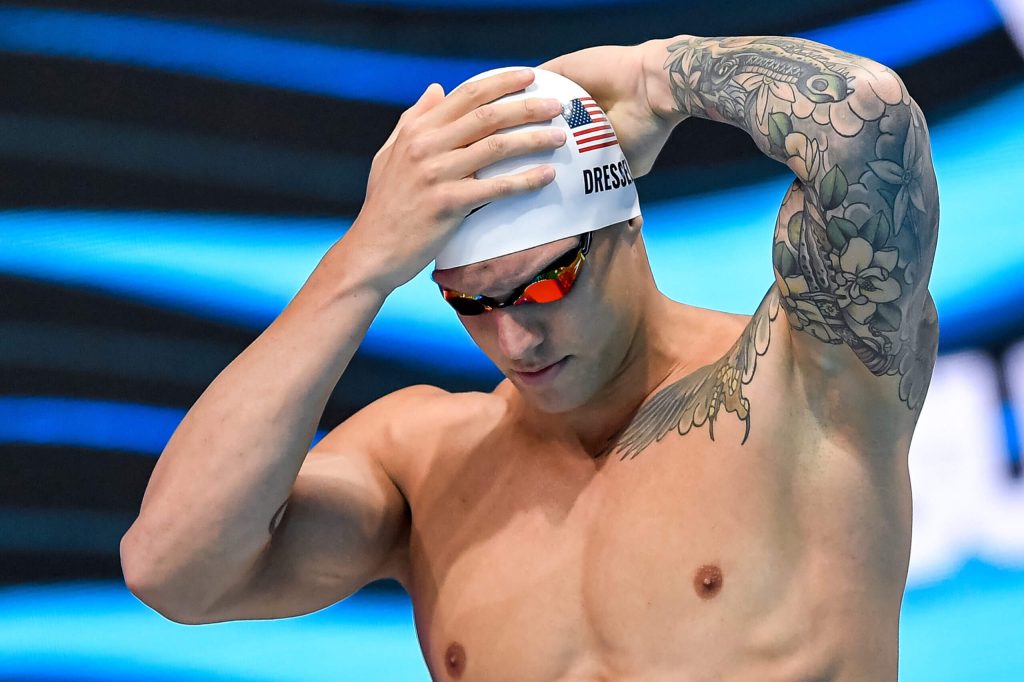
Caeleb Dressel Reaches Latest Test in Comeback at U.S. Open
by DAVID RIEDER – SENIOR WRITER
28 November 2023, 05:32am
Caeleb Dressel Reaches Latest Test in Comeback at U.S. Open
The biggest men’s star racing at this weekend’s U.S. Open — the most decorated swimmer at the meet other than Katie Ledecky — will be seeded 10th, 41st and 48th in his three races. Of course, everyone in attendance in Greensboro, N.C., will be well aware that Caeleb Dressel is a seven-time Olympic medalist and the American-record holder in the 50 freestyle, 100 butterfly and 100 freestyle (his three events at the U.S. Open), with a world record to his credit in the 100 fly.
All of Dressel’s entry times were recorded at U.S. Nationals, his only high-level competition in more than one year since withdrawing from the 2022 World Championships and taking nine months away from the pool as he sought to find a balance between happiness and his competitive pursuits. That meant his results at the qualifying meet, the most important competition for every other swimmer in the United States all year, were of little importance. “I am very indifferent about my results right now. I am kind of being pulled both ways — a little embarrassed, but fully understanding what just happened,” Dressel said.
Speaking with reporters at the conclusion of Nationals, University of Florida head coach Anthony Nesty said, “The people who came here to qualify for the meet, except for one DQ, did, and we’re pretty happy with where we’re at.” After his extended break, Nesty and co. had no illusions that Dressel would suddenly be back to top form and contending for World Championships medals and threatening world records.
Caeleb Dressel at the 2022 World Championships — Photo Courtesy: Andrea Staccioli / Deepbluemedia / Insidefoto
Nesty noted that Dressel was lacking his customary power, “which obviously if you haven’t been in the weight room for a long time, that shows up.” The coach added that while he was coaching his other athletes through the World Championships over the following month, he expected Dressel to put in time building strength in anticipation of beginning the new season with Florida’s other college and professional athletes in early August.
It’s been five months since Nationals, providing Dressel with his first uninterrupted block of training in a year-and-a-half and only his second such stretch since the Tokyo Olympics. Perhaps that will yield some quicker times at the U.S. Open, especially compared to his 2023 bests of 22.57 in the 50 free and 49.42 in the 100 free. Maybe Dressel will be able to contend with deep fields in the sprint events, particularly in a 100 free field that features five men who broke 48 this year, Hungary’s Nandor Nemeth, the Cayman Islands’ Jordan Crooks and Americans Ryan Held, Matt King and Chris Guiliano, plus 2022 World Champs bronze medalist and Florida training partner Josh Liendo.
But in the long run, Dressel’s results at the U.S. Open will not be consequential. The only meets that truly matter are the Olympic Trials in June and the Paris Olympics, provided he qualifies. Meets like this weekend’s in Greensboro are check-ins, opportunities for Dressel and Nesty to measure his progress in this comeback, one which his coach was confident would succeed even as Dressel was well behind the top contenders at Nationals.
“I think Caeleb has always done a good job taking care of his body. When you take care of your body, the longevity in the sport will enhance,” Nesty said. “We just need to get a full year of training in, a year of weights in, and I think he’ll be OK.”
If Dressel excels this weekend or in other in-season racing opportunities, perhaps at stops on the Pro Swim Series early next year, we will be reminded of his elite talent level and start imagining how fast he can swim in June. But if he is still well behind his competition, that won’t really matter. Not when talking about a swimmer with so much experience and such impressive results in his career.
Remember, Dressel was the undisputed top male swimmer at three consecutive global championship meets, the 2017 and 2019 World Championships plus the 2021 Olympics. The only other swimmer to claim that accomplishment in the 21st century is Michael Phelps. Whatever happens over the next six months, no one will be counting out Dressel in crunch time at Olympic Trials.
Have you considered donating to ISHOF on GIVING TUESDAY? Today it the day!!!

What is Giving Tuesday?
Giving Tuesday, often described as a global day of giving or a global generosity movement, is held each year on the Tuesday after Thanksgiving. On Giving Tuesday 2021, nonprofits in the U.S. alone raised $2.7 billion.
To donate to ISHOF on Giving Tuesday, click on this link.
The International Swimming Hall of Fame (ISHOF), Inc. is a 501(c)(3) nonprofit organization established in 1965. Its museum is the “Official Repository for Aquatic History” as deemed by Fédération Internationalede Natation (FINA) – the governing body for Olympic aquatic sports.
Mission – To collaborate with aquatic organizations worldwide to preserve, educate and celebrate the history of aquatic sports while promoting Every Child A Swimmer.
Vision – To be the global focal point for sharing cultures, showcasing events, increasing participation in aquatic sports and developing educational and lesson programs that promote swimming as an essential life-skill.
ISHOF PAST
Ft. Lauderdale’s swimming heritage dates back to the Civitan raft off Las Olas Beach and the Olympic-sized Casino Pool which opened in 1928. In the early 1960’s, the city created the Swimming Hall of Fame non-profit organization. In 1965, a 50M pool and a 25Y diving well, as well as the original Hall of Fame museum were completed. Soon after, the City and the ISHOF organization joined together to build the West ISHOF museum building that opened in December of 1968. That same year, the Fédération Internationale de Natation (FINA) – the governing body for Olympic aquatic sports – designated the ISHOF museum as the “Official Repository for Aquatic History”. By 1985, it was estimated that the ISHOF brought $20M annual economic impact to the City which encouraged an expansion of the museum. This coupled with the prestige of the aquatic facilities brought world class swim events and athletes to compete at the aquatic complex whereby increasing ISHOF’s worldwide visibility.
ISHOF PRESENT
In 2020, the City committed $46 Million to the renovation of the Fort Lauderdale Aquatic Center. The City also approved the replacement of the south administration building and locker rooms, along with the construction of a 27-meter high dive tower. This will be the only tower of its kind in the western hemisphere. This renovation of the aquatic center will undoubtedly bring the facility back to its world class competition status and reestablish Fort Lauderdale as the premier location for competitive aquatic sports, not just in the United States but around the world.
ISHOF FUTURE
Our vision includes: an architecturally stunning building that will house a fully updated and modern display of aquatics sports history; two event spaces with 360° views of the intracoastal, aquatic center and Atlantic Ocean; a café; a restaurant; a library; teaching pool; welcome center; meeting rooms and office space; and on-site parking. In addition, ISHOF’s vision is to launch a brand-new website that will include a virtual museum that will showcase the hundreds of thousands of artifacts to viewers worldwide.
Happy Birthday Hans Fassnacht!!

Hans Fassnacht (GER)
Honor Swimmer (1983)
FOR THE RECORD: OLYMPIC GAMES: 1972 silver (relay); WORLD RECORDS: (400m freestyle, 200m butterfly); EUROPEAN CHAMPIONSHIPS: 1970 gold (200m freestyle, 1500m freestyle, relay), silver (400m freestyle, 400m individual medley, relay); 5 U.S. AAU CHAMPIONSHIPS: (200yd freestyle, 400yd freestyle, 1500m freestyle, 2 relays); NCAA CHAMPIONSHIPS: (1650yd freestyle, 400yd individual medley); 4 NATIONAL CHAMPIONSHIPS: (200yd freestyle, 400yd freestyle, 1500yd freestyle); AMERICAN RECORDS (Short course): 500yd freestyle, 1650yd freestyle, 400yd individual medley; AMERICAN RECORDS (Long course): 400m freestyle, 1 relay.
Hans Fassnacht was the Federal Republic of Germany’s greatest post World War II swimmer and athlete during a period when the country needed a great champion in sports. Most of their national effort had been on rebuilding the state and re-establishing West Germany as an industrial power. Because of Fassnacht’s swimming accomplishments, he was selected as Germany’s Sportsman of the Year three straight years in a row: 1969, 1970 and 1971, beating out Hans Beckenbauer, the greatest soccer player on the national team known throughout the world as an international soccer powerhouse.
The Sportsman of the Year Award included all professional as well as amateur athletes and is the highest athletic award presented in Germany.
Fassnacht set a total of forty-nine German swimming records beginning in 1965 with the 800-meter freestyle. Within three years, he set his first European record in the 1500-meter freestyle and swam the 400-meter and 1500-meter freestyles at the 1968 Mexico City Olympics. He finished 6th as a member of the 4×100-meter freestyle relay and 4×200-meter freestyle relay.
While attending Long Beach State University in 1969 under Coach Don Gambril, Hans set the world record in the 400-meter freestyle and became the first swimmer under four minutes in the 400-meter freestyle, short course. He was a two-time NCAA Champion in the 400-yard individual medley and 400-yard freestyle.
Within the two years before the Munich Games, Fassnacht set the world record in the 200-meter butterfly and set an additional ten European records. His next Olympic achievement was at the 20th Olympiad of Munich in his home country. His four by 200-meter freestyle relay team won the Silver Medal, beaten only by the world record setting USA team. Hans placed fifth in the 200-meter butterfly in a field that was led by world record holder Mark Spitz.
As Germany’s premier swimmer, Hans Fassnacht set twenty-one European records, two world records and five world best times. He was a national hero to a country which was selective in its athletes and became a role model to another great swimmer, Michael Gross, who emerged ten years later on Germany’s international scene, swimming the same events.
Happy Birthday Kathy Ellis!!

Kathy Ellis (USA)
Honor Swimmer (1991)
FOR THE RECORD: OLYMPIC GAMES: 1964 gold (400m freestyle relay, 400m medley relay); bronze (100m freestyle, 100m butterfly); WORLD RECORDS: 4 (100m butterfly, 3 relays); AAU NATIONAL CHAMPIONSHIPS: 4 (100yd & 100m butterfly); 1963 PAN AMERICAN GAMES: gold (100m butterfly), bronze (100m freestyle); AMERICAN RECORDS: 7 (100yd & 100m butterfly, 3 relays).
Coach Gene Lee developed many champions at the Indianapolis Athletic Club during the 50s and 60s, but none as aspiring as the young Kathy Ellis, who won her first National Championships at age 14 in the 100 yard butterfly in 1961. She was a freestyler/butterflyer combo and performed equally well in both strokes.
1963 was her “take-off” year when she won the Gold Medal in the 100 meter butterfly at the Pan American Games in Sao Paulo, Brazil, followed by the bronze medal in the 100 meter freestyle. At the U.S. Nationals that same year, she set the world record mark for the 100 meter butterfly with a 1:06.5.
1964 was Kathy’s most successful year. At the 15th Olympiad, in Tokyo, Kathy again proved her dominance in two strokes by winning gold medals in the 400 medley relay as the “flyer” and as the anchor of the 400 meter freestyle relay, both world record finishes. Individually, she captured the bronze medals in the 100 meter freestyle and butterfly.
Ellis retired after the Olympics to enroll at Indiana University. She returned to swimming in 1977 as a coach of the Riviera Team, left vacant by the death of her coach, and then assumed the coaching position of the men’s team at Butler University, a position held by few women in a Division I school.
Kathy lives in Carmel, Indiana, with her husband and two children, both of whom are star soccer players.