
Former ISHOF CEO Brent Rutemiller Posthumously Recognized by United States Aquatic Sports with Prestigious Max Ritter Award

by JOHN LOHN – EDITOR-IN-CHIEF
21 July 2024, 03:48pm
Brent Rutemiller Posthumously Recognized by United States Aquatic Sports with Prestigious Max Ritter Award
United States Aquatic Sports President Patty Miller presented the prestigious Max Ritter Award to the family of Brent Rutemiller during a virtual ceremony last week. Rutemiller, who contributed widely to the sport of swimming for several decades, died last month after a courageous battle with cancer. USAS presented the award to Rutemiller’s widow, Ellen, and his daughter, Shoshanna.
Before his passing, Rutemiller was a key figure in the sport of swimming on multiple levels, including athlete, coach, journalist, publisher, advocate and executive. He was the former publisher of Swimming World and also served as the CEO of the International Swimming Hall of Fame. Among those attending the ceremony were Rutemiller’s friend and 1980 Olympian Glenn Mills, Hall of Fame coach Mark Schubert, Olympic champion Anthony Ervin and World Aquatics’ Dale Neuburger.
“Brent was a great teacher, mentor and friend, and I miss him a lot,” Mills said. “The fighter that we saw over the last few years was not surprising. Brent always fought his battles with grace and thoughtfulness. He deserves all of these accolades and more.”
Courtesy: Peter Bick.
The Max Ritter Award is presented annually by United States Aquatic Sports to the organization or individual of a World Aquatics member country who has contributed the most to the advancement of understanding and good will among nations through international participation in amateur aquatic sports. Rutemiller’s plaque, which was sent to his family reads:
“United States Aquatic Sports salutes your lifelong passion for swimming, honors your leadership and celebrates your voice as an advocate of aquatic sports throughout the world.”
Rutemiller was expected to receive the Max Ritter Award during last month’s United States Olympic Trials in Indianapolis. Sadly, he passed away during Trials. Since his passing, Rutemiller’s vast contributions have been recognized. Among his achievements include being the driving force toward the Hall of Fame constructing a new building to celebrate aquatic sports, and leading Swimming World, including the implementation of the Morning Swim Show. Rutemiller was also deeply involved in the Special Olympics, and frequently celebrated the accomplishments of his swimmers.
“Brent’s personality and demeanor was the successful formula to rebuilding the relationship between the International Swimming Hall of Fame and the City of Fort Lauderdale,” Neuburger said. “During his tenure as the CEO of ISHOF, many would have considered the differences between the two parties as insurmountable but Brent was able to bring the two organizations together.
“Like in his battle with cancer, Brent was undeterred by the obstacles ahead of him; he saw them not as boulders in the road but nothing more than pebbles in his shoe. He was always happy and smiling when bringing people together who may not have wanted to work together. I don’t think that anyone else could have done this. Brent did things that others failed at doing, he often did things that people dream of doing.
“Few could say they didn’t have an enemy. Brent was an amazing individual who everyone loved, respected and admired. He was a very special person who is dear to all of us. I can’t think of anyone that embodies the Max Ritter Award. Brent is everything that this award represents.”
Happy Birthday Cathy Ferguson!!

Cathy Ferguson (USA)
Honor Swimmer (1978)
The information on this page was written the year of their induction.
FOR THE RECORD: OLYMPIC GAMES: 1964 gold (100m backstroke; 4x100m medley relay); WORLD RECORDS: 4; AMERICAN RECORDS: 7; NATIONAL AAU Titles: 10; “World Swimmer of the Year”: 1965 (100m, 200m backstroke).
It was the final of the 100m backstroke in the Tokyo Olympics. There were six World Record breakers at the start of the race — Linda Ludgrove and Jill Norfolk (Great Britain, Sata Tanaka (Japan), Christine Caron (France), Ginny Duenkel and Cathy Ferguson (USA). Only one could win. It was Cathy Ferguson, backstroker supreme, but also capable of a fine Individual Medley or a Freestyle Relay leg to help coach Peter Daland’s Los Angeles Athletic Club win a National Championship.
Happy Birthday Anita Nall!!

Anita Nall (USA)
Honor Swimmer (2008)
The information on this page was written the year of their induction.
FOR THE RECORD: 1992 OLYMPIC GAMES: gold (4x100m medley), silver (100m breaststroke), bronze (200m breaststroke); THREE WORLD RECORDS: 2-200m breaststroke, 1-4x100m medley; EIGHT US NATIONAL CHAMPIONSHIPS: 5 short course: 2-100m breast-stroke, 3-200m breaststroke; 3 long course: 1-100m breaststroke, 2-200m breaststroke; 1990 US OPEN: gold (200m breaststroke); 1991 US OPEN: gold (200m breaststroke); 1993 PAN PACIFIC CHAMPIONSHIPS: gold (100m, 200m breaststroke); 1995 PAN AM GAMES: bronze (200m breaststroke);
She joined the swim team at age five following in the footsteps of her two older sisters. By age 12, she set age group records and at 14 notched an American record. Swimming for Coach Murray Stephens at North Baltimore Aquatic Club, she developed a technically perfect breaststroke using the new-style stroke of the time.
At age 15, only a sophomore in high school, she qualified for the 1992 Olympic team and in the process, set two world records on the same day in the 200 meter breaststroke, which were not broken for another two years. Competing as the “baby” of the 1992 U.S. Barcelona Team, Anita Nall won gold, silver and bronze medals swimming the breaststroke. Her gold medal swim came as a member of the 4 by 100 meter medley relay, which also set the world record. Her silver medal came in the 100 meter breaststroke, just out-touched by Russia’s Elena Rudouskaya, and the bronze medal in the 200 meter breaststroke, where only point two seconds separated gold from bronze. Anita continued swimming after the Olympic Games, winning gold medals in the 100 and 200 meter breaststroke at the 1993 Pan Pacific Championships. Due to chronic health problems, that went incorrectly diagnosed for years, her swimming faltered and she was unable to qualify for the 1996 or 2000 Olympic Teams.
Today, Anita is a Holistic Nutrition Specialist focusing on nutrition and wellness where she conducts workshops for food allergy sufferers.
Happy Birthday Tamas Kásás!!

Tamas Kásás (HUN)
Honor Water Polo (2016)
The information on this page was written the year of their induction.
FOR THE RECORD: 1998 WORLD CHAMPIONSHIPS: silver; 2000 OLYMPIC GAMES: gold; 2003 WORLD CHAMPIONSHIPS: gold; 2004 OLYMPIC GAMES: gold; 2005 WORLD CHAMPIONSHIPS: silver; 2007 WORLD CHAMPIONSHIPS: silver; 2008 OLYMPIC GAMES: gold
Hungary is a land of thermal springs and although landlocked, swimming and water sports are ingrained in their culture. This love of water led to an early domination of international swimming and diving competitions in the late 19th and early 20th century. In the 1920s, it was water polo that came to symbolize Hungary’s unique strengths and individuality. From 1928 to 1980, the Hungarian National Water Polo Team dominated the sport like no other nation, reaching the podium at twelve consecutive Olympic Games. During this streak the Hungarians won six gold medals, three silver medals, three bronze medals, and back to back titles twice: 1932 and 1936 and, 1952 and 1956. It came to be that anything less than the gold medal was considered a failure.
So it became something of a national catastrophe and source of embarrassment when the pride of Hungary failed to medal in four consecutive Olympic contests. After finishing fourth in 1996, the Federation reached out to a young coach, who had made a name for himself coaching in Italy and Australia, to rescue the program.
Denes Kemeny started by building his team around two young men who had helped Hungary finish fourth at the 1996 Games in Atlanta: Tibor Benedek and Tamas Kásás.
Benedek was one of the most talented youngsters to ever play the game. He had joined the National Team as a teenager prior to the 1992 Olympic Games. His speed, quickness, rifle left arm and goal-scoring in Barcelona earned him the Hungarian Player of the Year titles in 1992, 1993 and 1994.
Tamas Kásás took up water polo at the age of six, being taught by his father Zoltan, a famous coach and silver medalist in 1972. Because of his world-class swimming speed, defensive skills, accurate shooting and passing he would come to be regarded as one of the world’s best defensive and all around players of his era.
Born in Szeged, Tamás Molnár was selected for the national team in 1997. He was a powerhouse at the all-important center position and could score or draw exclusions against the best defenders in the world.
The youngest to join the team in 1997, was 19-year old Gergely Kiss. He was not only a brilliant left-hander and center defender, but at 6’6”, 245 pounds, he was one of the most physically intimidating players in the sport.
It was 1998 when Péter Biros joined the team. Born in Miskolc, Biros had combined water polo with handball until the age of 17. He could play any position and could score from anywhere in the pool.
The final piece of Kemeny’s team was the goalkeeper, 21-year old Zoltán Szécsi. Standing 6’6” tall, he had learned to swim as an infant, but grew up playing a variety of other sports, like basketball and tennis, which was good training for his position.
Kemeny’s new approach brought immediate results, as the Hungarians won gold at the 1997 European Championships, silver at the 1998 FINA World Championships and gold at the 1999 World Cup.
At the 2000 Sydney Games, Hungary regained its Olympic water polo success by winning their first Olympic medal in 24 years, and their record seventh water polo gold medal, by routing Russia, 13-6.
Four years later, at the 2004 Athens Olympic Games, Gergely Kiss scored four goals, including the game-winner in an 8-7 come-from-behind victory over Serbia-Montenegro to defend their title.
In Beijing, at the 2008 Olympic Games, the Hungarians faced off against the surprising team from the USA. In a wild shoot out, the Magyars took command in the fourth quarter for a 14-10 victory.
The win gave Hungary an unprecedented third consecutive Olympic title. While a total of 21 players won Olympic gold medals playing for Hungary over the period of 2000 to 2008, only six own three by themselves. It is to them, and their coach, that we honor the Hungarian Men’s National Water Polo Team as the first team to be inducted into the Hall of Fame.
Happy Birthday Diana Mocanu!!

Diana Mocanu (ROM)
Honor Swimmer (2015)
The information on this page was written the year of their induction.
FOR THE RECORD: 2000 OLYMPIC GAMES: gold (100m backstroke; 200m backstroke); 2001 WORLD CHAMPIONSHIPS: gold (200m backstroke), silver (100m backstroke); 1999 EUROPEAN CHAMPIONSHIPS: bronze (100m butterfly); 2000 EUROPEAN CHAMPIONSHIPS: silver (50m backstroke, 100m backstroke, 200m backstroke), bronze (4x100m medley relay).
Olympic gold medals are cherished in any country, but in 2000, Romania was especially desperate to be seen as something other than a poor unstable Balkan nation. That is when an unknown 16 year old girl emerged, who would become known as “Golden Diana”.
Diana Mocanu was from the small Eastern Romanian town of Braila. She was virtually unknown in her own small town, much less Romania, when she headed off to Sydney to compete in the 2000 Olympic Games. All totaled, Diana would compete in five events at the Olympic Games, but her specialty, the backstroke would bring her gold. On the third day of Olympic competition, Diana won her first gold medal and became Romania’s first Olympic gold medalist in the sport of swimming. Her gold medal in the 100 meter backstroke set a new Olympic record. Her second gold medal came on the seventh day of competition, in the Women’s 200 meter backstroke, where she swam 2:08.16. Diana also qualified for the finals in the Women’s 100 meter butterfly, where she finished eighth. With her Romanian teammates, she also competed in the 4 x 100 medley relay and the 4 x 100 freestyle relay. Unfortunately, they did not make the finals in either event.
Diana competed in the 2001 World Championships in Fukuoka, Japan where she won gold in the 200 meter backstroke and silver in the 100 meter backstroke.
She competed in two European Championships, the 1999 Championships in Istanbul, Turkey, where she placed third in the Women’s 100 meter butterfly, fourth in the Women’s 50 meter backstroke, fifth in the Women’s 4 x 100 medley relay, and sixth in the Women’s 200 meter backstroke. Her next trip to the European Championships in 2002, in Berlin, she placed fifth in the Women’s 200 meter backstroke and eighth in the Women’s 50 meter backstroke.
Diana decided to retire in 2004 after not making the Olympic team. She was quoted as saying “My decision is final. I totally lost my determination as an athlete. My future is now in coaching.” Diana’s career as a swimmer may not have lasted a long time but what she did for her country’s morale by winning double Olympic gold, in a time when it was so desperately needed, will last a lifetime.
2023 ISHOF Honoree Michael Phelps Named No. 1 Athlete of Century By ESPN

Photo Courtesy: Peter H. Bick
by DAN D’ADDONA — SWIMMING WORLD MANAGING EDITOR
18 July 2024, 08:58am
Olympic champion and record holder Michael Phelps has been named the No.1 athlete of the past 25 years by ESPN.
The sports network released its decision in a video.
Phelps became a household name when he won a record eight Olympic gold medals in 2008 in Beijing.
In his career, his is a five-time Olympian, spanning from 2000 to 2016, and accumulated 28 medals, including a record 23 gold.
He won six gold in Athens in 2004, four gold in London in 2012 and five gold in Rio in 2016.
“This all started and began with one little dream as a kid,” Michael Phelps once said. “I wanted to try to change the sport of swimming and do something no one else has ever done – and it turned out pretty cool.”
His medal count at the Olympics is 10 more than the second-most of all time. His 23 gold medals are 14 more than the second-most in history.
In between Olympic years, his success continued. His career featured 33 medals from the World Championships and 21 medals from the Pan Pacific Championships, along with an incredible 39 world records.
Since his retirement from competitive swimming, Phelps has served as an inspiration to the next generation with his raising awareness of the importance of mental health has highlighted the need to take care of oneself and seek support when necessary.
Daniel GYURTA joins long list Outstanding Hungarian Swimmers as he is inducted into ISHOF in 2024

Daniel Gyurta, of Hungary, was a breaststroke specialist, specializing in the 200-meter. He is a four-time Olympian, with a gold and a silver and a three-time world record holder. He is a five-time World Champion, all in the 200-meter breaststroke, and an eight-time European Champion, seven in the 200 and one title in the 100-meter breast, both long and short course. Gyurta has over 30 National Championships, with too many national records to count.
He was awarded the Order of Merit by the Republic of Hungary in 2004 (Knight’s Cross), in 2010 (Officer’s Cross), and in 2012, ( Commander’s Cross); Voted Hungarian Swimmer of the Year five times (2004, 2009, 2011, 2012, 2013), and was the Hungarian Sportsman of the Year, three times, as voted by journalists (2009, 2012, 2013). He was voted Best Youth Hungarian Athlete of the Year by the National Hungarian Sports Association (2011); He was Swimming World Magazine’s European Swimmer of the Year in 2013; Daniel was given the UNESCO Fair Play Award in 2014. In 2015, he was chosen Hungarian University Athlete of the Year and a year later, in 2016, he was elected to the International Olympic Committee by his fellow athletes.
Come join Gyurta and the rest of this year’s Class of 2024 in Fort Lauderdale.
If you cannot join us, please consider making a donation.
To make a donation, click here: https://ishof.org/donate/
This year’s International Swimming Hall of Fame Honorees include:
Honor Swimmers:
Lars Frölander (SWE)
Daniel Gyurta (HUN)
Dana Vollmer (USA)
1976 Women’s 4×100 Freestyle Gold Medal Relay Team (USA)
(Includes Shirley Babashoff, Wendy Boglioli, Kim Peyton*, Jill Sterkel)
Honor Divers:
Alexandre Despatie (CAN)
Yulia Pakhalina (RUS)
Wu Minxia (CHN) 2023
Honor Artistic Swimmer:
Virginie Dedieu (FRA)
Honor Water Polo Players:
Carmela “Lilli” Allucci (ITA)
Vladimir Akimov* (USSR)
Honor Coach:
Dennis Pursley (USA)
Honor Contributor:
Dale Neuburger (USA)
ISHOF 59th Annual Honoree Induction weekend
~ HOTEL INFORMATION ~
Host Hotel: Westin Fort Lauderdale Beach Resort & Spa
To make reservations click here: https://book.passkey.com/e/50757008
321 North Fort Lauderdale Beach Blvd., Ft. Lauderdale, FL 33316 (954) 467-1111. Special ISHOF Guest Rate of $229 per night,
Additional Hotel Option:
Courtyard Marriott Fort Lauderdale Beach
Book your group rate for Honoree Ceremony
440 Seabreeze Blvd., Ft. Lauderdale, FL 33316 (954) 524-8733
Special ISHOF Guest Rate of $169 – $199 per night
~ TICKET INFORMATION ~
Friday, October 4, 2024: Includes:
The Masters International Swimming Hall of Fame (MISHOF) Induction Ceremony
The ISHOF Aquatic Awards presented by AquaCal and
The ISHOF Specialty Awards
Click here to purchase tickets: MISHOF/AWARDS
Saturday, October 5, 2024: Includes
The 59th Annual International Swimming Hall of Fame Honoree Induction Ceremony
The Al Schoenfield Media Award and
The 2024 ISHOF Gold Medallion Award
Click here to purchase tickets: INDUCTION
Happy Birthday Cornel Marculescu!!

Cornel Marculescu (ROM)
Honor Contributor (2010)
The information on this page was written the year of their induction.
FOR THE RECORD: EXECUTIVE DIRECTOR OF FINA: 1986 – Pres-ent; TECHNICAL DIRECTOR OF ROMANIAN SWIMMING FEDER-ATION: 1970-1980; HONORARY SECRETARY FINA TECHNICAL WATER POLO COMMITTEE: 1978-1980; TECHNICAL DIREC-TOR OF ROYAL SPANISH SWIMMING FEDERATION: 1980- 1986; MEMBER ROMANIAN OLYMPIC COMMITTEE: 2000-Present; IN-TERNATIONAL WATER POLO REFEREE: 1970-1980; MEMBER OF ROMANIAN NATIONAL WATER POLO TEAM PLAYING IN 165 INTERNATIONAL GAMES (1958 to 1970) PLACING FIFTH AT 1964 OLYMPIC GAMES
In 1986, FINA President Bob Helmick handpicked Cornel to take the helm of a permanent FINA Officein Lausanne. The workload had grown to a point where a professional office staff was needed and Cornel had the capacity to do the work of ten people. He has served as Executive Director with a sense of duty and dedication that has made him one of the busiest people in world sport. The results have been impressive.
He knows what it means to be an athlete, a coach, a referee and a manager – having experienced all of those worlds in water polo. He is a graduate of Bucharest’s Institute of Sport and Physical Education in Romania. He was a member of the Romanian National Water Polo Team, playing in 165 international games finishing5th at the 1964 Tokyo Olympics. He has taken part in every Olympic Games since Tokyo. He served as a water polo referee for ten years officiating the 1972 Olympic Gold Medal Game Final that ended in a 3-3 tie between Hungary and the Soviet Union.
Cornelio Miguel Marculescu Bulfon He speaks fluent English, French, Spanish, Italian, Russian and Romanian. He served as Technical Director of the Romanian Swimming Federation and Honorary Secretary of the FINA Water Polo Committee. In 1980, he was chosen Technical Director of the Spanish Swimming Federation where he hosted the 1986 Madrid World Championships. He has served on FINA’s Development and Marketing Committees. Since 2007, he has been the Coordinator of the Water Polo World League and is FINA’s regular representative at sports forums throughout the world. Cornelio Miguel Marculescu Bulfon (ROM)2010 Honor Contributor.
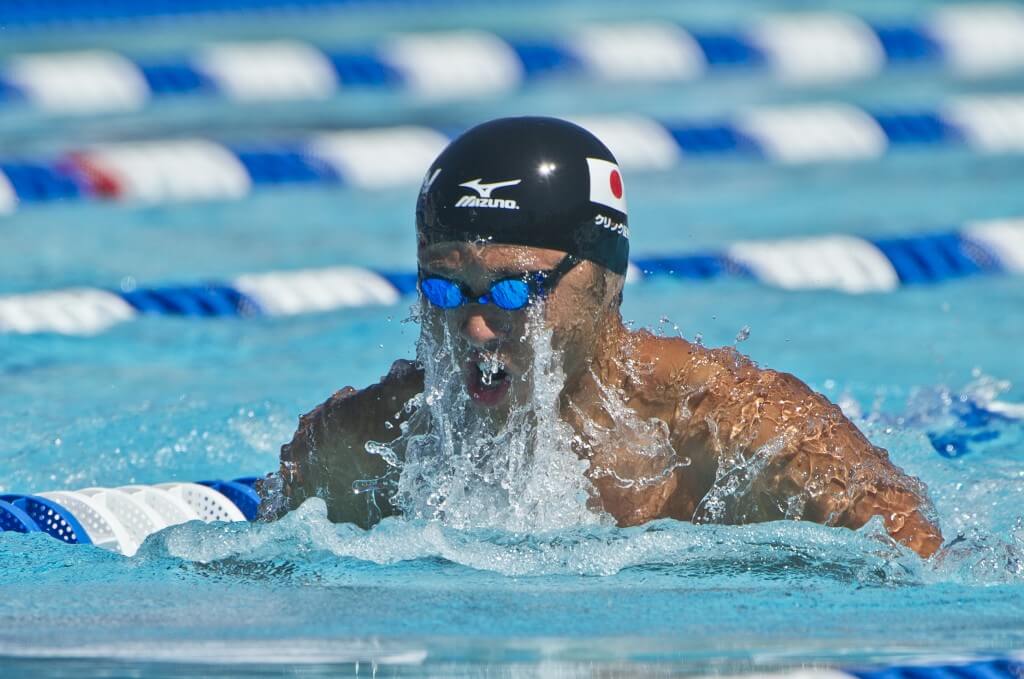
Olympic Throwback: The Dolphin Kick Controversy of Kosuke Kitajima vs. Brendan Hansen
by JOHN LOHN – EDITOR-IN-CHIEF
15 July 2024, 04:34am
The Dolphin Kick Controversy of Kosuke Kitajima vs. Brendan Hansen
The final of the 100 breaststroke at the 2004 Olympics in Athens was shrouded in controversy after Japan’s Kosuke Kitajima was shown performing an illegal dolphin kick on the way to defeating American Brendan Hansen. The move by Kitajima set off a charge of cheating by Hansen’s teammate and friend, Aaron Peirsol, and also proved to be the impetus for a rule change in the stroke.
Certain athletes will be forever linked. While many boast stand-alone credentials of great prestige, some possess a bond with another which is inescapable. On the basketball court, only first names were needed: Larry and Magic. In the ring, it was Ali vs. Frazier. On the grass of Wimbledon, it was Borg vs. McEnroe.
Swimming, too, has had its share of high-profile rivalries, duels spanning all of the strokes. In the breaststroke discipline, there has been nothing close to matching the rivalry of the United States’ Brendan Hansen and Japan’s Kosuke Kitajima. For a little more than a decade, the men pushed one another – and their events – to greater heights. A coolness primarily permeated the relationship, a language barrier not helping matters, although warmth was found when their dueling was done.
Yet, for all the showdowns shared between Hansen and Kitajima – from Japan to Spain to Canada to Australia, and beyond – nothing compares to what unfolded in a little more than a minute at the 2004 Olympic Games in Athens. The events of August 15 defined – in part – a pair of careers and ultimately triggered a change to the breaststroke which continued to bring controversy.
Photo Courtesy: Peter H.Bick
The early years of the Hansen-Kitajima rivalry resembled a tennis match, the men volleying accomplishments and titles back and forth. Kitajima broke onto the Olympic stage first, qualifying to race the 100 breaststroke and 200 breaststroke at the 2000 Games in Sydney. Although Kitajima failed to advance beyond the preliminaries of the longer distance, he just missed a medal in the 100 breast, finishing fourth. As important, he gained valuable experience which proved beneficial in the years – and Olympiads – to come.
Hansen, on the other hand, experienced his first true heartache during the 2000 campaign. At the United States Olympic Trials in Indianapolis, an 18-year-old Hansen placed third in both the 100 breaststroke and 200 breaststroke. With only the top-two finishers in each event qualifying for the Olympic Games, Hansen found himself in the worst position possible. The 200 breaststroke was particularly agonizing, as Hansen was charging down the last lap and gaining ground on the leaders with every stroke. Had the race been 201 meters in length, he probably would have earned a trip to Sydney. Instead, he was 15 hundredths of a second short.
Several athletes in Hansen’s position have allowed that near-Olympic miss to mentally destroy them, to cast doubt over whether they could get over the hump and achieve a lifelong dream. Hansen, exhibiting maturity well beyond his teenage years, opted for a different approach. Although deeply disappointed, Hansen used the events in Indianapolis to drive him.
“There were a few days when I didn’t see the light at the end of the tunnel. It was hard,” he said. “But I’m going to use it as a positive. You can’t regret what happened in the past, but you can use it as motivation, for myself and my teammates. I’m a man on a mission.”
Off to the storied program at the University of Texas following the Olympic Trials, Hansen didn’t waste time grinding away under the watch of coach Eddie Reese. During his freshman year, he won the first of four NCAA titles each in the 100 breaststroke and 200 breaststroke, that momentum leading to the biggest moment of his career – to date – at the 2001 World Championships in Fukuoka, Japan. While not considered a favorite, Hansen captured the gold medal with a championship-record time of 2:10.69, Kitajima picking up the bronze medal a little more than a half-second back.
“His swimming at the (Olympic) Trials was a great indicator of his ability,” Reese said of Hansen. “But to get third in both events would floor most people. Not Brendan. He took no time to get back on his horse and get back to work.”
Photo Courtesy: Peter H. Bick
The battle between Hansen and Kitajima was clearly on. They each walked away with one individual title at the 2002 Pan Pacific Championships, but the end of that season and the 2003 campaign belonged to Kitajima. He set his first world record in the 200 breaststroke at the end of 2002, breaking the iconic 10-year-old standard of American Mike Barrowman. Then at the 2003 World Championships, Kitajima broke world records en route to gold medals in both the 100 breast and 200 breast, Hansen taking silver and bronze, respectively.
It didn’t take long, however, for the momentum to shift back in Hansen’s favor. At the 2004 United States Olympic Trials in Long Beach, California, Hansen popped – arguably – the two-biggest performances of the meet. He shaved 48 hundredths off Kitajima’s world record in the 100 breaststroke and sliced 38 hundredths off Kitajima’s global mark in the 200 breaststroke. The stage was set for an epic duel at the 2004 Games in Athens, the birthplace of the Olympics.
Neither Hansen nor Kitajima had any difficulty navigating the preliminaries and semifinals of the 100 breaststroke, although their times did not match what they previously produced. Still, as the men took to the blocks for the final of the 100 breast on August 15, Hansen’s birthday, the spectators at the outdoor venue expected a down-to-the-wire duel.
Indeed, a neck-and-neck showdown is what evolved. Stroke for stroke over two laps, Hansen and Kitajima battled. As they touched the wall and looked to the scoreboard, it was shown that Kitajima got to the touchpad first, his time of 1:00.08 narrowly edging the 1:00.25 of Hansen. At the realization of his triumph, Kitajima let out several primal screams, much to the dismay of Hansen. But the screaming was just starting.
Underwater cameras used for television purposes showed that Kitajima had twice violated a rule of the stroke. He was shown using a downward dolphin kick at the start of the race and again after the turn at the 50-meter mark. At the time, the event did not allow for any dolphin kicks, unlike the other strokes in the sport.
Hansen didn’t cry foul at the end of the race. For one, that wasn’t his style. More, he had no way of knowing what transpired in the lane next to him. Hansen was fixated on his race, and that is where he remained after it had concluded. Hansen saw the clock and knew he was nearly a second slower than the time he produced at the Olympic Trials. He blamed only himself for not claiming victory.
Photo Courtesy: Griffin Scott
While Hansen was mum on the sight of Kitajima dolphin-kicking on two occasions, his teammates were not prepared to stay quiet. Sprinter Jason Lezak voiced his displeasure over Kitajima’s tactics, but his words hardly resonated when juxtaposed with the statements of Aaron Peirsol, Hansen’s teammate at the University of Texas and friend. Peirsol, who swept the backstroke events at the Athens Games, went on the offensive almost immediately after the race.
“He knew what he was doing,” Peirsol said of Kitajima. “It’s cheating. Something needs to be done about that. It’s just ridiculous. You take a huge dolphin kick and that gives you extra momentum, but he knows that you can’t see what from underwater. He’s got a history of that. Pay attention to it.”
Experts in the sport, primarily coaches, figured the power of a dolphin kick was good for up to two-tenths of a second per lap, meaning Kitajima’s usage easily provided the winning difference over Hansen. But none of the deckside judges saw or were willing to call the violations and because video replay is not used in swimming, technology could not be employed. With no room to file a protest, Hansen was out of luck. He was also admirable in the way he handled the situation.
“It would be a big deal for an official to come out and to disqualify somebody,” Hansen said. “I can only account for my actions and I know exactly what I did in my race. Everything else, I hope the officials who are sitting right next to me will take care of that. They are not there to have a front-row seat and watch the Olympic Games. They’re there to take care of the rules. I believe that’s what they do.
“I don’t agree with (Peirol’s) actions because the U.S. is very diplomatic on these sorts if things. He was a little fired up and he was protecting his teammate, that’s all.”
Kitajima initially declined to address the topic after the race, although his coach, Norimasa Hirai, defended his pupil by indicating he has never performed an illegal kick. A day later, with the 200 breaststroke looming, Kitajima discussed the accusations levied by Peirsol and maintained his innocence.
“There’s nothing about the race I actually remember,” Kitajima said. “I got in and did the best I could. I just remember when I finished and I won, I was as happy as I’ve ever been. A lot of people will now start to pay attention more than before. When I heard the comments by Peirsol, I was really surprised because I always try to have fair competition. I’m always trying my best within the regulations. I have never, ever been cautioned by the official judges.”
Three days after claiming his controversial gold medal in the 100 breaststroke, Kitajima left no doubt about his dominance in the 200 breaststroke, winning by more than a second over Hungarian Daniel Gyurta, with Hansen taking the bronze medal. Hansen got his gold on the final night of action when he joined Peirsol, Ian Crocker and Lezak on the triumphant 400 medley relay.
The controversy sparked by the final of the 100 breaststroke in Athens did not dissipate and forced a rule change to the sport. Almost a year after Kitajima’s clouded win, FINA, the international governing body of swimming, decided to amend its regulations by allowing athletes a single dolphin kick off the start of each race and off each turn. Basically, rather than placing the onus on officials to enforce the rules, FINA took the easy way out.
Photo Courtesy: Peter H. Bick
In the meantime, Hansen regained the upper hand in the rivalry with Kitajima. Hansen won gold medals in the 100 and 200 breaststroke events at the 2005 World Championships in Montreal, then won both events at the 2006 Pan Pacific Championships, twice beating Kitajima and lowering the world record in the 200 distance. Before illness forced Hansen to withdrawal from the 200 breaststroke at the 2007 World Championships in Melbourne, he again beat Kitajima in the 100 breast.
The 2008 Olympics, though, proved to be forgettable for the American. Before the Beijing Games, Hanen failed to qualify for the 200 breast, leaving him with just the 100 breaststroke and medley relay on his schedule. Hansen’s inability to qualify in the 200 breast elicited a jab from Kitajima, who said: “For a swimmer of his level, it shouldn’t be that difficult to qualify. He didn’t seem to set his goals and rise to the challenge just one month before the Olympics.”
Kitajima went on to repeat his Olympic sweep of the breaststroke events in Beijing while Hansen finished out of the medals in the 100 breast, placing fourth. Although Hansen helped the U.S. prevail in the medley relay, it was another bitter Olympic experience. Hansen ultimately retired after the Beijing Games, content to explore other endeavors. Kitajima, meanwhile, took a sabbatical in 2009 before returning to the sport.
Eventually, the competitive urge got the best of Hansen and he returned to action in time to qualify for the 2012 Olympics in London. With lower expectations than his previous Olympic experiences, Hansen competed without pressure. He barely squeaked into the final of the 100 breaststroke, grabbing the last spot for the final. But racing out of Lane Eight, Hansen managed to collect the bronze medal, calling his latest piece of hardware “the shiniest bronze medal ever.” He also beat Kitajima in an individual Olympic race for the first time, with Kitajima finishing fifth. The medley relay on the last day of the meet saw Hansen win another gold with Team USA and Kitajima picking up silver with his Japanese teammates.
The final in London, much like Athens, wasn’t without controversy. Underwater video footage showed several swimmers, most notably South African gold medalist Cameron van der Burgh, performing several dolphin kicks off the start. Shockingly, van der Burgh later admitted to utilizing more than the single dolphin kick allowed by the rule change of 2005. The regulation change the governing body hoped would eliminate problems a year after Athens still hadn’t proven successful.
At the end of their final duel, Hansen and Kitajima put aside the digs that had been exchanged through the years and paid each other respect through Twitter. They also posed for a picture with one another after a press conference and exchanged a few words. Growing together in the sport clearly generated an appreciation level for one another’s talents.
“We had a good run against each other,” Hansen said.
With one race in Athens serving as a defining moment.
Happy Birthday Michelle Ford!!

Michelle Ford (AUS)
Honor Swimmer (1994)
The information on this page was written the year of their induction.
FOR THE RECORD: 1980 Olympic Games: gold (800m Freestyle), bronze (200m Butterfly); Two World Records (800m Freestyle); 1978 Commonwealth Games: gold (200m Butterfly), silver 400m and 800m Freestyle), bronze (200m Freestyle and 4x100m Free Relay); 1982 Commonwealth Games: gold (200m Butterfly), silver (800m Freestyle); Four Australian National Championships (200m Butterfly).
Crazy about the water since age four, she was touted as the coming superstar of Australian swimming, and at age 13 she broke nine records, six state and three national, all in three days. Two of those records were by Shane Gould and Jenny Turrall. That same year she earned a spot on the 1976 Olympic team, the second youngest Australian ever to do so. Just one year later, she set her first world record in the 800 freestyle. Little did she know her times in the 800 free would someday beat the times swum earlier by the immortal Murray Rose and John Konrads.
This blonde haired, blue eyed beauty continued her winning streak at the 1978 Commonwealth Games, taking a gold in the 200 butterfly, two silvers in the 400 and 800 free and two bronzes in the 200 free and 400 freestyle relay.
But Michelle Ford’s greatest memory is winning the gold medal in the 800 freestyle and bronze in the 200 butterfly in the Moscow 1980 Olympics. “Competing in the Olympics helped define everything I am today,” she said. Ford was named Amateur Athlete of the Year in 1980. Her name is cast in gold as the Australian women’s team has not won a gold in the Olympics since 1980.
Ford’s Olympic gold did not stop her. She went out hard and fast in the 1982 Commonwealth Games (her second) to take the gold in the 200 fly and silver in the 800 free. During the course of her career, she won four Australian National Championships.
Michelle Ford was a swimmer who made many coaches look great including Hall of Famer Don Talbot, Bill Sweetenham in Australia and Don Lamont at the University of Southern California. Michelle was elected to the International Olympic Committee Athletes Commission 12 person board and was a member of the Olympic Academy from 1984 to 1988. She retired from active competition in 1985 and two years later was invited to work with the Olympic Museum in Switzerland. In 1988 she edited the FINA learn to swim manual.
Ford has used her master’s degree in sports psychology to manage the growth and budgeting of 15 sports as the head of the University Association of Switzerland. Impacting three countries (Australia, Switzerland and the USA) her fluid and elegant style in and out of the water are her trademark.