
Happy Birthday Enith Brigitha!!
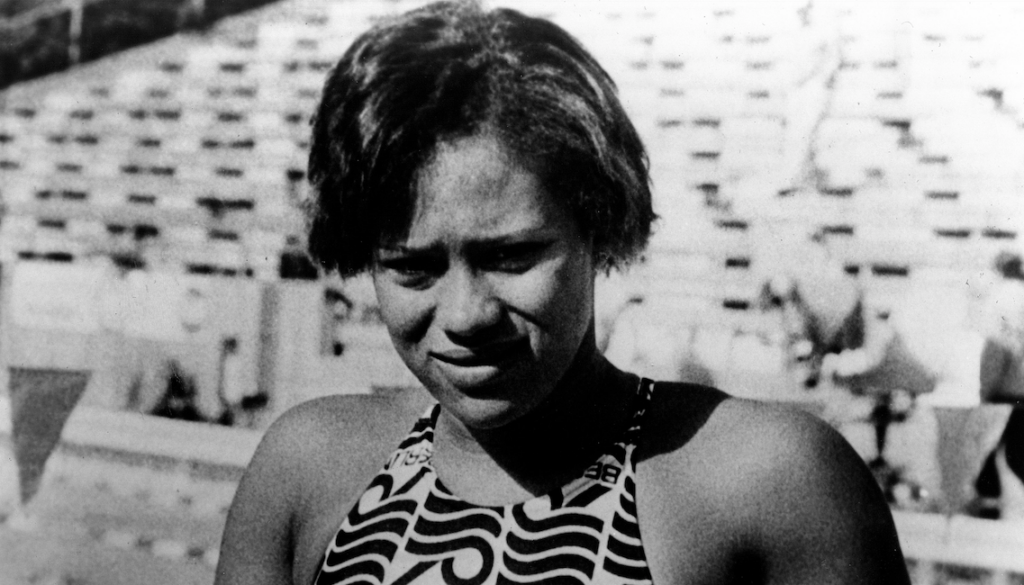
Enith Brigitha (NED)
Honor Swimmer (2015)
FOR THE RECORD: 1972 OLYMPIC GAMES: 8th (100m freestyle), 6th (100m backstroke), 6th (200m backstroke), 5th (4x100m freestyle); 1976 OLYMPIC GAMES: bronze (100m freestyle), bronze (200m freestyle), 4th (4x100m freestyle relay), 5th (4×100 medley relay), 10th (100m backstroke); FIVE SHORT COURSE WORLD RECORDS: 2 (100m freestyle), 2 (200m freestyle), 1 (400m freestyle); 1973 WORLD CHAMPIONSHIPS: bronze (100m freestyle); silver (200m backstroke); 1975 WORLD CHAMPIONSHIPS: bronze (100m freestyle, 200m freestyle, 4x100m freestyle); 1974 EUROPEAN CHAMPIONSHIPS: bronze (100m freestyle, 100m backstroke), silver (200m freestyle, 4x100m freestyle); 1977 EUROPEAN CHAMPIONSHIPS: silver (100m freestyle, 4x100m freestyle).
Enith Brigitha was born on the West Indian Island of Curacao, where she first learned to swim in the Caribbean Sea. By the time she moved to Holland with her mother and brother in 1970, she had become the island’s most promising swimmer.
Two years later, swimming for Coach Willie Storm at the Club Het Y in Amsterdam, Enith qualified for the 1972 Munich Olympic Games and reached the final in four events, and this was just the start of her success. At the 1973 inaugural FINA World Championships in Belgrade, she claimed a silver medal in the 200 meter backstroke and a bronze medal in the 100 meter freestyle. At the 1974 European Championships she won five medals, including four individual medals for the 100 and 200 meter freestyle and backstroke events. In 1975, at the II FINA World Championships in Cali, Columbia, she added three bronze medals to her collection, including individual pieces of hardware in the 100 and 200 meter freestyle.
At the 1976 Olympic Games in Montreal, she earned individual bronze medals in both the 100 and 200 meter freestyle, and at the 1977 European Championships, she won a silver medal in the 100 meter freestyle.
Enith was a genuine superstar in an era dominated by women swimmers from the German Democratic Republic. All told, she set five short course world records and collected 21 Dutch titles in the freestyle, backstroke, medley and butterfly events. She won the Dutch 100 meter freestyle title seven years in a row, was twice named Dutch Sportswoman of the Year – and has the distinction of being the first person of African descent to win Olympic medals in swimming.
Still, her accomplishments have for too long been diminished by the dazzling success of the East Germans. Of the 11 individual medals Enith won at the Olympic Games, World and European Championships – only East German swimmers finished ahead of her in 10 of those events, the one exception being America’s Shirley Babashoff, in the 200 meter freestyle at Munich.
After the fall of the Berlin Wall, Dr. Werner Franke and his wife Brigitte Berendonk, discovered files from the Stasi – the East German secret police – documenting the fact that all of the East German swimmers who finished ahead of Enith Brigitha had been systematically doped, without the knowledge or consent of them or their parents, as a matter of national policy. To the GDR’s rulers, these young athletes were nothing more than pawns in
a global chess game, sacrificial lambs on the altar of East German ideology. Had the world known this at the time, the steroid and testosterone enhanced performances of the GDR’s athletes would have resulted in their disqualification, and Enith’s record would be even more stellar than it is. She also would be recognized today as the first black Olympic champion in swimming history, beating Anthony Nesty of Suriname to the top of the podium by 12 years.
There’s more to life than just swimming, of course. After hanging up her swimsuit and retiring from the sport, Enith married and had three daughters. She moved back to Curacao, where she opened her own swimming school and taught children to swim. Once her daughters were ready to go to University, the family moved back to Holland, where they remain today. Enith says, “With the girls in Holland and with our three grandchildren, it’s not so easy to leave Holland again.”
Happy Birthday Dara Torres!!
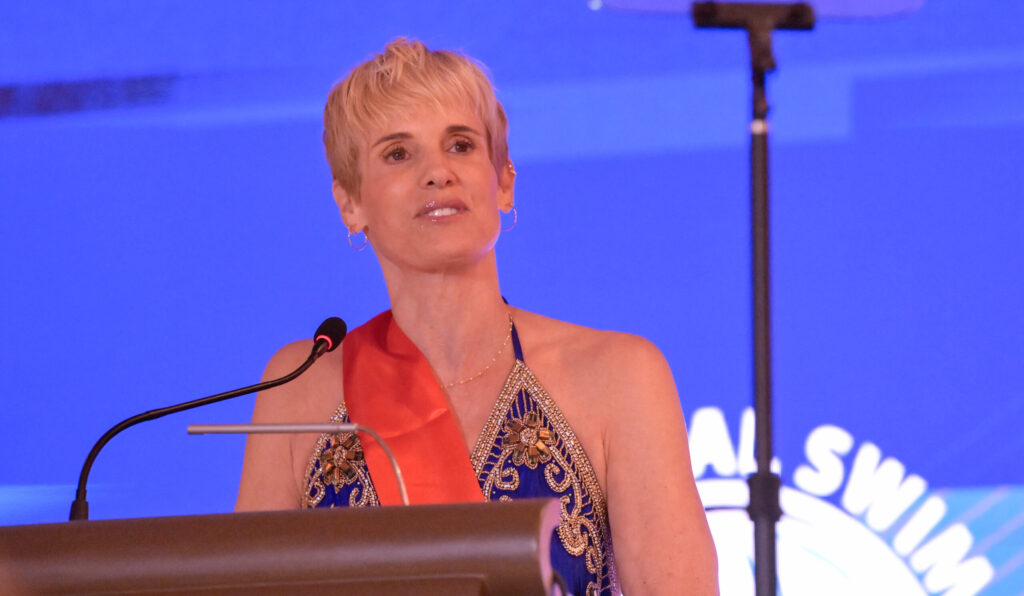
Dara Torres (USA)
Honor Swimmer (2016)
FOR THE RECORD: 1984 OLYMPIC GAMES: gold (4×100 m freestyle); 1988 OLYMPIC GAMES: silver (4×100 m medley), bronze (4×100 m freestyle); 1992 OLYMPIC GAMES: gold (4×100 m freestyle); 2000 OLYMPIC GAMES: gold (4×100 m freestyle, 4×100 m medley), bronze (50 m freestyle, 100 m freestyle, 100 m butterfly); 2008 OLYMPIC GAMES: silver (50 m freestyle, 4×100 m freestyle, 4×100 m medley); 1986WORLD CHAMPIONSHIPS (LC): silver (4×100 m freestyle); 1987 PAN PACIFIC CHAMPIONSHIPS: gold (100 m freestyle, 4×100 m freestyle, 4×100 m medley); 1983 PAN AMERICAN GAMES: gold (4×100 m freestyle); SIX WORLD RECORDS: three individual (50m free), three relays (4x100m free, 4x100m medley)
Dara Grace Torres grew up in Beverly Hills, California, where she learned to swim in her family’s backyard pool. At the age of seven, she followed her brothers to swim practice at the local YMCA. During her junior year of high school, Torres moved to Mission Viejo, CA, to train with Hall of Fame Coach Mark Schubert, and in 1983 she broke the world record in the 50-meter freestyle. The next year, while not yet a senior in high school, she won her first Olympic gold medal as a member of the USA’s 4×100 freestyle relay team.
Swimming for Randy Reece at the University of Florida, Torres earned 28 NCAA All-American swimming awards and at the 1988 Olympic Games, she won two silver medals swimming on relays. She finished her collegiate athletic career playing volleyball and took two years off before returning to win her second Olympic relay gold medal in Barcelona, Spain during the summer of 1992.
After 1992, Torres lived what appeared to be a glamorous life. She moved to New York City, worked in television, and as a Wilhelmina model she became the first athlete model in the Sports Illustrated swimsuit issue. Then in the spring of 1999, despite not having trained in a pool for seven years, she decided to give the Olympics one more try.
Training with coach Richard Quick in Palo Alto and Santa Clara, Dara made the Olympic team for the fourth time, at the age of 33. She returned home with five medals, more than any other member of the team, including three in individual events, and retired.
In 2005, while pregnant with her first child, Dara began swimming three or four times a week at the Coral Springs Aquatic Complex, to keep fit. After giving birth to her daughter, Tessa Grace, in April 2006, she entered two Masters meets and posted times that emboldened her to try another comeback. She asked Coral Springs coach Michael Lohberg if he would coach her, and a little over a year later, she won the 100-meter freestyle at the U.S. Nationals in Indianapolis. Three days later, she broke the American record in the 50-meter freestyle for the tenth time – an amazing 24 years after setting it for the very first time. In 2008, Dara qualified for her fifth Olympic team and at the 2008 Beijing Games, she became the oldest swimmer to compete in the Olympics. Dara returned home with three silver medals, including the heartbreaking 50-meter freestyle race where she missed the gold by 1/100th of a second.
In 2009, Dara won the ESPY award for “Best Comeback,” was named one of the “Top Female Athletes of the Decade” by Sports Illustrated magazine and became a best selling author with the release of her inspirational memoir, Age is Just a Number.
Dara continued swimming after recovering from reconstructive knee surgery and with the encouragement of coach Lohberg, she set her sights on making a record sixth U.S. Olympic swim team. When she just missed making the London Olympics by nine-hundredths of a second in the 50-meter freestyle at the 2012 US Swimming Olympic Trials, she announced her retirement with a smile on her face and her six-year old daughter Tessa in her arms.
Olympian, television personality, fitness guru, Queen of the Comeback, best-selling author and mother. Dara Torres is many things to many people, but above all, she is an inspiration.
Kirsty Coventry (IOC) on why leaders should train – and fail – like Olympians
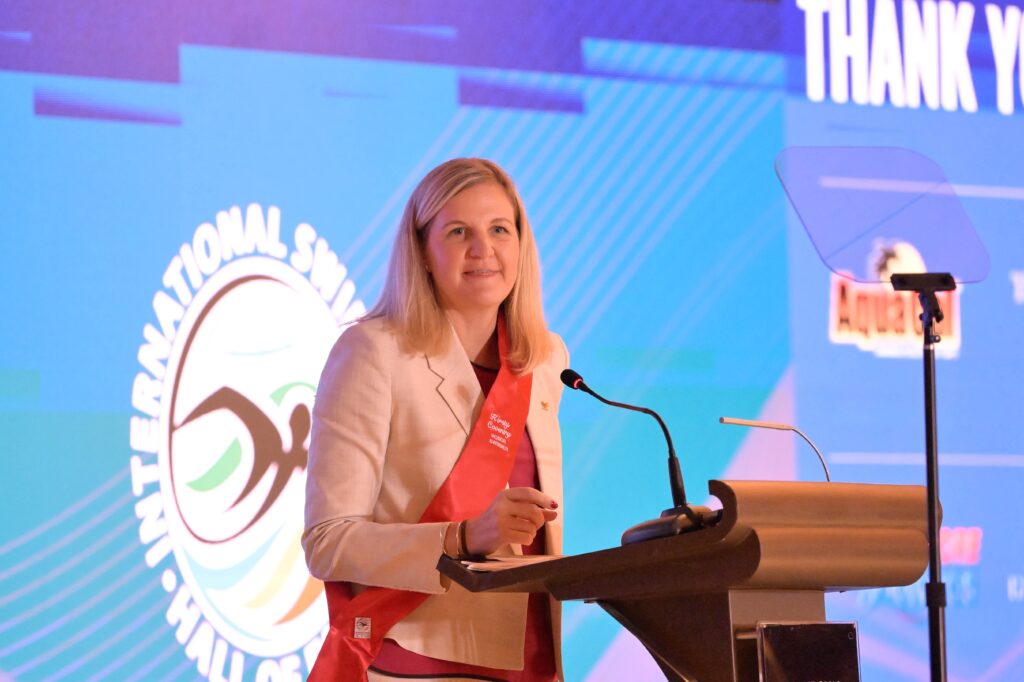
What can leaders learn from Olympians?
In the latest episode of Leaders Unplugged by IMD, IOC President Kirsty Coventry shares how an athlete’s mindset shapes her approach to leadership — from training with purpose to learning from failure and performing under pressure.
Drawing on her experience as an Olympic champion, she reflects on why listening and feedback are essential, and what it takes to lead a global organisation in complex times.🎧
Listen to the conversation and explore what leadership can learn from sport.
ISHOF is looking for swimmers for its Corporate Swim Challenge, which is going to be a great FUN Event on Saturday, April 25, 2026, from 3:00-6:00pm.

ISHOF is looking for up to 36 swimmers for our inaugural event, the ISHOF Corporate Swim Challenge. The event will be held, Saturday, April 25, 2026, from 3:00 to 6:00 in the afternoon at the Fort Lauderdale Aquatic Center. The format of the event will be: Each team of four will swim as many laps as they can in the 45 minutes time limit; Any of the four swimmers on the team can substitute for one another as many times as they like during the forty five minutes; Just try and get in as many laps as you can in to win.
It will be a great day filled with music, fun, food, prizes and friends!
If you would like to participate and be a part of this great event, email Devin at Devin@ishof.org or call 631.880.2539.
Come join the Fun!!!
Texas, Again: Longhorn Men Prevail at NCAA Championships for Second Straight Year, 17th Overall Title
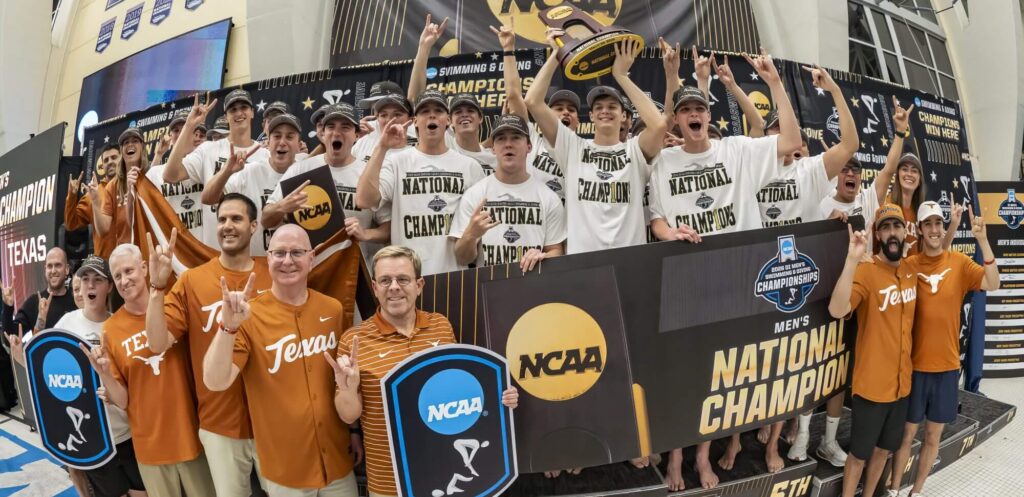
Texas celebrates another national championship — Photo Courtesy: Peter H. Bick]
by David Rieder – Senior Writer
28 March 2026
Throughout the four days of the NCAA Men’s Championships, the Texas Longhorns were not exactly showing peak form. Hubert Kos delivered a performance best described as legendary, pushing Josh Liendo to the limit in the 100 butterfly before swimming the fastest time ever in both backstroke events, but results for Rex Maurer, Will Modglin, and Nate Germonprez, top seeds entering the competition, were mixed. Several members of the team’s supporting cast could not replicate their sensational midseason times, particularly after the team dealt with multiple bouts of illness following the SEC Championships.
Meanwhile, the Florida Gators were making a run, enough to make head coach Bob Bowman nervous. Liendo won three sprint titles while distance aces Ahmed Jaouadi and Ahmed Hafnaoui each came through with dramatic victories. Florida briefly took the lead over Texas during Friday’s finals, and although the Longhorns would quickly restore order, the margin was just 9.5 points at the end of the night.
But simply, by meet’s end, Texas had too much. The team set the tone with an opening-night win in the 800 free relay with Rafael Fente-Damers, Camden Taylor, Maurer and Baylor Nelson. Maurer set an American record in his winning effort in the 400 IM with Nelson taking second. Maurer and Nelson each added another top-three finish, Maurer in the 500 free and Nelson in the 200 IM. Campbell McKean and Germonprez picked up a 2-3 finish in the 100 breaststroke, and Germonprez came in fifth in the 200 breast.
Modglin swam in three championship finals, finishing fourth in the 100 back and 200 IM, and Cooper Lucas came in sixth in the 400 IM. Sprint freestyle has been a weakness all season, but the relays came through, all finishing in the top six. Diving did its part, as per usual under longtime diving coach Matt Scoggin, with Nick Harris and Luke Forester placing sixth and seventh, respectively, in 3-meter.
The last day was especially critical, with Texas putting three swimmers and one diver into championship finals and getting five more scoring points between ninth and 16th place.
Bob Bowman rooting on his team at the NCAA Championships — Photo Courtesy: Peter H. Bick
“With the challenge Florida gave us, I wasn’t confident that we might be able to win until after this morning session,” Bowman said. “I never once thought we would win until maybe after the prelims this morning. They were swimming very well. They improved quite a bit off of their seeds. We did not. We didn’t swim particularly well in a number of places here. I just thought we showed great resilience and toughness and just stayed with the task until we got it to a point where it was manageable.”
The Longhorns finished the meet with 445.5 points, 29 ahead of second-place Florida, to secure their second consecutive NCAA title and 17th all-time. Bowman has now guided his teams to three consecutive national titles after previously winning with Arizona State in 2024. Eddie Reese, who guided the program for more than 40 seasons, was responsible for the first 15 titles.
“It’s a lot of fun, actually,” Bowman said. “It’s pretty gratifying because for me as a coach, all of my real success in the first half of my career was in long course meters. I was the coach at Michigan for four years in there, but I had no idea what I was doing. Sorry, boys. I figured it out later. We had some kind of success there with long course, not really in the college system.
“When I got to ASU, I had nine years to kind of figure this thing out, and it’s just fun now to understand the game, even as it changes week to week, and just try to learn how to put together a roster and then develop that. Gratifying, but really just fun.”
Florida scored 416 points to capture second place, the team’s highest finish since 1985. Indiana’s impressive final day lifted the Hoosiers to third place with 351 while Arizona State rode four relay wins to 328 points and a fourth-place finish. Tennessee claimed fifth with 272 points, just ahead of NC State (258.5). A rebuilding campaign for California put the Bears in seventh (231), followed by Michigan (220), Virginia (192) and Stanford (136).
This latest title-winning team fully embraced their head coach’s motivational tactics that have previously directed some of the greatest swimmers in history. Bowman knew his team was heavily favored entering this meet, expecting a different scenario than the knockout fight with Cal last season that was decided by just 19 points. Still, he steered the team toward daily incremental improvement, assuming that every point would count at the end.
“I think we try to keep the same mindset either way,” Maurer said. “We don’t really focus on external projections or external expectations on what we need to do. Our goal is to win by as many points as possible, no matter if we are expected to or if we’re expected to win by one point. I think just keeping our foot on the pedal for this entire meet until that last relay finishes is our goal no matter what.”
Each day when Bowman gives his swimmers their workouts, the sheet includes his favorite catchphrase: “Do your work.” Those three words perfectly capture the level-headed intensity he expects from his athletes, and the results, evident for decades, continue to show up. His rapid rebuilding of Texas into the country’s premier program ranks among his greatest accomplishments, even in a career that has included years mentoring Michael Phelps and Leon Marchand.
“Just do your work because that’s the only thing you can control,” Kos said. “You do your work, then everything else will fall into place, and there’s nothing else you can really control.”
In honor of Women’s History Month, Hilda James: One of the great early female pioneers and feminists!

Hilda James (GBR) 2016 Honor Pioneer Swimmer
FOR THE RECORD: 1920 OLYMPIC GAMES: silver (4x100m freestyle); SEVEN WORLD RECORDS: two (300yd freestyle), two (150yd freestyle), one (440yd freestyle), one (400m freestyle), two (220yd freestyle), three (300m freestyle); 29 ENGLISH RECORDS: four (300yd freestyle), one (440yd freestyle), one (500yd freestyle), four (220yd freestyle), four (100yd freestyle), four (150yd freestyle), two (440yd freestyle), two (500yd freestyle), one (440m freestyle), one (1750yd freestyle), one (880yd freestyle), one (1000yd freestyle); EIGHT U.K. NATIONAL CHAMPIONSHIPS: four (220yd freestyle), one (100yd freestyle), two (Thames Long Distance from Kew Putney five miles 50yd), one (440yd freestyle); FOUR SCOTTISH RECORDS: one (220yd freestyle), two (200yd freestyle), one (300yd freestyle), one (400m freestyle); FOUR OTHER MEET RESULTS: gold (300yd individual medley), gold (220yd freestyle), gold (110yd breaststroke), one River Seine 8k Race.
To avoid attending Church of England religious education classes, which conflicted with her parents religious beliefs, this 11-year old Liverpudlian was assigned to swimming classes at the Garston Baths.
Five years later, Hilda James was Great Britain’s best female swimmer and left for the 1920 Olympic Games with high expectations. Unfortunately in Amsterdam, the USA women completely dominated, sweeping the gold, silver and bronze medals in the 100m and 300m freestyle, the only individual swimming events for women at the 1920 Games. And while the British did win silver medals in the 4x100m relay, they finished a full 30 seconds behind the Americans. The following day Hilda cheekily asked the American coach, Lou de B. Handley, to teach her the American Crawl.
In 1922, Hilda was invited by her American friends to visit the USA for the summer racing season. While she was still behind the American stars Helen Wainwright and Gertrude Ederle, she was closing the gap.
By 1924, Hilda held every British and European freestyle record from 100 meters to the mile, and a handful of world records as well. She easily made the 1924 Olympic team, and it was widely believed that she would return from Paris with a handful of medals. When Hilda’s mother insisted she accompany her daughter as chaperone, and the British Olympic Committee refused, Hilda’s mother refused to let her go. Unfortunately, Hilda was not yet 21, was under the care of her parents – and had to obey.
Hilda turned 21 shortly after the Olympic Games, gained her independence, and took a job with the Cunard Shipping Company, traveling the world as a celebrity spokesperson, at a time when women were just starting to gain their freedom.
We will never know how Hilda would have fared in the 1924 Olympic Games, but she was a trailblazer and one of Europe’s first female sports superstars who inspired future generations of girls to follow in her wake.
From Hilda’s grandson: Ian Hugh McAllister:
tFenSbcpodroungssagaeryr lo5tnarm, e2d0d1a4 · Poole, United Kingdom ·
My Grandmother Hilda James officially opened the pool in 1925. As the premiere swimming star of the era she was also invited to participate in the opening gala but declined to swim in the races, substituting a demonstration of trick and fancy swimming instead. What the audience didn’t know was that she had already signed as a professional with Cunard, and was due to become the first celebrity crew member aboard Carinthia, the very first purpose-built cruise liner. Although not officially on the Cunard payroll until the following week, she was not exactly sure when they would start paying her, and dared not compete in case the press found out she was no longer an amateur. It was a poignant moment for Hilda, her last ever appearance as an amateur following a meteoric nine year career. During that time she held an Olympic silver medal, broke seven World Records, and actually introduced the crawl stroke to the UK.
The whole story is told in her biography “Lost Olympics” which was published last year on Amazon and for Kindle download. Please visit the Lost Olympics facebook page for a lot more information, including my various TV and radio interviews etc. Hilda has recently been nominated for induction to The International Swimming Hall of Fame.
When the pool gets rebuilt, can I come and open it again for you, or at least be at the opening? (although I am no swimmer!)

If you are interested in purchasing a copy of The Hilda James story: Lost Olympics, please reach out to meg@ishof.org
City of Fort Lauderdale Mayor Dean Trantalis praises ISHOF in his monthly newsletter
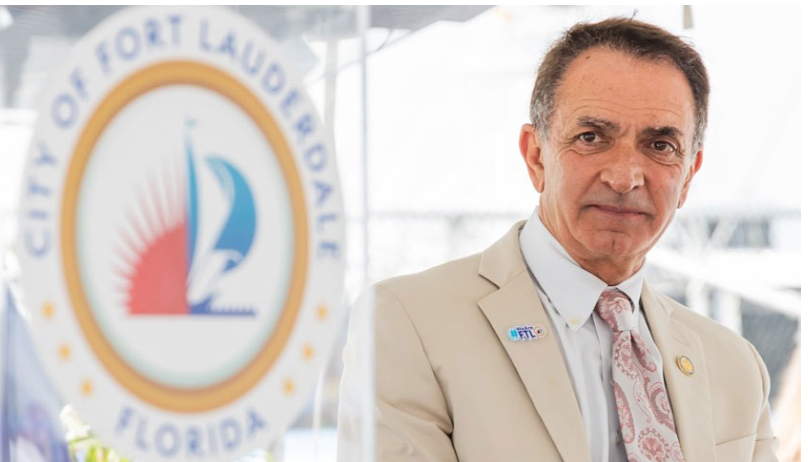
Photo credit City of Fort Lauderdale
March 2026
Mayor Dean Trantalis, City of Fort Lauderdale
The transformation of the International Swimming Hall of Fame is set to be built alongside the redeveloped Aquatic Center, while the new THRIVE Arts District has begun bringing fresh life to Progresso Village through art, commerce and adaptive reuse. Both projects point to the same commitment. Fort Lauderdale is investing in places that strengthen identity, expand opportunity and create lasting value.
The International Swimming Hall of Fame has long held an important place in Fort Lauderdale’s story. It is part of our beachfront and part of our history and connects Fort Lauderdale to the global swimming community.
Now, the second phase of its modernization will soon get underway. The museum portion of the complex is expected to begin its $220 million transformation this summer following the City Commission’s unanimous approval of its design. The reimagined destination is targeted to open in late 2028.
Plans call for a larger and more elegant International Swimming Hall of Fame museum, a family-friendly aquarium, a rooftop restaurant with panoramic waterfront views as well as space for events and exhibits. An elevated promenade will strengthen the public experience from the beach toward the Intracoastal.
We accomplish this update while maintaining a sense of place at the complex. The approved concept was scaled to a more intimate structure, preserving the skyline and protecting the visual prominence of the Aquatic Center and its iconic dive tower. After all, progress should not compete with identity, but reinforce it.
What a great way to bookend the accomplishments we have already completed on this historic peninsula. It was only a few short years ago that we undertook a massive overhaul of the aquatic center. We upgraded pools, built new grandstands, improved spectator amenities and added the now-famous 27-meter dive tower.
The renovated aquatic center and the new ISHOF will be a great combination. We are restoring the city’s standing as an international venue for swimming and diving and enhancing the opportunities for locals and visitors alike.
A revitalized Hall of Fame can do more than celebrate elite achievement. It can introduce young people to aquatic history. It creates more reasons for residents to return and for visitors to stay longer. This is the kind of investment in community that makes sense.
While the Swimming Hall of Fame represents Fort Lauderdale rebuilding one of its most significant public assets, the THRIVE Arts District reflects investment in a different but equally important kind of strength: neighborhood energy, local enterprise and adaptive reuse.
Happy Birthday Rebecca Soni!!
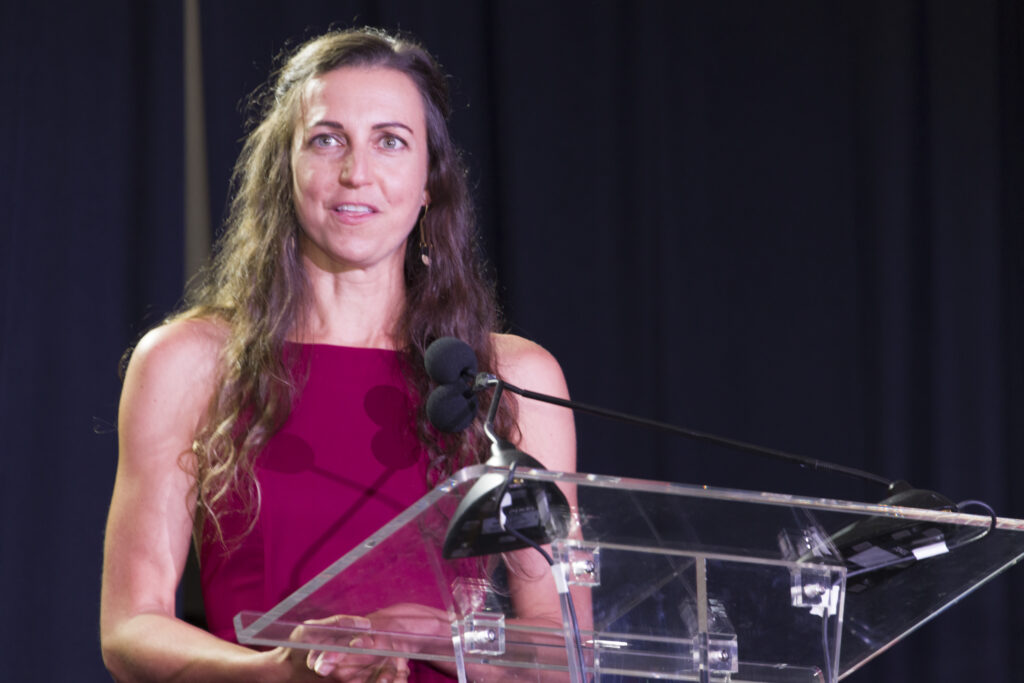
Rebecca Soni (USA)
Honor Swimmer (2021)
FOR THE RECORD: 2008 OLYMPIC GAMES: gold (200m breaststroke), silver (100m breaststroke, 4×100m medley relay); 2012 OLYMPIC GAMES: gold (200m breaststroke, 4×100m medley relay), silver (100m breaststroke); EIGHT WORLD RECORDS: 100m breaststroke (1 LC, 1 SC), 200m breaststroke (3 LC, 1 SC), 4×100 medley relay (1 LC, 1 SC); 2009 WORLD CHAMPIONSHIPS (LC): gold (100m breaststroke), silver (50m breaststroke); 2011 WORLD CHAMPIONSHIPS (LC): gold (100m breaststroke, 200m breaststroke, 4×100m medley), bronze (50m breaststroke); 2010 WORLD CHAMPIONSHIPS (SC): gold (50m breaststroke, 100m breaststroke, 200m breaststroke), silver (4×100m medley relay)
Rebecca Soni is known as a breaststroke phenom. What she lacked in size, she made up for in strength and desire. Her much-discussed technique is what separated her from her rivals. It featured an abbreviated leg kick aligned with perfectly timed rapid arm sweeps. It was an effective and efficient approach, and it was gold – Olympic gold.
Soni is a two-time Olympian and six-time Olympic medalist. She broke eight world records in breaststroke events and as part of two women’s medley relay teams, one long course and one short course.
During the summer of 2006, Soni had a procedure called a cardiac ablation that helped regulate her heartbeat. She had an irregularly high heartbeat that affected her training and needed to be treated.
Soni worked through her health issues and qualified for her first Olympic team in 2008 by winning the 200m breaststroke. In the 100m breaststroke, she took fourth place. However, fate stepped in when one American teammate withdrew and another missed a deadline for the Games, allowing Soni to represent the United States in her first Olympic Games in three events – both breaststrokes and the 4×100 medley relay. She did not disappoint.
In her first event, the 100m breaststroke, Soni won the silver medal behind world record holder Leisel Jones of Australia. She followed with a stunning victory in the 200m breast, out-swimming Jones with a time of 2:20.22 that also broke Jones’ world record.
Soni wrapped up her first Games as a member of the USA medley relay team, taking her second silver medal, behind the Australians.
Soni attended the University of Southern California from 2005-2009 and swam for multi-time Olympic coach Dave Salo. Her career was defined by four national titles in the 200-yd breaststroke and in her junior and senior years, she also won titles in the 100-yd breaststroke. Soni ended her career at USC with the NCAA record in the 200-yd breaststroke, gathered 12 All-American honors and finished as one of the most dominant breaststrokers in NCAA history.
At her second Olympic Games in 2012, Soni again won the silver medal in the 100m breaststroke, this time behind Lithuania’s Ruta Mejlutyte by only .08 seconds. In the 200m breaststroke, Soni broke the world record in the semi-finals with a time of 2:20.00. In the finals, she won the gold medal and broke the world record again with a time of 2:19.59. The effort made Soni the first woman to break 2:20 in the event.
With that gold medal, Soni became the first female to successfully win back-to-back Olympic titles in the 200m breaststroke. In the medley relay, Soni helped the United States win gold, as she teamed with Missy Franklin, Dana Vollmer and Allison Schmitt. Together, the foursome broke the world record with a time of 3:52.05.
After her retirement in 2014, Soni went into business with friend and former Olympic teammate, Caroline Burckle. They co-founded a company called RISE Athletes, an online mentoring platform for young athletes. Soni’s company recruits Olympians to help mentor young athletes by using one-on-one interaction.
Happy Birthday Tom Gompf!!
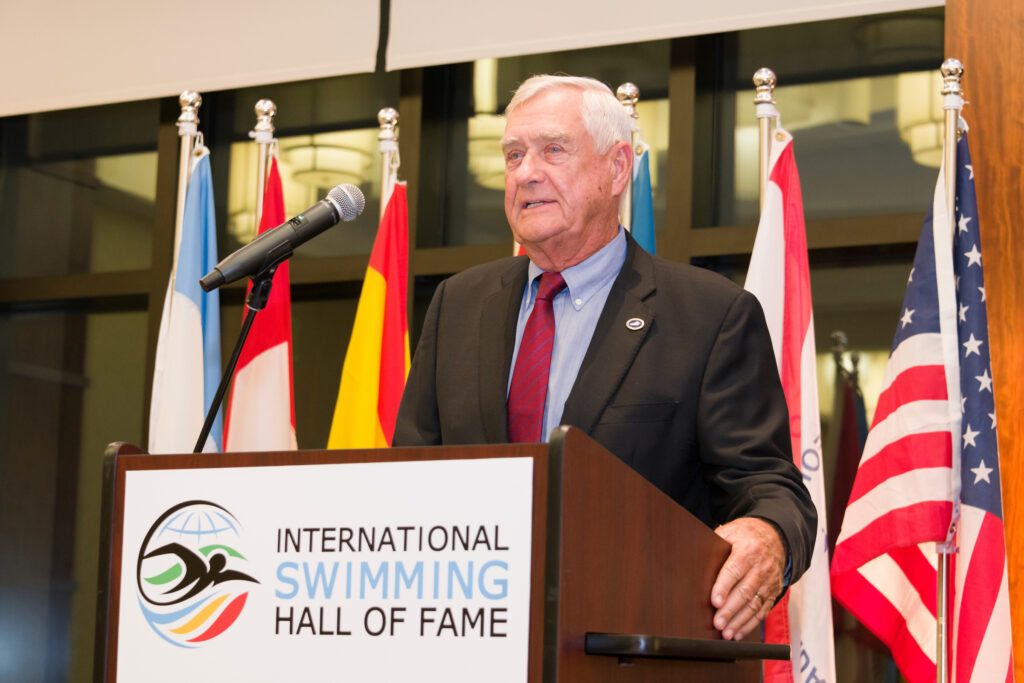
Tom Gompf (USA)
Honor Contributor (2002)
FOR THE RECORD: 1964 Olympic Games: bronze (10m platform); 3 National AAU Championships: (trampoline-1, 10m platform-2); 4 Foreign National Championships: Japan (3), Spain (1); 2 World Professional High Dive Championships; 11 years Diving Coach: University of Miami (FL) (1971-82); 1976, 1984 U.S. Olympic Diving Team: Coach/Manager; U.S. Olympic Committee Executive Board of Directors: Member (1977-2000); 1984-2004 FINA Technical Diving Committee: Chairman (1988-2000); U.S. Diving, Inc.: President (1985-90); U.S. Aquatic Sports: President (1999-present); Executive Board of Amateur Swimming Union of the Americas: member (1999-present).
Tom Gompf loves all aspects of diving; always has, always will. He started as a young local
competitor, advanced to the Olympic Games, performed in professional competition and grew to serve the international diving community as an administrative leader. He is a hard worker for the good of the sport and a friend to all. Gompf has had a profound international influence on the sport of diving.
As a youngster, growing up in Dayton, Ohio, Tom won five National YMCA Diving titles and two National AAU Junior Nationals Championships. He was coached in the early years by Ray Zahn, George Burger and Lou Cox.
By the time he graduated from college at Ohio State University in 1961, diving for Hall of Fame Coach Mike Peppe, Tom had won the NCAA National Trampoline Championships and a year later, the U.S. National AAU Diving Championships twice on the 10m platform. In 1964 at the Tokyo Olympics, and under the eye (1961-1965) of coach Dick Smith, Tom won the bronze
medal on the 10m platform, only two points behind gold medalist Bob Webster (USA) and one point behind silver medalist Klaus Dibiasi (Italy) both Hall of Famers. Tom went on to win National Championships in Spain and Japan and then competed in and won first place in the 1970 and 1971 World Professional High Diving Championships in Montreal. His next competition
was diving off the cliffs of Acapulco. He survived. All this was while flying several hundred combat missions in Vietnam from 1965 to 1967 earning the Distinguished Flying Cross, the Air Force Commendation Medal and the Air Medal with multiple silver clusters.
From 1971 to 1982, he coached diving at the University of Miami (FL) developing divers, winning six National Championships and competing on World, Pan American and Olympic teams. Steve McFarland, Melissa Briley, Julie Capps, Greg Garlich and Greg Louganis were among his team members.
But perhaps Tom’s greatest contribution came from behind the scenes as a leader in the sport. Universally acknowledged for his low-key, amiable manner, his stock-in-trade is his ability to work effectively and silently to promote the sport. Extremely intelligent, he can be very persuasive. Says one veteran, “Tom can make you believe a watermelon is an apple.” Since 1977, he has served on the United States Olympic Committee Board of Directors (1977-2004) and Executive Board, working to autonomize the four aquatic disciplines under the Amateur Sports Act of 1978. He helped establish U.S. Diving, Inc. in 1980 and serves as the only continuous board member. He served four years as its president (1985-90) and since 1998 has been president to United States Aquatic Sports which represents all the disciplines and reports directly to FINA.
On the international scene, Tom serves on the Executive Board of the Amateur Swimming Union of the Americas (ASUA). In 1984, he was elected to the FINA Technical Diving Committee and continues in that position today. He served three, four-year terms as chairman during which time he proposed and passed legislation to include 1 meter diving in the FINA World Championships (1986) and synchronized diving for World competitions, with its debut at the 2000 Sydney Olympics. “It lends the element of team, which every other sport has. It’s TV and a proven crowd favorite,” says Tom. Tom is responsible for the renovation of international judging, initiating a judges’ education program involving clinics and manuals. Tom has served as the
Chairman of the FINA Diving Commission for the World Swimming Championships (1990-98) and as Chairman of the FINA Diving Commission for the Olympic Games (1992-2000).
Tom has received the FINA silver and gold pins, served as the U.S. Team Manager for the 1976 and 1984 Olympic Games, was Chairman eight years (1991-98) for the ISHOF Honoree Selection Committee and served four years (1986-90) on the ISHOF Board of Directors. All the while, Tom was airline captain for National (1967-80), Pan American (1980-91) and Delta Airlines (1991-2000). He has received the Mike Malone/Glen McCormick Award (1984) for outstanding contribution to U.S. Diving, the Phil Boggs Award (1995), U.S. Diving’s highest award and the 1997 Paragon Award for competitive diving.
Tom’s accomplishments were never for personal fame, but always an honest attempt to help the sport he loves. He has applied the same determination and passion that made him an Olympic medalist to pursuing the goal of advancing and improving all aspects of diving on the international scene for the good of the sport and the athletes.
What U.S. Olympians won gold in the 1976 Montreal Summer Olympics? There are a few Swimmers that made this list.

Barry Werner, List Wire
Wed, March 11, 2026 at 3:08 PM EDT·
1 min read
Fifty years ago, the United States was celebrating its bicentennial. North of the border, in Montreal, the 1976 Summer Olympics were held. Team USA won 34 gold medals, and some of those names resonate to this day. Overall, Team USA finished third in the medal count behind the Soviet Union and East Germany. Who were the USA Olympians in 1976 that came home with gold?
Mike Bruner: 200M butterfly
Interior of the magnificent swimming pool built in Montreal in preparation for the 1976 Olympic Games.
Bruce Furniss: Men’s 200M freestyle
British Royals Prince Philip, Duke of Edinburgh and Queen Elizabeth II wave to crowds from the back of their car as they tour the Olympic Village.
Men’s 200M freestyle
John Naber: 100M and 200M backstroke
USA swimmers Peter Rocca and John Naber with their silver and gold medals for 100m backstroke, and Roland Matthes of East Germany with his bronze medal.
Jennifer Chandler: 3M springboard
The stadium scoreboard during the opening ceremony of the 1976 Summer Olympics.
Donald Haldeman: Shooting, Trap
Trap competition at an Olympic Games.
Brian Goodell: 1,500, 400M freestyle
Projections cover the pool ahead of the men’s 400-meter individual medley final.
1,500, 400M freestyle
John Hencken: 100M breaststroke
A look at the pool inside Lucas Oil Stadium which is set to host the U.S. Olympic Team Trials.
Lanny Basham: 50 meter rifle, three positions
General view during men’s 50m rifle three position final competition.
50 meter rifle, three positions
Matt Vogel: 100M Butterfly
100 meter butterfly swim.
Swimming relay: Men’s 4 X200M freestyle
John Naber stands in the pool and reacts to setting a world record.
Phil Boggs: 3M springboard
A general view as competitors warm up on the 10-meter platform and 3-meter springboard before U.S. Olympic Diving Team Trials.
Swimming relay: Men’s 4X100
American swimmer John Naber during the 1976 Montreal Olympics, at which he won four gold medals.
Edwin Moses: 400M hurdles
Edwin Moses running a lap of honor at the Montreal Olympics after winning the final of the 400 meters hurdles final. pi
Mac Wilkins: Discus
Mac Wilkins prepares to do the discus.
Edmund Coffin: Individual eventing
Eventing Jumping.
Equestrian: Team eventing
American actor and singer Telly Savalas (center) is amongst the spectators at the 1976 Summer Olympics in Montreal, Canada, July 1976.
Jim Montgomery: 100M freestyle
Americain swimmer Jim Montgomery.
Rod Strachan: 400M individual medley
Swimmers dive into the pool during prelims for the U.S. Olympic Team Swimming Trials.
Swimming relay: Women’s 4X100M freestyle
A look at the pool set to host the U.S. Olympic Team Trials for USA Swimming.
Men’s basketball
Summer Olympics basketball final between USA and Yugoslavia in Montreal.
Arnie Robinson: Long jump
Andy Sythe waters the long jump pit prior to the 2016 U.S. Olympic Team Trials at Hayward Field.
Darrell Pace: Archery, men’s individual
General view of the Opening Ceremony of the Olympic Games at the Olympic Stadium in Montreal, Canada.
Luann Ryon: Archery, women’s individual
A view of the living quarters designed for the athletes at the 1976 Montreal Olympics.
Bruce Jenner: Decathlon
Bruce Jenner of the USA celebrates during his record setting performance in the decathlon in the 1976 Summer Olympics in Montreal, Canada.
Track and field: Men’s 4X100M relay
American athletes Steve Riddick, Harvey Glance, John ‘Lam’ Jones (partially obscured behind Glance), and Millard Hampton, the United States men’s 4×100 meters relay team.
Track and field: Men’s 4X400M relay
A runner holds a baton before starting a race.
Leon Randolph: Flyweight boxing
A detail image of the timekeeper ringing the bell to signal the beginning of a round.
Howard Davis: Lightweight boxing
Howard Davis of the USA in action during a bout against Tzvetan Tzvetkov of Bulgaria.
Ray Leonard: Light welterweight
American light welterweight boxer Sugar Tay Leonard jubilating after winning the final of his boxing tournament.
Michael Spinks: Middleweight boxing
Michael Spinks holds his hands up in victory after he retains his IBC heavyweight title by beating Larry Holmes.
Leon Spinks: Light heavyweight boxing
American Leon Spinks knocks down Sexto Soria of Cuba, winning the gold.
John Peterson: Freestyle wrestling, 82KG
USA wrestler John Peterson holds his opponent’s hands on the podium of the wrestling freestyle 82 kg competition.
This article originally appeared on The List Wire: USA Olympians who won gold medals in 1976 Summer Olympics