
World Aquatics reveals Artistic Swimming World Cup calendar through 2028, with Youth and Junior World Championship hosts confirmed until 2030
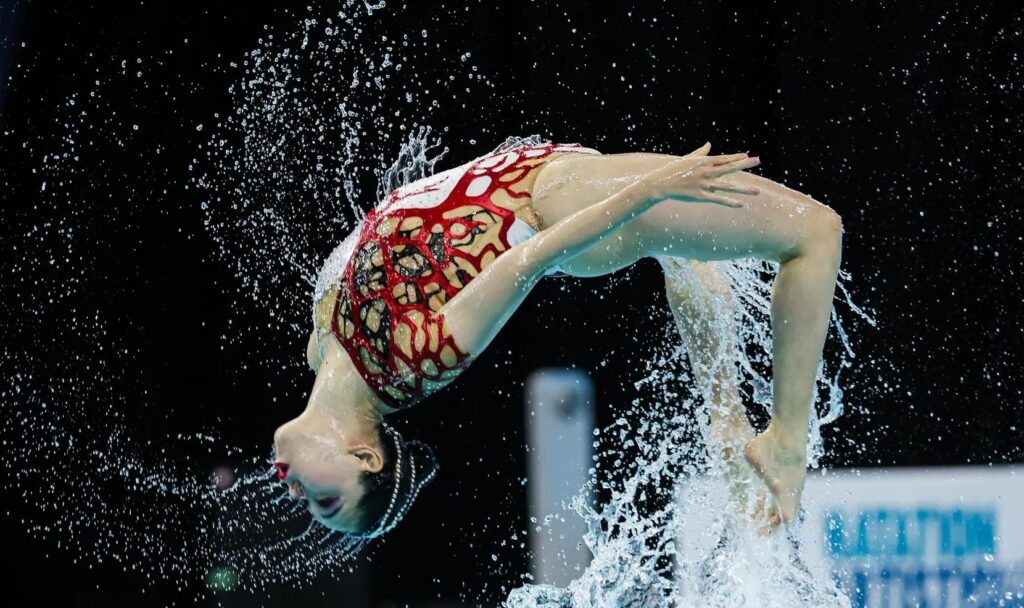
Shared and Written by:World Aquatics Communications Department
Image Source: Antoine Saito / World Aquatics
World Aquatics has today unveiled the Artistic Swimming World Cup calendar for 2027 and 2028, with Peru, France and Canada among the first nations selected to stage pinnacle events in the competition over the next two years as part of a competitive bidding process.
Peru, France and Canada among first nations revealed as hosts of Artistic Swimming World Cup stops in 2027 and 2028
Youth and Junior Artistic Swimming Championships announced up to 2030, with Canada, Chile and Greece selected to stage key age-group events
Image Source: Antoine Saito / World Aquatics
Held across four stops and culminating in the Super Final, the 11th edition of the World Aquatics Artistic Swimming World Cup in 2027 will begin in Lima, Peru from 26 to 28 February before its second stop takes place from 19 to 21 March.
The competition then heads to Paris, France (26-28 March) and Markham, Canada (29 April – 1 May) for stops three and four respectively, before the world’s best athletes arrive at the competition’s defining chapter – the Super Final – held from 11-13 June.
Peru, France and Canada will return to the schedule as part of the World Aquatics Artistic Swimming World Cup 2028, with the latter selected to host the Super Final in June of that year, offering the last remaining qualification spots for the Los Angeles 2028 Olympic Games.
The remaining locations that will host stops during the Artistic Swimming World Cup in 2027 and 2028 will be announced in due course.
Also revealed as part of the announcement were host cities for World Aquatics Youth and Junior Artistic Swimming Championships from 2027 to 2030, where the sport’s most talented young athletes will compete for glory.
Canada celebrates further awards, with the country confirmed as hosts of the Youth Artistic Swimming Championships in 2027 and the Junior Artistic Swimming Championships in 2030.
Meanwhile Santiago, Chile will stage the Junior Artistic Swimming Championships in 2028, and the Youth Artistic Swimming Championships 2029 will take place in Athens, Greece.
Image Source: Antoine Saito / World Aquatics
World Aquatics Artistic Swimming World Cup 2027
Stop 1 – Lima, Peru – 26-28 February 2027
Stop 2 – Location TBC – 19-21 March
Stop 3 – Paris, France – 26-28 March
Stop 4 – Markham, Canada – 29 April – 1 May
Super Final – Location TBC – 11-13 June
World Aquatics Artistic Swimming World Cup 2028
Stop 1 – Lima, Peru – 25-27 February 2028
Stop 2 – Paris, France – 24-26 March
Stop 3 – Location TBC – 28-30 April
Stop 4 – Location TBC – May
Super Final – Canada – 16-18 June
Youth and Junior Championships
Youth Artistic Swimming Championships 2027 – Calgary, Canada – 18-22 August 2027
Junior Artistic Swimming Championships 2028 – Santiago, Chile – 30 August – 3 September 2028
Youth Artistic Swimming Championships 2029 – Athens, Greece – August 2029
Junior Artistic Swimming Championships 2030 – Canada – August 2030
World Aquatics President Husain Al Musallam expressed his excitement at unveiling the multi-year calendar for Artistic Swimming competitions.
“We are delighted to confirm this exciting group of hosts for Artistic Swimming, both for the World Cup and for our age-group World Championships. Each of these host nations bring passion, experience and a real commitment to the sport, and I am confident they will deliver memorable events for athletes, fans and the wider Artistic Swimming community.By President Husain Al Musallam
“By unveiling the World Cup calendar for the next two years, and Youth and Junior World Championships until 2030, not only are we building excitement among fans, but this extended runway for athletes, Member Federations and hosts will aid their long-term planning and preparations as the sport gathers momentum ahead of the World Aquatics Championships – Budapest 2027 and the Los Angeles 2028 Olympic Games.
“I would like to thank all of the bidders for their dedication throughout the process, and I look forward to seeing more memorable performances as the world’s best Artistic Swimmers shine on the world stage,” President Al Musallam said.
Roadmap forms as sport builds towards milestone events
Image Source: Zsolt Zsiboras/ World Aquatics
Having successfully hosted the Junior World Championships in 2024, Lima, Peru provides the backdrop to the opening stage of the World Aquatics Artistic Swimming World Cup 2027.
“Opening the season is a real privilege. Our fans showed in 2024 how much they love this sport, and we want to give the world’s best athletes a welcome they will remember,” Natalie Martinez Zapata, Artistic Swimming Liaison to the Board of Directors of the Federación Deportiva Nacional de Deportes Acuáticos (FDNDA) said.
“The previous events we have hosted have made a significant impact on the sport in the country, and we’re thrilled to be given the opportunity to make more progress in the next two years by welcoming the world’s best performers back to Lima,”By Natalie Martinez Zapata
France and Canada then return to the calendar having established themselves as popular hosts of World Cup events in recent years, before the Super Final provides the final event before Budapest 2027.
The World Aquatics Championships – Budapest 2027 takes place from 26 June to 18 July, with the Artistic Swimming competition held from 10 to 17 July.
Gilles Sezionale, President of the French Swimming Federation said: “Since the Paris 2024 Olympics, there has been real momentum behind aquatics in France.
“Hosting another Artistic Swimming World Cup is a chance to further build on that legacy and bring artistic swimming to new audiences”By Gilles Sezionale
Steve Wallace, Canada Artistic Swimming CEO, added: “We are proud to continue our long-standing hosting partnership with World Aquatics through the 2027 World Cup and 2028 Super Final.
As hosts of the Super Final in 2028, Canada will represent the final chance for athletes to realise their Olympic ambitions and secure their place in LA, much to the excitement of the Artistic Swimming community there.
“Hosting the final qualifying event for LA 2028 is a special honour, as the world’s best compete in Canada for the last Olympic spots,”By Steve Wallace
Future stars get extended runway through to 2030
Image Source: Zsolt Zsiboras/ World Aquatics
Following the comprehensive bidding process, World Aquatics is also pleased to secure hosts for its age group World Championships in Artistic Swimming for the next four years through 2030.
Youth Artistic Swimming Championships are open to athletes aged 13 to 15 (women) and 13 to 16 (men), with athletes aged 15 to 19 (women) and 15 to 20 (men) competing in the Junior Artistic Swimming Championships.
Canada has secured both the Youth Artistic Swimming Championships in 2027, to be held in Calgary from 18-22 August 2027, and the Junior Artistic Swimming Championships 2030.
The Junior Artistic Swimming Championships 2028 will be held in Santiago, Chile, before the Youth Artistic Swimming Championships returns to Athens in 2029, the venue which hosted the same event in 2025.
On the prospect of hosting their very first World Aquatics Artistic Swimming competition, Claudia Molkembur, President of Chilean Swimming Federation said:
“This is a historic moment for Chilean aquatics. Welcoming the world’s best juniors to Santiago will leave a lasting legacy for our clubs, coaches and young swimmers.”By Claudia Molkembur
President of the Hellenic Aquatic Federation, Kyriakos Giannopoulos said:
“Athens is a city that lives and breathes aquatics. With so many unforgettable memories celebrated when we last hosted this event in 2025, we are delighted to welcome the Youth Artistic Swimming Championships back. We can’t wait to see the stars of tomorrow take to the water.”By Kyriakos Giannopoulos
Image Source: Zsolt Zsiboras/ World Aquatics
Happy 85th Birthday to the Great Aussie Coach LAURIE LAWRENCE!
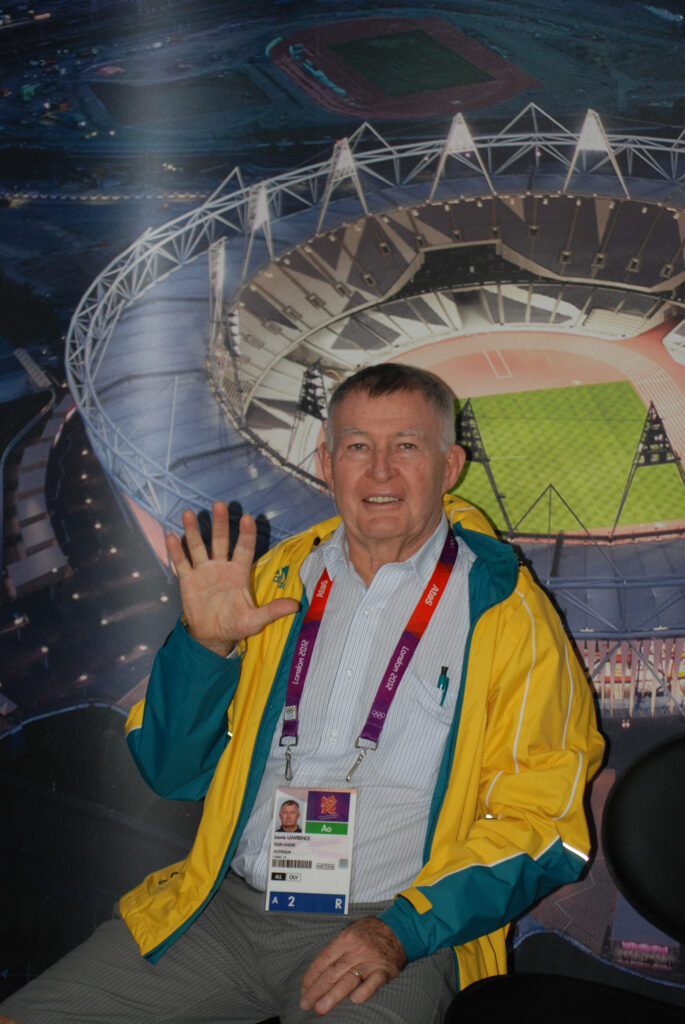
ISHOF and the world of swimming wish Laurie Lawrence a very Happy 85th Birthday!
In 1988, Lawrence launched a Kids Alive Drowning Prevention Campaign to combat the problem of accidental death by drowning in the under five age group. With support from the Australian government and community service advertising, the program runs nationally. He has researched, documented and developed a program which is now internationally recognized.
Read Laurie’s 1996 Honoree Bio below
Country: AUS
Honoree Type: Coach
FOR THE RECORD: 1984, 1988, 1992, 1996 OLYMPIC GAMES: Team Coach; 1982, 1986 COMMONWEALTH GAMES: Team Coach; Swimming Coach since 1966; Coach of swimmers Jon Sieben, Duncan Armstrong, Julie MacDonald, Glen Buchanan, Justin Lemberg, Glen Houseman, Helen Gray, Steve Holland and Tracy Wickham; Author of Lawrence of Australia, Sink or Swim and Babies Can Swim videotape.
His own voice beams with enthusiasm, pride and with the feeling that nothing easy is worth doing. It is defying the odds…doing the impossible that excites Laurie Lawrence. He is the master innovator. He inspires confidence and belief. No challenge is too great, no task is impossible. Everyone around him soaks in his enthusiasm.
And that is just what Laurie has done – create the atmosphere for his swimmers to succeed. To some people, Laurie Lawrence is a crazy, over-competitive mad man. But his shining side, his greatest asset, is his ability and attitude in helping young Australians achieve their goals. He is the kind of coach who could have coached in any sport and been successful. Lucky for us, he chose swimming. Even from his own competitive days as an athlete playing rugby for his country, it was winning for Australia that counted for Laurie.
Win and produce winners is what he did, and in a way that only Laurie Lawrence could do. His first big charge was Helen Gray, whom he shocked in 1970 by throwing her Queensland silver medal over the fence as his way of saying, “Don’t be complacent. You can be a medalist at the Commonwealth Games if you re-focus, work hard.” She did, winning a silver medal in the 800m freestyle and a berth on the 1972 Olympic Team. His swimmers include Hall of Famer Steve Holland, the skinny little youngest ever world record holder at age fifteen who set eleven world records in the 800m and 1500m freestyles, and was a World Championship and Commonwealth Games gold medalist, and an Olympic bronze medalist; Hall of Famer Tracy Wickham, five time world record holder for nine and one-half years in the distance freestyle events, World Championship and Commonwealth Games gold medalist; Glenn Buchanan the 1984 100m butterfly double bronze medalist and his teammate Jon Seiben who at the Los Angeles Olympics beat Michael Gross of Germany in the 200m butterfly, setting a new world record; Julie MacDonald, Pan Pacific’s gold medalist and Commonwealth medalist and Australia’s only 1988 Olympic female medalist, bronze in the 800m freestyle; Hall of Famer Duncan Armstrong, Seoul’s 200m freestyle gold medalist and 400m silver medalist and world record holder in the process. There will be others who will benefit from his iron-hard philosophy of success. Said Duncan Armstrong, “He had that gift of inspiration. He could reach into you and you could feel the strength from him.”
Most of Laurie’s Olympic swimmers learned to swim under his guidance and in his now famous Learn to Swim School for babies, pre-school and school-aged children. Laurie personally instructs youngsters in swimming and also specializes in teaching physically handicapped children. Judy Young is one of the swimmers who won the Para-Olympic gold in the 400m freestyle at the Seoul Olympics. His book, Sink or Swim, on teaching babies is a valuable guide for all parents, and he joins Hall of Famer Virginia Hunt Newman, promoting trust and motivation to teach swimming the comforting way.
From being around the Townsville Pool his father ran, and sparked into swimming by the legendary Hall of Famer Jon Henricks, Laurie Lawrence has become a swimming legend and a maker of champions, capable of lifting the spirits of those around him to soaring heights. He is many other things too – extrovert, patriot, poet, humorist, singer and now the most sought after motivational speaker in Australia. His swimmers have set over seventeen world records, and he has coached Aussie Teams to three Commonwealth Games and three Olympic teams. He possesses the qualities with which he works to instill in every competitor: be proud, persist, work hard, stand tall, don’t quit, don’t bend, don’t break, don’t fall.
HAPPY BIRTHDAY ~ WE LOVE YOU LAURIE!!!!
ISHOF 2027 Honoree Induction shares weekend once again with World Aquatics High Diving World Cup in Fort Lauderdale, April 9-11, 2027
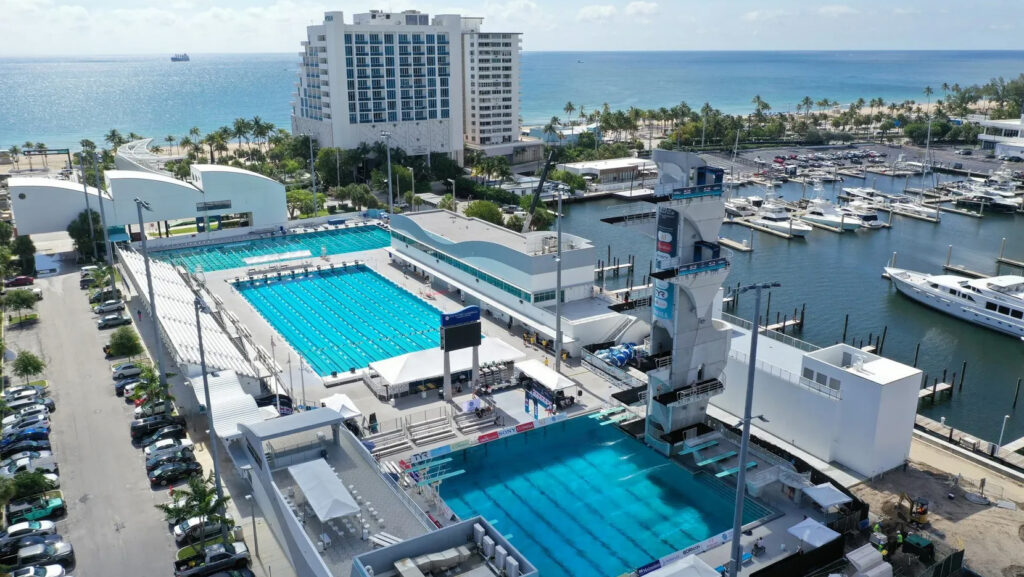
ISHOF is proud to announce that we are once again partnering with USA Diving and hosting the 2027 ISHOF Honoree Induction Ceremony on the same weekend as the 2027 World Aquatics High Diving World Cup.
Just like this year, attendees to the Induction weekend will be able to watch exciting high diving events during the day and attend the ISHOF events in the evening. Please read World Aquatic’s recent press release below and stay tuned for more information, both on the Induction weekend and on the high diving.
World Aquatics High Diving World Cup 2027 Venues Announced
“It’s awesome to know that Fort Lauderdale will be part of the World Cup again in 2027. Competing in front of a home crowd is always very special and returning to Porto Flavia – where I won gold this year – makes it even more exciting,” she said.
Great Britain’s Aidan Heslop was another gold medal winner in Porto Flavia, and expressed his delight at the announcement of the 2027 calendar: “The World Cup is always one of the highlights of the season. Having Fort Lauderdale and Porto Flavia back on the calendar gives us two incredible places to compete next year.
“The whole season is about building momentum and performing when it matters most, and I can’t think of two better settings for us to showcase the incredible power of high diving.”
World Aquatics High Diving World Cup 2026, remaining schedule
Stop 3 – Zhaoqing, China , 21-22 November 2026
World Aquatics High Diving World Cup 2027
Stop 1 – Fort Lauderdale, USA, 10-11 April 2027
Stop 2 – Porto Flavia, Italy, 12-13 June 2027
World Aquatics Championships – Budapest 2027
High Diving, 8-11 July 2027
Photo Credit: World Aquatics
ISHOF and Diving Mourn the Passing of ISHOF Contibutor Eldon C. Godfrey
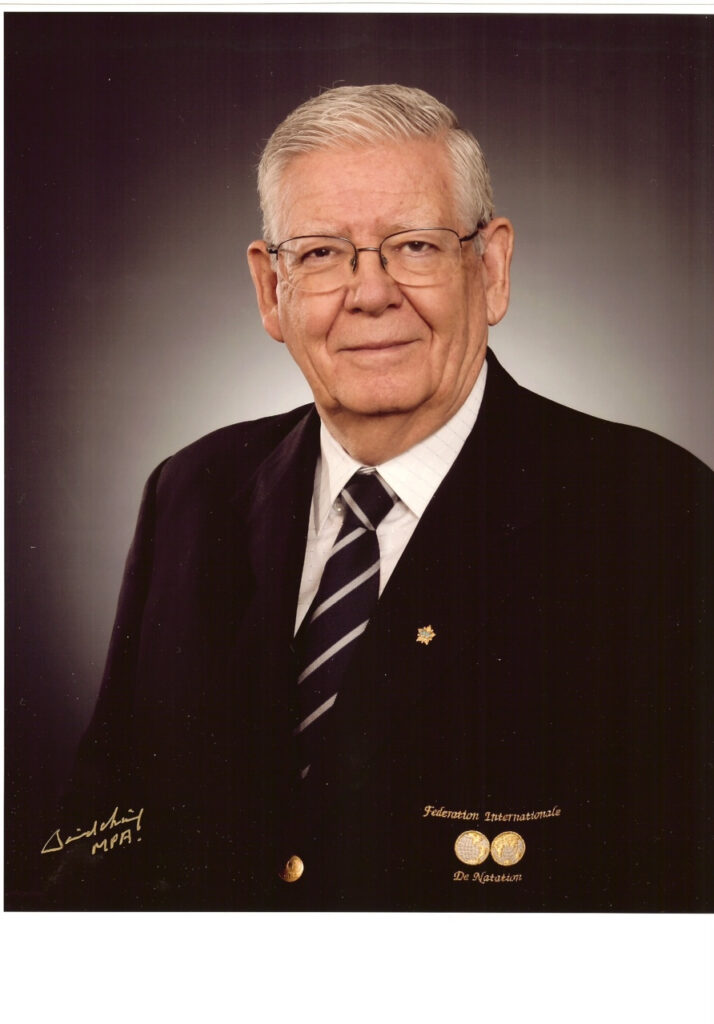
Shared from DIving Canada
Diving Canada mourns the passing of Eldon C. Godfrey, O.C., a remarkable leader, volunteer, official and ambassador whose lifelong dedication helped shape the development of diving in Canada and beyond.
Eldon’s involvement in diving began in Calgary in the 1970s when his daughter, Allison, began competing in the sport. What started as a parent’s involvement quickly grew into an extraordinary lifetime of service. Within just a few years, Eldon was elected President of the Canadian Amateur Diving Association, a position he held from 1976 to 1980. He later served as President of the Aquatic Federation of Canada and represented Canada in leadership roles at the national and international levels.
His influence extended well beyond Canada. Eldon served for 13 years on the FINA Bureau (now World Aquatics) and for 16 years on the FINA Technical Diving Committee, including as Honorary Secretary and Vice Chairman. He also held several leadership positions with the Union Americana de Natación (now Pan Am Aquatics), ultimately serving as its President from 2007 to 2011.
Over the course of his career, he served as an official or as a member of the jury of appeal at eight Olympic Games. He officiated at four World Championships, eight World Cups and three Pan American Games, while also contributing as an international clinician and mentor.
In recognition of his exceptional contribution to sport and to his community, Eldon was appointed an Officer of the Order of Canada in 2019 and invested in 2022. The honour recognized his decades of service to diving and his leadership in promoting Canadian sport on the international stage.
Eldon was also inducted as an Honor Contributor into the International Swimming Hall of Fame in 2012. Among his many distinctions were the FINA Gold Pin, the Canadian Sports Award, the Alberta Achievement Award and the Calgary Booster Club’s Sportsman of the Year Award. He was inducted into the Canadian Olympic Hall of Fame in 2003 and the Alberta Sports Hall of Fame in 2007.
His contribution to diving was also a family endeavour. Eldon’s late wife, Carlie Jean, was deeply involved in supporting his work and was herself an active volunteer in sport and in the community. Together, Eldon and Carlie Jean received Diving Canada’s Irene McDonald Award for Volunteerism to Diving, recognizing more than four decades of service to the sport.
Carlie Jean was described by her family as a dedicated volunteer who supported Eldon’s international sporting commitments and travelled the world alongside him. Eldon’s standard remark about CJ was:
“Anything I have ever done that has been deemed worthy of recognition was as much Carlie Jean’s work as mine.”
For generations of Canadian divers, officials, coaches and volunteers, Eldon Godfrey represented the very best of what service to sport can mean. His leadership, generosity and commitment helped strengthen Canadian diving at every level, from the local pool in Calgary to the international stage.
Diving Canada extends its deepest condolences to Eldon’s family, friends and the many members of the Canadian and international diving communities whose lives he touched.
His legacy will continue to be felt throughout Canadian diving for years to come.
Celebration of Life
A celebration of Eldon’s life will be held on November 1, 2026, at 2:00 p.m. at Summit View United Church in Calgary, Alberta.
Family, friends and members of the community are invited to come together to remember and celebrate his remarkable life and legacy.
The event will also be livestreamed:
Livestream:https://youtube.com/live/XappUTDfy2k?feature=share
Received October 1, 2026
Good evening friends,
Re: Eldon C. Godfrey, OC, FCA – 5 September, 1935 – 26 September, 2026
I’m writing this message from Dad’s email list, in hopes to connect with people important to him.
Dad died on Saturday, September 26, 2026, surrounded by his family and the angels.
His obituary is posted at https://www.dignitymemorial.com/en-ca/obituaries/13053173
Thank you for your part in his fulfilling and meaningful life.
Much love from the Godfrey Family
Allison Godfrey Bobenic
──────────────────────── ❦ ────────────────────────
Eldon Godfrey has made prodigious contributions to the sport of diving. Beginning as a parent volunteer over 40 years ago, he has since become an internationally acclaimed diving judge and official. He has both served and promoted Canadian sporting interests and values on the world stage with dedication and integrity, notably through his leadership of the Fédération internationale de natation and the Unión Americana de Natación. An exceptional role model and generous volunteer, he remains active and engaged in the sport at all levels.
──────────────────────── ❦ ───────
Eldon Godfrey – 2012 ISHOF Contributor
Eldon Godfrey’s International Swimming Hall of Fame Honoree Acceptance Speech
Link to Biographical Information of Eldon Godfrey – 2012 ISHOF Contributor
──────────────────────── ❦ ─────
Eldon was a valued, trusted colleague whom I deeply respected and admired. As the FINA Bureau Liaison to the Technical Diving Committee, he brought leadership and integrity to the sport. Athletes, judges, and coaches loved and respected him for his extraordinary dedication and good judgment, and many of the most important advances in diving competition over the past thirty years resulted directly from his remarkable efforts.
Dale Neuburger World Aquatics Treasurer
──────────────────────── ❦ ────────
Eldon was a kind and thoughtful leader of aquatics in Canada and internationally. He was the person one turned to for sage advice. Eldon will be sorely missed by the aquatic community.
Cheryl Gibson World Aquatics Bureau MemberCanada
──────────────────────── ❦ ────────
I knew Eldon from years of service on the FINA Technical Diving Committee. He was the liaison to the FINA Bureau and he provided guidance to the Committee that was led by the Chair, Kathy Seaman of Canada. He was a person of character who could be trusted to do what he said. That simple but rare quality is what made him a great leader in the sport of diving. He was guided by his faith and his wonderful wife, Carlie-Jean, who was always by his side.
Steve McFarland Past President of United States Aquatic Sports and Member of the FINA Technical Diving Committee
After the Applause ~ 1995 Honor Swimmer, Michael Gross
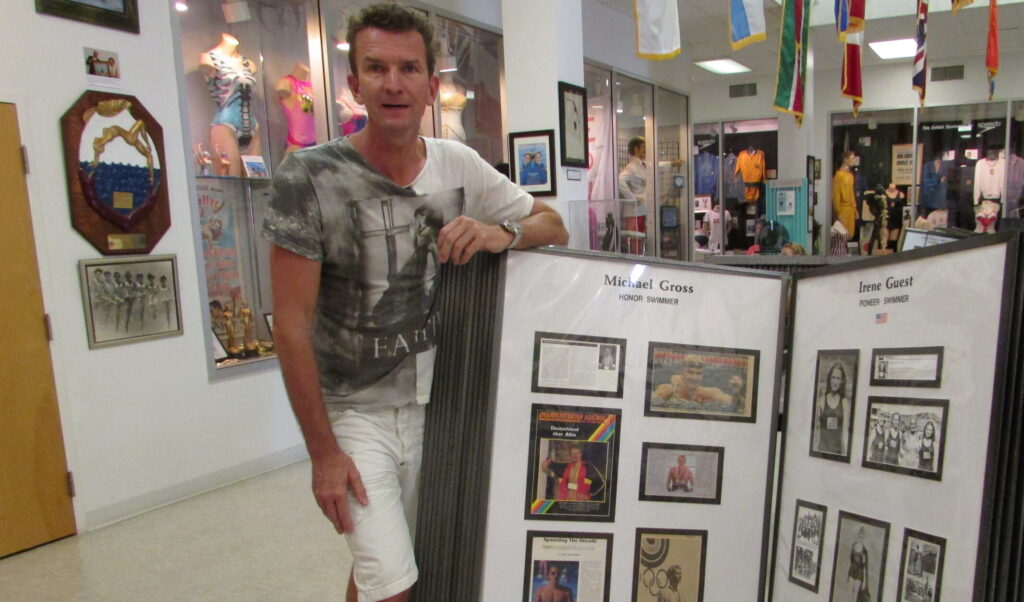
You were inducted in 1995, tell us what you have been up to since then?Got married, raised kids, run my own consultancies and many more, e.g. author and lecturer. Meanwhile and in parallel to my business, I´m an honorary professor for leadership at Goethe University in Frankfurt and curator of the Sports Management MBA at Goethe Business School.
What do you do for work / as a profession?Running my own business in change management for more than 30 years.
Are you still involved in swimming in any capacity?No.
Do you still stay in touch with any swimming friends from your competition days, if so, who?Yes, many friends form my home club and the national team
If you have children, do your kids swim, if yes, tell us about them, if no, tell us about what they are involved in (sports, arts, etc.)No, my daughter (30) is a good cyclist and the son (27) plays hockey, due to his years for the bachelor studies in Vancouver.
What is best memory of your days in swimming? (You can have more than one)That´s a tough question because many experiences are unique. As a young swimmer, state championships – held usually outdoors, often in cold and rainy conditions – were memorable. Because you have to overcome many obstacles and learn much at a young age. All ends with the Olympics, not only winning medals, being part of a community and global movement.
Seeing the changes that have occurred in swimming/aquatics now versus when you were competing, do you wish you could have competed now, or are you glad you competed when you did and why?Actually, I never think about “what if …”. I´m happy about my time in sports and won´t miss it at all exactly how it was.
Have you written a memoir/book about yourself, if yes, what’s the title and can our readers purchase it? If not, do you ever plan on written a book?In 2011, I published “Siegen kann jeder” (Everyone can win). It´s not a traditional memoir book. Moreover, I transfer my experiences in everyone´s life (it´s not available in English and sold out in German, too)
Any advice to all the future want-to-be Olympic swimmers out there?First of all, you should have fun jumping into the water every day – andexperience what you can do and improve. The water should be your friend, work on your technique constantly. Finally, enjoy the competition to see how hard and far you can push yourself.
As an Olympian, National Team Member, you travelled all over the world. What was your favorite place you visited, or your favorite meet to attend?My favorite spot is Sydney, no doubt. The North Olympic Pool close to theHarbour Bridge is THE place to swim. And the Olympics are unique in manyways, of course.
Meg Keller-Marvin, with 1995 honoree Michael Gross in Dover, August 2026
Every Child Deserves the Chance to Become a Swimmer.
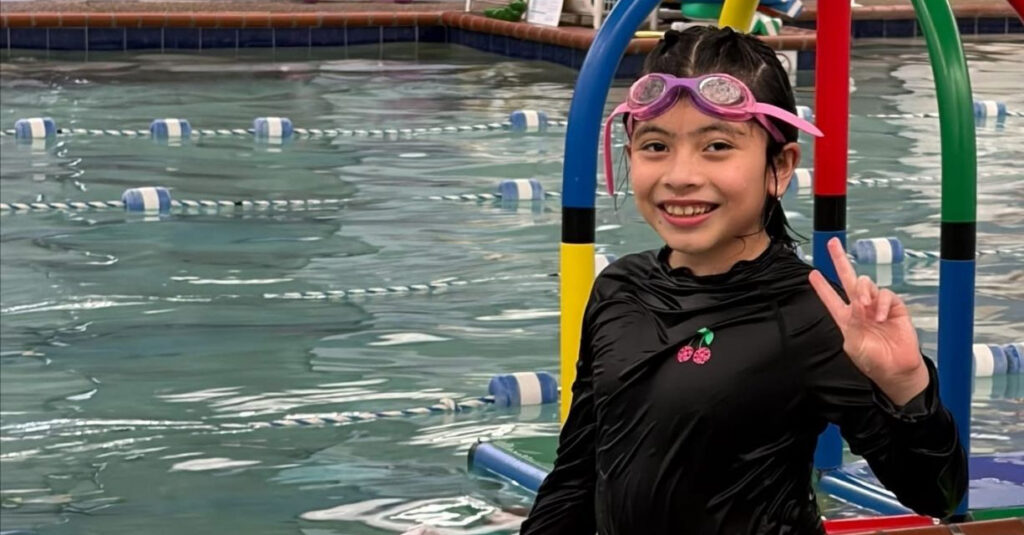
Learning to swim is about more than skills, it’s about building confidence, feeling safe, and having instructors who make learning fun.
That’s why Every Child a Swimmer means so much. Scholarships give children access to lessons where they can learn, grow, and develop essential water-safety skills.
One scholarship family said it perfectly: “We love the teachers. They make it fun.” 💜
Grateful to everyone who helps make these opportunities possible for children and families in our communities.
#EveryChildASwimmer#WaterSafety#SwimLessons#SaferSwimmers#LearnToSwim
ISHOF Announces the Class of 2027
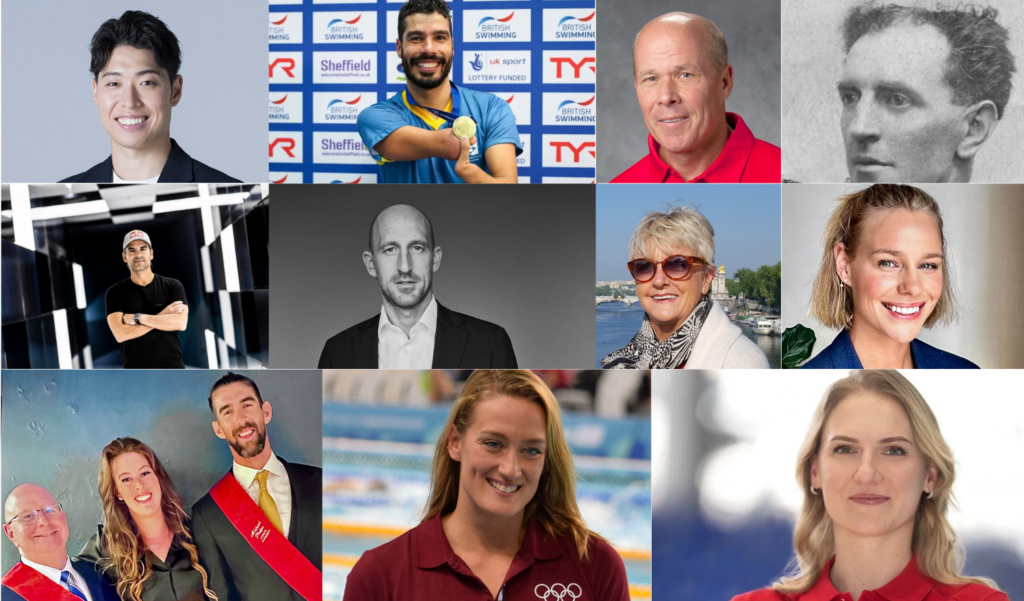
The International Swimming Hall of Fame (ISHOF) is thrilled to announce it will host its 62nd Annual Honoree Induction Ceremony in Fort Lauderdale, Florida, USA on Saturday, April 10, 2027. ISHOF is proud to announce its truly international Class of 2027, which will induct 12 Honorees from 11 different countries from around the globe.
This year’s ISHOF Honorees include: HONOR SWIMMERS: Allison Schmitt (USA), Mireia Belmonte Garcia (ESP), Pernille Blume (DEN), Kosuke Hagino (JPN)and Federica Pellegrini (ITA) (2005) ; OPEN WATER SWIMMER: Thomas Lurz (GER); for the first time-ever: HIGH-DIVER: Orlando Duque (COL); WATER POLO PLAYER: Debbie Handley (AUS); ARTISTIC SWIMMER: Svetlana Romashina (RUS); COACH: Jack Bauerle (USA); PIONEER: Paul Beulque (FRA); and PARALYMPIC SWIMMER: Daniel Dias (BRA);
Note: Federica Pellegrini was selected in 2025 but will be honored in 2027.
HONOR SWIMMERS:
Mireia BELMONTE GARCIA (ESP)
Mireia Belmonte Garcia is a three-time Olympian, 2008, 2012 and 2016. She has four medals in Olympic competition: In Rio, 2016, she earned one gold in the 200m butterfly and a bronze in the 200 IM. In 2012, London, she won two silver medals, the first in the 800m freestyle and the second in the 200m butterfly.
In World Championship competition ranging from 2010 to 2017, both long and short course, she has eight individual titles, in the fly, IM and freestyle.
In all combined World Aquatic competitions, in her career, she has won a total of 92 medals, 40 gold, 35 silver and 17 bronze. Many consider her the greatest Spanish swimmer of all time.
Photo Courtesy: Spanish Swimming Federation
Pernille BLUME (DEN)
Pernille Blume is a three-time Olympian who is best known for winning the gold medal in the 50-meter freestyle at the 2016 Rio Olympics. Blume shocked the world in Rio with her time of 24.07 seconds. This victory was Denmark’s first Olympic swimming gold medal in 68 years.
She added two more Olympic bronze medals to her collection, the first at the same Games, while anchoring the 4 x 100 medley relay, and the second, in Tokyo, in 2021, in her signature event, the 50-meter freestyle.
Blume retired from competitive swimming in 2022 at age 28. In June 2024, she was appointed to the World Aquatics Bureau, where she continues to give back to all aquatic sports.
Photo Courtesy: World Aquatics
Kosuke HAGINO (JPN)
Kosuke Hagino, of Japan, is a two-time Olympian, 2012 and 2016, who specialized in the individual medley and 200-meter freestyle, but was also talented enough to compete in nearly every event. He is a four-time Olympic medalist, winning gold in the 400 IM and silver in the 200 IM at the 2016 Olympic Games in Rio. In 2012, at the London Games, Hagino won two bronze medals, one in the 400 IM and the second in the 4 x 200m freestyle relay.
Hagino has a total of 26 medals in international competition, nine gold, 12 silver and six bronze.
Hagino is one of only two Asians to have been voted World Swimmer of the Year (2014).
Allison SCHMITT (USA)
Allison Schmitt is an American Olympian, specializing in the freestyle events. She is a four-time Olympian 2008, 2012, 2016, 2020/1 and a 10-time Olympic medalist, winning four gold, three silver, and three bronze medals.
Schmitt has won 25 medals in major World Aquatics international competitions: 13 gold, nine silver, and three bronze medals.
Allison has become an advocate for mental health. She is working to try and de-stigmatize mental health struggles. Schmitt believes “Get help when you need it” and it’s okay to “Ask for Help”. She shares positive thoughts on her social media, “It’s okay to not be okay!”
HONOR OPEN WATER SWIMMER:
Thomas LURZ (GER)
Thomas Lurz is a three-time Olympian (2004, 2008, 2012), winning a silver in London in 2012, and a bronze medal in 2008 in Beijing in the 10k open water event. He is a 15-time World Champion in open water events, including the 5k, 10k and 25k.
Lurz is a 3-time – Men’s 10km, European Swimming Champion.
He was inducted into the International Marathon Swimming Hall of Fame in 2019.
He was named Swimming World Open Water Swimmer of the Year five times, 2005, 2006, 2009, 2011 and 2013.
HONOR DIVER:
Orlando DUQUE (COL)
Orlando Duque will be the first “high diver” ever inducted into ISHOF. If any diver embodies the spirit of cliff/high diving, it must be Orlando “The Duke” Duque. He is a Columbian High Diving champion and considered a legend in the sport. With an extraordinary natural talent, Orlando has won 13 world titles in total: nine Red Bull Cliff Diving World Series events, the first-ever FINA High Diving World Champion (2013), two-time FINA High Diving World Cup (2014 and 2015) and the first ever overall champion of Red Bull Cliff Diving.
He has also been immortalized in the film 9 Dives, which includes the highest jump of his career to date: a 34m descent off a bridge in Italy.
Today, Duque is the Chairman for the Technical High Diving Committee for World Aquatics.
Photo Courtesy: Romina Amato/Red Bull Content Pool
HONOR WATER POLO PLAYER:
Debbie HANDLEY (AUS)
Trailblazer Debbie Handley was a pioneer of women’s water polo in Australia and she was selected on the first Australian women’s team in 1976 — widely regarded as the first women’s international team, against USA in Hawaii.
She accrued 93 caps for Australia during the next 13 years, the final 10 years (69 games) as the national captain, leading the Australians in two World Championship campaigns, a FINA silver medal as a demonstration event in 1982 and a FINA gold medal in 1986 — the first official World Championships. Handley also competed in six FINA Women’s World Cup tournaments — at that time the pinnacle of women’s water polo pre-Olympics and World Championships.
She was awarded Australian Water Polo’s highest award, the Harry Quittner Medal.
HONOR ARTISTIC SWIMMER:
Svetlana ROMASHINA (RUS)
Svetlana Romashina, of Russia, became the most decorated artistic swimmer of all time when she won her sixth and seventh Olympic gold medals in duet and team at the 2020 Games in Tokyo. That was the cap to an extraordinary career where she won the duet and team events three times in a row (2012 , 2016 and 2020), a record unlikely to ever be duplicated.
In World Aquatics competition, Romashina never finished lower than silver, with an astonishing international record of 42 gold and three silver medals in her career.
Romashina won four consecutive Olympic gold medals in the team competition at the 2008, 2012, 2016 and 2020 Olympic Games. She also won the duet event in 2012, 2016 and 2020.
HONOR COACH:
Jack BAUERLE (USA)
Jack Bauerle reached the pinnacle of his coaching success in 2008, when he was chosen as the United States women’s team head coach for the Olympics, leading the American women to 14 medals, the most of any nation. Including Beijing, he has coached for Team USA at six Olympic Games, serving as a women’s assistant in 2000, men’s assistant in 2016 and 2020, and a personal coach in 2004 and 2012.
Serving as the Swimming and Diving Head Coach at the University of Georgia, Bauerle experienced unparalleled success in all facets of coaching life. National champions, All-Americans, record-setters, Olympians, Scholar All-Americans, and NCAA Postgraduate Scholarship recipients became the norm under Bauerle, who spent 43 seasons at the helm of the program.
Photo credit: University of Georgia Athletics
HONOR PIONEER:
Paul BEULQUE (FRA)
Paul Beulque’s greatest achievement was not merely coaching France to Olympic victory in 1924, but his lasting contribution was demonstrating that Olympic champions could be systematically created through an integrated program of municipal education, standardized pedagogy, scientific coaching, civic investment, and long-term athlete development.
The Tourcoing model transformed swimming instruction into an educational continuum extending from schoolchildren to Olympic athletes. Henri Padou, Ernestine Lebrun, and the 1924 Olympic water polo champions were not isolated successes but successive products of a deliberately constructed developmental system.
Recognition of Tourcoing’s achievements does not diminish Britain’s invention of water polo or Hungary’s subsequent dominance. Instead, it restores Paul Beulque to his proper place in aquatic history—as one of the first architects of the modern athlete-development system and a pivotal figure in the evolution of twentieth-century swimming and water polo.
HONOR PARALYMPIC SWIMMER:
DANIEL DIAS (BRA)
Daniel Dias, is a four-time Brazilian Paralympic Swimmer, competing in the 2008, 2012, 2016 and 2020 Paralympic Games, winning a total of 27 Paralympic medals, 14 of them gold.
In international competition, he earned a total of 100 medals, 78 gold, 14 silver, and eight bronze. Twenty-seven of these are from the Paralympic Games, 40 from World Para Swimming Championships and 33, all GOLD, were from Parapan American Games. In addition to being Brazil’s and South America’s most decorated Paralympian in history, at the Tokyo Paralympics, he equaled Swedish shooter Jonas Jacobsson as the greatest male multi-medalist of all time.
Photo credit: International Paralympic Committee
Ticket and Hotel information will be forthcoming; We hope to have it by October. Keep checking at ISHOF.org and or any of our social media platforms.
FOLLOW US ON SOCIAL MEDIA:
Facebook: International Swimming Hall of Fame
Instagram: ishof_museum
Twitter: @ISHOF
Linkedin: International Swimming Hall of Fame
For more information, reach out to Meg Keller-Marvin at meg@ishof.org or 570.594.4367.
PASSAGES: 1977 ISHOF Honoree, Mike Burton Passes Away at 79
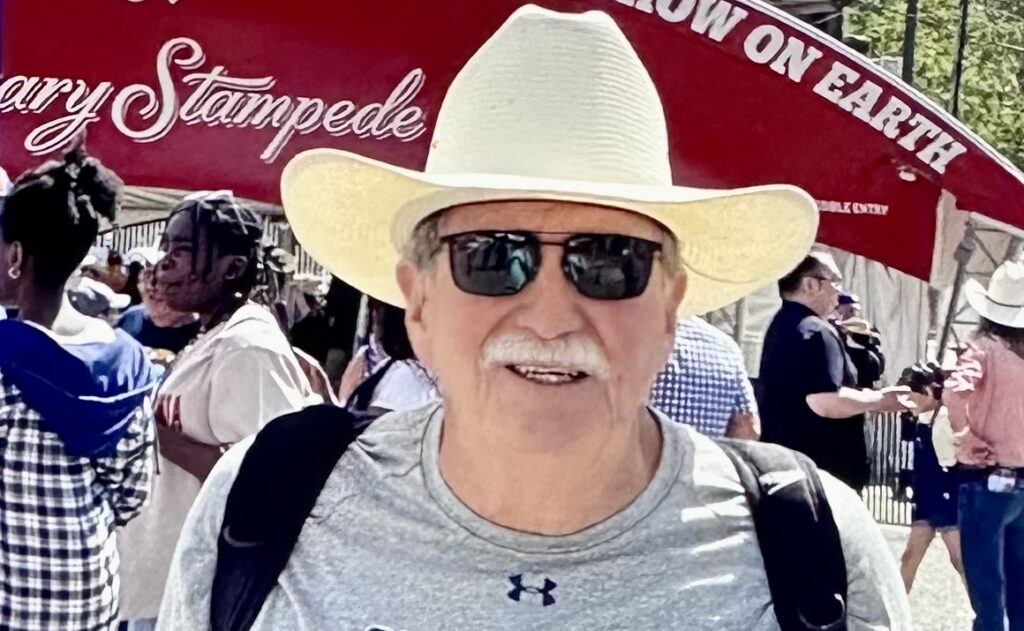
ISHOF is saddened to share that on Friday morning, September 18, 2026, Honor Swimmer Mike Burton passed away after a long battle with Alzheimer’s and dementia.
Burton was inducted into ISHOF in 1977 after his spectacular performance at the 1968 and 1972 Olympic Games, winning three golds ~ and becoming the first man to win back to back gold medals in the 1500 freestyle.
Burton swam at Arden Hills, for famed coach and Honoree, Sherm Chavoor, who would later develop Mark Spitz.
After retiring from swimming, Burton became a swim coach for 35 years which included winning an NCAA title at BYU. We at ISHOF, and the entire swimming community send our condolences to the Burton family.
Read Mike Burton’s 1977 Bio Here:
FOR THE RECORD: OLYMPIC GAMES: 1968 gold (400m, 1500m freestyle); 1972 gold (1500m freestyle); WORLD RECORDS: 7; PAN AMERICAN GAMES: 1 gold; AMERICAN RECORDS: 16; NATIONAL AAU CHAMPIONSHIPS: 10; NCAA Titles: 5; 1968 “Swimmer of the Year”; First person in Olympic history to win the 1500m freestyle in two Olympics; first man to break 16 minutes for the 1650yd freestyle; First to swim the 800m freestyle below 8:30.
Mike Burton was finished as an athlete at 13 because he tackled a truck with his bicycle. Swimming was all he could do after that and he made the most of his opportunities. At 5’9″, 165 lbs., it was still bicycle versus truck. From September, 1960 to August, 1969, he improved the 1500m record 4 times from 16:41.6 to 16:08.5 and twice set 800m records on the way. “Mr. Machine or perpetual motion”, Burton set examples of hard work hitherto unheard of in practice and specialized in winning meets when he was sick (stomach trouble in World Students Games & Montezuma’s revenge in the Olympics).
If Spitz’s 7 gold medals was the greatest performance in Olympic history, Burton’s comeback win in World Record time was the greatest single performance of the 1972 Olympic Games. Married, working and without sufficient training time, he qualified 8th to make the finals at the Olympic Trials, finished 3rd to make the team, and then won the Olympic Games.
The information on this page was written the year of their induction
World Aquatics recognises 2025 Masters Swimmers Top 10
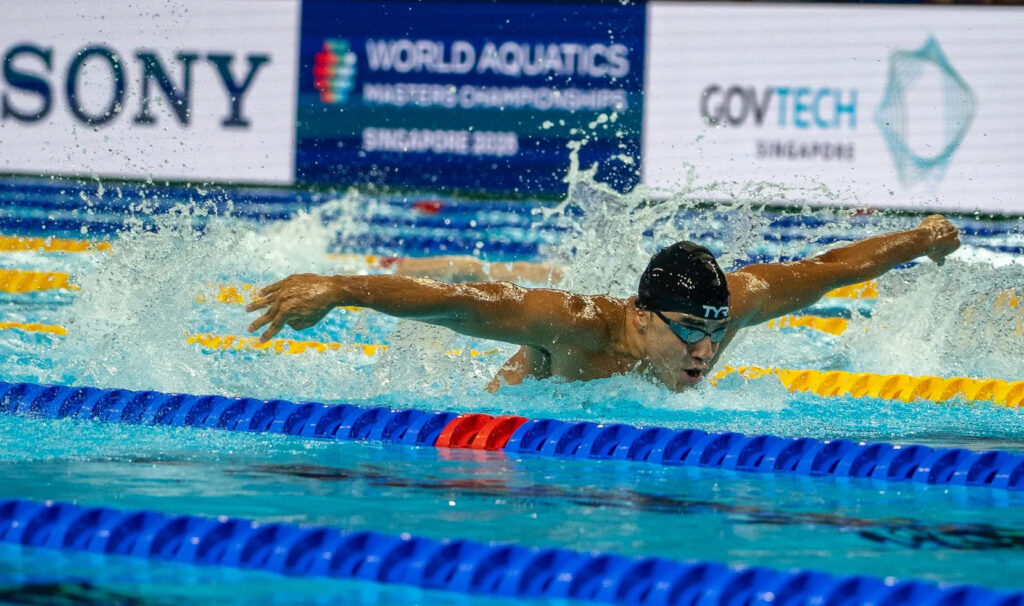
Written by:World Aquatics Communications Department
World Aquatics is proud to recognise the finest performances in Masters swimming through the official Top 10 across every event and age group from 25-29 through to 100 and beyond for the 2025 season.
The rankings have been compiled from more than 150,000 results submitted by National Masters Recorders around the world. Standings have been calculated per event and per age group for both long course and short course pools, covering individual and relay events across men’s, women’s and mixed categories.
The breadth of participation, and the meticulous work of the National Recorder network in collecting and verifying these results, makes this one of the most comprehensive rankings in Masters sport.
The all-time Masters Top 10 can be found here.
The Long Course Top 10 can be found here, and the Short Course Top 10 here.
Image Source: Hiroyuki Nakamura
It was already a landmark year for Masters swimming, with 310 new Masters World Records set across individual and relay events in both the 25m and 50m pool.
From the sprints to the distance events, swimmers of all ages delivered performances that pushed the boundaries of what is possible, and the Top 10 stands as further proof that Masters swimming continues to grow in quality and ambition with each passing season.
Masters aquatics participants perfectly illustrate the lifelong power of sport, and provide a reminder that the pool remains a place for competition, community and personal challenge, whatever your age.
World Aquatics congratulates every participant who has earned a place in the Top 10, and all Masters swimmers who competed throughout 2025.
– Masters participants outside the US and Canada should contact their local federation, which can place an order on their behalf.
Scenes from the 2026 ASCA World Clinic ~ Orlando, Florida
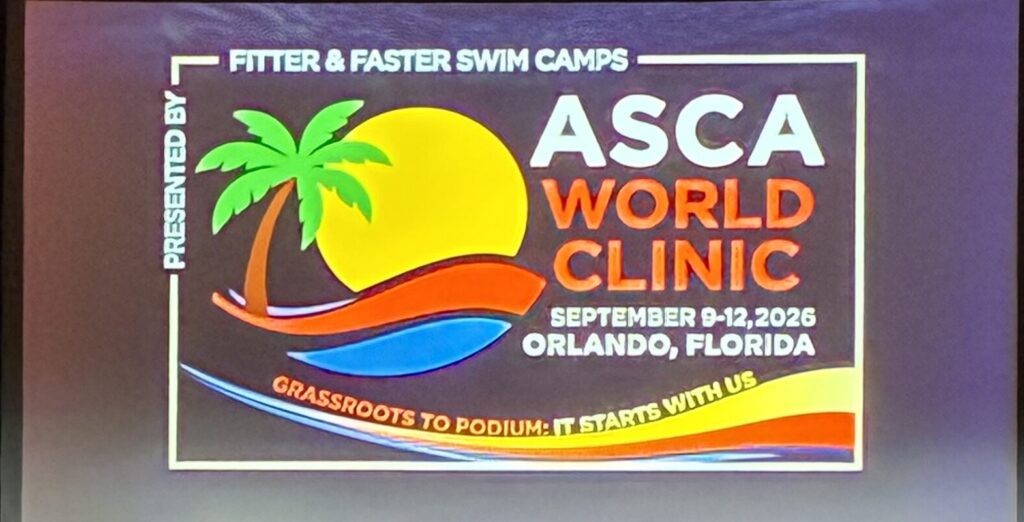
For the last three days, ISHOF has been in Orlando visiting with aquatic friends, old and new, Honorees, coaches, swimmers and other exhibitors discussing the world of swimming.
ASCA said “This year’s theme was, “Grassroots to Podium: It Starts With Us,” celebrates the full coaching journey! From swim lessons and age group foundations to senior development and international success. Every breakthrough in our sport begins with a coach willing to learn, reflect, and grow. That coach is you.”
Meg Keller-Marvin and ISHOF Honoree Craig Beardsley, Swim Across America
ISHOF Honoree David Marsh giving a demonstration to a group.
ISHOF Staffer Devin Ginas at her first Asca World Clinic
Honoree Mel Stewart visiting the ISHOF Booth
ISHOF Honoree Jonty Skinner giving a demo for the coaches at clinic
Meg Keller, Rob Marvin Carolin Victoria, former longtime ISHOF employee
More from ASCA……..
Fort Lauderdale High School grad Dylan Felt, 2024 Olympic Trials Qualifier with 2008/2012 Olympian Ricky Berens.
Swim Fort Lauderdale Head Coach Dave Gibson was inducted into ASCA Hall of Fame Thursday NIght.