

Last week, Team ISHOF attended Fort Lauderdale’s Tower Club Internationals, Featuring Hungary, and celebrated the great history of our numerous Hungarian Honorees. Of the over 800 Honorees that have been inducted into ISHOF since 1965, 44 of them come from the small land-locked country of Hungary. It’s rather amazing if you think about it. Most other European countries approximately the same size have less than ten, but nor Hungary. And for those that know little about it, Hungary is a water polo powerhouse.
So, last Wednesday night, our good friend and President of Sister Cities International, Russell Weaver, invited us to attend the event and talk a little bit about Hungary and its aquatic success. Bruce Wigo, our resident Historian, made a fascinating presentation that really resonated with the crowd, talking about the history of Hungary and how aquatics fit into their story, history and culture.
To make the evening even more exciting, this year Laszlo Cseh, one of Hungary’s greatest swimmers in the history of sport, is being inducted into ISHOF this May as part of the Class of 2026. Then next Summer, Hungary will host the 2027 World Aquatic World Championships in Budapest. On the same weekend Cseh is being inducted, Mr. David Szanto, Chief Operating Officer of the LOC, World Aquatics Swimming Championships, Budapest is being awarded the ISHOF Aquatic Award / Competitive Swimming for his work in running the World Championship events and more.
ISHOF was proud to be a part of this great event and we look forward to welcoming South Florida’s Hungarian community to ISHOF’s 61st Honoree Induction weekend, May 15-16, 2026.
To join in the celebration and buy tickets for the Honoree weekend, to see Laszlo Cseh (Sat. 5/16)
WHEN: Saturday, May 16, 2026
WHERE: War Memorial Auditorium, 800 Northeast 8th Street, Ft. Lauderdale, FL, 33304
Tickets are NOW ON SALE ~ PURCHASE THEM HERE!
Use QR Code to buy tickets to Saturday night, May 16th ISHOF Honoree Induction HERE!

and David Szanto (Fri. 5/15) receive their awards, click here:
WHEN: Friday, May 15, 2026
WHERE: Embassy Suites, 1100 S.E. 17th Street, Ft. Lauderdale, FL 33316
Tickets for Friday Night’s Masters Induction, ISHOF Aquatic and Specialty Awards
Use QR Code to buy tickets to Friday night, May 15th Masters and Awards Night.

Click link to see all award winners
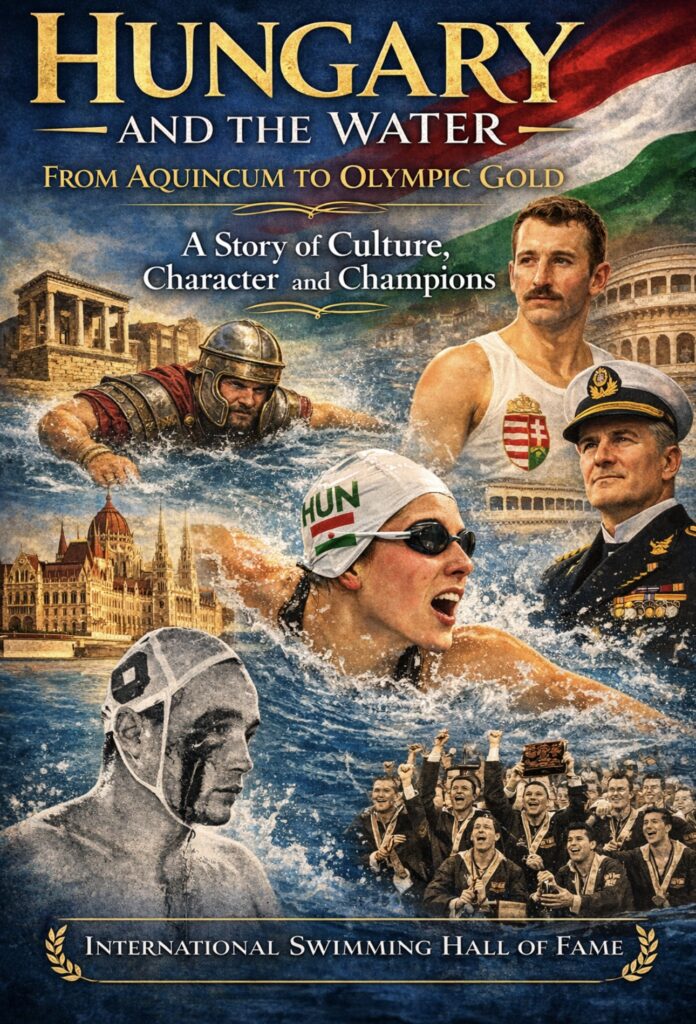
Hungary and the Water
From Aquincum to Olympic Gold
A Story of Culture Character and Champions
Presented by the International Swimming Hall of Fame
(c) 2026
Hungary: A Nation of Water Champions
For a nation of fewer than ten million people, Hungary has produced an astonishing number of Olympic champions, world champions, and Hall of Fame athletes in swimming and water polo. At the International Swimming Hall of Fame, Hungary ranks among the most honored nations in the world. Today there are 43 Hungarian swimmers, water polo players, contributors, and coaches enshrined in the Hall of Fame.
Hungarian water polo teams alone have won nine Olympic gold medals, along with three silver and four bronze.
But the real question is this:
Why Hungary?
Why has this landlocked nation, far from the sea, become one of the great aquatic powers in the history of sport?
To answer that question, we must go back nearly two thousand years.
Aquincum and the Roman Origins
Just north of modern Budapest lie the ruins of the Roman city of Aquincum. In the second century, this city was a major outpost of the Roman Empire along the Danube frontier.
Among the Roman soldiers stationed there was a Batavian legionary named Soranus. According to the writings of the Roman emperor Hadrian, Soranus demonstrated his physical prowess by swimming across the Danube River wearing full armor.
Hadrian reportedly wrote with admiration of the feat, praising the courage and physical endurance of the soldier who crossed the great river under such conditions.
It is a small anecdote in the long history of the Roman Empire—but it reminds us that even in antiquity, the Danube was not merely a river.
It was a proving ground.
And from the very beginning, swimming was associated with strength, endurance, and courage in this part of the world.
The Culture of Water
If you travel to Budapest today, you will discover that the relationship between Hungarians and water runs far deeper than competitive sport.
Hungary is blessed with extraordinary natural resources beneath its soil.
The country contains more than 1,300 thermal springs, with over 120 located in Budapest alone, making it one of the great spa capitals of the world.
The Romans built baths here. The Ottomans built baths here. And modern Hungarians continue to gather daily in these pools.
In Budapest, bathing is not a luxury. It is part of everyday life.
Children grow up learning to swim in these waters. Families gather there. Friends play chess while immersed in steaming outdoor pools during the winter months.
Water is woven into the cultural fabric of Hungary.
So when organized sport arrived in the late nineteenth century, Hungarians were already a nation comfortable in the water.
Hungary’s First Olympic Champion
The first great symbol of Hungarian aquatic excellence came in 1896. At the first modern Olympic Games in Athens, a young Hungarian swimmer named Alfréd Hajós entered the open-water races in the Mediterranean Sea. The water was freezing. Competitors were taken by boat far offshore and told simply to swim back to land.
Hajós later said he swam not for victory, but to survive.
Yet he won both the 100-meter and 1200-meter races, becoming Hungary’s first Olympic champion. Later in life, Hajós became an architect and designed one of the great aquatic facilities of the world: the Alfréd Hajós National Swimming Stadium on Margaret Island in Budapest. When it was built in the 1930s, Margaret Island became known as the “Wimbledon of Swimming.”
The Turning Point: The Treaty of Trianon
But the story of Hungary’s dominance in water polo cannot be understood without understanding one of the great tragedies of Hungarian history.
After World War I, the Treaty of Trianon reduced Hungary’s territory by two-thirds and its population by millions. The nation was humiliated. Military training was prohibited. And Hungary faced the enormous challenge of rebuilding its national identity.
At this moment, sport became something far more important than recreation. Because the army was restricted, sport became a substitute for national training.
Under the leadership of Regent Miklós Horthy and Minister of Education Kuno von Klebelsberg, Hungary invested heavily in physical education and sport, and Olympic competition became a way to demonstrate the resilience and vitality of the Hungarian people.
The Rise of Hungarian Water Polo
Water polo had not been played in Hungary at a high level before the war. It was a sport dominated by Great Britain, France, Belgium Sweden and Netherlands – the same nations that had defeated the Central Powers on the battlefield and humiliated Hungary at Trianon. This fact provided the Hungarians – and Germans – with a powerful political symbol if they could beat them in the pool Water polo was not simply a game. It was became a demonstration of national character.
After having been barred from competiting in the 1920 Olympic Games, the Hungarians took up the sport in earnest when Béla Komjádi, whose scientific approach to tactics and training revolutionized the sport. Under his leadership, Hungary developed a faster, more tactical style of play—emphasizing mobility, speed, and strategic passing. Hungarian teams trained systematically, studied opponents, and developed complex tactical systems.
This approach held and Hungary began to dominate the sport of water polo beginning for decades. Hungarian players and coaches would traveled widely, exporting their knowledge of the sportm developing water polo programs in many other countries across Europe.
Noting this success, Horthy would declare:
“The essence of this game is that within a very short period the team must face the keenest struggle possible! And we can struggle! This is ascertained by the result which are at the same time proofs what we are determined to live. Watching the play of the Hungarian water polo team, the spectator will gain an idea of the character of the Hungarian nation.”
It was not simply a game. It was a demonstration of national character.
The Cold War and the “Blood in the Water” Game
One of the most dramatic chapters in this history occurred in 1956. That year, Hungary erupted in revolution against Soviet control. Soviet tanks entered Budapest to suppress the uprising.At the same time, the Hungarian Olympic team was preparing to compete at the Olympic Games in Melbourne, Australia. Among the events was a water polo match between Hungary and the Soviet Union. The teams knew each other well. Hungarian coaches had helped teach the the sport to the Soviets. But the political circumstances transformed the match into something far larger than sport. The Hungarian players entered the pool carrying the emotional weight of their nation.During the match, tensions boiled over. Late in the game, Hungarian player Ervin Zádor was struck in the face by a Soviet opponent, leaving blood streaming down his face.Photographs of the incident spread around the world.The match became known forever as the “Blood in the Water Game.”Hungary won the match—and ultimately the Olympic gold medal.
Budapest: The World Capital of Aquatics
Budapest remains one of the great capitals of aquatic sport. Historic venues such as the Alfréd Hajós Aquatic Complex, the Komjádi Pool, and the modern Duna Arena continue to host international competitions.
In 2027 Budapest will again host the World Aquatics Championships, continuing Hungary’s extraordinary legacy in the water.
For a nation surrounded by land rather than ocean, Hungary has truly become one of the global capitals of aquatic health and aquatic sport. And this May, László Cseh will become the 44th Hungarian to be honored in Fort Lauderdale, by the International Swimming Hall of Fame.
Hungarian Honorees in the International Swimming Hall of Fame — Chronology of Induction
1966 — Alfréd Hajós
1968 — Zoltán Halmay
1969 — János Németh
1971 — Márton Homonnay
1973 — Eva Novak / Ilona Novak
1976 — Eva Szekely / Dezső Gyarmati
1978 — Olivér Halassy / Valeria Gyenge / István Bárány
1981 — Imre Sárósi
1982 — György Kárpáti
1983 — Ferenc Csík
1985 — Katalin Szőke Dómján
1987 — Mihály Mayer
1988 — Leo Donath
1993 — Tamás Faragó
1994 — Kálmán Markovits
1995 — Andrea Gyarmati / Béla Komjádi
1996 — István Szívós Jr / István Szívós Sr / Béla Rajki
1998 — Dezső Lemhényi
2000 — Tamás Darnyi
2001 — Krisztina Egerszegi
2005 — Norbert Rózsa
2008 — András Hargitay
2010 — Tamás Széchy
2011 — Dénes Kemény
2012 — József Szabó / László Kiss
2014 — Ágnes Kovács
2016 — 3 x Olympic gold medal winning Hungarian Olympic Water Polo Team members: Tamás Molnár, Tamás Kásás, Tibor Benedeck, Gergely Kiss, Péter Biros, Zoltán Szécsi
2017 — András Bodnár
2019 — Ferenc Salamon
2024 — Daniel Gyurta
2025 — Endre Molnár
2026 — László Cseh