

by John Lohn
Aussie Fanny Durack a Pioneer in Olympic Women’s Swimming As The First Champion
On October 27, 1889, Australian Swimming Pioneer, Fanny Durack was born in Sydney, Australia. Durack became the first female Olympic swimming champion at the Stockholm Olympic Games in the 100m freestyle, on July 12, 1912.
When the Olympic Games returned to Tokyo in 2021, one of the highlights was a swimming schedule that was identical for men and women, the 1500 freestyle added for the ladies and the 800 freestyle added to the program for the gentlemen. But the first four editions of swimming at the Modern Olympics did not feature equality, women were not involved until 1912, at which point Fanny Durack made a major splash.
Not long after Hungarian Alfred Hajos became the first Olympic swimming champion, winning the gold medal in the 100 freestyle at the 1896 Games in Athens, Australia’s Sarah “Fanny” Durack developed the urge to learn to swim. It wasn’t that Durack, a youngster at the time, was inspired by Hajos’ efforts, or the performances by any other male swimmer.
Rather, Durack’s desire to swim was triggered out of necessity and in the pursuit of peace of mind. While on vacation as a 9-year-old, Durack struggled with the surf in her native land, and it was that experience which convinced her to become water safe. It was a decision which made Durack swimming’s first female superstar.
From 1896, when the first Modern Games were held in the birthplace of the Ancient Olympics, through 1908, only men were allowed to compete in swimming at the Olympics. During that time, the likes of Hajos, American Charles Daniels, Great Britain’s Henry Taylor and Hungary’s Zoltan Halmay emerged as the sport’s standouts.
It wasn’t like women were banned from the Olympics altogether during that stretch of time, as female athletes competed in events such as sailing, tennis and equestrian as early as the 1900 Games in Paris. Swimming, though, didn’t create a coed program until the 1912 Games, which were held in Stockholm, Sweden.
When it was announced women would be invited to compete in Stockholm, some countries jumped at the opportunity while others were disinterested. Only 27 women took part in the two swimming events, the 100 freestyle and 400 freestyle relay, with host Sweden and Great Britain sending six athletes each. Australia sent two swimmers, Durack and Mina Wylie, while the United States opted to send no women, despite fielding a team of seven men.
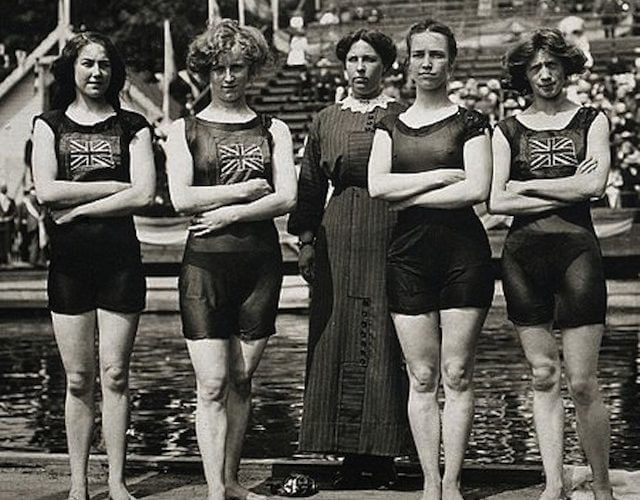
Belle Moore, Jennie Fletcher, a team chaperone, Annie Speirs and Irene Steer at Stockholm 1912 – Photo Courtesy: ISHOF
While Durack had put together an impressive career, Wylie actually held the upper hand over her countrywoman in the leadup to the 1912 Games. Wylie beat Durack on several occasions at the Australian Championships and was considered a gold-medal favorite as much as Durack, who had the higher profile.
Getting to the Olympics, however, proved to be an issue for Durack and Wylie, with politics playing a role. Considering the role politics have played throughout the history of the Olympic Games, maybe it was fitting Durack and Wylie had to play a waiting game.
“The Aussie men in charge of selecting the team for the 1912 Games declared that it was a waste of time and money to send women to Sweden,” wrote Craig Lord in an article for the former SwimVortex website.
“The rule book didn’t help, either. The New South Wales Ladies’ Amateur Swimming Association regulations held that no women could compete at events where men were present. A public outcry resulted in a vote and rule change at the association and Durack and Wylie were allowed to make the journey to Europe – provided they paid for themselves. The wife of Hugh McIntosh, a sporting and theatrical entrepreneur and newspaper proprietor, launched a successful appeal for funds and with money donated by the public, family and friends, Durack sailed for Sweden via London, where she was reported to have trained half a mile a day.”
The competition pool was hardly high-tech in nature, constructed in Stockholm Harbor and consisting of salt water. But Durack wasn’t derailed by the conditions. Representing Australasia, a combined team from Australia and New Zealand, Durack opened her Olympic career in grand fashion, setting a world record of 1:19.8 during qualifying heats of the 100 freestyle. She followed by winning her semifinal easily, and then captured the gold medal with a time of 1:22.2, more than three seconds quicker than Wylie.
To read Sarah “Fanny” Durack’s Honoree bio, click here: https://ishof.org/honoree/honoree-fanny-durack/