
ISHOF Honoree Anthony Ervin Leads Unconventional Masters Clinic in Montauk
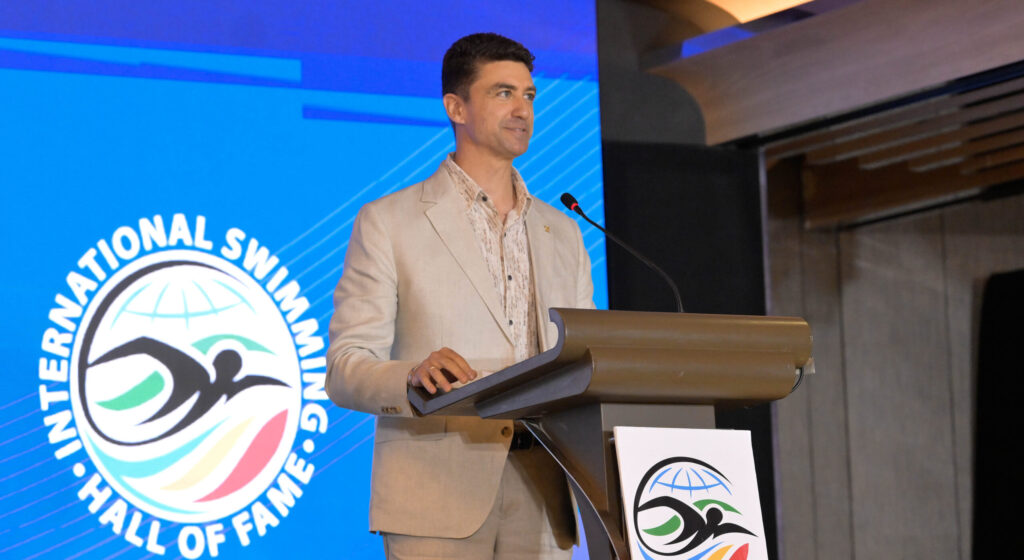
by Dan D’Addona — Swimming World Managing Editor
19 April 2026
Olympic champion Anthony Ervin taught a masters class that was a little different than most clinics.
Ervin led a clinic in Montauk, New York, less on technique and more about feeling.
“Everything becomes so mechanical in our lives, even how we get through the day ” Ervin told the East Hampton Press. “I wanted to reinsert the fundamental understanding of movement in the water, to try to break up the mechanical nature of it, to get back to the liquid movement … in the water, you plan for every breath, it can be a moving meditation.”
The clinic was for swimmers 18-84 at the Montauk Playhouse pool. Ervin was Cal teammates with Lars Merseburg, who runs Imagine Swimming that also runs a pool in Brooklyn and three in New York City.
“It wasn’t a typical masters class — he had us play around with the strokes and with being in the water,” Jasie Britton, one of the swimmers in the clinic told the East Hampton Press. “(He) was trying to get us to focus on the flow, through practicing different ways of moving … seeing him swim that lap alternating the breaststroke and butterfly was the most beautiful thing to watch.”
Merseburg was pleased to see the different approach resound with the swimmers.
“Yes, think it, feel it, do it,” Merseburg told the East Hampton Press. “He wanted to show them what they could do.”
ISHOF Honoree Libby Trickett tells of her shock heart attack ~ send her well wishes!
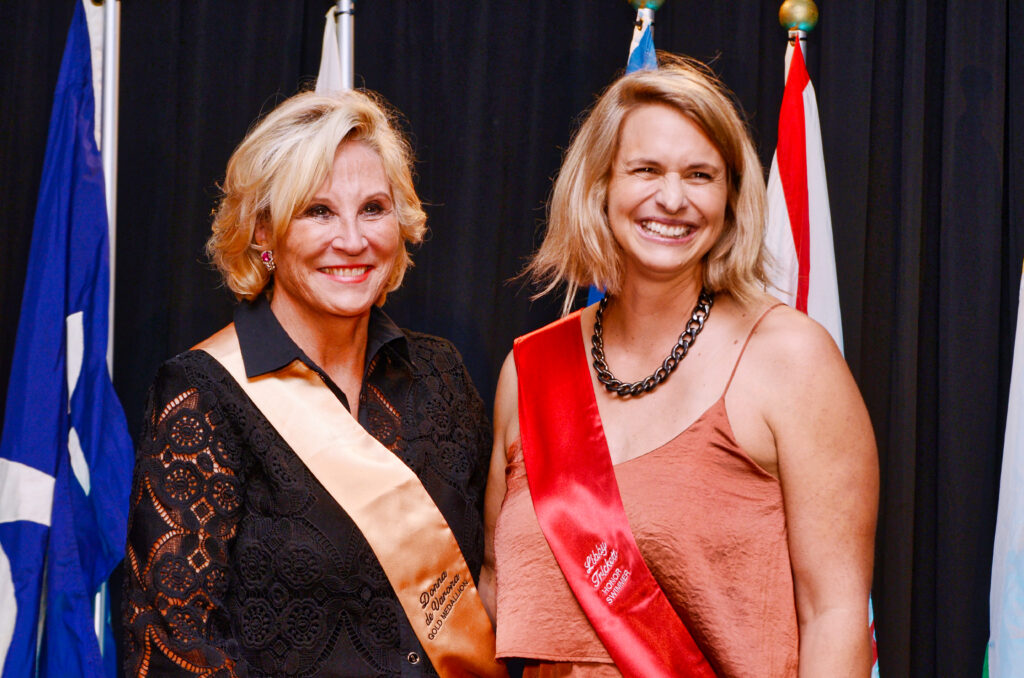
Libby at her 2019 Honoree Induction with Donna deVarona
Shared from Woman’s Day, powered by NOW.
Olympic legend and mum-of-five Libby Trickett has received an outpouring of support from friends and fans after sharing details of a shock heart attack she suffered.
In a video shared to Instagram on April 17, Libby, 41, revealed that there had been some “health things” she’s been “exploring and investigating” in recent months.
Libby welcomed her fifth child with husband Luke – a little boy named Archie – after a “volatile” pregnancy in April 2025.
“Turns out, in June last year, I would have been about two months postpartum after Archie, I actually had what turns out to be a type of heart attack,” the mum shared.
Libby shared details of her shock heart attack. (Credit: Instagram/libby_trickett)
She went on to explain she had suffered a specific kind of heart attack called a spontaneous coronary artery dissection (SCAD) – a serious, often emergency condition where an artery wall in the heart tears, blocking blood flow.
“It’s not caused by the normal things that cause heart attacks like build up of plaque and things like that,” Libby went on. “But basically a tear that happens in the artery wall in the heart.”
The star went on to explain that her diagnosis has “lots of different implications” that she continues to work through and discover, adding that she felt it was a “frustrating condition” because it is relatively under researched.
“It almost exclusively happens to women under the age of 50, it commonly happens in pregnant women or women who have recently given birth. There’s a genetic component it seems.”
Libby appeared visibly shaken as she said it had been a “challenging” time for her.
“There’s a lot of uncertainty because there is a certain change of recurrence as well, and they don’t necessarily know why that happens,” she said.
“I will likely be on lifelong medication to manage my heart rate and my blood pressure.
“I need to do moderate cardio exercise, I can’t lift heavy weights, there’s question marks around rollercoasters and all different types of things,” she added.
“It’s been a lot.”
The star’s followers were quick to share their concern, writing messages of support beneath her post.
Home and Away star Penny MacNamee was one of those to send a message, writing, “Thanks for sharing and being so vulnerable Libby, sending you so much love as you navigate this diagnosis.”
Australian author Maggie Dent added, “Libby as always you are such a voice for good and sharing this big health challenge will help so many. Huge Maggie hugs.”
Libby is a proud mum of five. (Credit: Instagram/libby_trickett)
A critical care paramedic was also among those commenting on Libby’s post, with the expert saying they had been “screaming about SCAD for a decade” after having a young female patient “nearly get dismissed as anxiety” when she was actually having a heart attack.
“I was mortified how little was known and taught about it in the pre-hospital world and went on to present many times about SCAD,” they wrote. “Thank you for using your experience to raise awareness of SCAD. I hope your recovery is speedy.”
It’s not the first time that Libby has been candid about health challenges she has gone through.
In a 2019 interview with The Morning Show, Libby revealed how she had suffered from severe post-natal depression after the birth of her first child in 2015.
“It felt very slow and steady, as though the burden just became harder and harder to carry,” she shared.
“It wasn’t until she was about eight months that I had a mental break – and it was at that moment that I realised I wasn’t behaving in a normal way.
“I was so angry at everything, and I had no idea that anger was a sign of depression. But that was the moment I realised I needed to get help.”
Everyone at ISHOF wishes Libby a fast recovery and her ISHOF family is sending lots of love her way!
Passages: ISHOF Honoree and 1964 Olympic Gold Medalist, Steve Clark, age 82
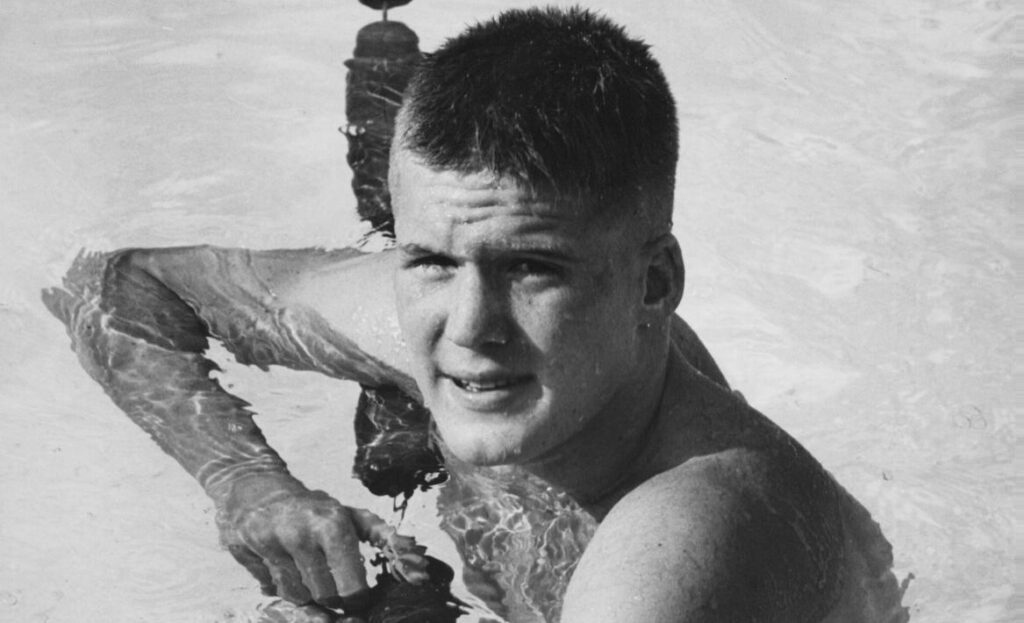
by Matthew De George – Senior Writer
21 April 2026, 05:15am
Steve Clark, a two-time Olympian and a three-time Olympic relay gold medalist for the United States, died on April 14. He was 82 years old.
Clark was a rare two-time Olympian, qualifying for the U.S. team at both the 1960 and 1964 Olympics. He won gold medals in the men’s 400 freestyle, 800 freestyle and 400 medley relays at the 1964 Olympics, and he swam in preliminaries for two gold-medal winning American relays at the 1960 Rome Games before the rule change that allowed prelims swimmers to win the same medals as finals participants.
It’s one of several ways in which the final numbers on Clark’s career undercount his true impact. Clark was a dominant short-course swimmer, in an era where that discipline remained underemphasized.
He set world records in the 50-yard, 100-yard, 100-meter, 200-yard and 200-meter freestyles. He was the first man to break 21 seconds for 50 yards, 46 seconds for 100 yards, 53 seconds for 100 meters, 1:50 for 200 yards and two minutes for 200 meters. (The Olympic program in 1960 and 1964 featured only the 100 free and 400 free for men).
Clark was born in California and swam for Santa Clara Swim Club under George Haines, where he won six AAU national titles, and at Los Altos High School for future Cal coach Nort Thornton. He competed at Yale under Phil Moriarty, where he won five NCAA titles and graduated in 1964.
At the 1960 Olympics, in the inaugural Olympic men’s 400 medley relay, Clark anchored the American team in prelims to a world record in 4:08.2, the finals squad winning in 4:05.4 (only Jeff Farrell swam in both). He also swam in prelims of the 800 free relay. There was no 400 free relay in Rome in 1960.
Clark was not one of the American men to qualify for the men’s 100 free at the 1964 Olympics, suffering a bout of shoulder tendinitis during Olympic Trials. But he recovered in time for Tokyo, where he led off the 400 free relay in both prelims and finals. His time of 52.9 seconds on the leadoff leg in the finals set the 100 free world record for the gold-winning Americans.
His record held until the 1967 Pan American Games when countryman Ken Walsh took it down, and it would’ve medaled at the 1968 Olympics.
In the 100 free in 1964, Don Schollander set the Olympic record to win gold in 53.4. Gary Ilman was fourth in 54.0 (on unofficial electric scoring when he tied with Hans-Jaochim Klein of Unified Team of Germany), and Mike Austin was sixth in 54.5.
Clark led off the 800 free relay at the 1964 Olympics that set a world record in 7:52.1. He swam freestyle on the world-record 400 medley relay that went 3:58.3.
Clark won gold in the 100 free at the 1963 Pan American Games, beating fellow American Steven Jackman with a time of 54.7 seconds.
Clark’s career didn’t end at the 1964 Olympics: He set another American/world record as the first man to break 46 seconds in the 100-yard freestyle at the 1965 AAU National Championships in his home pool at Yale.
He was inducted to the International Swimming Hall of Fame in 1966. He enrolled in Harvard Law School and wrote a book on swimmer, Competitive Swimming As I See It, in 1967.
U.S. Divers Claim Three Gold Medals on Final Day of American Cup at Fort Lauderdale Aquatic Center
Share from USA Diving
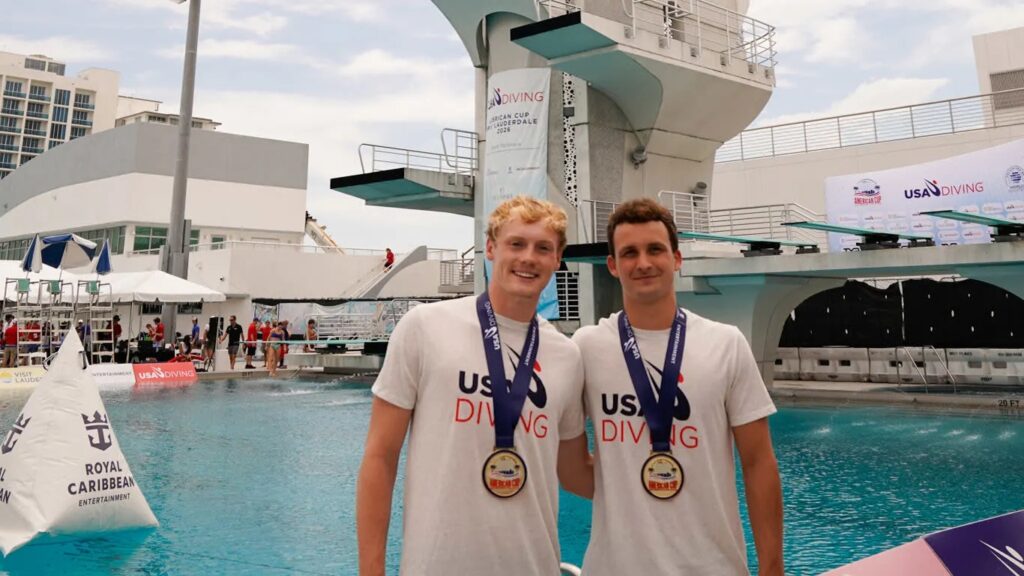
Jack Ryan and Quinn Henninger
Photo Courtesy USA Diving
FORT LAUDERDALE, Fla. – Three medals, three gold for Team USA.Three events, three golds for Sophie Verzyl.
The American Cup wrapped up Sunday with U.S. divers winning three more medals – all gold.In all, the U.S. won 10 medals – five gold, three silver and two bronze – throughout the four-day competition.
Verzyl won the individual women’s 3-meter gold medal on Sunday after winning gold in synchronized 3-meter and in the mixed 3-meter and 10-meter event earlier in the week.
Also on Sunday, Jack Ryan and Quinn Henninger won the gold medal in men’s synchronized 3-meter and Josh Hedberg won the men’s 10-meter contest .
Verzyl capped off an impressive week with 329.40 points for her 3-meter gold. She took the lead in round four and sealed the victory with 81.60 points on her front 2 ½ with 2 twists in the final round.
Great Britain’s Desharne Bent-Ashmeil came away with the silver at 303.60, and Australia’s Natalie Phan took bronze with 296.10 points.
USA’s Kyndal Knight scored 279.65 for sixth, and Margo O’Meara was eighth at 266.40.
Henninger and Ryan won gold in 3-meter synchro with 433.83 points, including more than 80 points on three of their four optionals. Their front 4 ½ tuck went for 90.06 points, and their front 2 ½ with 3 twists earned 88.92.
Ukraine’s Stanislav Oliferchyk and Kirill Boliukh claimed the silver with 397.47 points. USA’s Josh Sollenberger and Luke Sitz were third with 383.55, but the bronze medal went to Australia’s Sam Fricker and Ben Wilson. As the host country, the United States could enter two synchro teams, but only one could medal.Hedberg scored 474.80 to edge Ukraine’s Oleksii Sereda by 1.60 points for the gold. Great Britain’s Noah Williams took third with 428.65 points. Hedberg was consistent, scoring no lower than 73 points on any dive and having two go for more than 80 points – including 88.20 on a back 3 ½ pike.The U.S. had four other divers in the men’s 10-meter final. Leyton Dean finished fourth for Team USA with 420.95 points, and Max Weinrich scored 409.60 for sixth. Drew Bennett finished ninth and Nathaniel Grannis placed 11th.
Bayleigh Cranford and Ella Roselli finished fourth with 255.72 points in the women’s synchronized 10-meter contest, just 3.6 points behind bronze medalists Lois Toulson and Eden Cheng of Great Britain. Australia’s Lauren Flint and Laura Hingston scored 284.70 for gold, and Kseniia Bailo and Sofia Vystavkina of Ukraine came away with the silver.
ISHOF Specialty Awards to be presented Friday, May 15 in Fort Lauderdale

The International Swimming Hall of Fame (ISHOF) Specialty Awards are presented annually to individuals for outstanding contributions to aquatics. 2026 will be jam packed will a line-up a who’s-who from the aquatic world. As a kick-off to the ISHOF Honoree weekend, this year’s awards will be presented on Friday evening, May 15, 2026 in conjunction with the ISHOF Aquatic Awards, presented by AquaCal and MISHOF (Masters) Honoree Induction Ceremonies in Fort Lauderdale, Florida, USA.
This year’s 2026 ISHOF Specialty Award Recipients:
~The 2026 Every Child A Swimmer Award~
Pool Nation
The Pool Nation Podcast Team are true innovators and unifiers within the pool and spa industry and far beyond using their platform to bring people together, elevate voices, and spark meaningful change. Through authentic conversations and bold industry leadership, they have created a space where collaboration thrives and purpose leads. Their selfless commitment to raising awareness around drowning prevention and water safety is both powerful and deeply impactful, extending far beyond the microphone and into communities across the country. Leading with heart, the Pool Nation Podcast team is driven by a genuine desire to help others, give back, and use their influence to protect lives. By amplifying the mission of Every Child a Swimmer, they have helped give a voice to lifesaving work and inspired action throughout the industry. Their passion, generosity, and unwavering sense of purpose continue to make the pool industry safer, stronger, and more united.
About G. Harold Martin: Back in 1908, G. Harold Martin almost drowned in the Ohio River. Over the next two decades he nearly drowned two more times. From these experiences evolved a mission to make “Every Child A Swimmer.” His civic involvement led to the building of Fort Lauderdale’s first municipal pool in 1927. Kiwanian sponsored free swim lessons at the pool and eventually influenced the decision by ISHOF to be in Fort Lauderdale. An active Kiwanian his entire adult life, he was instrumental in making the Key Club an integral club within Kiwanis International and the adoption of Every Child A Swimmer as a Kiwanian project. It has since been taken over by ISHOF and become the spiritual mission.
~The 2026 Buck Dawson Author’s Award~
Katie Ledecky ~ co-recipient of the 2026 Buck Dawson Author’s Award
Just Add Water charts Ledecky’s life in swimming. It details her start in Bethesda, Maryland, where she played sharks and minnows and first discovered the joy of the pool; her early foray into the Olympics at the tender age of fifteen where, as the youngest member of the American team, she stunned everyone by winning her first gold medal; her time balancing competition and her education at Stanford University; how she developed a champion’s mindset that has allowed her to persevere through so many meets, even under intense pressure; and how she has maintained her dominance in a sport where success depends on milliseconds. You learn how every element of her life—from the support of her family to the tutelage of her coaches, from her childhood spent in summer league swimming to the bright lights of Olympic pools in London, Rio, and Tokyo—set her up to become the champion she is today.
Micki King and Elaine K. Howley ~ co-recipients 2026 Buck Dawson Author’s Award
In 1968, 24-year-old Maxine “Micki” King stood atop diving’s biggest stage poised to claim the gold medal in the women’s 3-meter event. She’d led for the entirety of the competition, but on the 9th of 10 dives, disaster struck and she finished in 4th place.
But destiny – and diving – was far from done with King, who went on to claim that gold in the 1972 Munich Games while pioneering a new leadership model for women in sports, the military, and public life.
In this inspiring recitation of her journey from suburban Michigan to the White House and beyond, King shares her tale of breaking boundaries and supporting athletes’ rights across the full spectrum of Olympic sports.
While King’s story is all because of diving, it isn’t just about diving; it’s about persistence, principle, and paving the way for others to achieve their fullest potential.
Elaine K. Howley is an award-winning freelance journalist and editor based in Boston, Massachusetts. A southern New Jersey native and a lifelong swimmer.
Howley holds a bachelor’s degree from Georgetown University and a master’sdegree in publishing and writing from Emerson College in Boston.Specializing in sports, health, and history topics, Howley’s freelance work hasappeared in TIME, U.S. News & World Report, AARP.org, espnW, and manyother publications. She is a frequent contributor to U.S. Masters Swimming’sflagship SWIMMER magazine and the UK-based open water swimmingpublication Outdoor Swimmer magazine.
Elaine’s first book-length memoir ghostwriting project, “A Life Aloft” completed with Tom Gompf and published by CG Sports Publishing in 2021, was awarded the 2023 Buck Dawson Authors Award from ISHOF.
About Buck Dawson: Dawson was a veteran of WWII who served as assistant and publicist for Generals Gavin and Ridgeway in the 82nd Airborne. From the time he was chosen to lead ISHOF in 1962, until his death in 2008, Buck traveled the world armed with Hall of Fame brochures, books, and bumper stickers.
~The 2026 John K. Williams, Jr. Adapted Aquatics Award ~
Beth Scalone (USA) — 2026 John K. Williams, Jr. Adapted Aquatics Award
Beth Scalone is a licensed physical therapist specializing in orthopedic and aquatic therapy. As the owner of North County Water & Sports Therapy Center it is her goal to provide quality one on one care to a variety of patients.
Beth is a Doctor of Physical Therapy and private practice owner with over 30 years of experience in aquatic and orthopedic physical therapy.She has a passion for problem solving and guiding her patients and clients back to doing the things they love. She has had the good fortune to share her experience with other aquatic therapists around the world. Beth finds that “treating and teaching keeps her curious, expands her knowledge and energizes her soul”.
~The 2026 Al Schoenfield Media Award ~
Ted Robinson (USA) — 2026 Al Schoenfield Media Award
Ted Robinson is a three-time Emmy award-winning sports broadcaster with a 45-year career spanning television and radio across global, professional and collegiate sports.
He has provided commentary on the last 15 Olympic Games, more than 60 professional Grand Slam tennis championships and as a lead play-by-play announcer for teams in the NFL, MLB and NBA.
His Olympic career has been highlighted by calling the diving competition in the last 6 Summer Games as well as the last 6 US Olympic Diving Trials with partner Cynthia Potter. In the first Summer Games he covered, Ted received a late assignment to cover Synchronized Swimming with partner Tracie Ruiz. In 2003, NBC/USA Swimming opened the door to aquatics with the chance to call the inaugural Duel in the Pool. Ted, partnered with Rowdy Gaines, went on to call the 2011 World Championships in Shanghai, the 2010 US National Championships, 2 Pan Pacific Championships and multiple years of USA Swimming Pro events, including Katie Ledecky’s first professional meet (Charlotte 2012.)
About Al Schoenfield: He was the Editor and Publisher of Swimming World Magazine (1960-1977) and served on various international committees of swimming, including the FINA Technical Swimming Committee (1980-1984). Schoenfield’s life was a commitment to swimming, and he participated in its administrative structure and spread its stories through his magazines and promotions. Al died in 2005, but his legacy will forever endure to all who have benefited from his lifetime of service to swimming.
About ISHOF
The International Swimming Hall of Fame (ISHOF) museum opened its doors to the public in December of 1968 in Fort Lauderdale, Florida. That same year, the Fédération Internationale de Natation (FINA) – the governing body for Olympic aquatic sports – designated the ISHOF museum as the “Official Repository for Aquatic History”. Today, ISHOF’s vision is to be the global focal point for recording and sharing the history of aquatics, promoting swimming as an essential life-skill, and developing educational programs and events related to water sports.
For ISHOF Aquatic & Specialty Awards and Masters Induction Ceremony (Friday, May 15, 2026) Buy Tickets Here: AWARDSMASTERSTICKETS
For Saturday 61st Annual Honoree Induction,(Saturday, May 16, 2026) Buy Tickets Here: INDUCTIONTICKETS
HOST HOTEL:Embassy Suites 17 th St, 1100 S.E. 17 th Street, Ft. Lauderdale, FL 33316,Phone: 954.527.2700 / Hotel Nightly Rate: $219.Hotel Link:– Use this link to make hotel reservations:
Embassy Suites 17th Street, 1100 S. E. 17th Street, Ft. Lauderdale, FL 33316
Use QR Code to make your Hotel Reservations
Click link below to see all award winners
ASCA/ISHOF Coaches Clinic Featuring Honoree Gregg Troy: https://web.cvent.com/event/95f72cfc-f855-4e4d-bfb4-856f4b86ddc
Passages: Two-time Canadian Olympic Medalist Nancy Garapick, 64
Photo Courtesy: Taylor Brien
by Matthew De George – Senior Writer
08 April 2026
Two-time Olympic medalist Nancy Garapick of Canada died on April 7. She was 64 years old.
Garapick died at her home in Langley, British Columbia, a Swimming Canada statement confirmed.
Garapick was born in Halifax, Nova Scotia. A product of the Halifax Trojan Aquatic Club, she qualified for a home Olympics in Montreal in 1976 at the age of 14. She finished second in both the women’s 100-meter backstroke and 200 back. She was named Canada’s female athlete of the year in 1976, the youngest person to ever win the award.
She won a silver medal in the 200 back at the 1975 World Championships in Cali, Columbia, to go with bronze in the 100 back. She added medley relay bronze at the 1978 edition of the meet.
At the 1979 Pan American Games in San Juan, Puerto Rico, Garapick won five medals, including silver in the 200 individual medley (behind American Tracy Caulkins) to go with bronze in the 100 fly and 400 IM.
Garapick continued to swim into the 1980s, first at the University of California and then at Dalhousie University. She won an Association of Intercollegiate Athletics for Women (AIAW, the NCAA precursor on the women’s side) national championship in 1981 in the 200 IM. She claimed five Canadian Interuniversity Swimming Championships for Dalhousie, from which she received a degree in 1982. Garapick also won a pair of national titles in the U.S. at the 1977 AAU National Short Course Championships.
In all, Garapick was a 17-time Canadian national champion and 38-time national medalist.
Garapick was inducted to the Canadian Olympic Hall of Fame and the Canadian Sports Hall of Fame, the latter in 2008. She is also a member of the Nova Scotia Sports Hall of Fame, which in 2018 named her one of the province’s 15 greatest athletes of all-time.
Garapick’s career was among those most affected by the Cold War geopolitics of the era. She was one of many victims of the East German doping regime that only came to light years later. In both Montreal backstroke races, she finished behind East Germans Ulrike Richter and Birgit Treiber, the former winning both events in Olympic records. At Worlds in 1975, she was behind Richter and Treiber in the 100 back and Treiber in the 200 back (though she did beat Richter to silver).
Garapick was not on Team Canada’s medley relay team in Montreal that won bronze, more than seven seconds behind the world record time set by the GDR. She also missed a chance at a second Olympics with Canada joining the U.S.-led boycott of the 1980 Olympics in Moscow, one of four swimmers recognized as 1980 Olympians by the Canadian Olympic Committee.
Kirsty Coventry (IOC) on why leaders should train – and fail – like Olympians
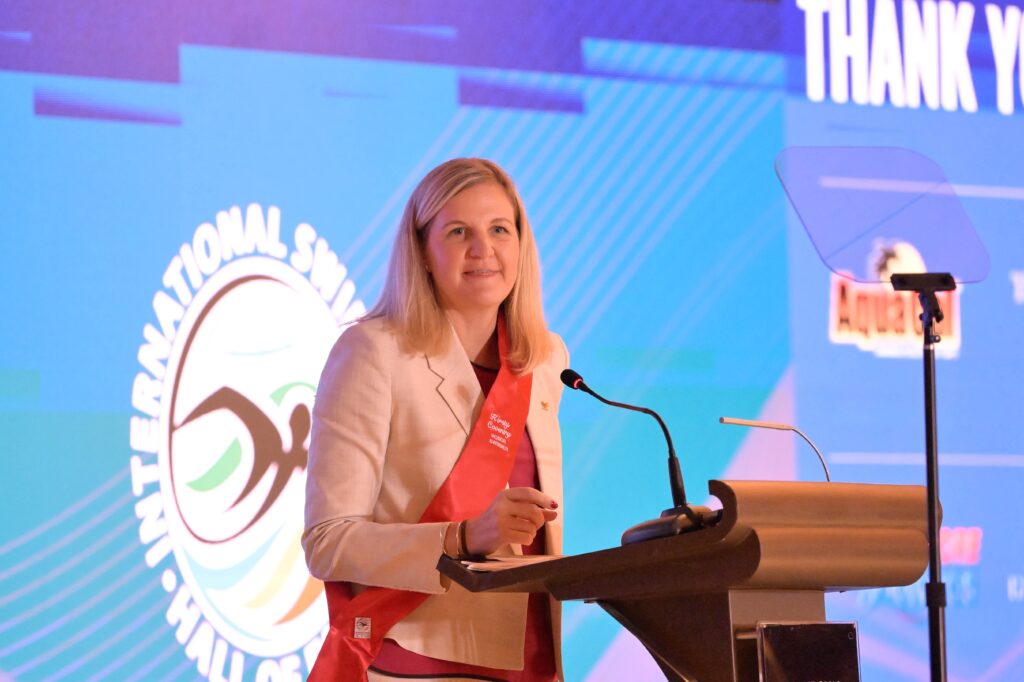
What can leaders learn from Olympians?
In the latest episode of Leaders Unplugged by IMD, IOC President Kirsty Coventry shares how an athlete’s mindset shapes her approach to leadership — from training with purpose to learning from failure and performing under pressure.
Drawing on her experience as an Olympic champion, she reflects on why listening and feedback are essential, and what it takes to lead a global organisation in complex times.🎧
Listen to the conversation and explore what leadership can learn from sport.
ISHOF to celebrate Aquatic Awards presented by AquaCal as kickoff to Honoree weekend
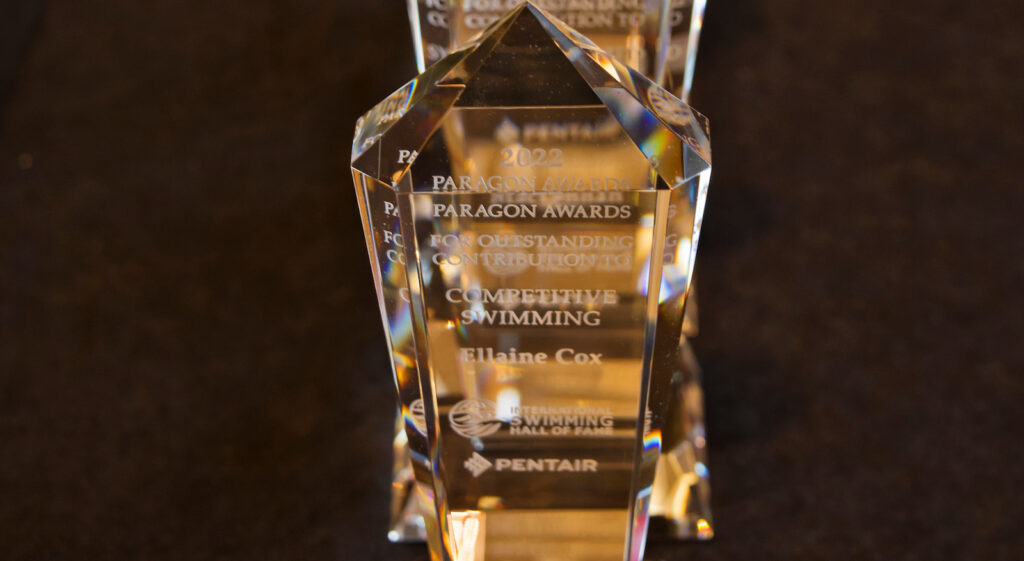
The 2026 ISHOF Aquatic Awards presented by AquaCal will be truly international this year as the individuals represent four countries out of the five categories this year. The ISHOF Aquatic Awards are presented annually to individuals or organizations for outstanding contributions to aquatics. This year’s awards will be held Friday evening, May 15, 2026, as a kick off to the 61st Annual ISHOF Honoree Induction weekend in Fort Lauderdale, Florida, USA.
If you have not bought your tickets yet, get them now, sets are limited!!!!
The annual awards are a spectacular event that celebrates the unsung heroes who make competitive and recreational aquatics possible. These are the people who save lives, promote water safety and further aquatic education around the world. We are proud to recognize these important individuals at the International Swimming Hall of Fame.
About this year’s ISHOF Aquatic Awards presented by AquaCal
David Szanto (HUN) – Competitive Swimming
David Szanto has been involved with swimming dating back from the time he was an athlete. He currently serves as the Chief Operating Officer for the Hungarian Swimming Federation (Magyar Uszo Szovetseg). He also holds the role of COO for various major organizing committees, including those of the 2022 FINA World Championships and the upcoming Budapest 2027 World Aquatics Championships, to be held next Summer.
He has been a central figure in bringing major international swimming events to Hungary, serving as head of the local organizing committee, bringing multiple World Aquatic World Cups (2021, 2023) and the 2024 World Swimming Championships (25m).
Drew Johansen (USA) – Competitive Diving
Drew Johansen is only the third Coach to lead one of the most storied programs in the country: Diving at Indiana University. Johansen took over the IU program in 2013. He has been Head Coach for the U.S. Diving Team for the 2012, 2016, 2020 and 2024 Olympic Games. Prior to the appointments, Johansen spent ten years as a U.S. National Team Coach. Under Johansen’s direction, the United States took home one gold, five silver and four bronze medals, putting the U.S. team as the number two medal producer in the world.
Mary Black (SCO) – Artistic Swimming
96 year old Mary Black has spent a lifetime involved in synchronized swimming. She began by attending courses at the Crystal Palace in London and soon after, synchro was born in Scotland. Mary represented Scotland, performing overseas, including a demonstration at the 1970 Commonwealth Games.
By 1974 Mary was Chair of the International Synchronized Swimming Coaching Panel. Next, she became an international judge, where she served at numerous national and international synchro events, including the Commonwealth Games, Pan American Games, as well as many regional and national synchro championships. The pinnacle was when Mary was selected as event referee at four Olympic Games (1984, 1988, 1992, 1996).
Mary was a member of the FINA Technical Synchronized Swimming Committee almost continuously from 1984 to 1996. She was also the first woman to become President of the Scottish Amateur Swimming Association and the first person, male or female, to serve two terms.
Mary, along with husband Bill, developed the Judges’ Evaluation criteria document which evolved into the Synchronized Swimming Operating Manual used at all international competitions.
Leanne Barnes (AUS) – Water Polo
Leeann Barnes is all things Water Polo. She played on the Victorian State Team from 1975, leading to selection on the Australian National Team from 1978 to 1982. Next, she Barnes stepped into the vacated national coach role at the 1982 World Championships in Guayaquil, Ecuador, followed by the manager role with the Australian National team from 1983 to 1992. Barnes then joined the international committee pursuing the inclusion of women’s water polo onto the Olympic program, working tirelessly from 1982 until the success of that campaign in 1997. Leanne then stepped into leadership roles with the Australian women’s program from 1986 until 2008.
Barnes has been recognized in the Australian Honours system with the Order of Australia Medal OAM, in 2019, for services to water polo and women’s sport; and in 2021, with the Public Service Medal PSM, for services to local government and community, particularly in emergency management and resilience.
The New Jersey Swim Safety Alliance –Aquatic Safety
The New Jersey Swim Safety Alliance is a collaborative coalition dedicated to advancing water safety and preventing drowning across communities throughout New Jersey. Through strong partnerships with swim schools, public agencies, healthcare leaders, and community organizations, the Alliance works to expand access to swim education and promote evidence-based safety practices. Their efforts focus on innovative programs, public awareness, and policy solutions that help keep children and families safe around water. United by a shared mission, the Alliance believes collaboration is the most powerful tool in creating lasting, community-wide impact.
Together, they are building safer environments and saving lives through prevention, education, and action.
Please join us in celebrating these stellar individuals and their achievements on Friday, May 15, 2026 at the Embassy Suites, 1100 S.E. 17th Street., Fort Lauderdale, FL 33316; to purchase tickets, click here:
Use QR Code to buy tickets to Friday night, May 15th ISHOF Aquatic Awards, Specialty Awards and Masters Induction Ceremony
WHERE: Embassy Suites 17th Street, 1100 S. E. 17th Street, Ft. Lauderdale, FL 33316
WHEN: Friday, May 15, 2026
Tickets are NOW ON SALE ~ PURCHASE THEM HERE!
Click link below to see all award winners
HOTEL:
Make your Hotel reservations Now! The Host Hotel ~ Special Rate $219
Photo Courtesy: Embassy Suites Fort Lauderdale
Embassy Suites 17th Street, 1100 S. E. 17th Street, Ft. Lauderdale, FL 33316
Use QR Code to make your Hotel Reservations
Tickets for the ISHOF Class of 2026 Honoree Induction Ceremonies
WHEN: Saturday, May 16, 2026
WHERE: War Memorial Auditorium, 800 Northeast 8th Street, Ft. Lauderdale, FL, 33304
Tickets are NOW ON SALE ~ PURCHASE THEM HERE!
AquaCal® has been the leading swimming pool heat pump manufacturer since 1981, offering a full range of units to meet any heating need. AquaCal® can maintain anything from small above ground pools up to very large commercial facilities. (Currently heating and chilling the City of Fort Lauderdale’s Aquatic Center pools) The chillers, as well as the heat and cool units, can be used to create cold plunge pools for therapy too. Whatever your pool heating/cooling needs, AquaCal® can help!
For more information call Meg Keller-Marvin at 570.594.4367
#ISHOF #Aquaticawards #AquaCal #Swimming #Fortlauderdale #Diving #Waterpolo #Artisticswimming #Everychildaswimmer #swimlessons #WorldAquatics
Flashback Friday – 1923: Six World Record Holders and Five Honorees

Six World Record Holders after competing in the greatest water carnival, 1923 at the famed Broadripple Pool, Indianapolis (L to R) Ludy Langer, Charlotte Boyle, Johnny Weissmuller, Norman Ross, Robert L. Pearson, Ethelda Bleibtry.
Five of the six would become Honorees in the International Swimming Hall of Fame. What are the odds?
Reach what made each one of these Honorees so special and learn their about history.
Honoree Bios:
Johnny Weissmuller
https://ishof.org/honoree/honoree-johnny-weissmuller/
Ethelda Bleibtrey
https://ishof.org/honoree/honoree-ethelda-bleibtrey/
Norman Ross
https://ishof.org/honoree/honoree-norman-ross/
Charlotte Boyle
https://ishof.org/honoree/honoree-charlotte-boyle/
Ludy Langer
ISHOF Celebrates 2026 Masters International Swimming Hall of Fame Honoree Ceremony ~ Friday, May 15
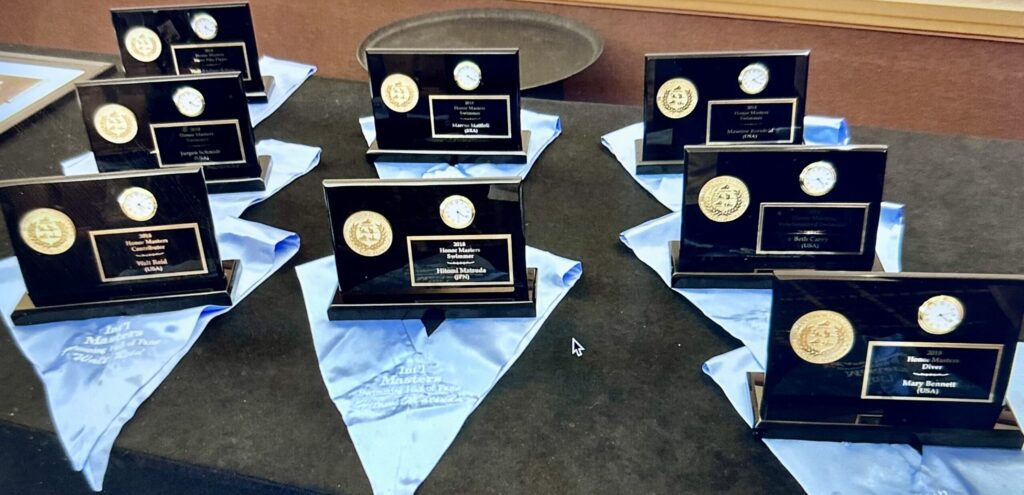
The Masters International Swimming Hall of Fame Honoree Induction Ceremony will take place on Friday, May 15 and serve as a kickoff to the Honoree weekend along with the ISHOF Aquatic and Specialty Awards, presented that same evening. The Class of 2026 includes four Masters Swimmers, and one Masters Water Polo Player. We will also be inducting one Masters Swimmer and one Masters Artistic Swimmer from last year who were unable to attend.
MISHOF’s Class of Honorees includes swimmers, Ellen Reynolds (USA), Kirsten Cameron (NZL, AUS, GBR, NED), Eiji Nomura (JPN), Toshio Tajima (JPN) and Hiroshi Matsumoto (JPN), Artistic Swimmer, Joyce Corner* (CAN), and Water Polo Player, Georgy “Misha” Mshvenieradze. “It’s quite a remarkable group”, said Bruce Wigo, ISHOF Historian, and former CEO; “We look forward to welcoming them to Fort Lauderdale and celebrating them during our Honoree weekend!”
Kirsten CAMERON (NZE, AUS, GBR, NED) Masters Swimmer
Kirsten is still relatively new to Masters Swimming. She did not even begin swimming competitively until she was 30 years old. She joined a Masters Club in Wellington, New Zealand, and that was the beginning of her swimming career. Yet, at 52, she already has 24 Masters World Records and 1033 World Points. A New Zealander, who began competing in the 30-34 age group, she is currently swimming in the 50-54 age group.
Kirsten left New Zealand and is currently living and swimming in Eindhoven, Netherlands. Prior to that, she was in Great Britain, and has also swum for a Melbourne swim club. She enjoys open water swimming and was part of a group of masters swimmers who attempted to break the English Channel relay record. She has also competed on the Open Water World Cup Circuit. Since COVID saw her return to open water, most recently she has focused on longer events which have included completing Ulswater, Lake Zurich, Capri-Napoli and the challenging Vidosternsimmit and is planning to swim Lake Malawi.
Kirsten has attended three FINA World Championships, Stanford, 2006, Perth, 2008, and Gothenburg, 2010, swimming all freestyle events while winning all gold, 10 medals in total, breaking world records while doing it.
Eiji NOMURA (JPN) Masters Swimmer
Eiji Nomura of Japan began his Masters career swimming in the 30-34 age group. During his Masters career, he has competed in five age groups ranging from the 30-34 through the 50-54 age group. He has broken 22 FINA Masters World Records in the butterfly, freestyle, and I.M. events. He has 889 points and has been in the Top Ten 18 times.
In World Rankings, he has a combined total, long and short course, of 61 – Number 1, 21 – Number 2 and 18- 3 Number 3 in the butterfly, freestyle and I.M.
Nomura also holds many Japanese records, including the fastest 25m butterfly (Masters SC 40-44 men), 100m butterfly (Masters LC 40-44 men), 200m freestyle (Masters LC 45-49 men), 50m freestyle (Masters SC 45-49).
He has not competed in any FINA Masters World Championships, accumulating all of his 889 world points by breaking world records and setting world rankings.
Ellen REYNOLDS (USA) Masters Swimmer
Ellen Reynolds, new to the women’s 60-64 age group in 2024, has set an unprecedented 26 Masters World records this year between long course and short course meters, solidifying her legacy as an extraordinary Masters swimmer. She’s also been a part of five world-record-setting relays as a member of Team Redbird Masters.
Her records span a remarkable range, from the shortest sprints, like the 50 backstroke and fly, to the grueling 1500-meter freestyle, showcasing her versatility. Despite her impressive achievements, Ellen remains humble and focused on enjoying the sport.
One of the more interesting stats is that Ellen holds a world record in every event except the 50 free, 50 breast, 100 breast, and 200 fly. And she didn’t just break these world records—she demolished them by large margins.
Just as impressive, Ellen has balanced a demanding career as a pediatric surgeon with her swimming for many years, but has just retired in September after 25 years in the field. Her work ethic as a surgeon often influenced her approach to swimming. This year, Ellen isn’t just grateful for her fast swimming. She said, “I’d like to say thank you to all of the volunteers running the swim meets. I couldn’t have done it without them!”
Toshio TAJIMA (JPN) Masters Swimmer
Toshio Tajima is a Japanese Masters swimmer who competes in the breaststroke and butterfly events. He has broken a total of 21 world records; Some of his records were broken up to 14 years ago and seven of them are still standing.
He has competed in seven different age groups beginning in the 60-64 age group through 90-94 and he has been in the Top Ten 32 times. He has been in the world rankings since 1985 with a combined total of 45 – Number 1, 22 – Number 2 and 11 Number 3 in the butterfly and breaststroke events.
Tajima competed in six FINA Masters World Championships: 1986, Tokyo; 1988, Brisbane; 1990, Rio; 1998, Casablanca; 2000, Munich; and 2002 Christchurch, winning 2 gold, 2 silver and 3 bronze medals.
Mr. Tajima stopped competing in 2019, where he was swimming in the 90-94 age group.
Georgy “Misha” MSHVENIERADZE (RUS) Masters Water Polo Player
Georgy “Misha” Mshvenieradze is a 65-year old Soviet water polo player.
Misha was known for his strength on the 2-meter line, his ability to score under heavy contact, his positional and tactical intelligence and his natural leadership ~ a combination that defined the center forward role in the 1980’s and remains a benchmark for modern coaches and players.
Misha has been active in Masters water polo since 2000, and his team has won seven gold medals and one silver in FINA/World Aquatics World Masters Championships competition.
He and his team, Moscu 04 also won gold in 2009 at the Copa de Espana Masters event in the 40+ age group, competing in Tenerife, Spain. Mishi has competed for three different clubs, while competing in Masters: WP Moscu04, Dynamo Masters, and Europa Sporting Roma.
Joyce CORNER (CAN) 2025 Masters Synchronized Swimmer
Canadian, Joyce Corner attended her first FINA World Championships in 1992 in Indianapolis, where she and her teammates came away with a bronze medal in the trio 65+ event. Four years later, Corner walked away with her first World title in the duet. She continued attending Masters World Championships, mostly bringing home gold medals. In all, she won ten World Championship gold, five silver, and one bronze.
In the mid-2000’s Corner formed a new club, the New Wave Synchro Masters, where she coached and competed as a member in her last two appearances at Worlds in 2004 and 2008.
Joyce has been involved in just about all areas of synchronized swimming. She was on the Canadian Synchronized Swimming Committee for countless years and represented Canada in Masters FINA meets when present. She was the Canadian representative to the FINA Masters Synchronized Swimming Committee which helped develop the requirements when FINA transitioned from a figure competition to a technical program.
She was a FINA-rated “A” international judge, and she has judged Pan American Games, World Aquatics Championships, the Olympic Games in Seoul in 1988, as well as many other events in Canada and around the world.
Hiroshi MATSUMOTO (JPN) 2025 Masters Swimmer
Hiroshi Matsumoto, born in 1936, began swimming in high school. There were no pools where he lived, just a pond with hundreds of frogs. And a few snakes.
When he was in his early 20s, he moved to the area in Japan where Mt. Fuji is, to take a job, as a lumberjack. There was a 50-meter pool near his office. For nine years, he swam there almost every day in the summer.
In his late 50’s, Matsumoto joined Masters Swimming. When he reached his 60’s, he started breaking national records, even though he was diagnosed with cancer, and needed surgery in his mid-60s. In his 70’s, he started breaking world records.
Matsumoto competes mainly in the butterfly and the freestyle events. His favorite stroke is the butterfly, but at 84, he had a terrible accident and tore up his shoulder; the doctors said he might not swim again. He is swimming again and breaking records, but only in the freestyle events.
Matsumoto has broken over 100 national records and 28 world records. He has been in the Top Ten for 27 years and has accumulated 945 world points.
He has attended four FINA/World Aquatic Championships, winning two gold and three silver: 2002: gold (50m butterfly 65-69); 2006: silver (50m butterfly 70-74); 2008: gold (50m butterfly 70-74); 2023: silver (50m free, 100 free 85-89).
Matsumoto still keeps hope that he is going to swim butterfly again someday.
Use QR Code to buy tickets to Friday night, May 15th Masters and Awards Night
WHERE: Embassy Suites 17th Street, 1100 S. E. 17th Street, Ft. Lauderdale, FL 33316
WHEN: Friday, May 15, 2026
Tickets are NOW ON SALE ~ PURCHASE THEM HERE!
Click link below to see all award winners
HOTEL:
Make your Hotel reservations Now! The Host Hotel ~ Special Rate $219
Photo Courtesy: Embassy Suites Fort Lauderdale
Embassy Suites 17th Street, 1100 S. E. 17th Street, Ft. Lauderdale, FL 33316
Use QR Code to make your Hotel Reservations
Tickets for the ISHOF Class of 2026 Honoree Induction Ceremonies
WHEN: Saturday, May 16, 2026
WHERE: War Memorial Auditorium, 800 Northeast 8th Street, Ft. Lauderdale, FL, 33304
Tickets are NOW ON SALE ~ PURCHASE THEM HERE!
ASCA/ISHOF Coaches Clinic Featuring Honoree Gregg Troy:
https://web.cvent.com/event/95f72cfc-f855-4e4d-bfb4-856f4b86ddc