
Throwback Thursday ~ When the Casino Pool and the New Hall of Fame Pool stood side by side
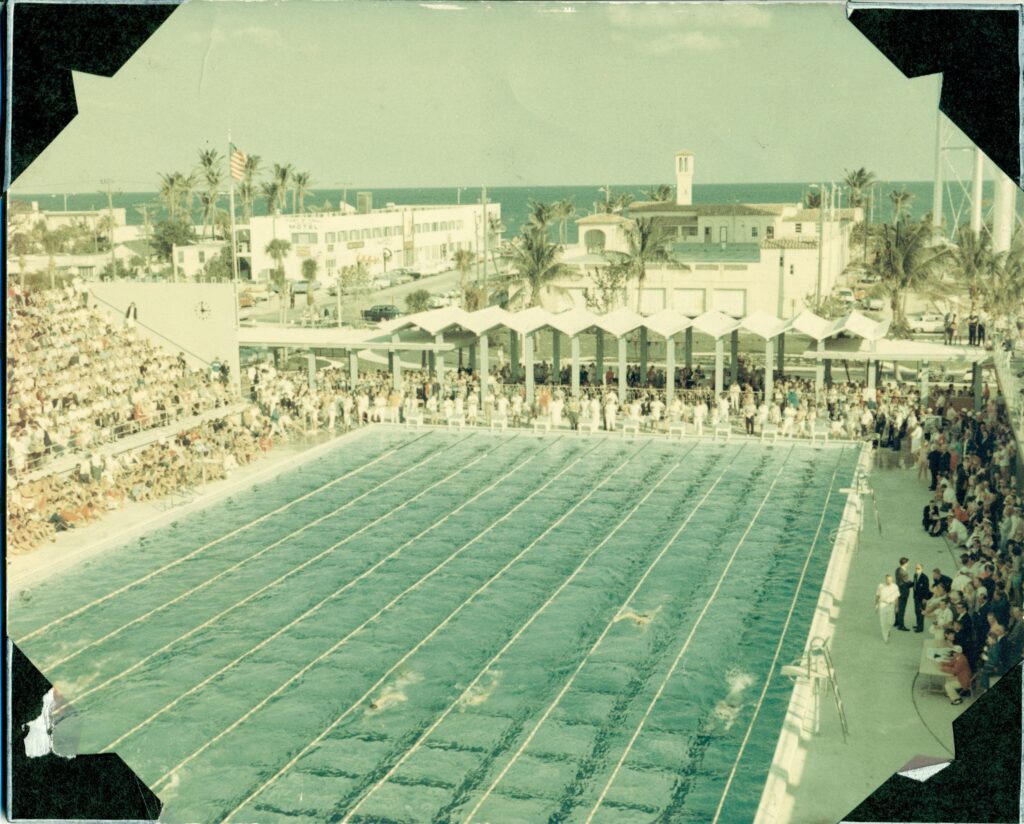
For a short time back in 1965 and early 1966, the beautiful Casino Pool and the Hall of Fame Pool, aka the Fort Lauderdale Aquatic Center, stood side by side or back to back, depending on how you looked at it. There are not many of those amazing photos; to see the contrast of the two pools. The Casino built by famed Fort Lauderdale architect Francis Abreu, who built many of the homes in and around Fort Lauderdale, which if you grew up in town, its a style you can’t help but love.
The city’s original beach structure, built in about 1915, called “casino” was a story wooden structure which contained dressing rooms and a dance floor, but no pool. Promoted by a group of Fort Lauderdale businessmen led by local promoter Commodore A.H. Brook, the new Casino and pool was widely regarded as a means of lifting the city out of the depression which had followed the collapse of the land boom. It was designed by Abreu and constructed by building contractor John Obegon at a cost of $118,000 according to this 1930 account. A 1928 Ft. Lauderdale Daily News newspaper article which announced the building’s opening, however, placed the cost at $125,000.
The municipal complex included an Olympic-size pool 60 by 165 feet, and three to 12 feet in depth. A story in the Fort Lauderdale Daily News claimed “the pool is filled several times weekly with 420,000 gallons of filtered salt water pumped by three wells from more than 20 feet of rock and shell and sand. The chlorinating system is one of the best in the south.” The municipal building also included a wading pool for children and hundreds of lockers for visitors.
35,000 people attended the opening ceremonies and the accompanying swim meet, which was presided overby City Commissioner Will J. “Cap” Reed.
In the ensuing decades, the Casino lived up to its promise as the center of beachfront activities in Fort Lauderdale. Beginning in 1935, it hosted the annual Collegiate Aquatic Forum, a Christmastime college swim meet which introduced vacationing college students from around the country to the attraction of Fort Lauderdale. The Casino remained a popular location for competetive swim meets for visiting tourists and for local citizens until it closed in 1965. It was subsequently demolished to make room for the Swimming Hall of Fame complex which opened that same year.
Which one did you like better? The Casino Pool with the Spanish style architecture or the new modern Swimming Hall of Fame?
Rebecca Adlington and husband Andrew Parsons celebrate birth of daughter
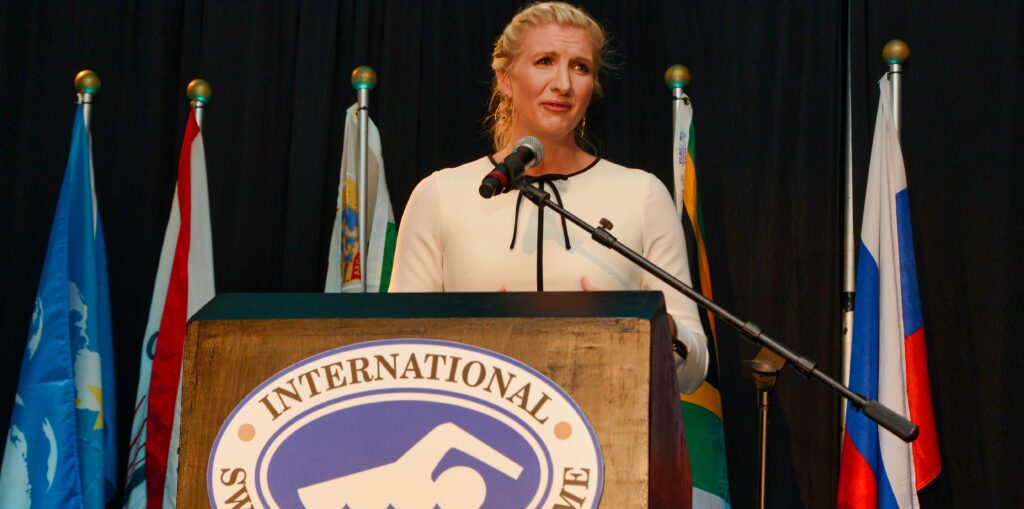
Photo Credit: 2018 ISHOF Induction
One of our favorite people ever, Becky Adlington, who we inducted in 2019, recently gave birth to daughter, Thea Joy Parsons on February 28, 2026. Thea joins sister Summer, and brother Albie! Congratulations to the whole family.
Below is Becky’s Instagram post after the birth of her and husband Andrew’s daughter:
“What a rollercoaster this whole experience has been. Three years, two miscarriages, 39 weeks carrying our magical rainbow girl, and 87 hours in hospital. 💜
Thea Joy Parsons arrived on 28th February, the very same day my nana, Joyce, passed away. A true full circle moment of life. Joy is a nod to her, and we know Thea will bring us all so much joy.
We are so incredibly happy she is home and healthy. I know so many of you are still waiting for your rainbow, and we are thinking of you, sending so much love and support your way.”
All Photos Courtesy Rebecca Adlington
Congratulations to the Adlington/Parsons family from everyone at the International Swimming Hall of Fame! I think you’re due for another trip to South Florida.
Read Rebecca Adlington’s Honoree bio here: https://ishof.org/honoree/honoree-rebecca-adlington/
Jane Figueiredo becomes second Zimbabwean to join ISHOF as Honor Coach

Jane Figueiredo (ZIM) was most recently awardedthe 2024 IOC Coaches Lifetime Achievement Award, “awarded to a coach who has gone above and beyond in assisting their athletes both on the sporting and the personal side, supporting them through their Olympic journeys”. She was chosen from more than 110 candidatures, nominated by Olympians, International Federations, National Olympic Committees (NOCs), members of the IOC Athletes’ and IOC Athletes’ Entourage commissions, and IOC Members. Jane has coached 13 Olympic medalists, and in World Championship competition, her divers have over 15 medals. She has been named World Aquatics Diving Coach of the Year, and she is a five-time NCAA Women’s Coach of the Year.
Learn more about Jane Figueiredo of Zimbabwe and the other 12 outstanding Honorees who will be inducted this year at ISHOF’s 61st Honoree Induction Ceremony Buy your tickets NOW for ISHOF’s 61st Anniversary of the Honoree Induction Ceremony in Fort Lauderdale in conjunction with the World Aquatics High Dive World Cup
WHEN: Saturday, May 16, 2026
WHERE: Embassy Suites 17th St. 1100 S. E. 17th Street, Ft. Lauderdale, FL
Tickets are NOW ON SALE ~ PURCHASE THEM HERE!
~ISHOF Class of 2026~
Nathan Adrian (USA) Honor Swimmer
Laszlo Cseh (HUN) Honor Swimmer
Ranomi Kromowidjojo (NED) Honor Swimmer
Ryan Lochte (USA) Honor Swimmer (Class of 2025)
Ferry Weertman (NED) Honor Open Water Swimmer
Tania Cagnotto (ITA) Honor Diver
Simone Fountain (AUS) Honor Water Polo Player
Heather Simon Carassco (USA) Honor Artistic Swimmer
Jane Figueiredo (ZIM) Honor Coach
Gregg Troy (USA) Honor Coach (Class of 2025)
Stephen A. “Sid” Cassidy (USA) Honor Contributor
Richard Burns (USA) Honor Masters Swimmer
Beatrice Hess (FRA) Honor Paralympic Swimmer
Make your Hotel reservations Now! The Host Hotel ~ Special Rate $219
Photo Courtesy: Embassy Suites Fort Lauderdale
Embassy Suites 17th Street, 1100 S. E. 17th Street, Ft. Lauderdale, FL 33316
Use QR Code to make your Hotel Reservations
Tickets for Friday Night’s Masters Induction, ISHOF Aquatic and Specialty Awards
Use QR Code to buy tickets to Friday night, May 15th Masters and Awards Night.
Fort Lauderdale: New Swimming Hall of Fame attraction to open in late 2028 – Update to Tuesday’s article
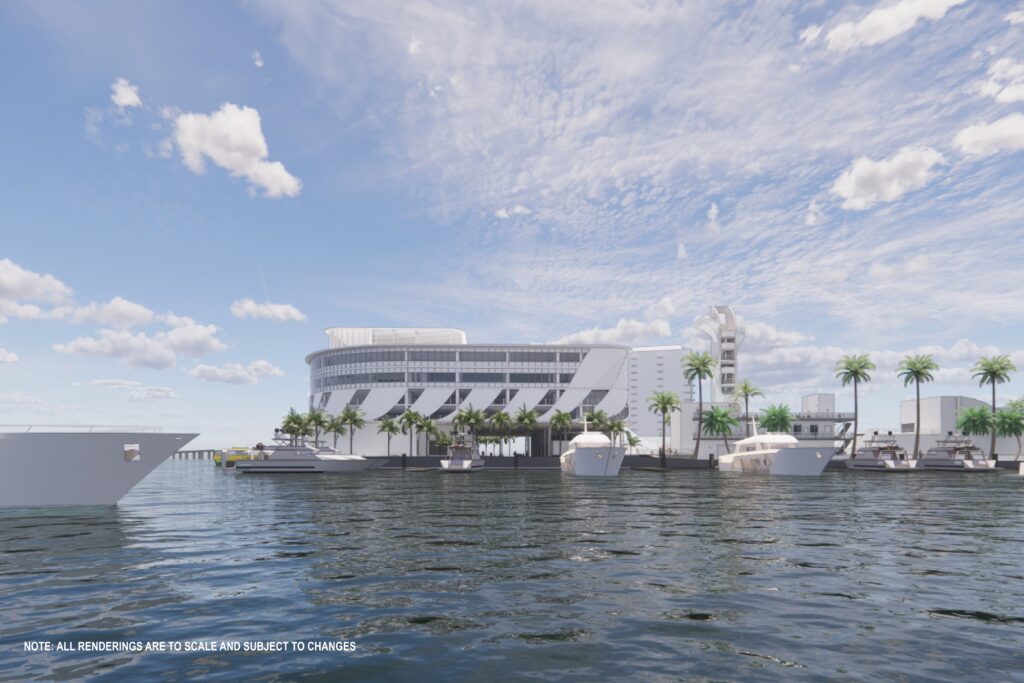
Shared from Sun Sentinel, March 4, 2026
An artist’s rendering shows a new International Swimming Hall of Fame building just west of Fort Lauderdale’s dive tower. (Architectonica/Courtesy)
By December 2028, a new International Swimming Hall of Fame is expected to beckon tourists and locals alike with a family-friendly aquarium, museum and rooftop restaurant.
Two new Hall of Fame buildings will flank the pools and dive tower at the Fort Lauderdale Aquatic Center that all share the same city-owned peninsula at 501 Seabreeze Blvd., just a block west of State Road A1A, south of Las Olas Boulevard.
The design plans for the six-story building on the west side of the peninsula sailed through commission approval Tuesday night.
The unanimous vote came after months of back-and-forth discussions over the right height for a building that will perch so close to the Aquatic Center’s 27-meter dive tower.
In a nod to critics who worried the building would dwarf the famous dive tower, developer Mario Caprini and his team scaled back the west building’s height from the equivalent of 13 stories to six.
The redesign will mean less on-site parking for visitors, but Mayor Dean Trantalis and Commissioner Steve Glassman say it was a necessary compromise to safeguard views of the dive tower and surrounding neighborhoods.
The ambitious vision — launched more than five years ago with an unsolicited proposal to City Hall — will cost an estimated $220 million.
The new Hall of Fame is expected to have an impact of $70 million a year on the local economy, according to Caprini.
Crews will break ground on the west building as soon as June, said Caprini, CEO of Capital Group P3 of Florida and a partner in the project with Hensel Phelps Construction.
Caprini said he expects to have design plans for the east building ready for commission approval in the next six months.
The Fort Lauderdale Aquatic Center, shown on Nov. 7, sits on the same city-owned peninsula as the International Swimming Hall of Fame. A developer plans to build two new Hall of Fame towers on the east and west end of the site. (Amy Beth Bennett/South Florida Sun Sentinel)
Plans for the east building call for a dive grandstand, retail shop and cafe, elevated promenade, dryland training and teaching pool.
Under current guidelines, the entire site requires 405 parking spaces but will only have 259, leaving the development short by 146 parking spaces.
Critics have expressed concerns about the lack of parking, but none spoke up during Tuesday’s commission meeting.
Debby Eisinger, a member of the Swim Fort Lauderdale Masters Team, did send an email to the commission Tuesday morning saying the shortage of parking remains a concern.
“One of the most significant and consistently voiced concerns has been the loss of on-site parking,” Eisinger, a former Cooper City mayor who now lives in Fort Lauderdale, said in her email. “Parking has been and continues to be a major concern. The option of off-site parking is not being well received by swimmers, particularly those who train daily and require convenient, reliable access.”
Bill Brown, president of the Central Beach Alliance neighborhood group, urged the commission to approve the design plan so the developer can finally get shovels in the ground.
“Some residents had concerns about this building being too high,” Brown said. “They brought the height down a couple floors. I know we’re losing parking spaces. But I think at the end, we’re all going to one day look back and just be so proud of what’s been accomplished.”
The west building went through significant design changes due to feedback from the swim community and neighboring condos, Glassman noted.
“We took two floors off that western building,” he said before the vote. “That means some parking was lost. You can’t have both. You’re either going to have the height, which no one wanted, or you’re going to lose some parking. It’s very difficult to have both.”
Stephanie Toothaker, attorney for the developer, told the commission that 176 parking spaces are required for the Aquatic Center and Ocean Rescue headquarters alone. The museum requires 61 spaces, the aquarium 43 and the restaurant 62.
But many people who come to the Hall of Fame might also swim at the pools or head to the restaurant, she added.
“So you don’t double count those spaces,” Toothaker said. “We are providing 259 parking spaces on site, which is a lot of parking. And there’s a tremendous amount of foot traffic. Not everybody is driving.”
Glassman and Trantalis suggested a shuttle service operated by the city or the developer could help get people from the Las Olas garage to the Hall of Fame.
“You might consider a dedicated shuttle service as an amenity so you don’t lose customers because people go there looking for a parking space and can’t find one and go away,” Trantalis said.
A man walks past the International Swimming Hall of Fame and Fort Lauderdale Aquatic Center on March 14, 2025. (Amy Beth Bennett/South Florida Sun Sentinel)
Vice Mayor John Herbst echoed that concern.
“I’ve had a number of calls about the parking as well,” he said. “I will just say I think this is probably a mistake. My personal preference would be to restore the height and put the parking back. I think cutting the height of the building and losing all that parking space is a mistake. Every time we’ve done a parking reduction in the city, we’ve always come back to regret it.”
Glassman defended the decision to lower the height of the building.
“People complained that we were dwarfing our beautiful high-diving tower,” Glassman said. “We made it very clear we were eliminating two floors of parking. It’s so hard to please everybody. But that’s why we did it. We didn’t just take two floors off for the heck of it or the fun of it. We took them off because that’s what everyone was clamoring for.”
Herbst said he was worried the lack of parking might hurt the bottom line for the new aquarium and museum — and the city.
Fort Lauderdale is expected to recoup money on the public-private project through revenue-sharing from tenants.
Fort Lauderdale is not borrowing the money, but is guaranteeing the debt.
If the project is a success, the city would see a gain of $1.1 million a year.
Under the deal, Fort Lauderdale will be required to contribute up to $13.6 million a year in lease payments over 30 years, bringing the city’s overall payment to $408 million. Under the original comprehensive agreement, Fort Lauderdale would have contributed up to $11 million a year toward the project, for a total of $330 million.
To help offset the increase in the master lease payment, the developer has agreed to increase other revenue that would be paid to the city from $2 million to $4.75 million.
The changes were approved by the commission in January.
“Anything that takes away from the customer experience is going to cut the number of patrons they have,” Herbst said on Tuesday. “And the reason I’m concerned about that is because we are guaranteeing the debt on that entire project. So if it doesn’t hit its revenue targets, we are the payer of last resort.”
Herbst told the commission he is less concerned with whether the swimmers are happy with the height of the building and more focused on whether the project is a financial success.
“I think this (lack of parking) has an impact on the business model,” Herbst said. “I hope I’m wrong.”
Tania Cagnotto (ITA) to join her father, Giorgio, as Honor Diver into ISHOF as part of Class of 2026

Tania Cagnotto (ITA) competed in five Olympic Games, eight World Championships, eight World Cups, 31 World Series and 54 FINA Diving Grand Prix’s. Her performance was progressive, getting better each year beginning in 1999, gaining results in the European Junior Championships, and reaching the top in 2016 at the Rio Olympic Games with a silver and a bronze medal in the springboard events. Her 3-meter synchronized team was the best in Europe with eight synchro 3-meter gold medals together with teammate Francesca Dallapè and second in the world only to the Chinese teams.
Learn more about Tania Cagnotto of Italy and the other 12 outstanding Honorees who will be inducted this year at ISHOF’s 61st Honoree Induction Ceremony Buy your tickets NOW for ISHOF’s 61st Anniversary of the Honoree Induction Ceremony in Fort Lauderdale in conjunction with the World Aquatics High Dive World Cup
WHEN: Saturday, May 16, 2026
WHERE: Embassy Suites 17th St. 1100 S. E. 17th Street, Ft. Lauderdale, FL
Tickets are NOW ON SALE ~ PURCHASE THEM HERE!
~ISHOF Class of 2026~
Nathan Adrian (USA) Honor Swimmer
Laszlo Cseh (HUN) Honor Swimmer
Ranomi Kromowidjojo (NED) Honor Swimmer
Ryan Lochte (USA) Honor Swimmer (Class of 2025)
Ferry Weertman (NED) Honor Open Water Swimmer
Tania Cagnotto (ITA) Honor Diver
Simone Fountain (AUS) Honor Water Polo Player
Heather Simon Carassco (USA) Honor Artistic Swimmer
Jane Figueiredo (ZIM) Honor Coach
Gregg Troy (USA) Honor Coach (Class of 2025)
Stephen A. “Sid” Cassidy (USA) Honor Contributor
Richard Burns (USA) Honor Masters Swimmer
Beatrice Hess (FRA) Honor Paralympic Swimmer
Make your Hotel reservations Now! The Host Hotel ~ Special Rate $219
Photo Courtesy: Embassy Suites Fort Lauderdale
Embassy Suites 17th Street, 1100 S. E. 17th Street, Ft. Lauderdale, FL 33316
Use QR Code to make your Hotel Reservations
Tickets for Friday Night’s Masters Induction, ISHOF Aquatic and Specialty Awards
Use QR Code to buy tickets to Friday night, May 15th Masters and Awards Night.
Click link below to see all award winners
Fort Lauderdale commissioners approve $220 million in upgrades to International Swimming Hall of Fame

FORT LAUDERDALE, Fla. — The International Swimming Hall of Fame on Fort Lauderdale Beach has been a landmark site for decades, drawing nautical enthusiasts from near and far.
But the property is on the verge of a $220 million facelift that will reshape a portion of the central beach area.Commissioners in Fort Lauderdale discuss upgrades to International Swimming Hall of Fame
Renderings show what a revamped Hall of Fame would look like for the west building, a six-story structure and a nearly 204,000-square foot multi-purpose building and family friendly aquarium.
City commissioners voted to approve the plans Tuesday evening in what’s being called a private-public partnership.
The Hall of Fame sits on city-owned land, but it’s run by an LLC called HOFP, or Hall of Fame Partners.
The idea to transform the current site has been in the works for roughly six years and would be done in four phases.
Mario Caprini is the CEO of the private company that worked with the developer and the city to bring the massive project to life.
“It’s been a long time coming, a lot of effort went into it,” said Caprini. “We have an elevated promenade that’s going to connect the east to west building. It’s going to connect the walk from the beach all the way to the water taxi and the dock we’re going to be putting in.”
When it’s complete, the new International Swimming Hall of Fame will also house a restaurant, a large event space and a 24,000-square-foot museum.
There will be large open pedestrian walkways along the waterfront as well.
The iconic diving board, one of the world’s tallest at nine stories, would remain in place, securing its future at the popular tourist attraction.
Plans for the east building will come before the commission later this year.
To watch the video from Channel 10 Local News Read More
Key Vote Tuesday for long awaited $220 million redesign of ISHOF

Shared from Fort Lauderdale Sun Sentinel March 2, 2026
An artist’s rendering shows a new International Swimming Hall of Fame building just west of Fort Lauderdale’s dive tower. (Architectonica/Courtesy)
A key vote is coming Tuesday on plans for a long-awaited $220 million redesign of Fort Lauderdale’s International Swimming Hall of Fame.
The project is slated to rise on city-owned land next to the Fort Lauderdale Aquatic Center and its iconic dive tower, one of the tallest in the world at nearly nine stories high.
Developer Mario Caprini plans to transform the two Hall of Fame towers on the east and west end of the peninsula at 501 Seabreeze Blvd.
Commissioners are expected to approve the latest design plan for the west building during a City Hall meeting that begins at 6 p.m.
A nod from the commission will pave the way for a groundbreaking of the six-story building in June or July, said Caprini, CEO of Capital Group P3 of Florida and a partner in the project with Hensel Phelps Construction.
The west building will include a family-friendly aquarium and museum, a rooftop restaurant overlooking the Intracoastal and space for events and exhibits.
Design plans for the east building would likely come to the commission in the next three to six months, Caprini said.
The east building would include a dive grandstand, retail shop and cafe, elevated promenade, dryland training and teaching pool.
If all goes well, the entire project would open by December 2028, Caprini said.
“The design plan has come a long way,” Commissioner Ben Sorensen said on Monday. “I’ve had multiple meetings with the swimmers and the developer and they’ve made several changes. We are now in a good place.”
The project is expected to transform the Swimming Hall of Fame into another landmark destination for Fort Lauderdale.
“This really does accomplish all of the changes we’ve been looking for in terms of wrapping up the bookends of the peninsula,” Commissioner Steve Glassman said.
Glassman said he has “not heard a peep” from anyone worried about the projected lack of parking on site.
The project is short 146 parking spaces, but hopes to make that up by providing parking at the nearby Las Olas garage.
“We are also looking for off-site parking solutions,” Caprini said. “We have a parking study and there is enough with the shared parking to meet the need. But we’re looking at other options, including creating packages for families to park at the mall or downtown and grab a boat. It could be a Water Taxi or our own boats. They’ll have a choice.”
ISHOF now carrying Under Armour Products once again!

A year or so back, ISHOF proudly carried the brand, UNDER ARMOUR, and we are happy to say we have them back!
We are now carrying and have in stock and ready to ship, the:
UA Men’s Short Sleeve, Stretch Tech T-Shirt in Navy and Charcoal Gray, sizes Small-XXL. We expect the long sleeve T-Shirts in white anyday now and the hats in about 2-3 weeks. The photos shown are from our last batch, last year and the word “International” has been added.
We will update the photos once we get the items in house.
UA Men’s Long Sleeve, Stretch Tech T-shirt in White, sizes, Small – XXL (Coming this week)
UA Men’s Zone Adjustable Hat, Available in Navy and White (Coming in 2-3 weeks)
Order them NOW ~ While they last!!!
Come be part of ISHOF’s Inaugural Corporate Swim Challenge, Saturday, April 26, 2026

Get your work friends and join us for a Day of FUN at the Pool!!!! Join in on a relay at ISHOF’s very first ever, Inaugural Corporate Swim Challenge at the Fort Lauderdale Aquatic Center, on Saturday, April 26, 2026 from 3:00 pm to 6:00 pm.
Bring your friends, family and all your co-workers to cheer your team on! Everyone can get in on a game of cornhole, play jenga or dance to our DJ in the beautiful South Florida sun while rooting for their favorite swimmers…..
Space is LIMITED, so make you reservations NOW. Call Devin at 631.880.2539
Flashback Friday to February 1977, When President Gerald R Ford Was Inducted as an Honorary Member of ISHOF
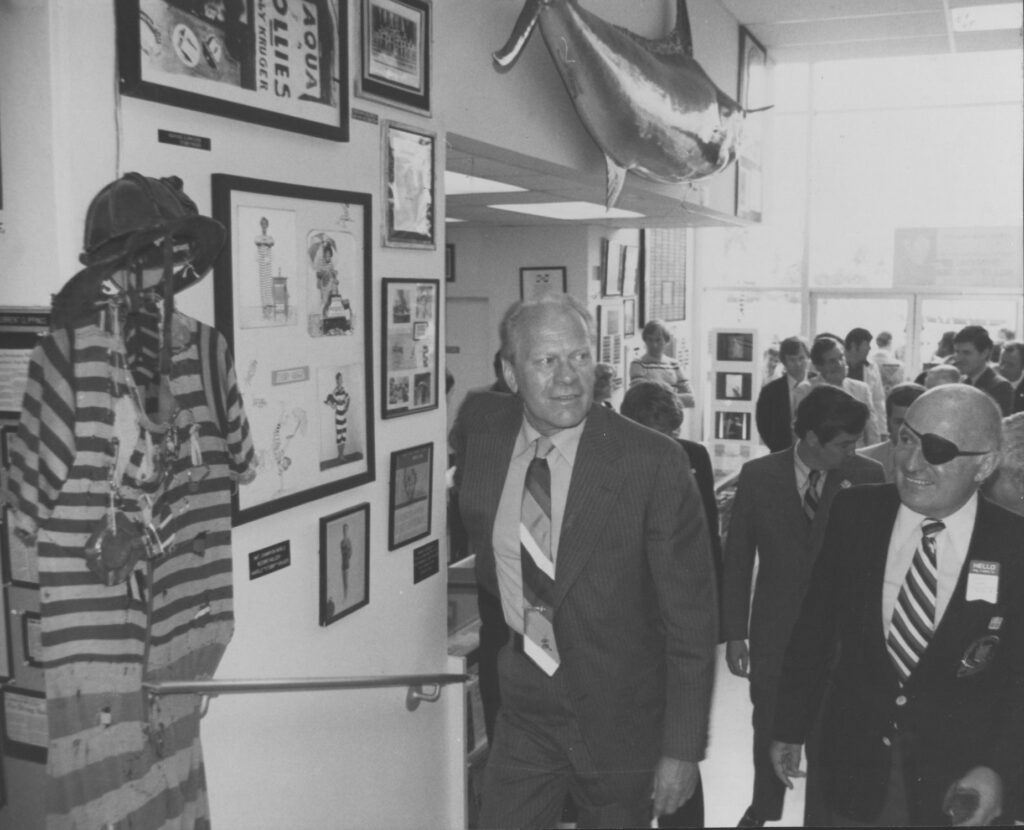
President Ford was an Honorary Director of the International Swimming Hall of Fame (ISHOF) Board of Directors and was a special guest at ISHOF in February, 1977, the year after he left the Presidency.
“You are honored here for your splendid example of swimming for health, exercise and pleasure in the historic tradition of other ‘Wet – Heads of State’ who were accomplished swimmers: John F. Kennedy, John Quincy Adams, Franklin Roosevelt, Winston Churchill, Pierre Trudeau, Julius Caesar, Alexander the Great, Mao Tse Tung, Charlemagne, King Gustav VII, King Louis XI and Prince Albert,” said 1977 ISHOF Executive Director Buck Dawson to President Ford at the meeting.
Just as he took the plunge into politics at an early age, so too did President Gerald Ford take the plunge into the swimming pool. Just as in his many years in politics, he also made swimming a life-long exercise for health benefits
As vice president, Ford swam daily in his Arlington, Va., home pool, and when he rose to the Presidency he was a regular swimmer in the newly-constructed pool on the White House grounds. (The original indoor pool built by FDR, had been removed in the late 1960’s.) The Swimming Hall of Fame contributed the first $1,000 to the fund generated by private donations to rebuild the White House pool in 1975. Widely-admired for his interest in physical fitness and sports, President Ford carried his swming regimen into his life as Citizen Ford.
Some of the things Ford did while he was at the Hall of Fame was sign the ISHOF guest book. He was also given a Picture of the Hall of Fame complex, which was presented by Bob Hoffman. He was also given a lifetime gold pass representnavie of his honerary memebrship into the Hall of Fame by Hall President Dave Roberts. He also watched the 100′ dive by Rick White, captain of the US Acapulco High Diving Team.