Milan, Italy, 02/11/2026. Lifesaving sport has achieved a remarkable milestone in its
international journey towards Olympic recognition. Dr. Stathis Avramidis’ motivational
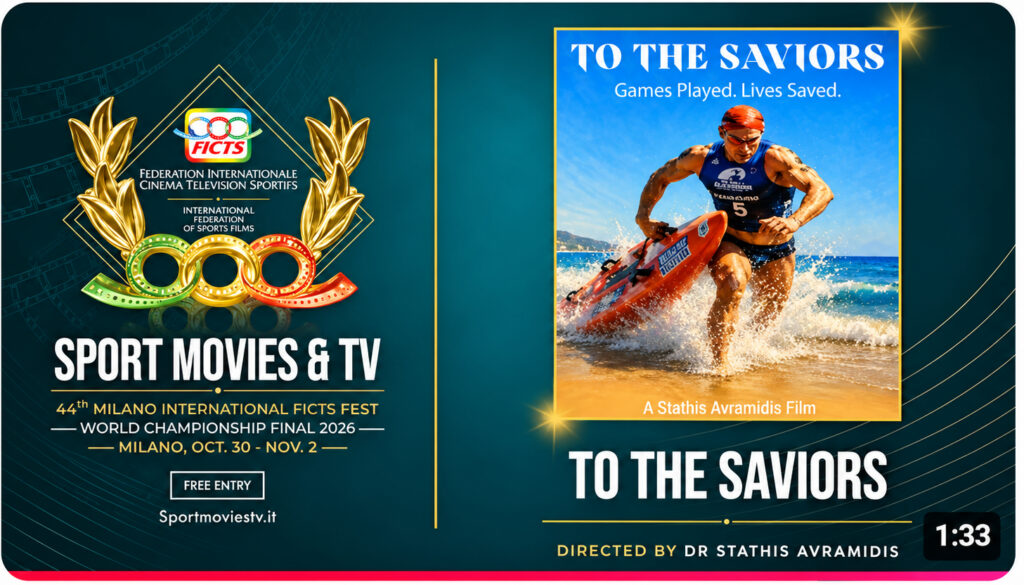
short film To the Saviors brought lifesaving sport’s Olympic dream to the world cinema
stage reaching the finals at “Sport Movies & TV 2026 – 44th Milano International FICTS
Fest”, following an international competition that attracted nearly 1,000 submitted
productions. The festival is the Milan World Final of the World FICTS Challenge, an
international circuit of 27 festivals across 5 continents and the World Championship of
Television, Cinema, Communication and Sports Culture. Part of the legacy of the Milano
Cortina 2026 Cultural Olympiad, the event was organized by the Fédération
Internationale Cinéma Télévision Sportifs (FICTS), recognized by the International
Olympic Committee (IOC).
Following an international competition that attracted nearly 1,000 submitted productions, To
the Saviors secured Official Selection for the Milan World Final, joining a selective
programme that was considered by the organizers “a parade of stars” of 120 productions
from 50 countries representing 55 sports. The achievement marked more than the
successful participation of a Greek short film: it carried lifesaving sport beyond pools, beaches
and championships into a wider international arena of cinema, culture, artistic expression
and Olympism, bringing its humanitarian and Olympic aspirations before filmmakers, athletes,
sporting organizations, journalists, academics, producers and cultural personalities from around
the world. To read more, click here.
The Milano International FICTS Fest is the World Final of the World FICTS Challenge, an
international circuit of 27 festivals across five continents. Recognized by the IOC, FICTS,
chaired by Prof. Franco Ascani, promotes sporting values through audiovisual culture across
130 Member Nations, in collaboration with institutions including the Minister for Sport and
Youth, the Lombardy Region and the Milano Cortina 2026 Foundation. The festival explores the
sacrifice, glory, emotion and human stories behind sport, while its 2026 edition held particular
significance as part of the cultural legacy of the Milano Cortina 2026 Olympic and
Paralympic Winter Games. Its programme extended beyond film screenings to exhibitions,
ceremonies, meetings, press conferences, side events and the Paralympic International
Movies & TV Fest, reinforcing its role as a major international meeting point for sport, cinema
and Olympic culture.
From Greece to the Global Stage
The World FICTS Challenge creates a unique international environment in which sport
becomes storytelling, inspiration, culture and entertainment. By reaching the Milan World Final,
To the Saviors introduced the story and philosophy of lifesaving sport to audiences beyond its
traditional community. The film was screened, presenting its humanitarian and Olympic
message within the festival’s international cinematic environment. Its inclusion alongside
productions portraying Olympic champions, Paralympic achievements, sporting legends and
remarkable human stories demonstrated that lifesaving sport has a meaningful place within the
broader cultural narrative of international sport. For decades, lifesaving athletes have
demonstrated extraordinary physical ability, technical skill, endurance, speed, courage and
teamwork in swimming pools, oceans and international championships. In Milan, lifesaving
sport entered another arena: the world of international cinema, artistic expression and Olympic
culture.
A 92-Second Tribute to 42 “Saviors”
Within 92 seconds, To the Saviors embraces more than a century of human achievement
through artistic portrayals of 42 historical and contemporary personalities whose lives and work
contributed to lifesaving, swimming, sport, medicine, education, public service, Olympism,
drowning prevention and humanitarian service. Among them are Baron Pierre de Coubertin,
founder of the modern Olympic Games; William Henry, co-founder of the Life Saving Society;
Raymond Pitet, pioneer of international organized lifesaving; Duke Kahanamoku, Olympic
swimming champion and legendary waterman; and Johnny Weissmuller, five-time Olympic
gold medalist, Hollywood icon and real-life rescuer. The film also honors Ronald Reagan,
former President of the United States and former lifeguard; Nelson Mandela, whose belief in
the transformative power of sport became a symbol of reconciliation; Queen Elizabeth II,
patron of the Royal Life Saving Society. Contemporary figures are also celebrated, including
Gregory J. Bonann, creator of Baywatch; Dr. Harald Vervaecke, “father” of world lifesaving;
Steven Munatones, founder of the World Open Water Swimming Association; Dr. Bill Kent,
Chairman of the International Swimming Hall of Fame; Bruce Wigo; Isabel García Sanz; Dott.
Giorgio Quintavalle; and other pioneers, researchers, rescuers, educators and sporting
leaders (more).
Rather than presenting these personalities merely as historical figures, To the Saviors unites
them symbolically in a procession of courage, knowledge, service, sacrifice and vision. Their
achievements cross nations, generations and professions and underline the idea that
humanity’s struggle against drowning has always depended upon extraordinary individuals
willing to serve others. Combining poetic narration, painterly moving portraits, music, sound
design and cinematic symbolism, the film connects the Olympic ideals of excellence, respect
and friendship with lifesaving’s fundamental commitment to the protection of human life. Pasted
markdown Pasted markdown Its message is simple: Games Played. Lives Saved.
More Than Sport
At the heart of To the Saviors lies a central proposition: lifesaving sport is more than
competition. Its athletes train to become faster, stronger and technically better competitors, but
the skills developed through the sport — swimming, rescue techniques, teamwork, rapid
decision-making and physical endurance — can also protect and preserve human life. That
gives lifesaving sport a humanitarian dimension that distinguishes it from most sporting
disciplines. In a world where drowning continues to represent a serious public-health challenge,
To the Saviors portrays lifesaving sport not simply as an athletic contest but as a discipline in
which competitive excellence can serve society. The film therefore advocates the long-term
aspiration of lifesaving sport to enter the Olympic Games, linking athletic achievement with a
broader humanitarian mission.
Supported by Leading International Institutions
The international significance of To the Saviors was reinforced by the support and endorsement
of prominent organizations representing global lifesaving and aquatic heritage. The film
received endorsement from the International Life Saving Federation (ILS), the International
Life Saving Federation of Europe (ILSE), the Mediterranean Lifesaving Confederation
(MLC) and the International Swimming Hall of Fame (ISHOF). Together, these organizations
represent complementary dimensions of the aquatic world: international sporting development,
European and Mediterranean cooperation, drowning prevention, aquatic history and the
preservation of the achievements of those who have advanced swimming and lifesaving. Their
support gave the production a broader international institutional foundation and reinforced its
core message: lifesaving is not merely a competitive activity but an international sporting,
educational and humanitarian movement deserving greater recognition.
An International Creative Collaboration
Behind the film’s brief duration lies a creative collaboration designed to transform decades of
lifesaving history into an emotionally accessible cinematic experience. To the Saviors was
written and directed by Dr. Stathis Avramidis, narrated by Joe Geoffrey and edited by
Stamatis Tripodis, with production by the GLSA. Geoffrey’s narration provides a human voice
to the historical tribute, while Tripodis’ editing combines the artistic portraits, visual transitions,
music and cinematic rhythm that carry the film’s message. The production demonstrates how a
short film can communicate a complex historical, sporting and humanitarian theme to an
international audience.
Introducing Lifesaving Sport to New Audiences
One of the most valuable outcomes of the Milan participation was the opportunity to present
lifesaving sport outside the boundaries of its established community. During the festival,
Avramidis exchanged views with filmmakers, producers, academics, sporting administrators,
scientists and cultural personalities from different countries and professional backgrounds.
These encounters introduced lifesaving sport to people who were unfamiliar with its competitive
structure, its international championships and its aspiration to become part of the Olympic
programme. For some, even the realization that lifesaving is not simply an emergency service
or professional qualification, but also a structured international competitive sport, opened an
entirely new perspective. The film became a natural starting point for conversations about
drowning prevention, sporting culture, education and the Olympic future of the discipline. It also
created links between lifesaving sport and the international filmmaking community, opening
possibilities for future documentaries, audiovisual productions, educational initiatives and
artistic collaborations. The Milan participation therefore achieved far more than one screening.
It helped transform lifesaving sport into a subject of international cultural dialogue.
Greece Gains a Voice in International Sporting Cinema
The Official Selection represented a significant international achievement not only for the
filmmaker but also for the GLSA. Through the FICTS World Final, GLSA extended its
international presence beyond championships, educational programmes, scientific activities
and drowning-prevention initiatives into the world of sporting cinema. In the official FICTS
records, To the Saviors was identified under the discipline Lifesaving Sport. This is significant in
itself. Lifesaving sport appeared by name alongside internationally established Olympic and
non-Olympic disciplines in a programme representing dozens of sports. Such visibility helps
strengthen the identity of lifesaving sport as an independent athletic, cultural and educational
field rather than simply an extension of swimming or professional rescue. The film has also
acquired a lasting digital presence within the FICTS audiovisual environment, providing an
international reference for future communication with sporting federations, universities, Olympic
institutions, cultural organizations, sponsors and other stakeholders.
Building Bridges Between Sport, Science and Art
Lifesaving occupies an unusual position at the crossroads of sport, public health, education,
emergency response and humanitarian service. Cinema adds another dimension: the ability to
communicate these values emotionally, visually and universally. The festival therefore provided
fertile ground for connections between professional worlds that do not always interact. For
filmmakers, lifesaving offers stories of courage, sacrifice and resilience. For scientists and
educators, it illustrates how sport can reinforce practical life-saving skills and promote drowning
prevention. For sports administrators, it demonstrates a discipline combining competitive
excellence with a humanitarian purpose. For the public, it introduces athletes who train not only
to win, but also to protect others. Perhaps one of the greatest achievements of To the Saviors
is therefore its contribution to changing the way lifesaving sport is perceived: from a specialist
aquatic discipline into a sporting and humanitarian movement with international cultural
significance.
Distinguished Voices on “To the Saviors”
The film’s artistic and humanitarian message has also attracted positive comments from
prominent figures within international lifesaving. Dr. Harald Vervaecke PhD, ILS Secretary
General, stated: “This audiovisual masterpiece idolizes some of the world’s most dedicated
servants of water safety to champion the inclusion of Lifesaving Sport in the Olympic Games. I
congratulate Stathis for using art to serve our noble cause.” Dr Bill Kent, Chairman of the
International Swimming Hall of Fame, added: “One small step for Stathis. One big step for
Lifesaving Sport towards the Olympics.” Graham Ford AO, President of the International Life
Saving Federation, commented: “This film helps us reach Olympic related audiences through
media and art. We are grateful for Stathis’ artistic view.” Former European Lifesaving
Federation President Dr. Detlev Mohr said: “Stathis is a huge ambassador for lifesaving and
the Olympic idea.” Former Royal Life Saving Society Australia President Dr. Shayne Baker
OAM remarked: “Stathis’ creative genes and concepts are truly exceptional.” Isabel García
Sanz commented: “Lifesaving needs professionals like Stathis, with the passion necessary to
move forward in this complex world. Congratulations!” Prof. Arturo Abraldes, recipient of the
International Swimming Hall of Fame Water Safety Award, added: “Stathis is truly amazing.
Congratulations for his dedication and perseverance in promoting lifesaving and rescue around
the world.”
From Official Selection to a Lasting International Legacy
For Avramidis, GLSA President and MLC Secretary General, this participation represents part
of a broader effort to connect lifesaving education, sport, history and artistic creation. He
summarized the meaning of this milestone: “This recognition belongs not to me, but to those
pioneers and dreamers who believe that lifesaving can save lives and thus it deserves to enter
the Olympic Games.” The recognition of the film at the FICTS Festival is therefore more than
an individual filmmaking accomplishment. Its selection demonstrates that the message of
lifesaving sport can earn a place within a competitive international cinematic environment. Its
screening brought the discipline before new audiences. Its inclusion in official festival
publications documented its presence within sporting cinema. Its presentation generated
discussions across cultures and professions. Its international endorsements strengthened its
institutional credibility. And its artistic message reinforced the connection between lifesaving,
humanity and Olympism. These achievements provide a foundation for future educational
initiatives, filmmaking collaborations, international partnerships and advocacy for the Olympic
recognition of lifesaving sport.
Meaningful sporting achievement is not measured exclusively by medals, rankings or trophies.
It can also be measured by the conversations it creates, the people it reaches and the ideas it
leaves behind. To the Saviors demonstrates that an artistic work lasting just 92 seconds can
carry an aspiration far beyond the limits of the screen. It can preserve history. It can honor
extraordinary people. It can connect generations and nations. It can inspire future lifesavers. It
can contribute to a movement dedicated to protecting human life. In Milan, lifesaving sport did
not merely participate in a film festival. It strengthened its international voice, expanded its
cultural horizons and carried its Olympic dream onto the world cinema stage.
The greatest achievement of To the Saviors may therefore be its contribution to changing how
people perceive lifesaving sport: from a specialist aquatic discipline to a sporting and
humanitarian movement with international cultural significance. Its symbolic reinterpretation of
the Olympic motto encapsulates an anthropocentric philosophy, that adds the word “Safer” to
express the film’s central vision: sporting excellence can be accompanied by another universal
aspiration — making the world safer. This is perhaps the most meaningful legacy of all. FICTS
was not an epilogue. It was a prologue. Faster, Higher, Stronger, SAFER – Together.
Watch the film “To the saviors” here.
Watch Stathis’ interview here.
Read about the “SPORT MOVIES & TV 2026 – 44th Milano International FICTS Fest”, here.