
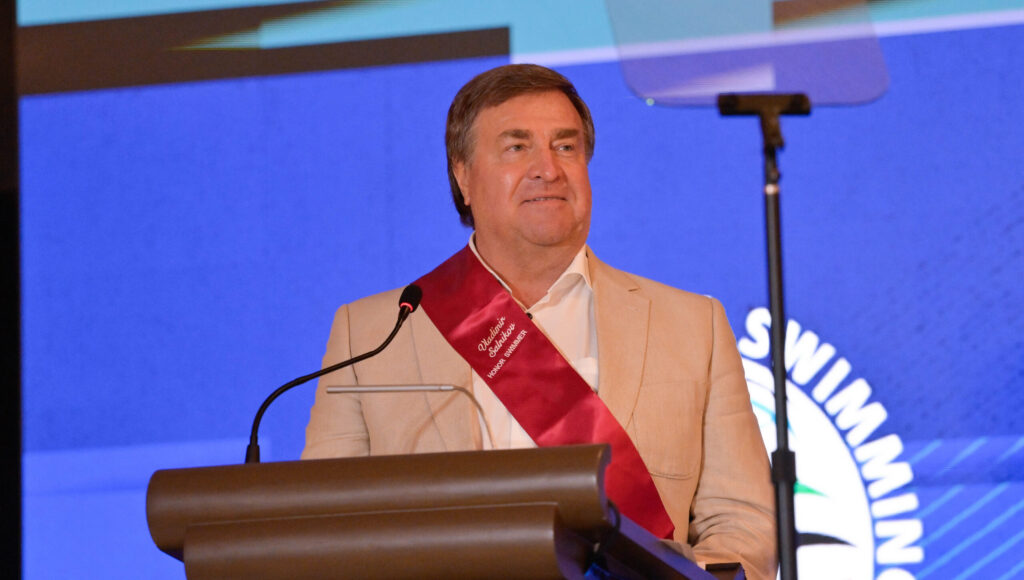
You were inducted in 1993, tell us what you have been up to since then?
After my induction into the Hall of Fame in 1993, I pursued various projects—some related to sports, others not. I collaborated with Speedo International, serving as their official representative in Russia and later across the CIS countries, eventually concluding my tenure there as Commercial Manager for Eastern Europe. Subsequently, I worked with Codorniu, one of Spain’s largest producers of sparkling wine.
What do you do for work / as a profession? In 2005,
I returned to the world of swimming, being elected Vice President of the All-Russian Swimming Federation. In 2010, I was elected its President, a position I held until 2024. At the end of 2024, the federations for swimming, diving, and artistic swimming merged to form the Russian Aquatic Sports Federation.
Since that time, I have served—and continue to serve—as the First Deputy Chairman of this organization.
If you have children, do your kids swim, if yes, tell us about them, if no, tell us about what they are involved in (sports, arts, etc.)
I have a son. He knows how to swim well—I taught him myself—but he chose tennis over swimming. He achieved some success in tennis, though he did not become a professional. He is an adult now, married, and has a daughter—my granddaughter—who will turn three in November. Naturally, it is my mission to teach her how to swim; she absolutely loves being in the water.
What is your best memory of your days in swimming?
There are several vivid and memorable moments in my life, primarily connected to swimming. Perhaps most notable was my participation in the Montreal Olympic Games in 1976, where I reached the final in the 1500m freestyle and set European records—both for the 1500m distance and for the 800m split along the way. Prior to that, I had never even managed to rank first in my own country, nor had I ever held any national records. I finished fifth in that race, which marked my first international success. As it is well known, Brian Goodell won that event with a new world record—a man with whom I would go on to have a major showdown four years later in Moscow. unfortunately it’s never happened. See the awards winning documentary ” The Duel we missed “
I also vividly remember the first world record I set, which took place at a competition in Minsk (Belarussia) in 1979 in the 800-meter freestyle. Afterward, I felt as though I were literally floating above the ground rather than walking on it. That sensation lasted for about a week. Later, when I went on to set world records in the 400, 800, and 1500-meter freestyle, the feeling of euphoria didn’t last quite as long. While each record brought me immense joy and happiness, I no longer felt like I was soaring quite as high above the ground, and these wonderful sensations were more fleeting.
Then there was my victory at the Moscow Olympics—specifically in the 1500-meter freestyle, where I set a new world record. I became the first person in history to complete the 1500-meter freestyle in under 15 minutes—a milestone that journalists hailed as a landmark achievement. I was incredibly proud to have accomplished this on home soil, though I did feel a certain regret that not all athletes were present due to the boycott—most notably my primary rival, Brian Goodell, who did not compete
A special place in my memory is held by the final race of my athletic career: the 1500-meter freestyle at the 1988 Seoul Olympics, where I won gold—eight years after the Moscow Games.
It was the most difficult and the most valuable victory of my entire sporting career. In that race, I gave everything I had; I drew upon all my extensive experience—I poured absolutely everything I possessed into that swim. later the same day in the evening when I walked in to a cafeteria at Olympic village I was met with standing ovation for my victory from athletes from different sports and countries . This is a most remarkable moment being appreciated by people who know what it costs to win a gold at the Olympics.The following day, I announced the end of my competitive career. I knew that there will be no other “sports mountain” for me. It looks like I got them all.
Seeing the changes that have occurred in swimming/aquatics now versus when you were competing, do you wish you could have competed now, or are you glad you competed when you did and why?
Indeed, swimming has undergone many changes over the years compared to how things were 40 or 50 years ago. Speeds have increased, and the prize money for victories at major tournaments—such as World Championships and the Olympic Games—has grown significantly
Have you written a memoir/book about yourself, if yes, what’s the title and can our readers purchase it? If not, do you ever plan on written a book?
After the Moscow Olympics, a book titled *The Winning Swim* was written and published. Unfortunately, it is very difficult to find nowadays.
Given that many interesting events have taken place since the Moscow Olympics, I am considering writing another one.
Any advice to all the future want-to-be Olympic swimmers out there?
A piece of advice for those who want to achieve good results:
High-level success in any sport cannot be attained without a certain degree of talent, but that is not the most important factor. Any lack of innate ability can always be compensated for through intensive training and by overcoming one’s own weaknesses. The most crucial thing is a deep, intense desire to succeed. My coach, Igor Koshkin—who guided me to victories at World Championships and the Olympic Games, and with whom I worked for 12 years—did not consider me naturally gifted; rather, he believed my defining trait was my capacity to train with persistence and endure heavy workloads.
As an Olympian, National Team Member, you travelled all over the world. What was your favorite place you visited, or your favorite meet to attend?
As for traveling the world—over the course of my sports career, I visited many countries, and there are certainly places I would love to return to. Of course, as I was born in Leningrad—which has since reclaimed its original name, Saint Petersburg—and I still consider it the most beautiful city on earth. That said, I also enjoy other cities: Cologne,Sydney, Singapore , Shanghai, Hamburg, Split, Amsterdam, Hong Kong Paris, Astana, London, Seattle, Baku, Barcelona, Fort Lauderdale ,Rome , Venice, Prague………….
I’m not one to speculate about what might have happened had I competed in the present day.
I believe that my results, and everything surrounding them, were in keeping with the standard of living that existed in our country—and the world—at that time.I loved what I was doing, so I have no regrets.
Best regards,
Vladimir