
Honoree Questions for: Michelle Ford ~ Honor Swimmer
You were inducted in 1991. Tell us what you have been up to since then?
Since my induction into the International Swimming Hall of Fame in 1991, I
have built an rewarding career in sport, raised two wonderful boys, and
contributed to several important milestones in sport. I was a founding
member of the IOC Athletes’ Commission, where we advocated for;
stronger anti-doping regulations – calling for bans on athletes and their
entourage if found guilty of doping, equal opportunities for women, and the
end of the amateur code. It was at the end of the cold war, and our call to
action became a critical turning point in sport and gave athletes a voice,
through the creation of the IOC Athletes Commission.
I was director of the university sports program in Switzerland, and created
a sports testing unit for sporting clubs and the university. I later returned to
Sydney, where I served as a Director of National Olympic Committees for
the Sydney 2000 Games. After the Games, I worked with the Oceania
region to develop its sports program. I also helped shape Australian sports
policy through my board work with the Australian government as well as
the board of swimming Australia. Most recently, and something that I am
extremely proud of, after 6 years of research and writing, I published my
memoir, ‘Turning the Tide’,
I continue to advocate for athletes and promote healthy lifestyle through
my coaching.
What do you do for work / as a profession?
I have degrees in Business communications and MA in Sports Psychology from the University of Southern California. My professional career began at the helm of the University sports program in Lausanne Switzerland, as Director and I have since held many board positions including the Australian Sport Commission, Swimming Australia, and the World Masters Games. From the organizing committee of the 2000 Sydney Games to help the Oceania region sports programs. and consulted with international Federations, I have enjoyed positions where I have influenced institutional changes and promoted sport programs.
Are you still involved in swimming in any capacity?
I coach adult swimming and still swim regularly
Do you still stay in touch with any swimming friends from your competition
days, if so, who?
Writing my memoir, I reconnect with many swimming colleagues in Australia and abroad; Shane Gould, Jenny Turrall, Tracey Caulkins, Wendy Boglioli, my USC Colleagues John Naber and Sharron Davis (UK). Recently I initiated and
organized a welcome home and recognition by the Australian Prime Minister for the Australian 1980 Olympic team and their contribution to Australian sport and the Olympic movement. 45 years on it was great to see some familiar faces.
If you have children, do your kids swim, if yes, tell us about them, if no, tell
us about what they are involved in (sports, arts, etc.)
I have two boys, now working in Private equity, and Hotel development. They
both swam and participated in a range of sporting activities. Compared to my
upbringing in Australia living in Switzerland, has been more challenging to have a successful career in swimming. Tennis and sailing were their preferred sports.
What is best memory of your days in swimming?
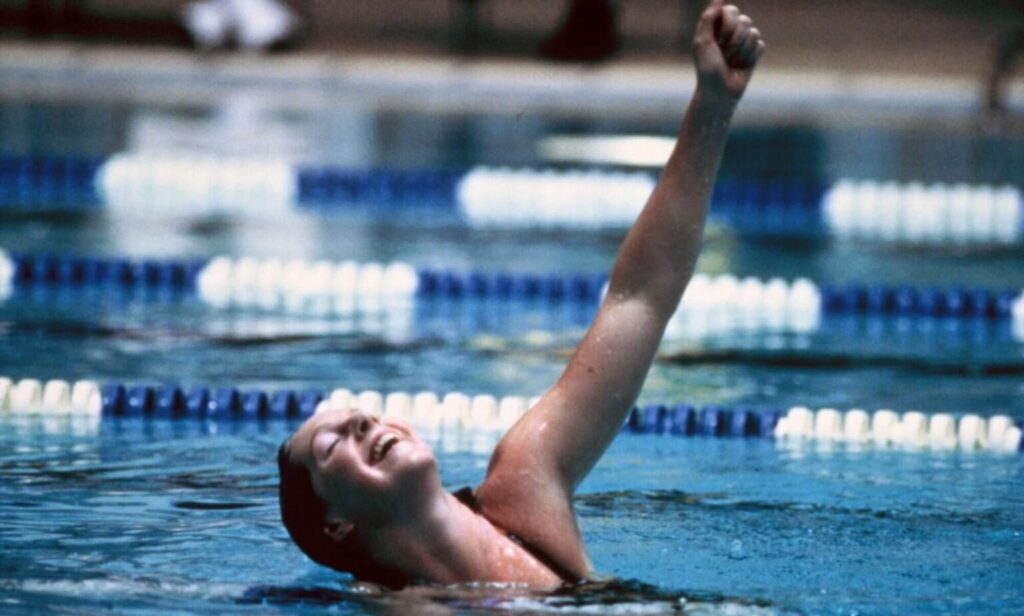
The best and proudest memory of my swimming days was to stand on the
Olympic podium to receive my Gold medal as the national anthem played and
the Australian flag rose above the East German flag – I became the only
individual female swimmer to defeat the GDR.
The coolest memory, however, is the incredible comradery amongst team mates and the friends that I made especially from my college days at USC.
Seeing the changes that have occurred in swimming/aquatics now versus
when you were competing, do you wish you could have competed now, or
are you glad you competed when you did and why?
Competing today would certainly have had its advantages—five-star hotels
instead of being billeted out with families or in migrant hostels, along with access to personal coaches, psychologists, physiotherapists, massage therapists, and other support staff. The opportunity for swimmers to earn money today would also have made a significant difference. In my era, none of that was permitted; you could even be considered a professional and be ineligible simply for working as a lifeguard.
Have you written a memoir/book about yourself, if yes, what’s the title and
can our readers purchase it? If not, do you ever plan on written a book?
I recently completed my memoir, Turning the Tide. Part memoir and part exposé, it is more than the story of winning Olympic gold. It is the journey of a young swimmer from Sydney whose determination, resilience, and love of the sport led her to become the only female swimmer to win an individual Olympic gold medal against the might of the East German state-sponsored doping machine. Interwoven with my personal story is the shocking truth behind the GDR’s systematic doping program and how politics, gender inequality, and doping reshaped the Olympic movement and the landscape of international swimming.
Above all, Turning the Tide is a tribute to the values that define our sport—hard
work, integrity, and fair competition—and to the belief that you can triumph even when the odds are stacked against you. It reflects my lifelong fight for clean sport, athletes’ rights, and fairness for women in sport, while reminding us why those causes remain as important today as ever.
Any advice to all the future want-to-be Olympic swimmers out there?
Swimming is an amazing and fulfilling sport. Although it is demanding, it is also deeply rewarding. And despite the misconception that swimming is not social or team-oriented, nothing could be further from the truth.
As an Olympian, National Team Member, you travelled all over the world.
What was your favorite place you visited, or your favorite meet to attend?
My trips to Europe, were always a buzz. Discovering new cultures and walking
cobbled street was new and exciting for me. Until then I had only read about it in books and talked about it at school history and geography lessons.
Something that I must add to this was my first trip behind the ‘iron curtain’ in 1989 for the Spartakiade Games in Moscow – it was definitely an eye-opener, quite austere and mystical.
You can purchase Michelle’s book, Turning the Tide, on Amazon.